PRESENTING BY
VIVEK KUMAR
UPASANA TOMAR
BCA 2nd SEM
Introduction
 DBMS stands for Database Management System.
 DBMS is a software system for creating, organizing and
managing the database.
 It provides an environment to the user to perform operations
on the database for creation, insertion, deletion, updating and
retrieval of data.
 Three level architecture is also called ANSI/SPARC
architecture or three schema architecture.
 Three-Schema Architecture it was proposed to help achieve
and visualize Insulation between programs and data, Support of
multiple views of the data.
 In this architecture the database schemas can be
defined at three levels explained in next slide.
Three Levels of Architecture
External View
 Highest or Top level of data abstraction ( No
knowledge of DBMS S/W and H/W or physical
storage).
 Each external schema describes the part of the
database that a particular user is interested in and
hides the rest of the database from user.
 For example, a accounts department may only be
interested in the student fee details. It would not be
expected to have any interest in the personal
information about students.
Conceptual View
 This level is in between the user level and physical
storage view.
 There is only one conceptual view for single database.
 It hides the details of physical storage structures and
concentrates on describing entities, data types,
relationships, user operations, and constraints.
Internal View
 It is the lowest level of data abstraction. (it has the
knowledge about s/w and h/w).
 At this level, it keeps the information about the actual
representation of the entire database i.e. the actual
storage of the data on the disk in the form of records or
blocks.
 The internal view is the view that tells us what data is
stored in the database and how. At least the following
aspects are considered at this level: Storage allocation,
Access paths etc.
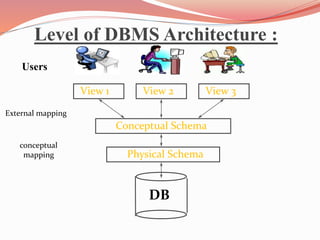
Level of DBMS Architecture :
Physical Schema
Conceptual Schema
View 1 View 2 View 3
DB
Users
conceptual
mapping
External mapping
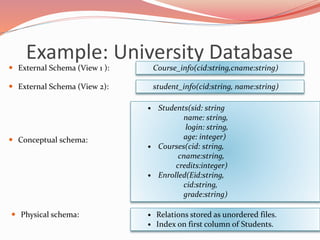
Example: University Database
 Students(sid: string
name: string,
login: string,
age: integer)
 Courses(cid: string,
cname:string,
credits:integer)
 Enrolled(Eid:string,
cid:string,
grade:string)
Course_info(cid:string,cname:string)
 Relations stored as unordered files.
 Index on first column of Students.
 Conceptual schema:
 Physical schema:
 External Schema (View 1 ):
student_info(cid:string, name:string) External Schema (View 2):
Data independence
 Data independence is the capacity to change the
schema at one level without having to change the
schema at the next higher level.
 Two types of data independence are
 Logical data independence
 Physical data independence
 Logical data independence:
capacity to change the conceptual schema without having to
change external schemas or application programs.
 Examples
 Adding a data item to schema
 Adding price of a part to PART table
 Physical data independence:
capacity to change the internal schema without having to
change the conceptual (or external) schemas
database  management system

database management system

  • 1.
  • 2.
    Introduction  DBMS standsfor Database Management System.  DBMS is a software system for creating, organizing and managing the database.  It provides an environment to the user to perform operations on the database for creation, insertion, deletion, updating and retrieval of data.
  • 3.
     Three levelarchitecture is also called ANSI/SPARC architecture or three schema architecture.  Three-Schema Architecture it was proposed to help achieve and visualize Insulation between programs and data, Support of multiple views of the data.  In this architecture the database schemas can be defined at three levels explained in next slide.
  • 4.
    Three Levels ofArchitecture
  • 5.
    External View  Highestor Top level of data abstraction ( No knowledge of DBMS S/W and H/W or physical storage).  Each external schema describes the part of the database that a particular user is interested in and hides the rest of the database from user.  For example, a accounts department may only be interested in the student fee details. It would not be expected to have any interest in the personal information about students.
  • 6.
    Conceptual View  Thislevel is in between the user level and physical storage view.  There is only one conceptual view for single database.  It hides the details of physical storage structures and concentrates on describing entities, data types, relationships, user operations, and constraints.
  • 7.
    Internal View  Itis the lowest level of data abstraction. (it has the knowledge about s/w and h/w).  At this level, it keeps the information about the actual representation of the entire database i.e. the actual storage of the data on the disk in the form of records or blocks.  The internal view is the view that tells us what data is stored in the database and how. At least the following aspects are considered at this level: Storage allocation, Access paths etc.
  • 8.
    Level of DBMSArchitecture : Physical Schema Conceptual Schema View 1 View 2 View 3 DB Users conceptual mapping External mapping
  • 9.
    Example: University Database Students(sid: string name: string, login: string, age: integer)  Courses(cid: string, cname:string, credits:integer)  Enrolled(Eid:string, cid:string, grade:string) Course_info(cid:string,cname:string)  Relations stored as unordered files.  Index on first column of Students.  Conceptual schema:  Physical schema:  External Schema (View 1 ): student_info(cid:string, name:string) External Schema (View 2):
  • 10.
    Data independence  Dataindependence is the capacity to change the schema at one level without having to change the schema at the next higher level.  Two types of data independence are  Logical data independence  Physical data independence
  • 11.
     Logical dataindependence: capacity to change the conceptual schema without having to change external schemas or application programs.  Examples  Adding a data item to schema  Adding price of a part to PART table  Physical data independence: capacity to change the internal schema without having to change the conceptual (or external) schemas

Editor's Notes