Degree/s-quality

Data- raw facts

Abstract- concept

    “Data designer produced a quality data
 model”
   American National Standard Institute
    (ANSI) Standards Planning and Requirements
    Committee (SPARC)

Defined a framework for data modelling based
 on degrees of data abstraction.
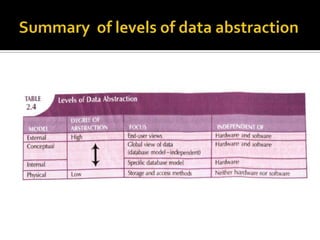
Defines three levels of abstraction:

   external
   conceptual
   internal
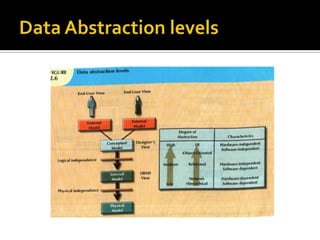
   Is the end user’s view of the data
    environment.


   The term end user’s refers to the people who
    use the application programs to manipulate
    the data and generate information.
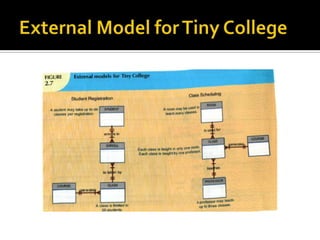
   A specific representation of an external view is
    known as an external schema.


   Each     external   schema       includes    the
    appropriateness      entities,     relationships,
    processes, and constraints imposed by the
    business unit.
   It makes it easy to identify specific data
    required to support each business unit’s
    operations.
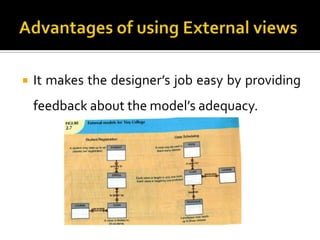
   It makes the designer’s job easy by providing
    feedback about the model’s adequacy.
   It helps to ensure security constraints in the
    database    design.   Damaging     an    entire
    database is more difficult when each business
    unit works with only a subset of data.
   It makes application program development
    much simpler.
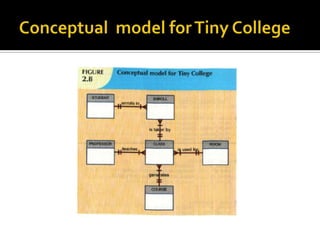
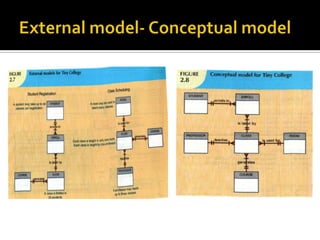
   The conceptual model represents as a global
    view of the entire database as viewed by the
    entire organization.
   Conceptual model integrates all external
    views (entities, relationships, constraints, and
    processes) into single global of a data.


   Also known as conceptual schema
   First, it provides a relatively easily bird’s eye
    (macro level) view of the data environment.
   Second, the conceptual model is independent
    of both software and hardware.
1.   Software independence means that the model
     does not depend on the DBMS software used
     to implement the model.


2.   Hardware independence means that the
     model does not depend on the hardware used
     in the implementation of the model.
   Generally, the term logical design is used to
    refer to the task of creating a conceptual data
    model that could be implemented in any
    DBMS.
   Once a specific DBMS has been selected, the
    internal model maps the conceptual model to
    the DBMS.
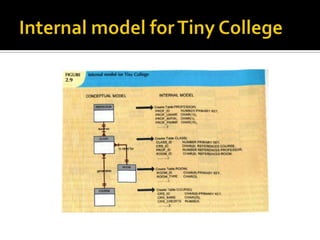
   The internal model is the representation of
    the database as seen by the DBMS.
   In other words, the internal model requires
    the designer to match the conceptual model’s
    characteristics and constraints to those of the
    selected implementation model.
   Internal model depends on specific database
    software, it is said to be the software
    dependent.
   Internal model is still hardware-independent
    because it is unaffected by the choice of the
    computer on which the software is installed.
   This lowest level of data abstraction is
    concerned exclusively with physical storage
    methods.
   Early data models forced the database
    designer to take the details of the physical
    model’s data storage requirements into
    account.
   However, the now dominant relational model
    is aimed largely at the logical rather than the
    physical level; therefore it does not require
    the physical-level details common to its
    predecessors.
Thanks!
Prepared by Me 
   Yours truly,

Degrees of data abstraction copy

  • 2.
    Degree/s-quality Data- raw facts Abstract-concept “Data designer produced a quality data model”
  • 3.
    American National Standard Institute (ANSI) Standards Planning and Requirements Committee (SPARC) Defined a framework for data modelling based on degrees of data abstraction.
  • 4.
    Defines three levelsof abstraction:  external  conceptual  internal
  • 6.
    Is the end user’s view of the data environment.  The term end user’s refers to the people who use the application programs to manipulate the data and generate information.
  • 7.
    A specific representation of an external view is known as an external schema.  Each external schema includes the appropriateness entities, relationships, processes, and constraints imposed by the business unit.
  • 9.
    It makes it easy to identify specific data required to support each business unit’s operations.
  • 10.
    It makes the designer’s job easy by providing feedback about the model’s adequacy.
  • 11.
    It helps to ensure security constraints in the database design. Damaging an entire database is more difficult when each business unit works with only a subset of data.
  • 12.
    It makes application program development much simpler.
  • 13.
    The conceptual model represents as a global view of the entire database as viewed by the entire organization.
  • 14.
    Conceptual model integrates all external views (entities, relationships, constraints, and processes) into single global of a data.  Also known as conceptual schema
  • 16.
    First, it provides a relatively easily bird’s eye (macro level) view of the data environment.
  • 18.
    Second, the conceptual model is independent of both software and hardware.
  • 19.
    1. Software independence means that the model does not depend on the DBMS software used to implement the model. 2. Hardware independence means that the model does not depend on the hardware used in the implementation of the model.
  • 20.
    Generally, the term logical design is used to refer to the task of creating a conceptual data model that could be implemented in any DBMS.
  • 21.
    Once a specific DBMS has been selected, the internal model maps the conceptual model to the DBMS.
  • 22.
    The internal model is the representation of the database as seen by the DBMS.
  • 23.
    In other words, the internal model requires the designer to match the conceptual model’s characteristics and constraints to those of the selected implementation model.
  • 25.
    Internal model depends on specific database software, it is said to be the software dependent.
  • 26.
    Internal model is still hardware-independent because it is unaffected by the choice of the computer on which the software is installed.
  • 27.
    This lowest level of data abstraction is concerned exclusively with physical storage methods.
  • 28.
    Early data models forced the database designer to take the details of the physical model’s data storage requirements into account.
  • 29.
    However, the now dominant relational model is aimed largely at the logical rather than the physical level; therefore it does not require the physical-level details common to its predecessors.
  • 31.
    Thanks! Prepared by Me Yours truly,