Introduction To :
Data Independence
Ashima Wadhwa
Assistant Professor (IT)
Amity University, Noida
Database Schemas
• Database Schema: The description of a
database. Includes descriptions of the database
structure and the constraints that should hold
on the database.
• Schema Diagram: A diagrammatic display of
(some aspects of) a database schema.
Database Schema Vs. Database
State
• Database State: Refers to the content of a
database at a moment in time.
• Initial Database State: Refers to the database
when it is loaded
• Valid State: A state that satisfies the structure
and constraints of the database.
Three-Schema Architecture
• Defines DBMS schemas at three levels:
• Internal schema at the internal level to describe
physical storage structures and access paths. Typically
uses a physical data model.
• Conceptual schema at the conceptual level to describe
the structure and constraints for the whole database for
a community of users. Uses a conceptual or an
implementation data model.
• External schemas at the external level to describe the
various user views. Usually uses the same data model as
the conceptual level.
Data Independence
When a schema at a lower level is changed, only the
mappings between this schema and higher-level
schemas need to be changed in a DBMS that fully
supports data independence. The higher-level
schemas themselves are unchanged. Hence, the
application programs need not be changed since they
refer to the external schemas.
Logical Data Independence
The ability to change the logical schema without changing the
external schema or application programs is called as Logical
Data Independence.
OR
The ability to change the logical schema without having to
change the external schema.
Examples
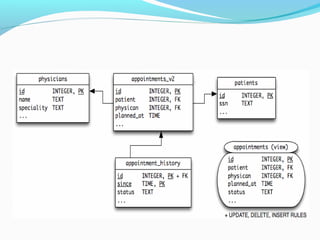
The addition or removal of new entities,
attributes, or relationships to the conceptual
schema should be possible without having to
change existing external schemas or having to
rewrite existing application programs.
Physical Data Independence
The ability to change the physical schema without
changing the logical schema is called as Physical Data
Independence.  Changes in the physical schema may
include.
Using new storage devices.
Using different data structures.
Switching from one access method to another.
Using different file organizations or storage structures.
Modifying indexes.
Examples
A change to the internal schema, such as using different
file organization or storage structures, storage devices, or
indexing strategy, should be possible without having to
change the conceptual or external schemas.
Summery :
• Logical Data Independence: The capacity to change
the conceptual schema without having to change the
external schemas and their application programs.
• Physical Data Independence: The capacity to
change the internal schema without having to change
the conceptual schema.
Thanks !
Slide 2-12

Data independence

  • 1.
    Introduction To : DataIndependence Ashima Wadhwa Assistant Professor (IT) Amity University, Noida
  • 2.
    Database Schemas • DatabaseSchema: The description of a database. Includes descriptions of the database structure and the constraints that should hold on the database. • Schema Diagram: A diagrammatic display of (some aspects of) a database schema.
  • 3.
    Database Schema Vs.Database State • Database State: Refers to the content of a database at a moment in time. • Initial Database State: Refers to the database when it is loaded • Valid State: A state that satisfies the structure and constraints of the database.
  • 4.
    Three-Schema Architecture • DefinesDBMS schemas at three levels: • Internal schema at the internal level to describe physical storage structures and access paths. Typically uses a physical data model. • Conceptual schema at the conceptual level to describe the structure and constraints for the whole database for a community of users. Uses a conceptual or an implementation data model. • External schemas at the external level to describe the various user views. Usually uses the same data model as the conceptual level.
  • 5.
    Data Independence When aschema at a lower level is changed, only the mappings between this schema and higher-level schemas need to be changed in a DBMS that fully supports data independence. The higher-level schemas themselves are unchanged. Hence, the application programs need not be changed since they refer to the external schemas.
  • 6.
    Logical Data Independence Theability to change the logical schema without changing the external schema or application programs is called as Logical Data Independence. OR The ability to change the logical schema without having to change the external schema.
  • 7.
    Examples The addition orremoval of new entities, attributes, or relationships to the conceptual schema should be possible without having to change existing external schemas or having to rewrite existing application programs.
  • 9.
    Physical Data Independence Theability to change the physical schema without changing the logical schema is called as Physical Data Independence.  Changes in the physical schema may include. Using new storage devices. Using different data structures. Switching from one access method to another. Using different file organizations or storage structures. Modifying indexes.
  • 10.
    Examples A change tothe internal schema, such as using different file organization or storage structures, storage devices, or indexing strategy, should be possible without having to change the conceptual or external schemas.
  • 11.
    Summery : • LogicalData Independence: The capacity to change the conceptual schema without having to change the external schemas and their application programs. • Physical Data Independence: The capacity to change the internal schema without having to change the conceptual schema.
  • 12.

Editor's Notes

  • #3 Schema Construct: A component of the schema or an object within the schema, e.g., STUDENT, COURSE.
  • #4 Database Instance: The actual data stored in a database at a particular moment in time. Also called database state (or occurrence). Distinction The database schema changes very infrequently. The database state changes every time the database is updated. Schema is also called intension, whereas state is called extension.
  • #5 Mappings among schema levels are needed to transform requests and data. Programs refer to an external schema, and are mapped by the DBMS to the internal schema for execution.
  • #12 Physical data independence: capacity to change the physical schema w/o having to rewrite the application programs Logical data independence: capacity to change the conceptual schema w/o having to rewrite the application programs logical data independence is more difficult to achieve than physical data independence