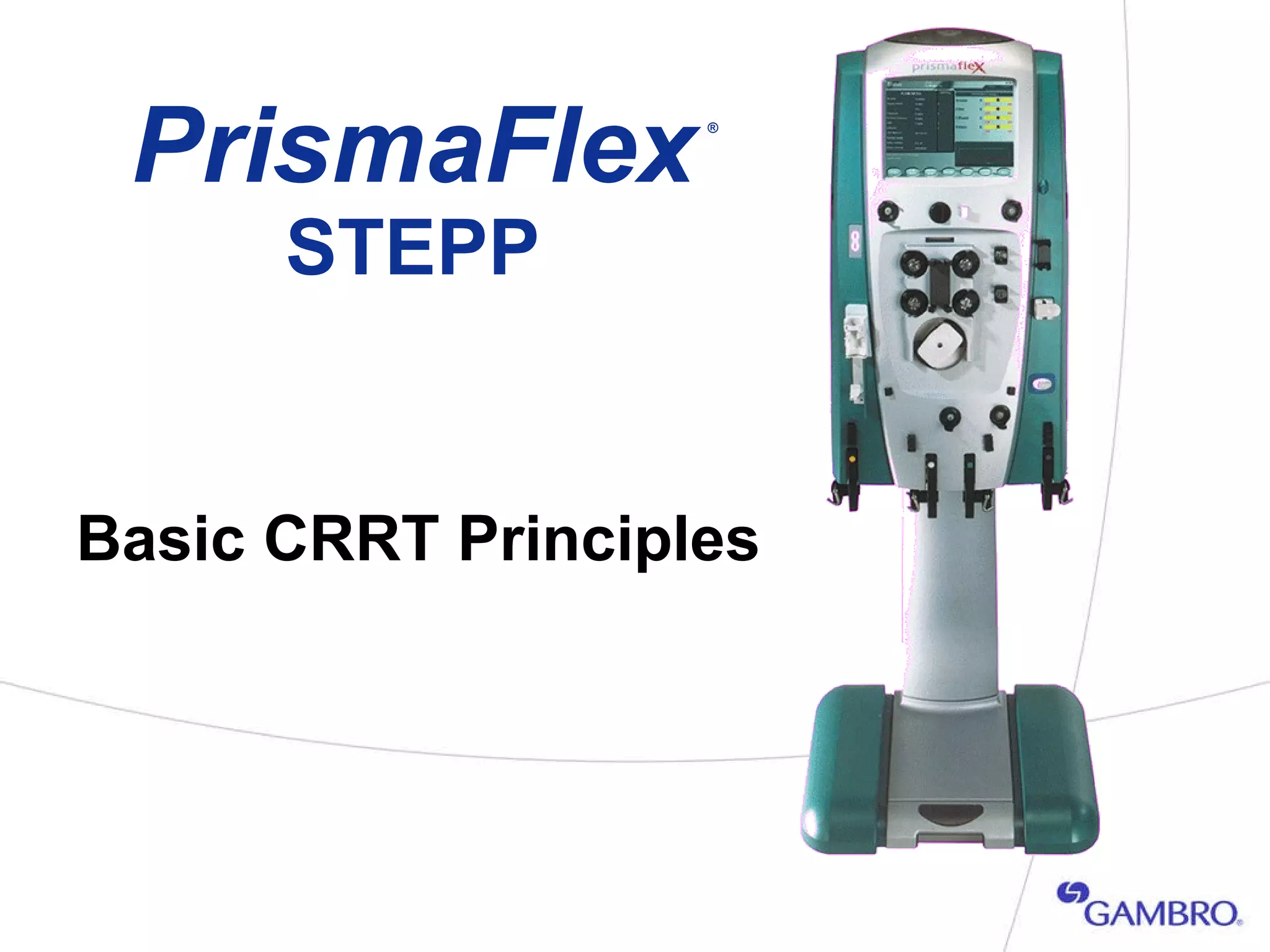
PrismaFlex  STEPP Basic CRRT Principles ®
Course Objectives By the end of the Gambro CRRT training course  the participant will be able to: Define CRRT and the associated therapies Discuss the basic CRRT principles  Discuss the basic principles of the solute transport mechanisms Identify the clinical indications for administering CRRT, including an overview of patient selection and therapy application Have a working knowledge of basic CRRT machine set up, run, end treatment and troubleshooting skills.  Describe the CRRT machine’s safety management features, pressure monitoring and fluid balance principles.
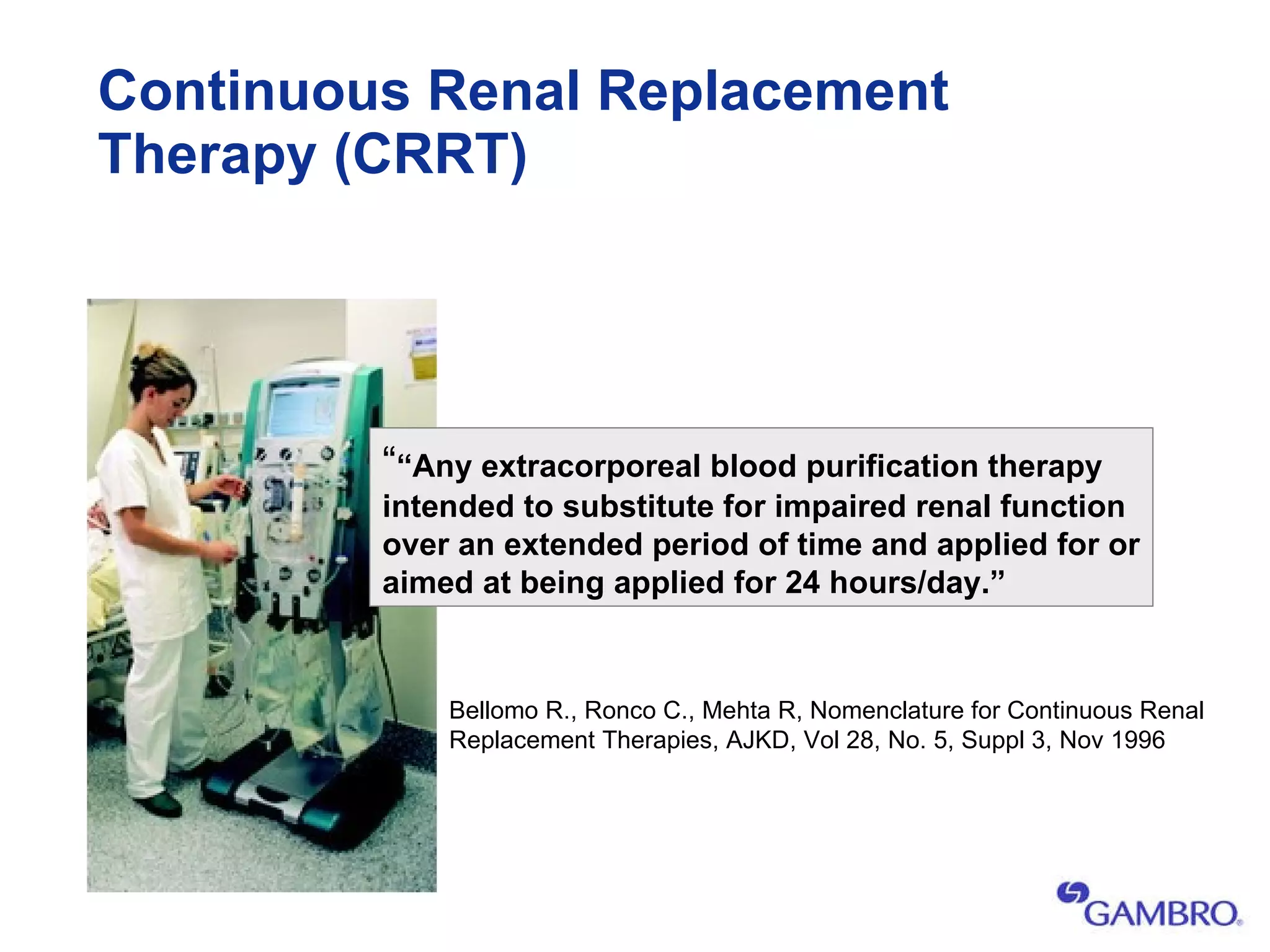
Continuous Renal Replacement Therapy (CRRT) “ “ Any extracorporeal blood purification therapy intended to substitute for impaired renal function over an extended period of time and applied for or aimed at being applied for 24 hours/day.” Bellomo R., Ronco C., Mehta R, Nomenclature for Continuous Renal Replacement Therapies, AJKD, Vol 28, No. 5, Suppl 3, Nov 1996
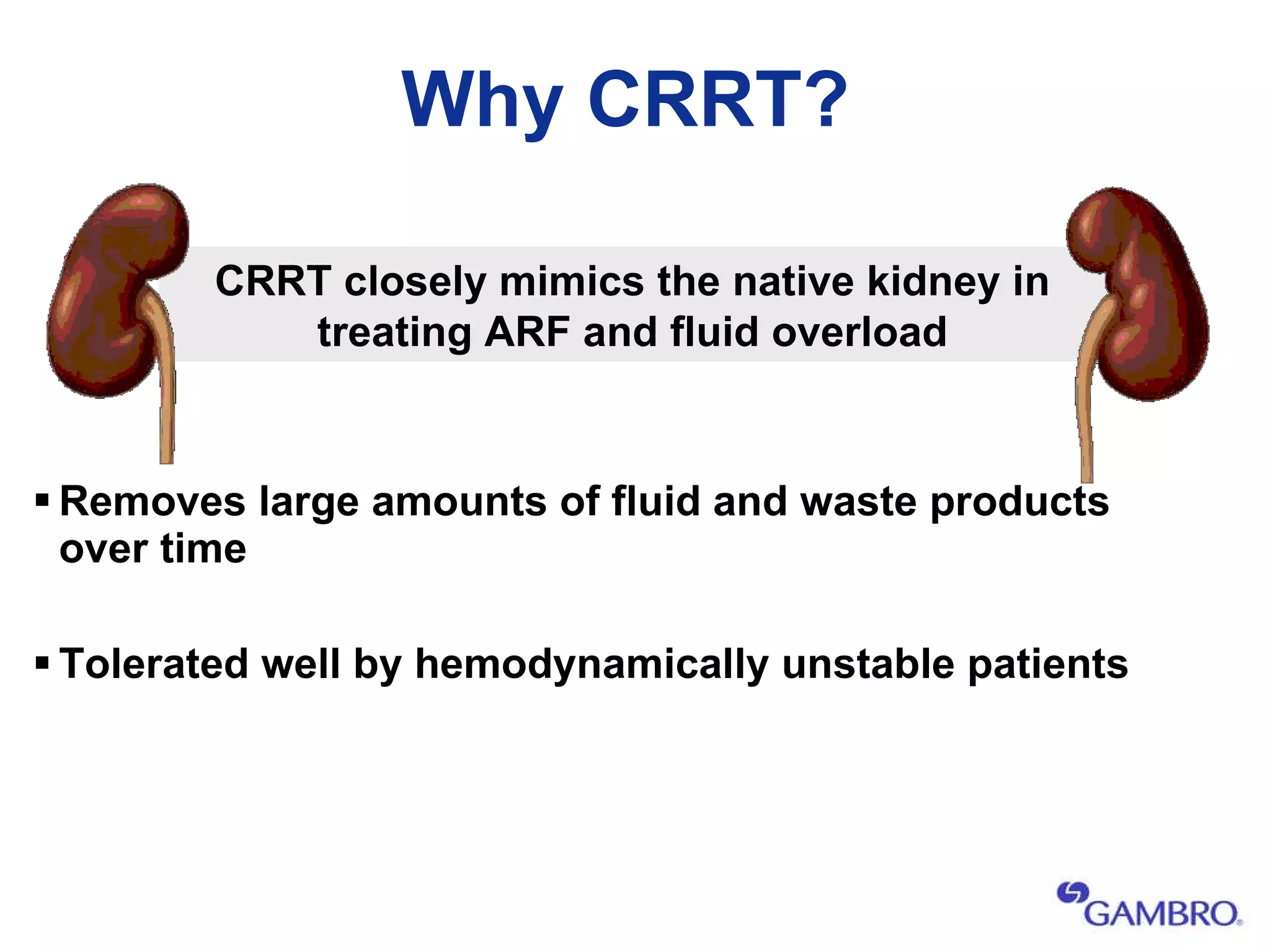
Why CRRT? Removes large amounts of fluid and waste products over time Tolerated well by hemodynamically unstable patients CRRT closely mimics the native kidney in treating ARF and fluid overload
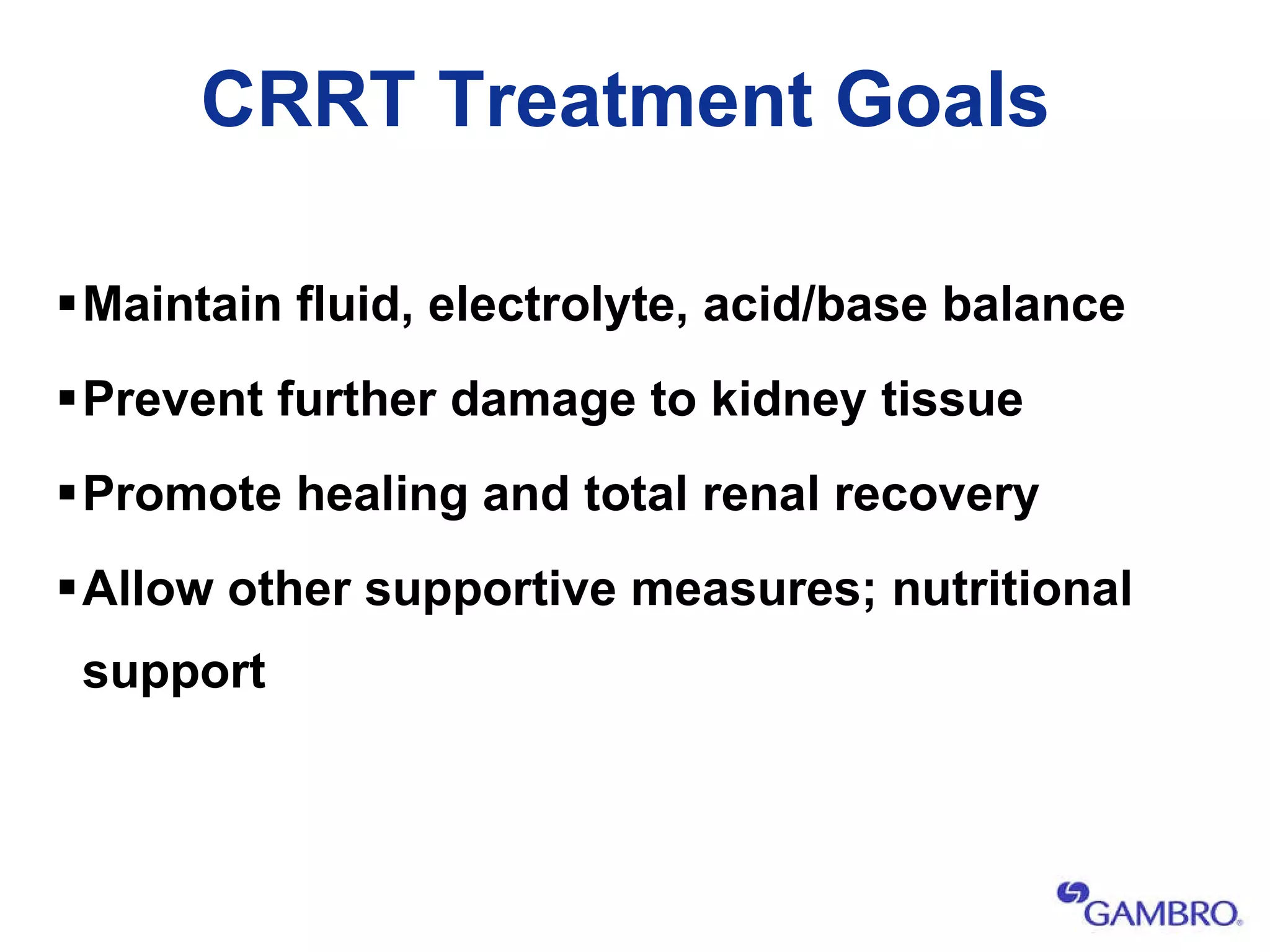
CRRT Treatment Goals Maintain fluid, electrolyte, acid/base balance Prevent further damage to kidney tissue Promote healing and total renal recovery Allow other supportive measures; nutritional support
Determinants of Outcome Initiation of Therapy Ronco Study Gettings Study ADQI Consensus Initiative - Rifle Criteria Dose Ronco Study Kellum Meta-Analysis Saudan Study
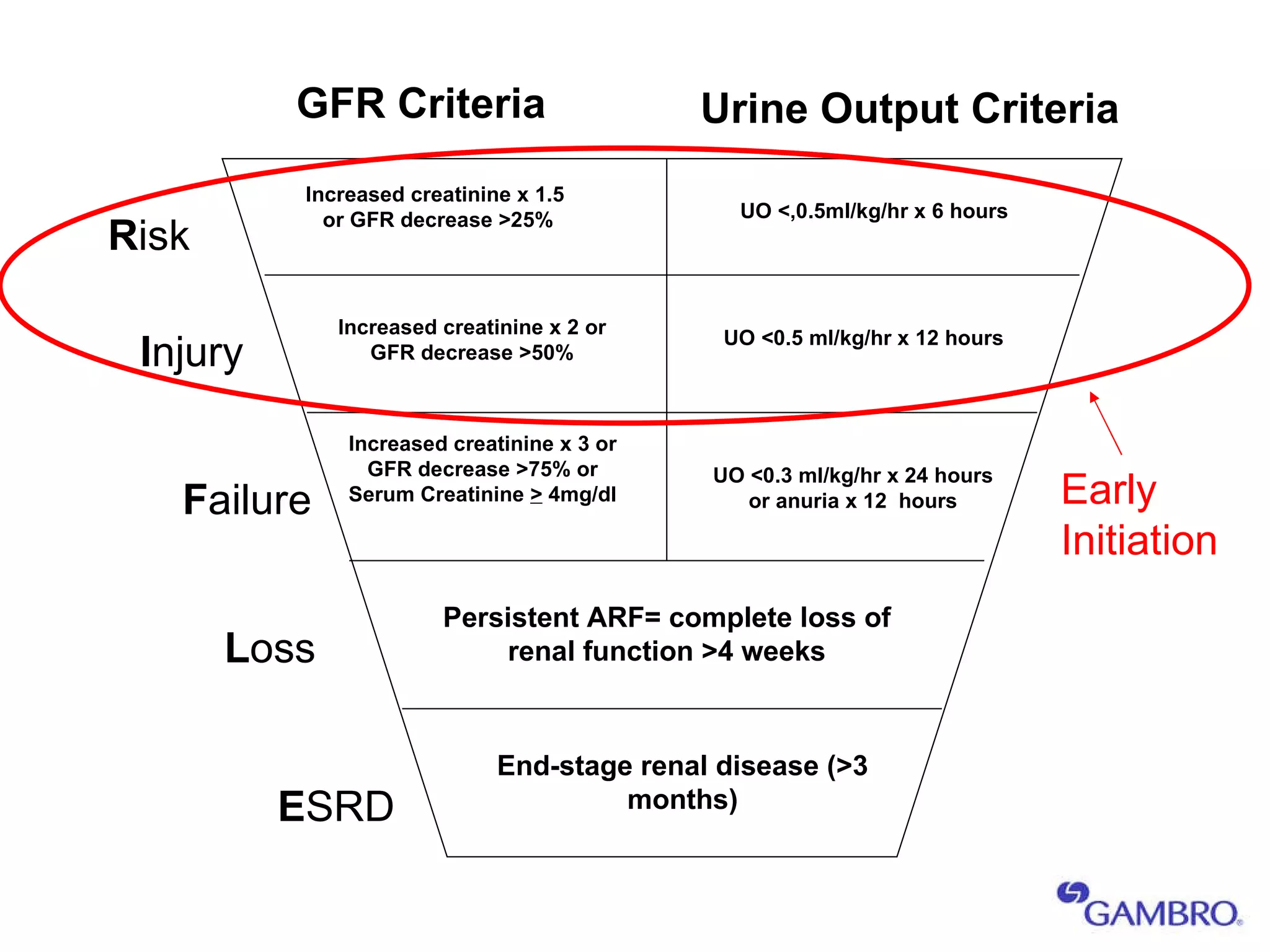
R isk I njury F ailure L oss E SRD GFR Criteria Urine Output Criteria Increased creatinine x 1.5  or GFR decrease >25% UO <,0.5ml/kg/hr x 6 hours Increased creatinine x 2 or GFR decrease >50% UO <0.5 ml/kg/hr x 12 hours Increased creatinine x 3 or GFR decrease >75% or Serum Creatinine  >  4mg/dl UO <0.3 ml/kg/hr x 24 hours or anuria x 12  hours Persistent ARF= complete loss of renal function >4 weeks End-stage renal disease (>3 months) Early Initiation
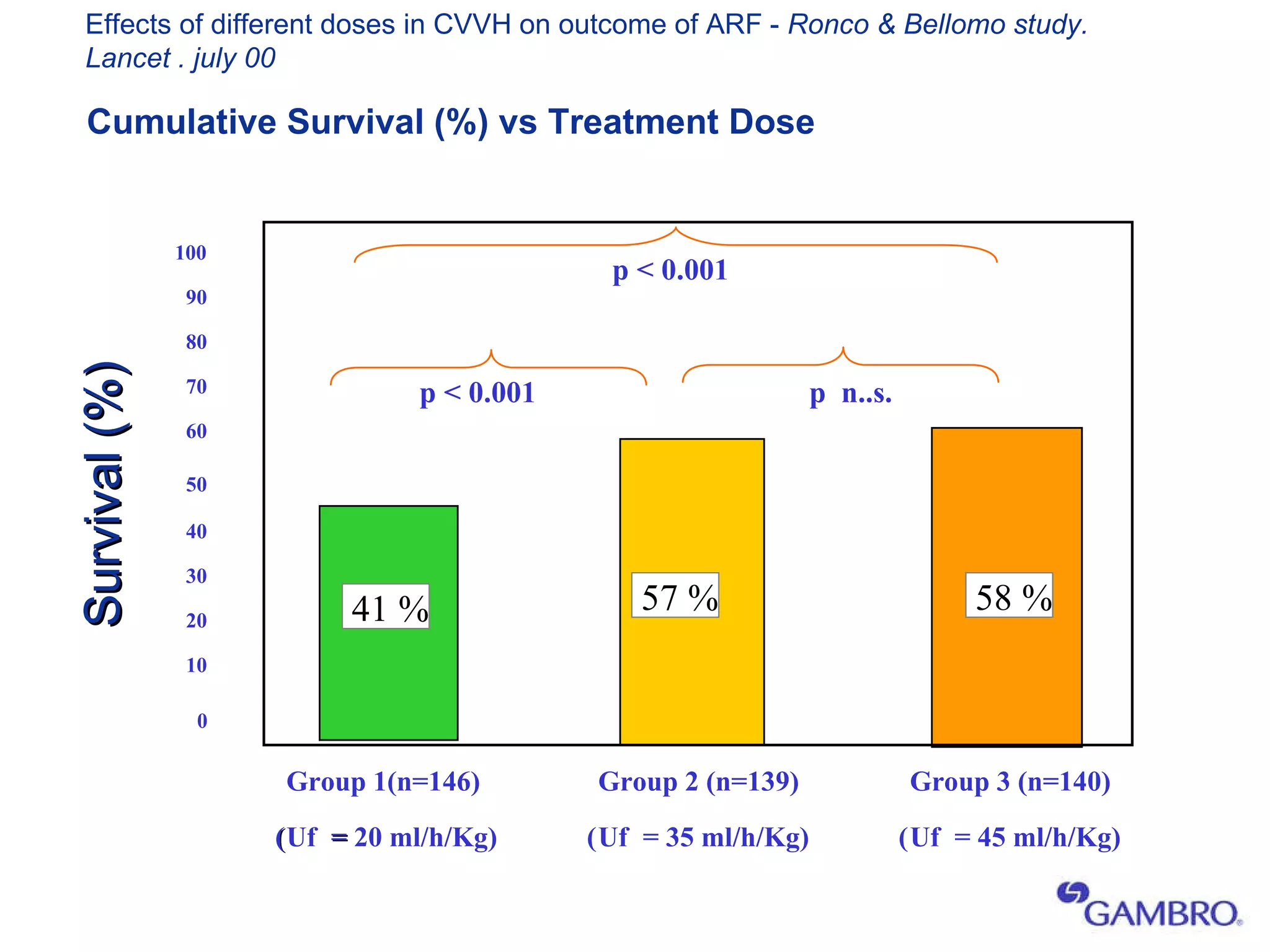
Cumulative Survival (%) vs Treatment Dose Effects of different doses in CVVH on outcome of ARF -  Ronco & Bellomo study. Lancet . july 00 100 90 80 70 60 50 40 30 20 10 0 Group 1(n=146) ( Uf  =  20 ml/h/Kg) Group 2 (n=139) ( Uf  = 35 ml/h/Kg) Group 3 (n=140) ( Uf  = 45 ml/h/Kg) 41 % 57 % 58 % p < 0.001 p  n..s. p < 0.001 Survival (%)
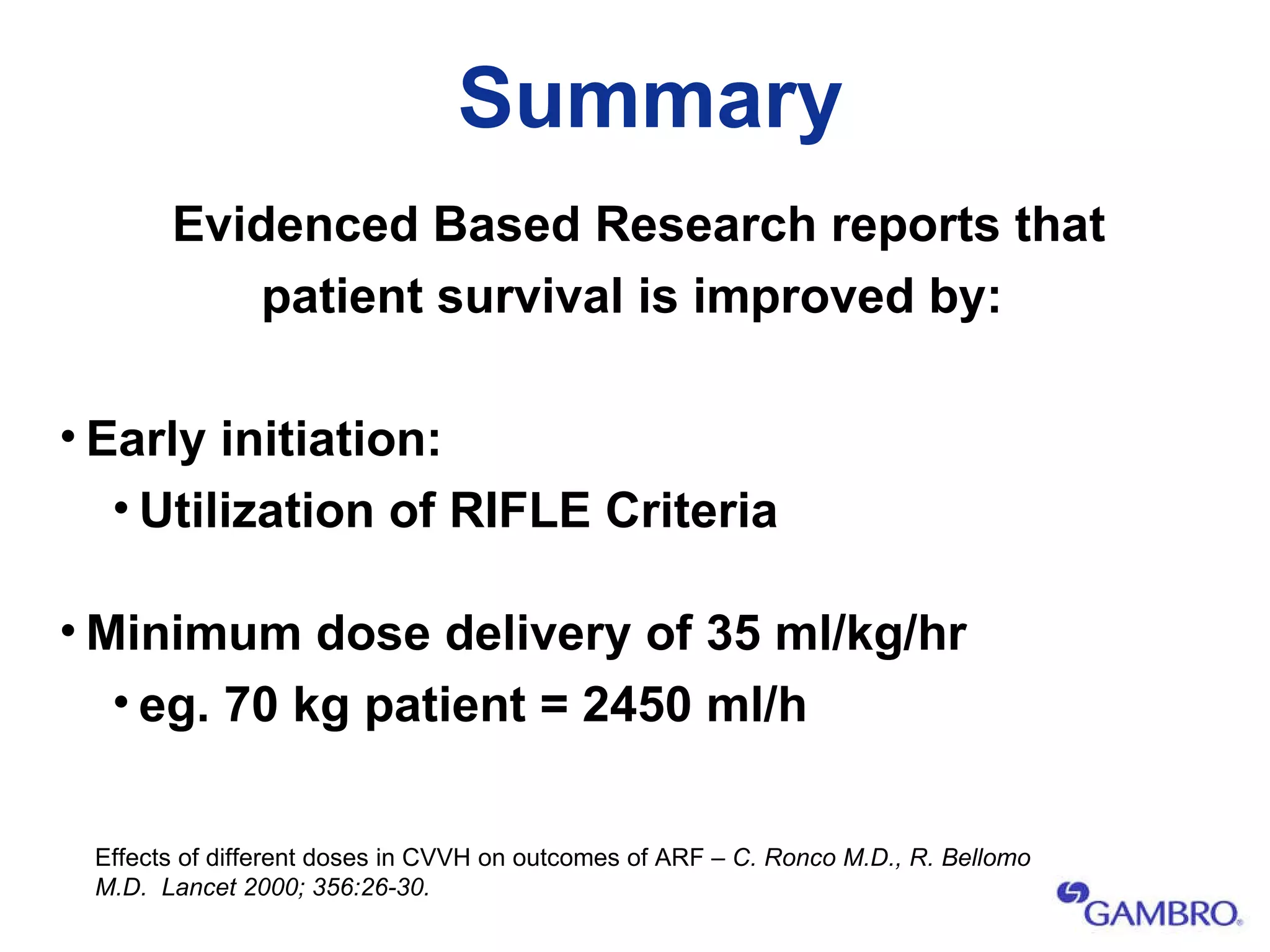
Summary Evidenced Based Research reports that patient survival is improved by: Early initiation:  Utilization of RIFLE Criteria Minimum dose delivery of 35 ml/kg/hr   eg. 70 kg patient = 2450 ml/h Effects of different doses in CVVH on outcomes of ARF –  C. Ronco M.D., R. Bellomo M.D.  Lancet 2000; 356:26-30.
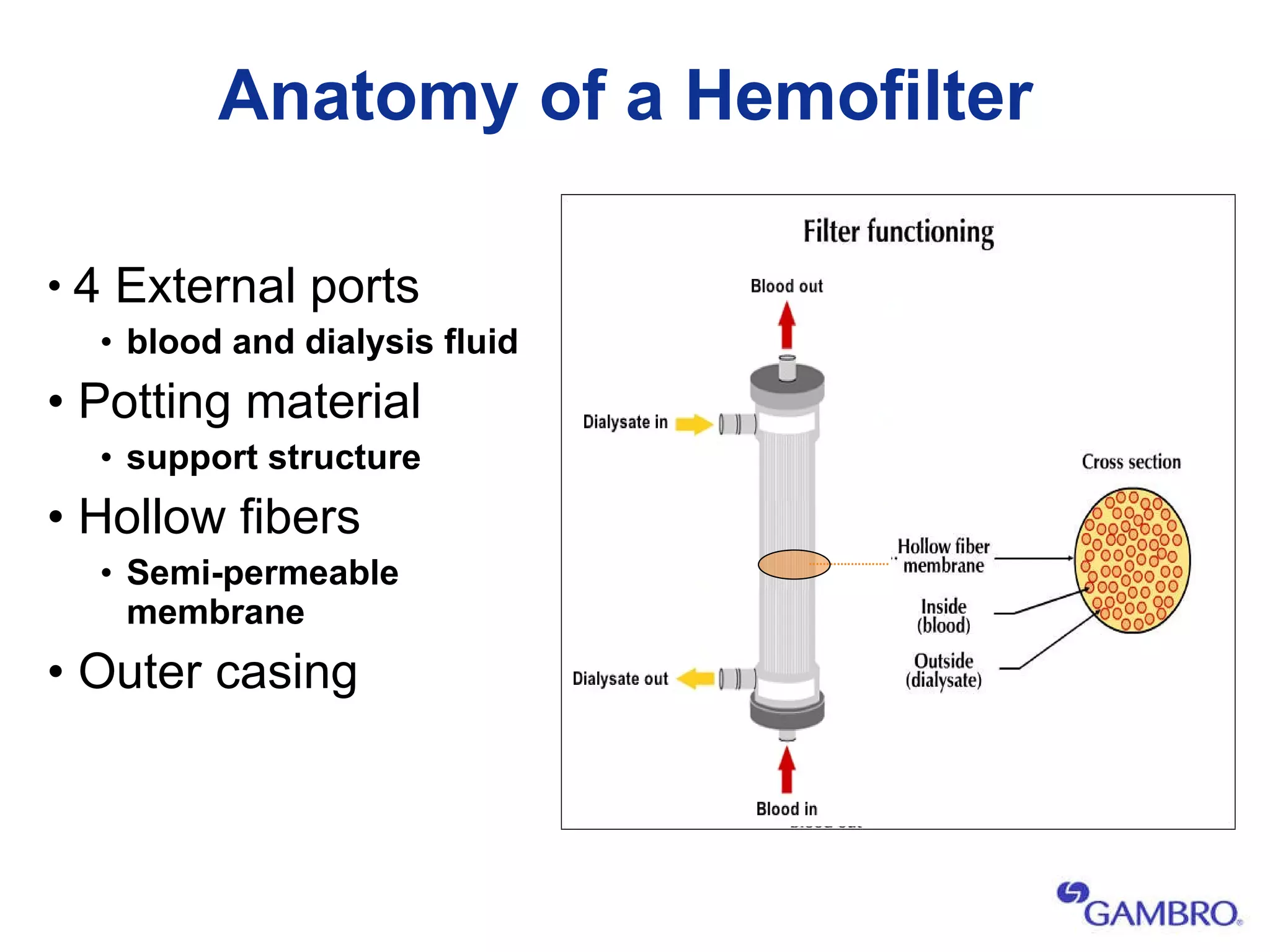
Anatomy of a Hemofilter 4 External ports  blood and dialysis fluid  Potting material  support structure Hollow fibers  Semi-permeable membrane Outer casing
CRRT  Transport Mechanisms
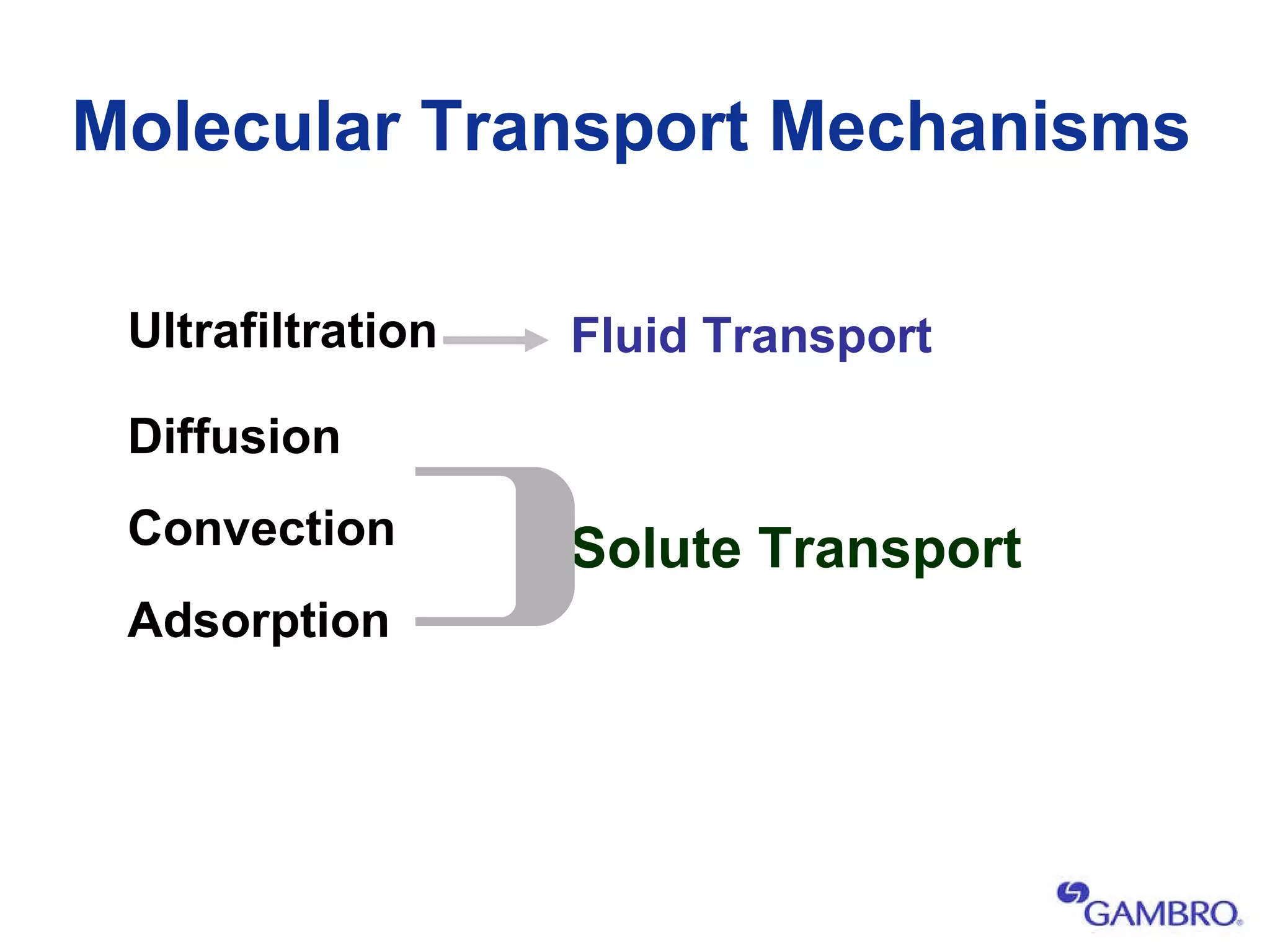
Molecular Transport Mechanisms Ultrafiltration Diffusion Convection Adsorption Fluid Transport Solute Transport }
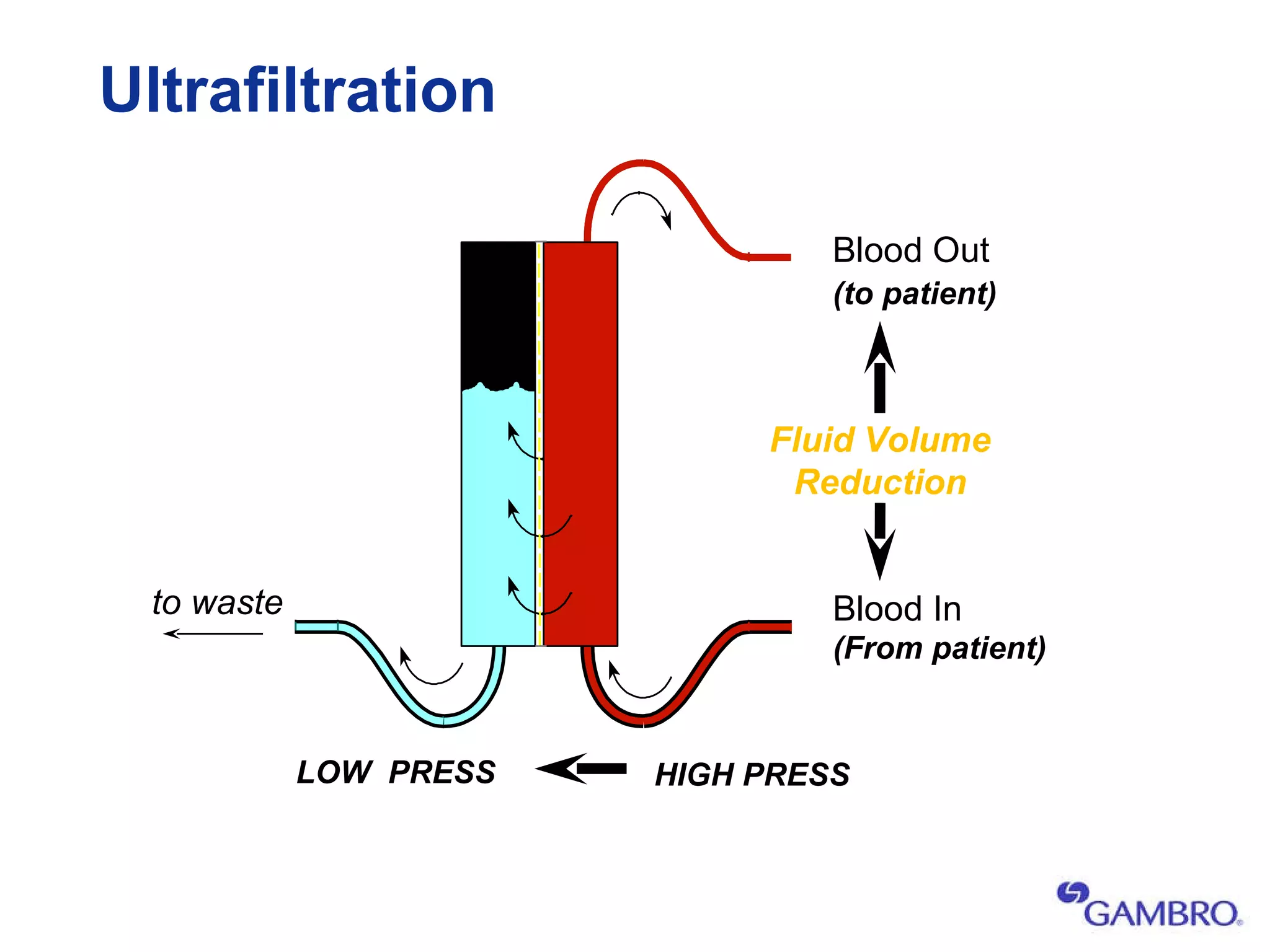
Ultrafiltration Movement of  fluid  through a semi-permeable membrane caused by a pressure gradient Positive, negative and osmotic pressure from non-permeable solutes
Ultrafiltration Blood Out Blood In to waste (to patient) (From patient) HIGH PRESS LOW  PRESS Fluid Volume Reduction
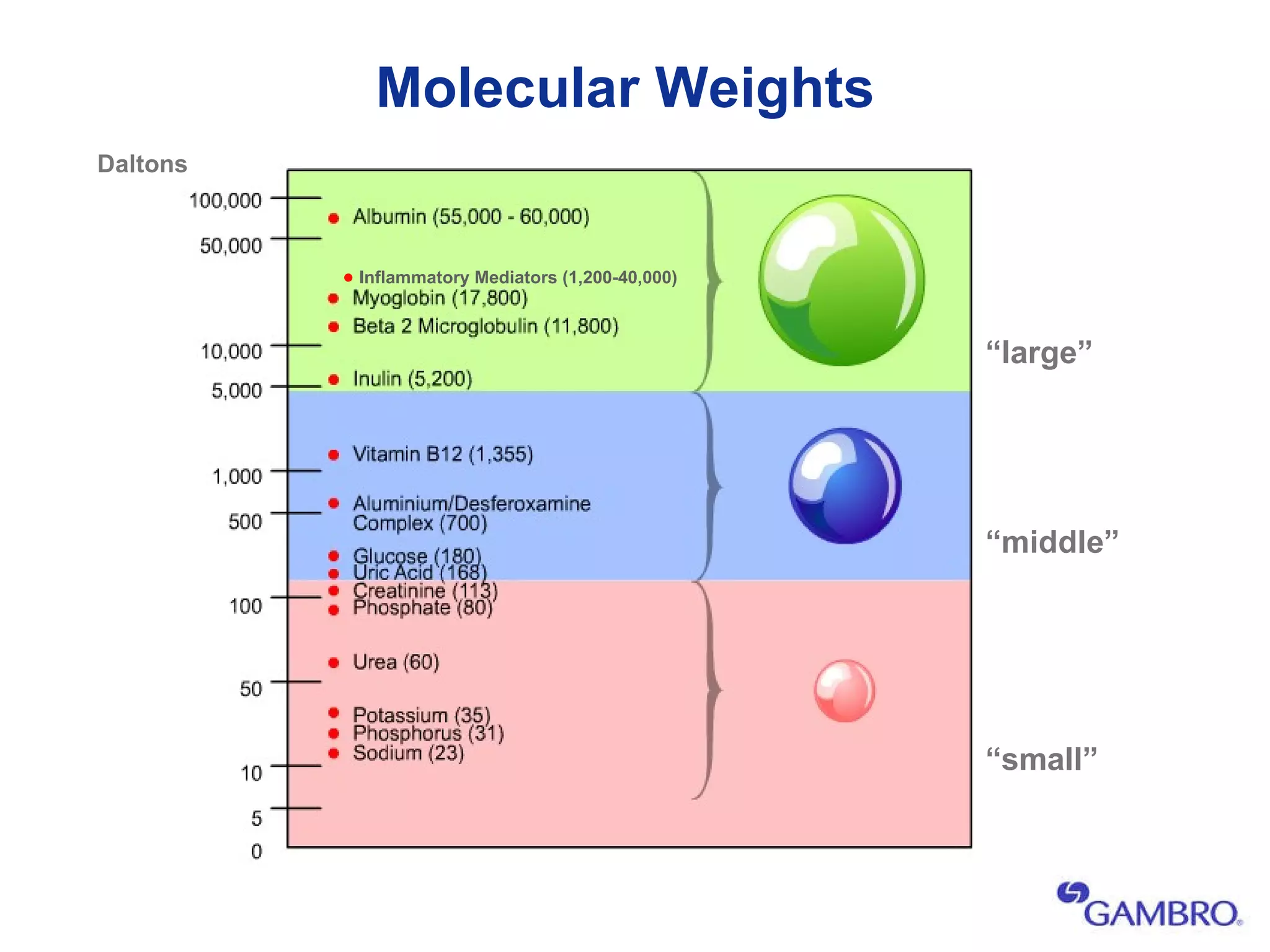
Molecular Weights Daltons •   Inflammatory Mediators (1,200-40,000) “ small” “ middle” “ large”
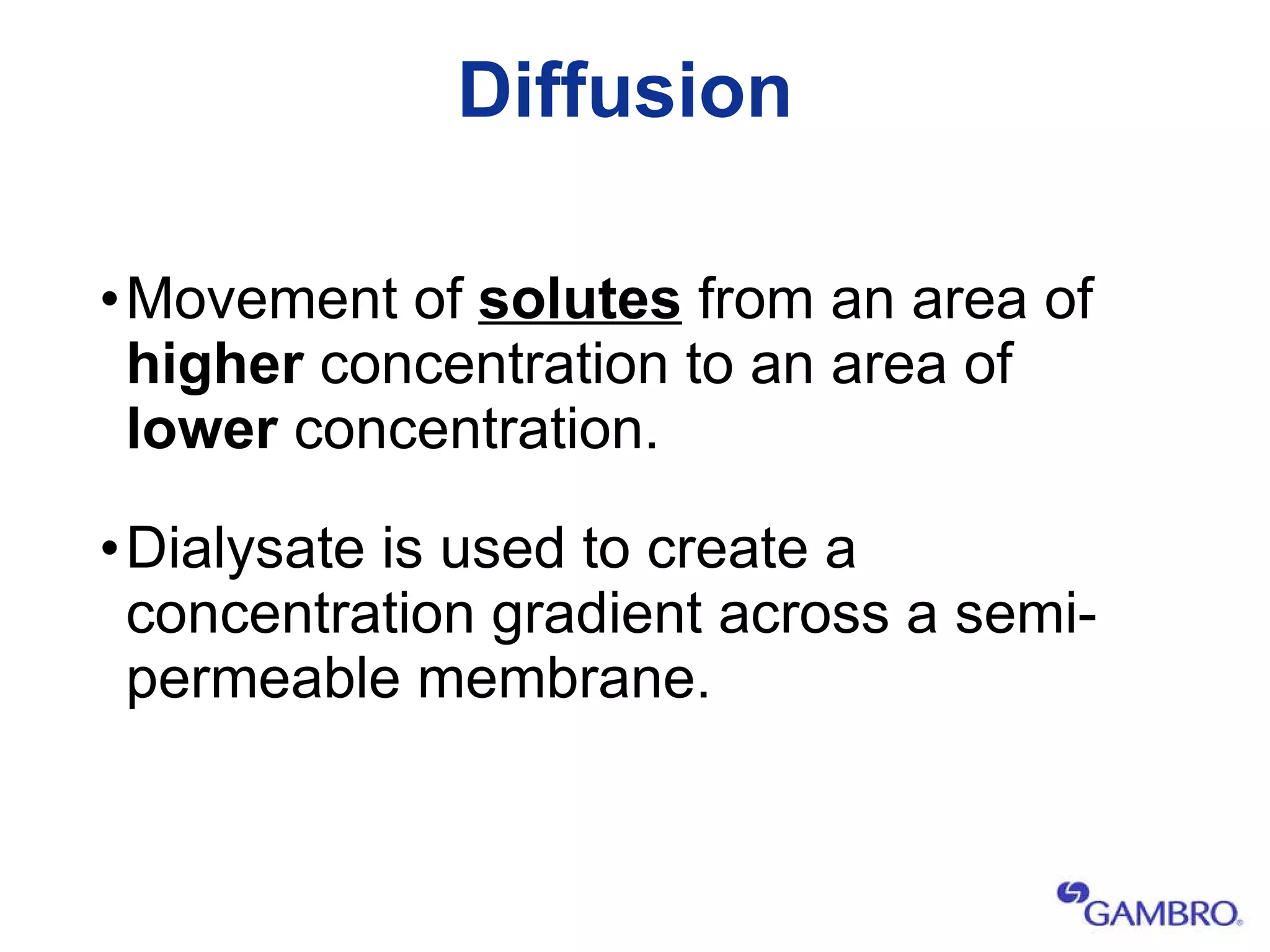
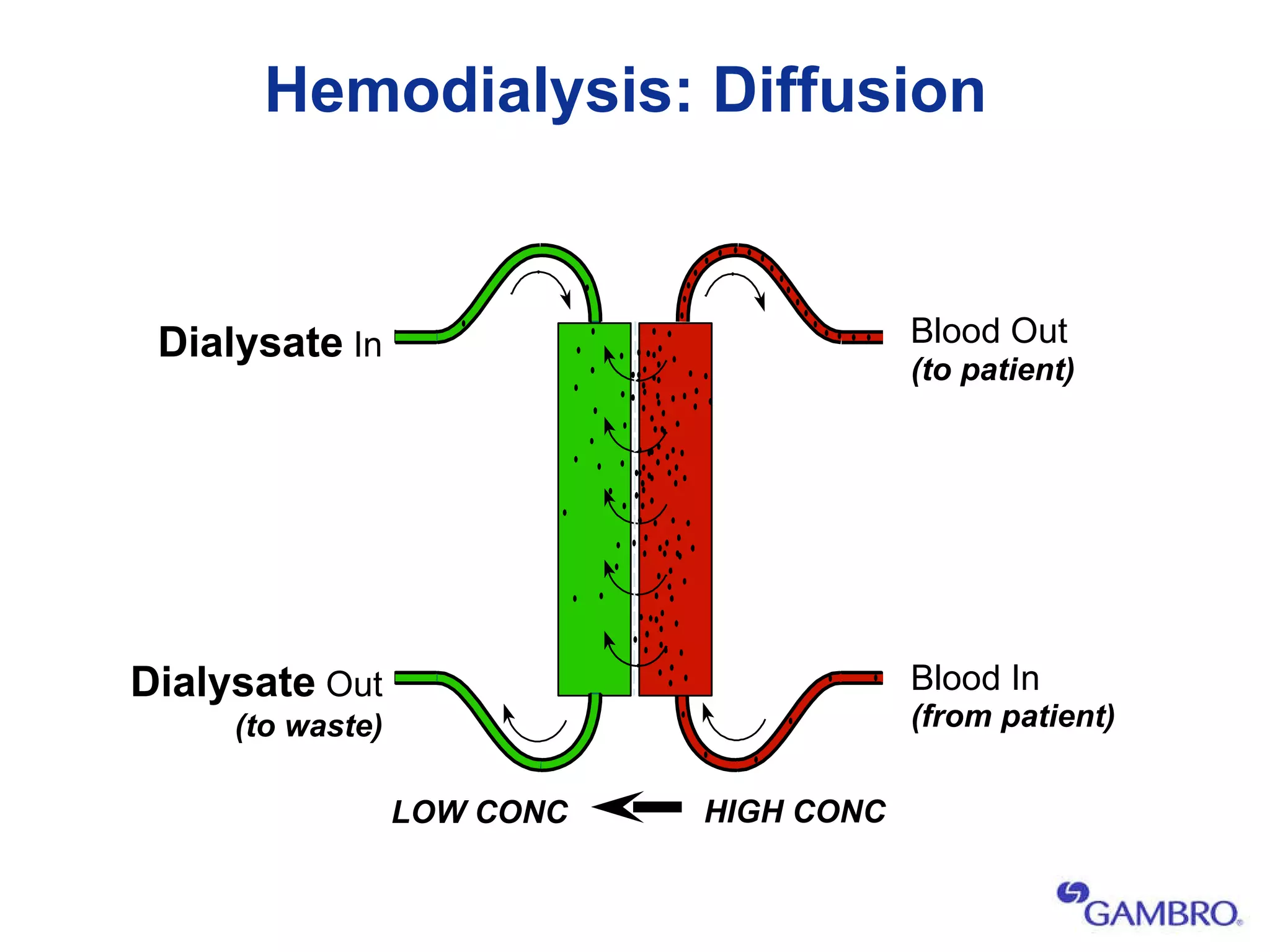
Diffusion Movement of  solutes  from an area of  higher  concentration to an area of  lower  concentration. Dialysate is used to create a concentration gradient across a semi-permeable membrane.
Hemodialysis: Diffusion Dialysate  In Dialysate  Out (to waste) Blood Out Blood In (to patient) (from patient) HIGH CONC LOW CONC
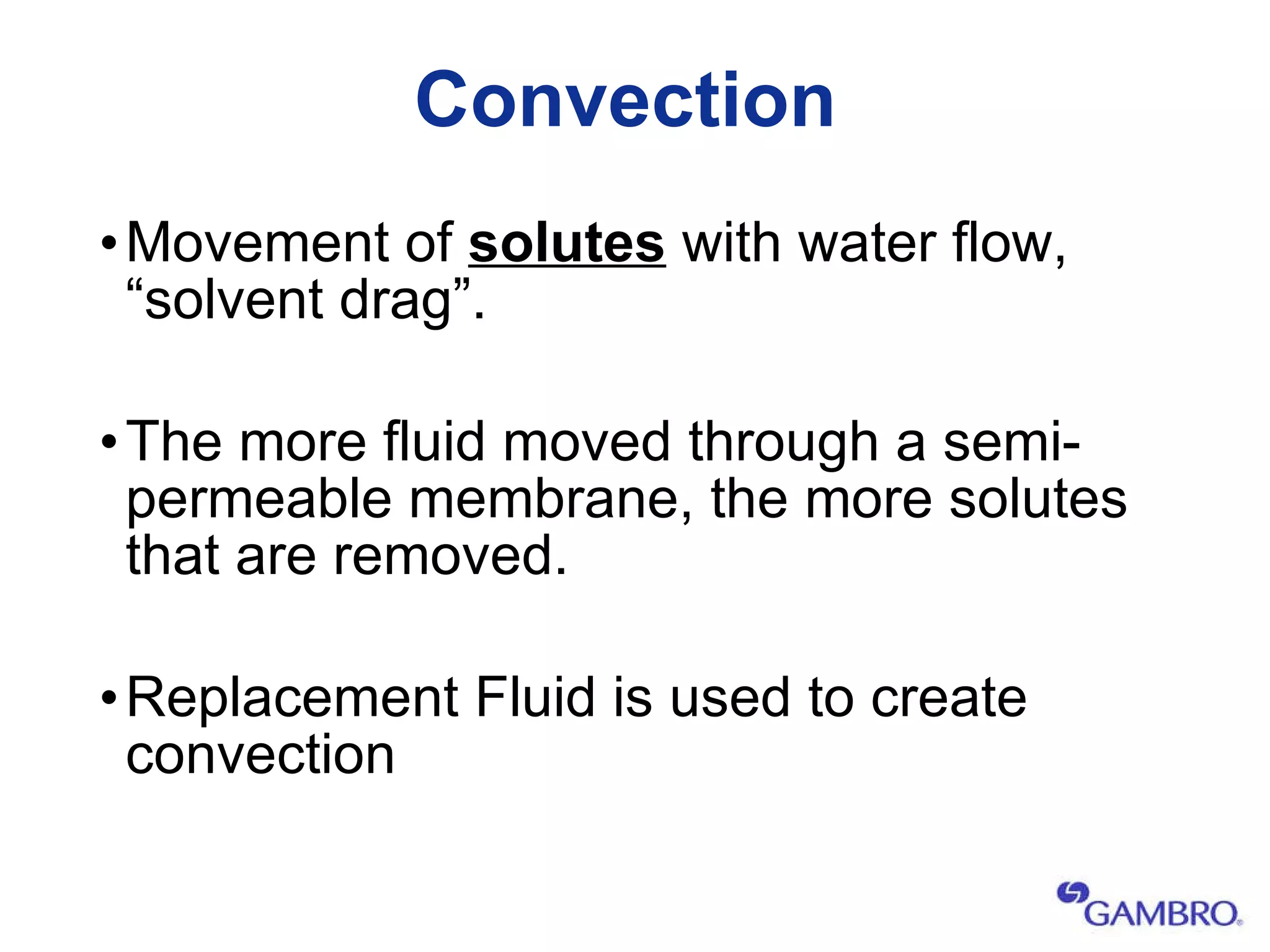
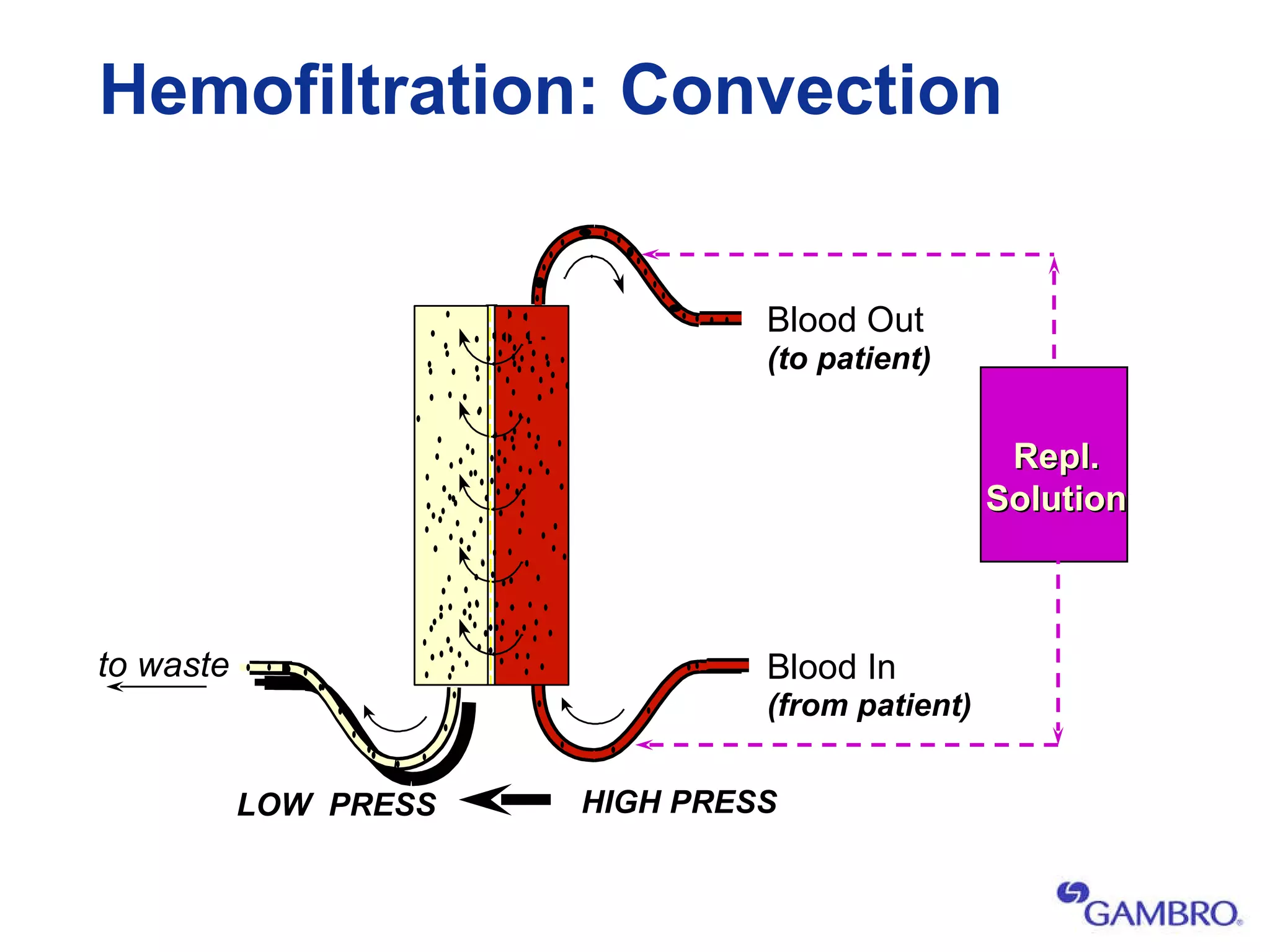
Convection Movement of  solutes  with water flow, “solvent drag”. The more fluid moved through a semi-permeable membrane, the more solutes that are removed. Replacement Fluid is used to create convection
Hemofiltration: Convection to waste HIGH PRESS LOW  PRESS Repl. Solution Blood Out Blood In (to patient) (from patient)
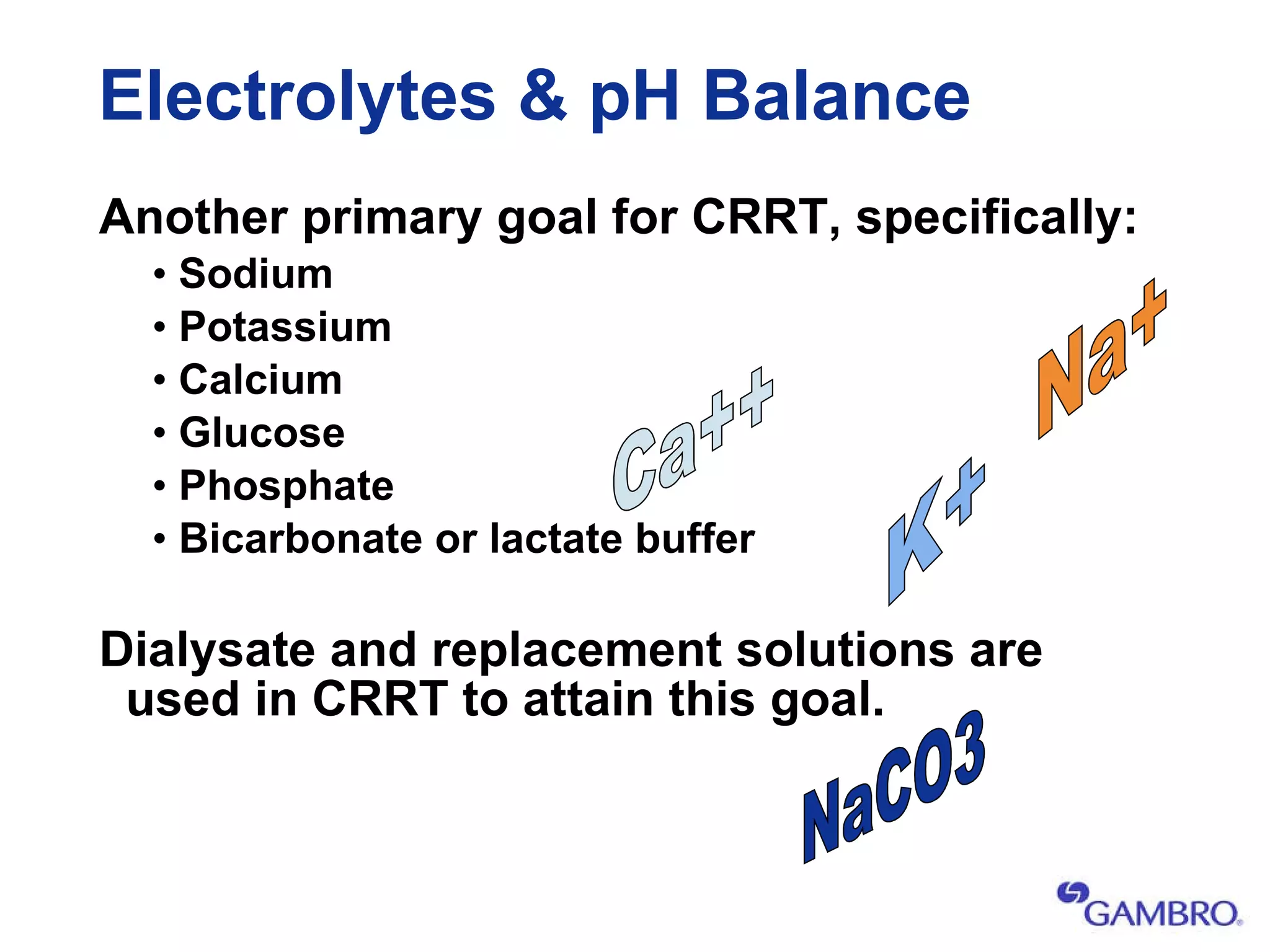
Electrolytes & pH Balance Another primary goal for CRRT, specifically: Sodium Potassium Calcium Glucose Phosphate Bicarbonate or lactate buffer Dialysate and replacement solutions are used in CRRT to attain this goal. K+ Ca++ Na+ NaCO3
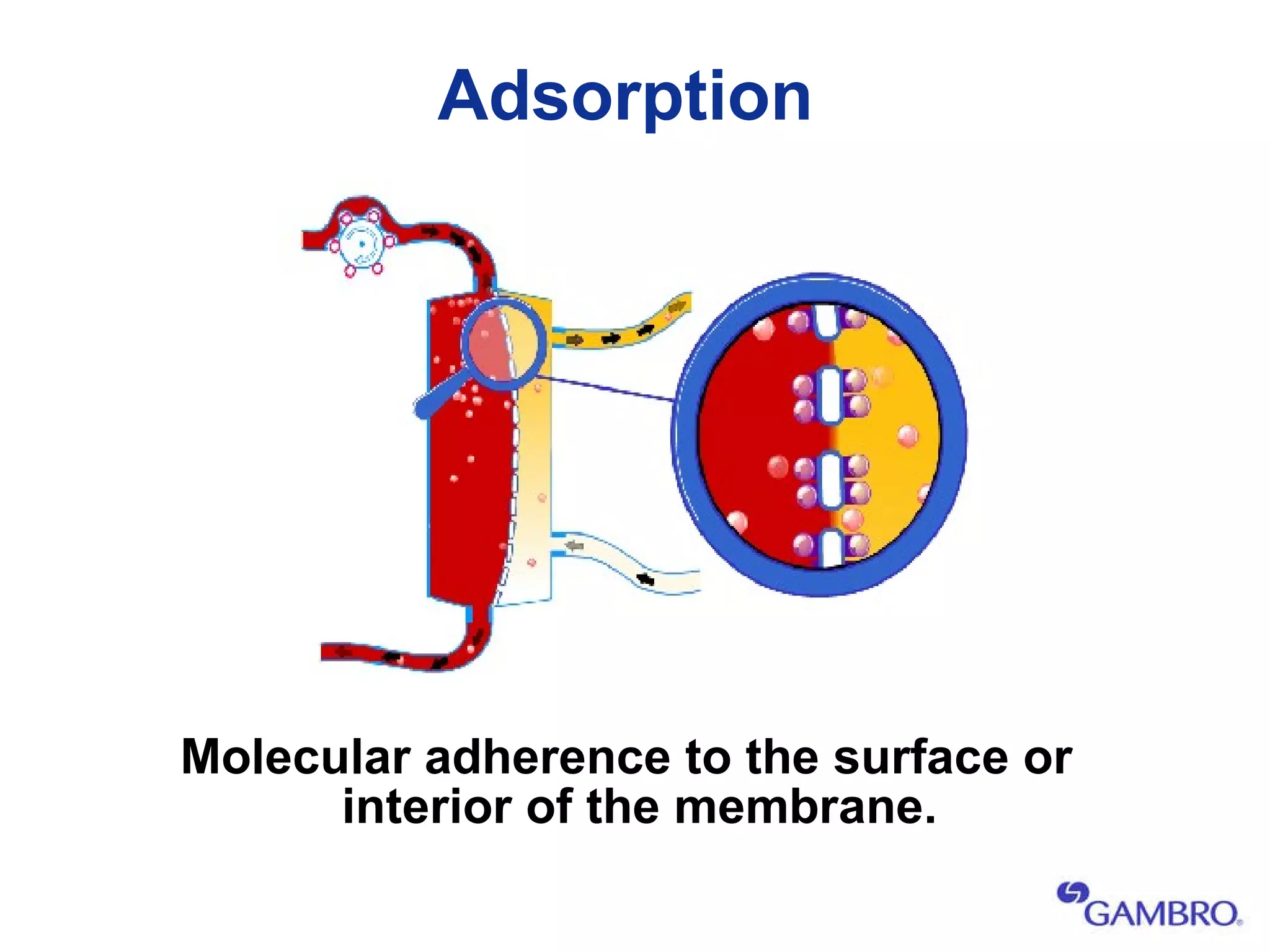
Adsorption Molecular adherence to the surface or interior of the membrane.
Small vs. Large Molecules Clearance 0 20 40 60 80 100 Clearance in % 35.000 55.000 20.000 5.000 2.500 Urea (60) Albumin (66.000) Myoglobin (17.000) 65.000 Creatinine (113) Kidney Convection Diffusion
What is the transport mechanism associated with dialysate and replacement solutions?
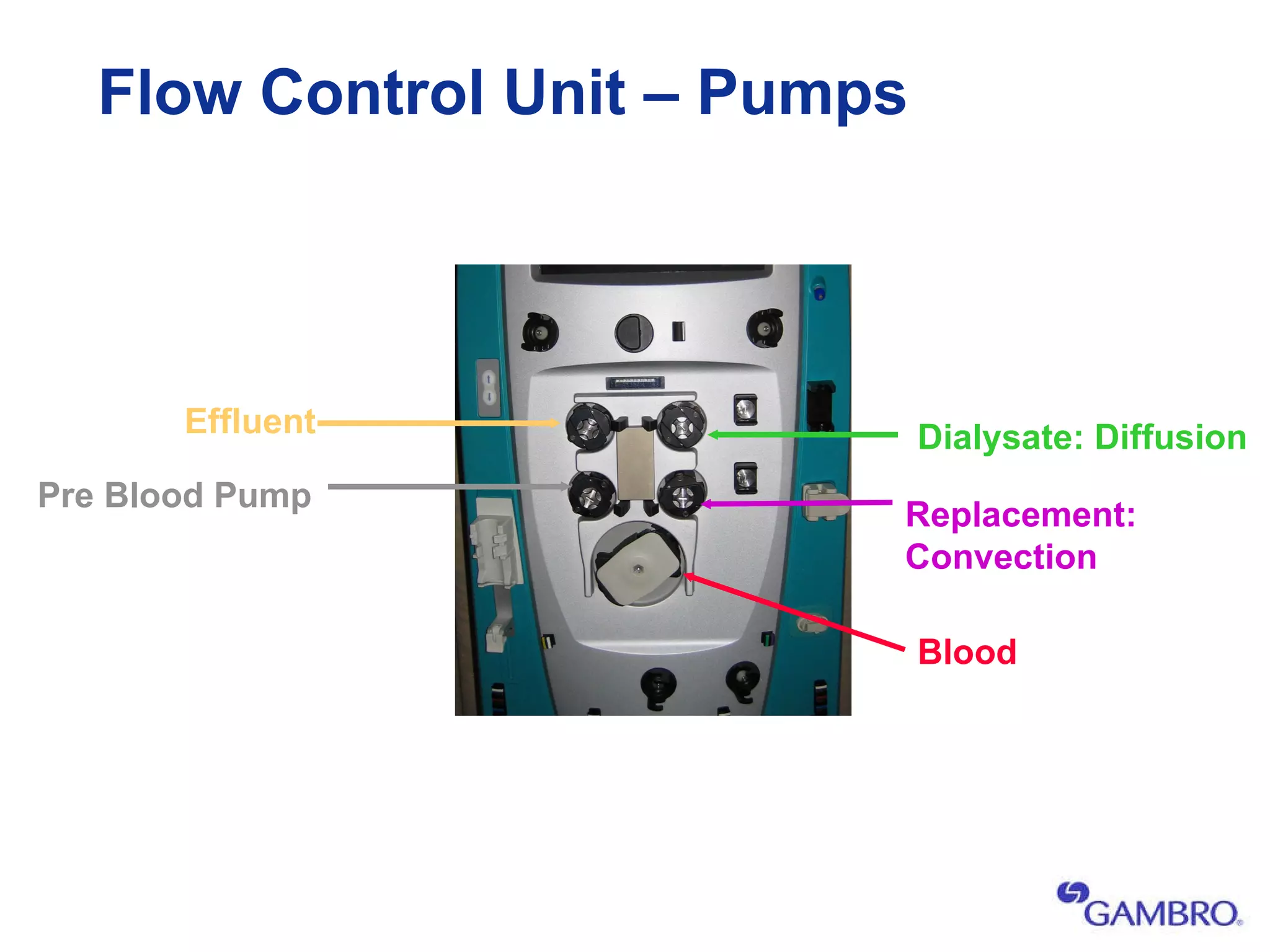
Flow Control Unit – Pumps Effluent Pre Blood Pump Replacement: Convection Blood Dialysate: Diffusion
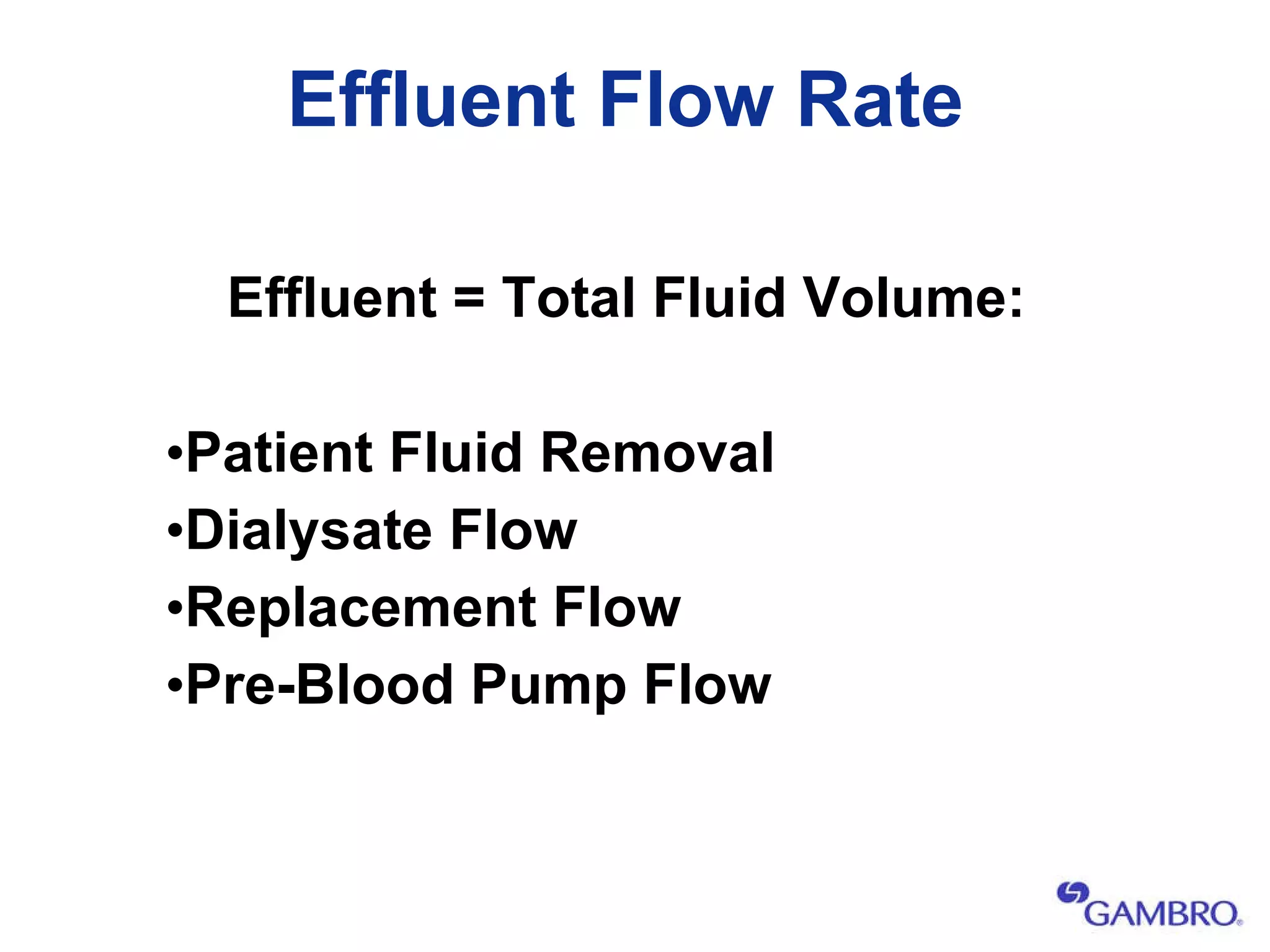
Effluent Flow Rate Effluent = Total Fluid Volume: Patient Fluid Removal Dialysate Flow Replacement Flow Pre-Blood Pump Flow
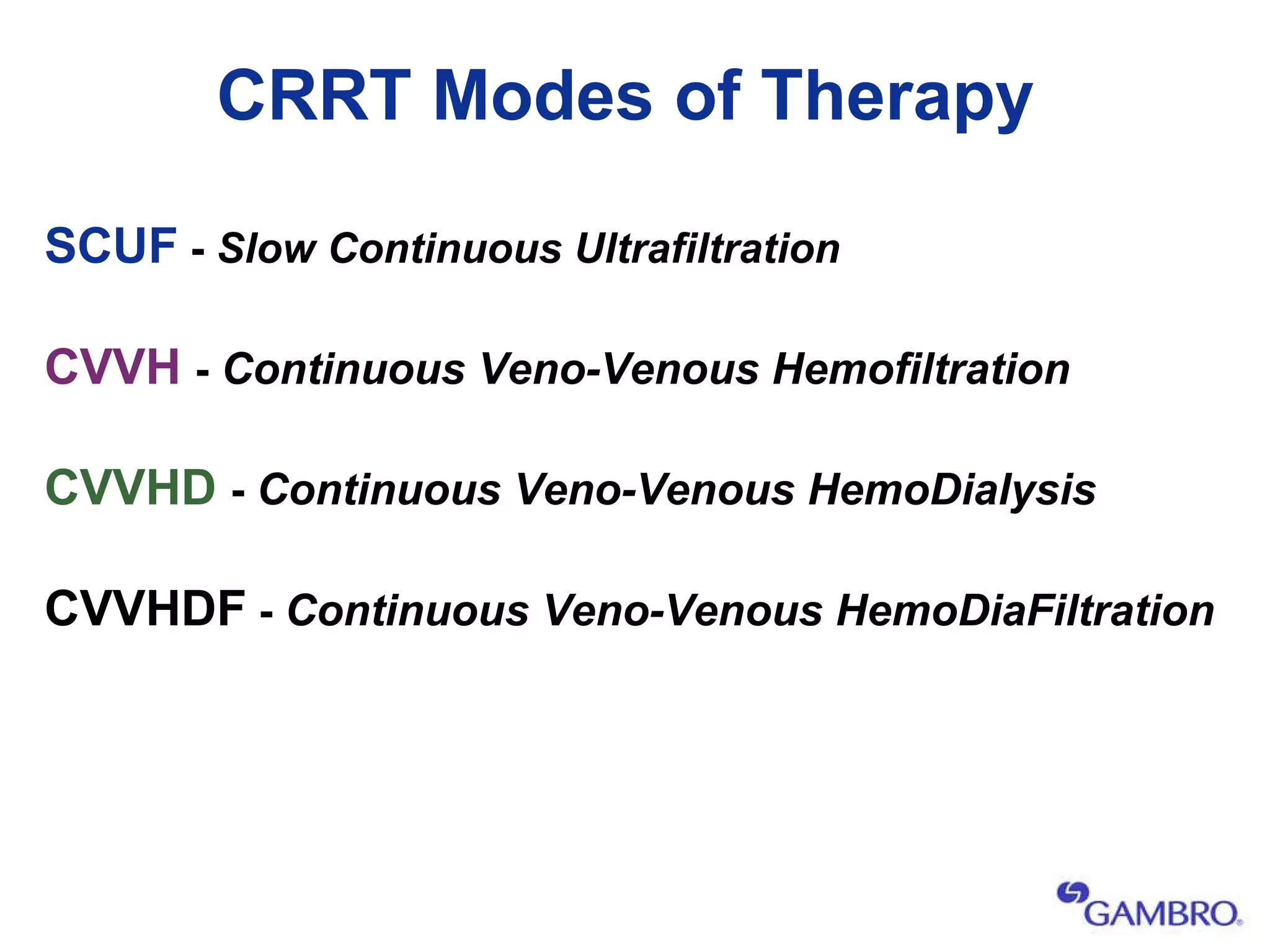
CRRT Modes of Therapy SCUF  -  Slow Continuous Ultrafiltration CVVH   -  Continuous Veno-Venous Hemofiltration CVVHD   -  Continuous Veno-Venous HemoDialysis   CVVHDF  -  Continuous Veno-Venous HemoDiaFiltration
SCUF Slow Continuous UltraFiltration Primary therapeutic goal: Safe and effective management of fluid removal from the patient
SCUF Slow Continuous UltraFiltration Effluent Pump Infusion or Anticoagulant Blood Pump PBP Pump Effluent Access Return
CVVHD Continuous VV HemoDialysis   Primary therapeutic goal: Small solute removal by diffusion Safe fluid volume management Dialysate volume automatically removed through the Effluent pump   Solute removal determined by  Dialysate Flow Rate .
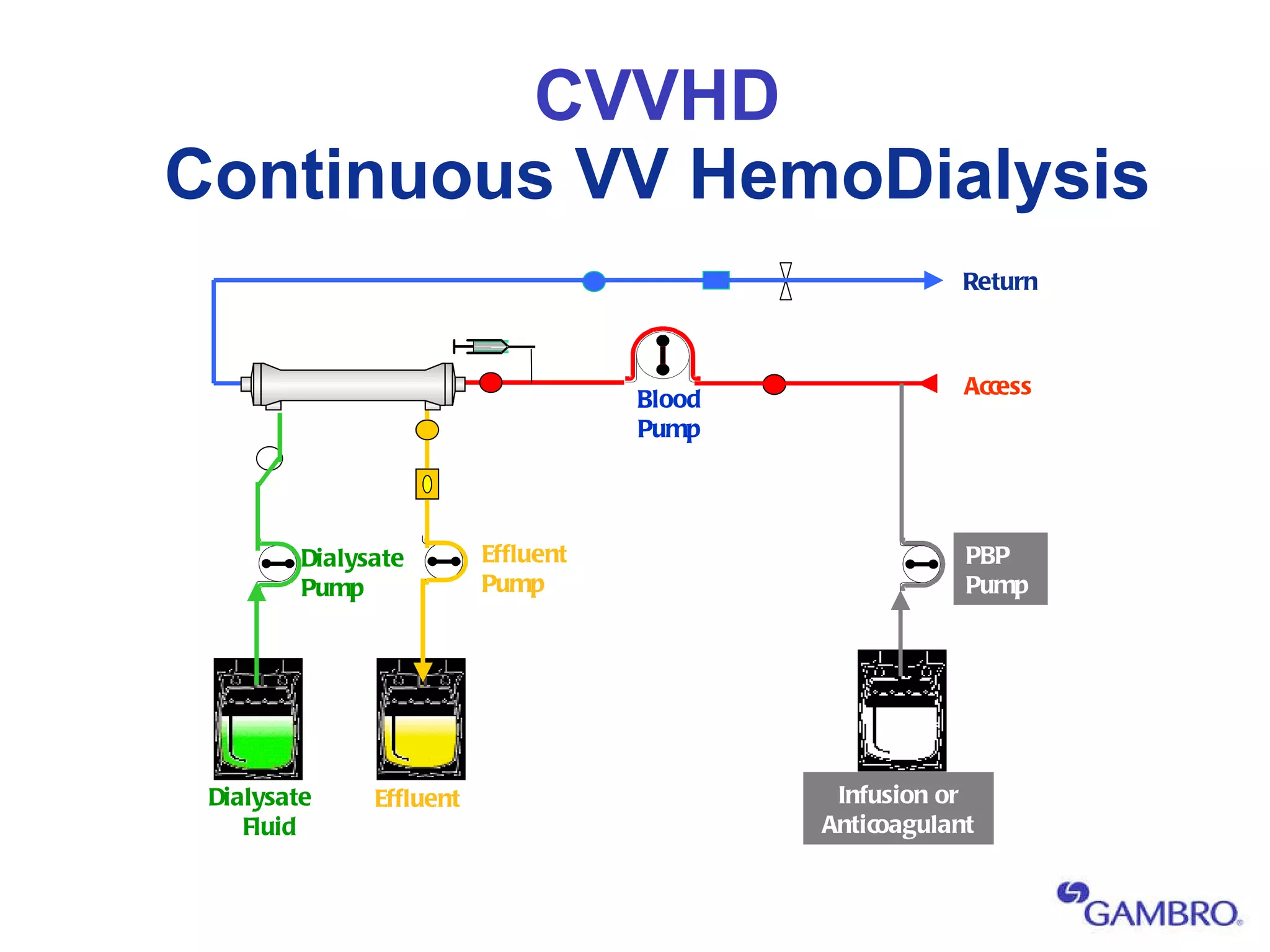
CVVHD Continuous VV HemoDialysis Hemofilter Effluent Pump Effluent Access Return Dialysate Pump Dialysate Fluid Blood Pump Infusion or Anticoagulant PBP Pump
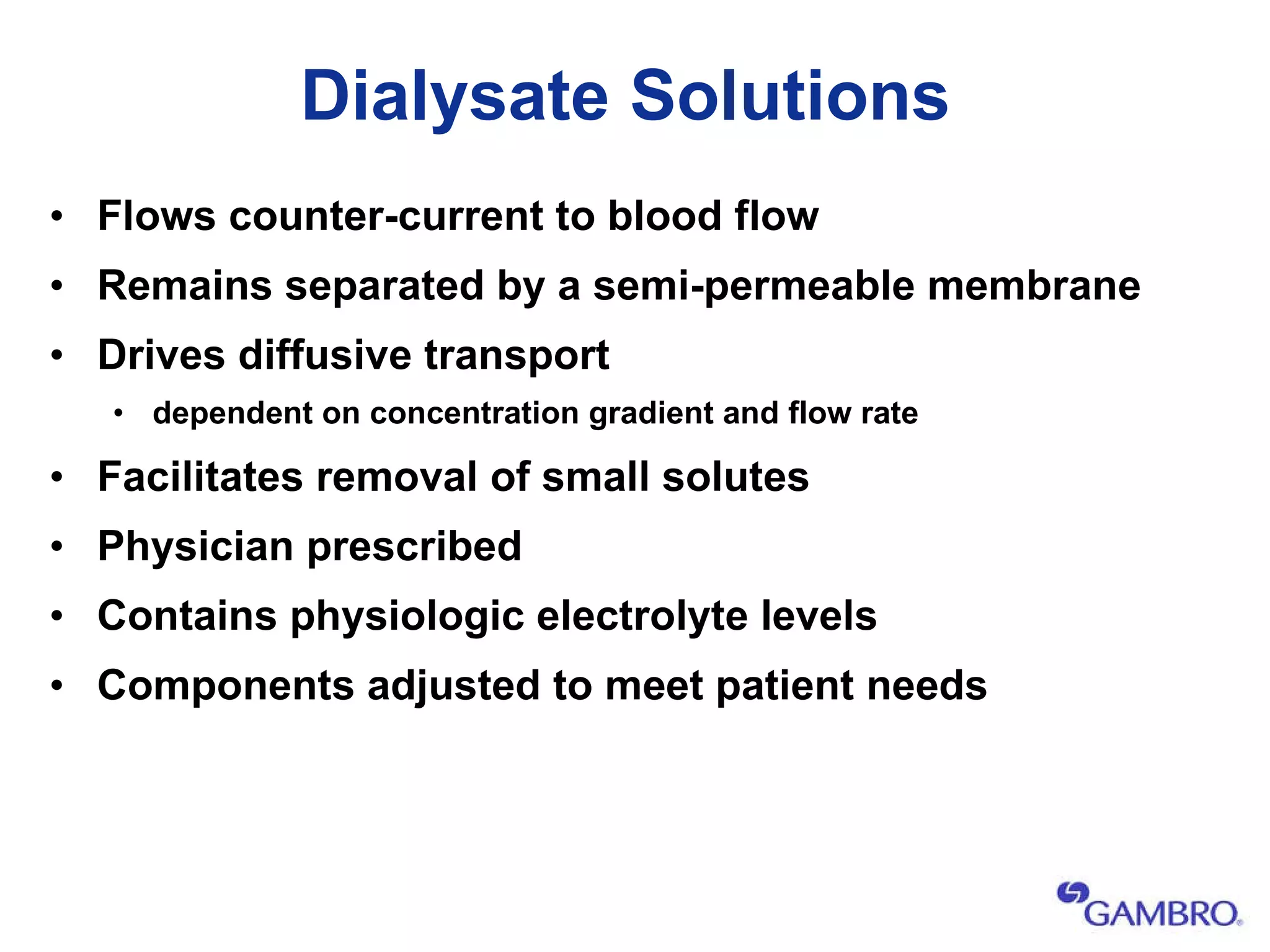
Dialysate Solutions Flows counter-current to blood flow  Remains separated by a semi-permeable membrane Drives diffusive transport   dependent on  concentration gradient  and flow rate Facilitates removal of small solutes Physician prescribed  Contains physiologic electrolyte levels  Components adjusted to meet patient needs
CVVH : Continuous VV Hemofiltration   Primary Therapeutic Goal:  Removal of small, middle and large sized solutes  Safe fluid volume management Replacement solution is infused into blood compartment pre or post filter Drives convective transport Replacement fluid volume automatically removed by effluent pump Solute removal determined by  Replacement Flow Rate .
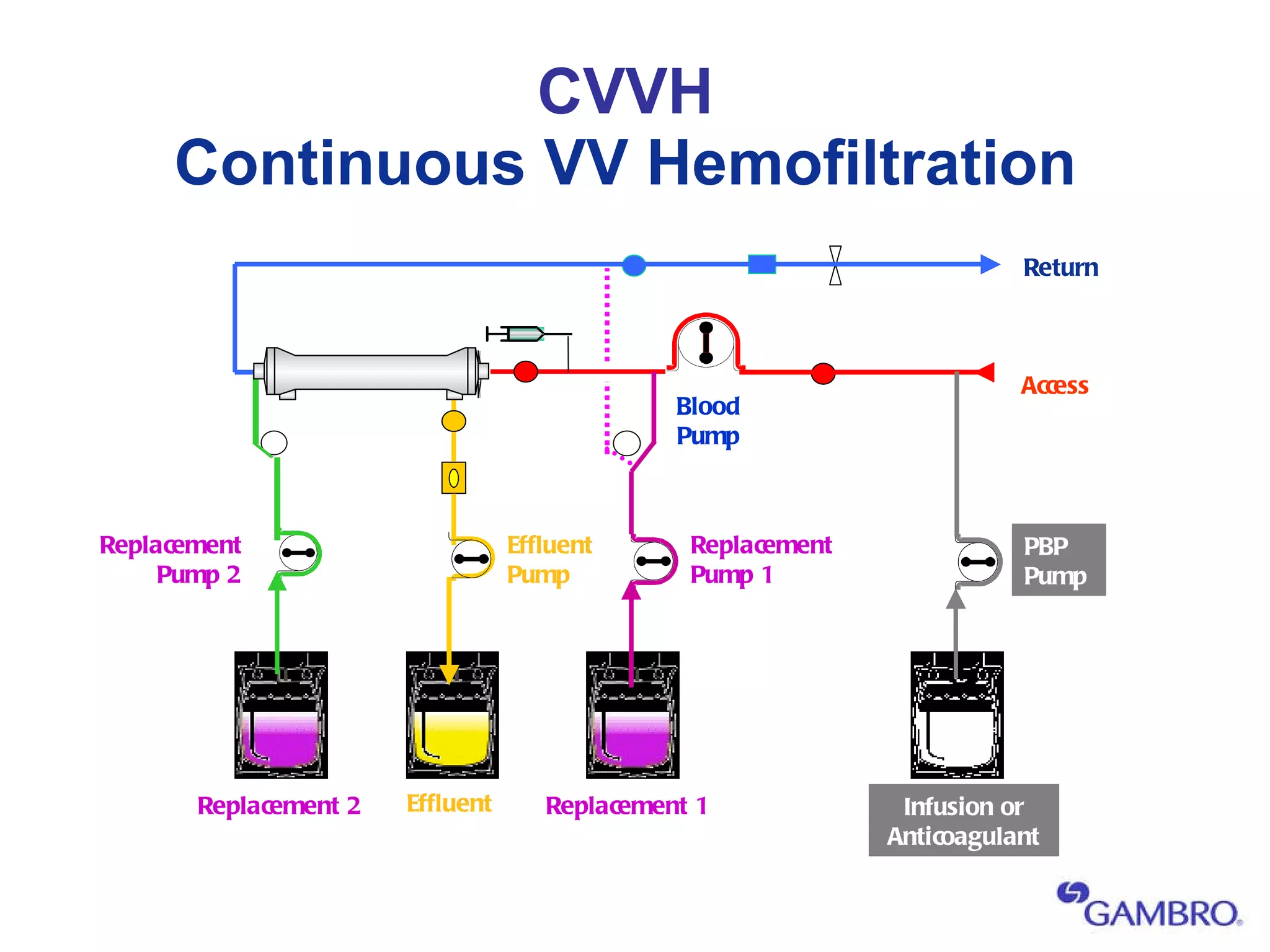
CVVH Continuous VV Hemofiltration Effluent Pump Blood Pump Effluent Access Return Replacement Pump 1 Replacement Pump 2 Replacement 1 Replacement 2 Infusion or Anticoagulant PBP Pump
Pre-Dilution   Replacement Solution Decreases risk of clotting Higher UF capabilities Decreases Hct.  In filter Hemofilter Effluent Pump Blood Pump PBP Pump Effluent Access Return Replacement Pump Replacement Fluid Infusion or Anticoagulant
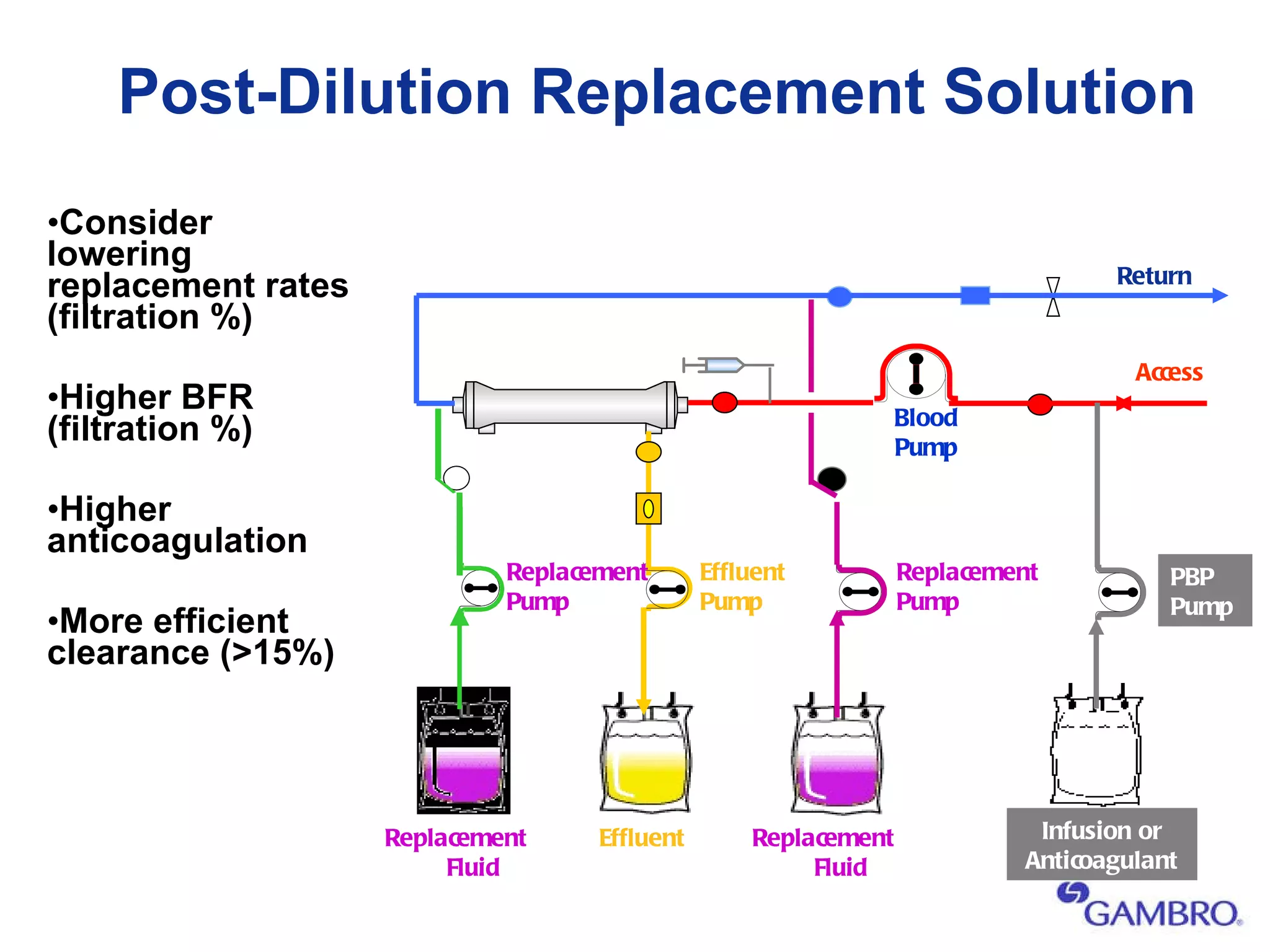
Post-Dilution Replacement Solution Consider  lowering replacement rates  (filtration %) Higher BFR (filtration %) Higher  anticoagulation More efficient clearance (>15%) Hemofilter Effluent Pump Blood Pump Effluent Access Return Replacement Pump Replacement Fluid Replacement Pump Replacement Fluid PBP Pump Infusion or Anticoagulant
Replacement Solutions Infused directly into the blood at points along the blood pathway Drives convective transport Facilitates the removal of small middle and large solutes Physician Prescribed  Contains electrolytes at physiological levels  Components adjusted to meet patient needs
CVVHDF Primary therapeutic goal: Solute removal by diffusion and convection Safe fluid volume management Efficient removal of small, middle and large molecules Replacement and dialysate fluid volume automatically removed by effluent pump Solute removal determined by Replacement +  Dialysate  Fl ow  Rates .
CVVHDF Continuous VV  H emo D ia F iltration Effluent Pump Effluent Access Return Dialysate Pump Dialysate Fluid Blood Pump Replacement Pump Replacement Fluid PBP Pump Infusion or Anticoagulant

1 prismaflex crrt intro - seg 1 (2007)

  • 1.
    PrismaFlex STEPPBasic CRRT Principles ®
  • 2.
    Course Objectives Bythe end of the Gambro CRRT training course the participant will be able to: Define CRRT and the associated therapies Discuss the basic CRRT principles Discuss the basic principles of the solute transport mechanisms Identify the clinical indications for administering CRRT, including an overview of patient selection and therapy application Have a working knowledge of basic CRRT machine set up, run, end treatment and troubleshooting skills. Describe the CRRT machine’s safety management features, pressure monitoring and fluid balance principles.
  • 3.
    Continuous Renal ReplacementTherapy (CRRT) “ “ Any extracorporeal blood purification therapy intended to substitute for impaired renal function over an extended period of time and applied for or aimed at being applied for 24 hours/day.” Bellomo R., Ronco C., Mehta R, Nomenclature for Continuous Renal Replacement Therapies, AJKD, Vol 28, No. 5, Suppl 3, Nov 1996
  • 4.
    Why CRRT? Removeslarge amounts of fluid and waste products over time Tolerated well by hemodynamically unstable patients CRRT closely mimics the native kidney in treating ARF and fluid overload
  • 5.
    CRRT Treatment GoalsMaintain fluid, electrolyte, acid/base balance Prevent further damage to kidney tissue Promote healing and total renal recovery Allow other supportive measures; nutritional support
  • 6.
    Determinants of OutcomeInitiation of Therapy Ronco Study Gettings Study ADQI Consensus Initiative - Rifle Criteria Dose Ronco Study Kellum Meta-Analysis Saudan Study
  • 7.
    R isk Injury F ailure L oss E SRD GFR Criteria Urine Output Criteria Increased creatinine x 1.5 or GFR decrease >25% UO <,0.5ml/kg/hr x 6 hours Increased creatinine x 2 or GFR decrease >50% UO <0.5 ml/kg/hr x 12 hours Increased creatinine x 3 or GFR decrease >75% or Serum Creatinine > 4mg/dl UO <0.3 ml/kg/hr x 24 hours or anuria x 12 hours Persistent ARF= complete loss of renal function >4 weeks End-stage renal disease (>3 months) Early Initiation
  • 8.
    Cumulative Survival (%)vs Treatment Dose Effects of different doses in CVVH on outcome of ARF - Ronco & Bellomo study. Lancet . july 00 100 90 80 70 60 50 40 30 20 10 0 Group 1(n=146) ( Uf = 20 ml/h/Kg) Group 2 (n=139) ( Uf = 35 ml/h/Kg) Group 3 (n=140) ( Uf = 45 ml/h/Kg) 41 % 57 % 58 % p < 0.001 p n..s. p < 0.001 Survival (%)
  • 9.
    Summary Evidenced BasedResearch reports that patient survival is improved by: Early initiation: Utilization of RIFLE Criteria Minimum dose delivery of 35 ml/kg/hr eg. 70 kg patient = 2450 ml/h Effects of different doses in CVVH on outcomes of ARF – C. Ronco M.D., R. Bellomo M.D. Lancet 2000; 356:26-30.
  • 10.
    Anatomy of aHemofilter 4 External ports blood and dialysis fluid Potting material support structure Hollow fibers Semi-permeable membrane Outer casing
  • 11.
    CRRT TransportMechanisms
  • 12.
    Molecular Transport MechanismsUltrafiltration Diffusion Convection Adsorption Fluid Transport Solute Transport }
  • 13.
    Ultrafiltration Movement of fluid through a semi-permeable membrane caused by a pressure gradient Positive, negative and osmotic pressure from non-permeable solutes
  • 14.
    Ultrafiltration Blood OutBlood In to waste (to patient) (From patient) HIGH PRESS LOW PRESS Fluid Volume Reduction
  • 15.
    Molecular Weights Daltons• Inflammatory Mediators (1,200-40,000) “ small” “ middle” “ large”
  • 16.
    Diffusion Movement of solutes from an area of higher concentration to an area of lower concentration. Dialysate is used to create a concentration gradient across a semi-permeable membrane.
  • 17.
    Hemodialysis: Diffusion Dialysate In Dialysate Out (to waste) Blood Out Blood In (to patient) (from patient) HIGH CONC LOW CONC
  • 18.
    Convection Movement of solutes with water flow, “solvent drag”. The more fluid moved through a semi-permeable membrane, the more solutes that are removed. Replacement Fluid is used to create convection
  • 19.
    Hemofiltration: Convection towaste HIGH PRESS LOW PRESS Repl. Solution Blood Out Blood In (to patient) (from patient)
  • 20.
    Electrolytes & pHBalance Another primary goal for CRRT, specifically: Sodium Potassium Calcium Glucose Phosphate Bicarbonate or lactate buffer Dialysate and replacement solutions are used in CRRT to attain this goal. K+ Ca++ Na+ NaCO3
  • 21.
    Adsorption Molecular adherenceto the surface or interior of the membrane.
  • 22.
    Small vs. LargeMolecules Clearance 0 20 40 60 80 100 Clearance in % 35.000 55.000 20.000 5.000 2.500 Urea (60) Albumin (66.000) Myoglobin (17.000) 65.000 Creatinine (113) Kidney Convection Diffusion
  • 23.
    What is thetransport mechanism associated with dialysate and replacement solutions?
  • 24.
    Flow Control Unit– Pumps Effluent Pre Blood Pump Replacement: Convection Blood Dialysate: Diffusion
  • 25.
    Effluent Flow RateEffluent = Total Fluid Volume: Patient Fluid Removal Dialysate Flow Replacement Flow Pre-Blood Pump Flow
  • 26.
    CRRT Modes ofTherapy SCUF - Slow Continuous Ultrafiltration CVVH - Continuous Veno-Venous Hemofiltration CVVHD - Continuous Veno-Venous HemoDialysis CVVHDF - Continuous Veno-Venous HemoDiaFiltration
  • 27.
    SCUF Slow ContinuousUltraFiltration Primary therapeutic goal: Safe and effective management of fluid removal from the patient
  • 28.
    SCUF Slow ContinuousUltraFiltration Effluent Pump Infusion or Anticoagulant Blood Pump PBP Pump Effluent Access Return
  • 29.
    CVVHD Continuous VVHemoDialysis Primary therapeutic goal: Small solute removal by diffusion Safe fluid volume management Dialysate volume automatically removed through the Effluent pump Solute removal determined by Dialysate Flow Rate .
  • 30.
    CVVHD Continuous VVHemoDialysis Hemofilter Effluent Pump Effluent Access Return Dialysate Pump Dialysate Fluid Blood Pump Infusion or Anticoagulant PBP Pump
  • 31.
    Dialysate Solutions Flowscounter-current to blood flow Remains separated by a semi-permeable membrane Drives diffusive transport dependent on concentration gradient and flow rate Facilitates removal of small solutes Physician prescribed Contains physiologic electrolyte levels Components adjusted to meet patient needs
  • 32.
    CVVH : ContinuousVV Hemofiltration Primary Therapeutic Goal: Removal of small, middle and large sized solutes Safe fluid volume management Replacement solution is infused into blood compartment pre or post filter Drives convective transport Replacement fluid volume automatically removed by effluent pump Solute removal determined by Replacement Flow Rate .
  • 33.
    CVVH Continuous VVHemofiltration Effluent Pump Blood Pump Effluent Access Return Replacement Pump 1 Replacement Pump 2 Replacement 1 Replacement 2 Infusion or Anticoagulant PBP Pump
  • 34.
    Pre-Dilution Replacement Solution Decreases risk of clotting Higher UF capabilities Decreases Hct. In filter Hemofilter Effluent Pump Blood Pump PBP Pump Effluent Access Return Replacement Pump Replacement Fluid Infusion or Anticoagulant
  • 35.
    Post-Dilution Replacement SolutionConsider lowering replacement rates (filtration %) Higher BFR (filtration %) Higher anticoagulation More efficient clearance (>15%) Hemofilter Effluent Pump Blood Pump Effluent Access Return Replacement Pump Replacement Fluid Replacement Pump Replacement Fluid PBP Pump Infusion or Anticoagulant
  • 36.
    Replacement Solutions Infuseddirectly into the blood at points along the blood pathway Drives convective transport Facilitates the removal of small middle and large solutes Physician Prescribed Contains electrolytes at physiological levels Components adjusted to meet patient needs
  • 37.
    CVVHDF Primary therapeuticgoal: Solute removal by diffusion and convection Safe fluid volume management Efficient removal of small, middle and large molecules Replacement and dialysate fluid volume automatically removed by effluent pump Solute removal determined by Replacement + Dialysate Fl ow Rates .
  • 38.
    CVVHDF Continuous VV H emo D ia F iltration Effluent Pump Effluent Access Return Dialysate Pump Dialysate Fluid Blood Pump Replacement Pump Replacement Fluid PBP Pump Infusion or Anticoagulant