
Sustained Low-Efficiency
Extended Dialysis
TBD aka Swapnil Hiremath,
@hswapnil
University of Ottawa
Disclosures
• No relevant financial conflicts
• Research funding from CIHR, PSI, TOHAMO, KFoC
Disclosures
Objectives
• At the end of this talk, the participant will be able:
• obtain an overview of the principles of SLED
• Discuss some logistic considerations
• Understand why SLED makes sense
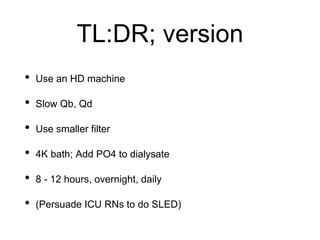
TL:DR; version
• Use an HD machine
• Slow Qb, Qd
• Use smaller filter
• 4K bath; Add PO4 to dialysate
• 8 - 12 hours, overnight, daily
• (Persuade ICU RNs to do SLED)
What is
SLEDD/SLED/SLEDD-f?
• Slow Low-Efficiency Daily Dialysis
• Sustained Low-Efficiency Dialysis
• Slow Extended Dialysis
• Slow Low-efficiency Daily Dia-Filtration
• Mainly New Zealand using Fresenius 4008S
• PIRRT: prolonged intermittent renal replacement therapy
A Brief History of Dialysis for
AKI
1950-70
Conventional HD
1970-85
Acute PD or conventional HD
1985-2005
CRRT
2005-
Conventional HD, CRRT, SLED
Fresenius 2008H machine
Software modified to do Qd 100 mL/min
Used Qb 100-200 mL/min
F40 dialyzer (surface area 0.7 sq metres)
Continuous
SLED is not really new: First Report from 1999
Issues
Hemodynamic instability: mainly from
Need to remove large volumes in 4 hours
Large amounts of fluids administered between
treatments
Rapid osmotic shifts
Multiple Investigations
EXTEND TIME TO 8
HOURS OR MORE
LOWER QB AND QD (SLOW)
DAILY
TREATMENTS
DO DIALYSIS AT NIGHT
How do you order?
• Filter: pediatric filter (F40s); order larger if you have
concerns about adequacy
• Duration: 8 - 12 hours (shorter if concerns of dialysis
dysequilibrium) Longer if more volume to come off*
• Qb, Qd: 200, 300* default (Can go higher if required)
• Fluid Removal: Total UF - unlike CRRT, like HD
Orders Contd.
• Dialysate:
• K - suggest 4 as default; 3 if hyperkalemia. Rarely if
ever 2 or lower
• Ca: 1.25 or 1.5 mmol/L
• HCO3: range 28-38 - perhaps 32 should be default
Orders: PO4
• 30 mL = 0.2 mmol/L
• 1 full fleet = 133 mL =
0.94 mmol/L
• Suggest starting with 90
- 120 ml for first run and
going to 150 ml (1
mmol/L) second run on
• Or just ‘full fleet’
SLED: anticoagulation
• Heparin
• No Anticoagulation: needed for ~ 30 - 80 %
• Saline flushes
• Citrasate (use 1.5 Ca bath)
SLED: Logistics elsewhere
• Fresenius 2008H
• CRRT option
• Qb ~200; Qd ~ 100mL/min (1 canister = complete Rx); small
dialyzer (F80)
• Usually nocturnal, started between 1600 – 2400 hours
• Usually HD RN starts and terminates; ICU RN does most of the
hourly charting/alarms
Ottawa
Gambro Artis
F40
Polysulfone
0.6m2
High
8
Nocturnal
3-7/week
200
300
0
bicarb
SLED across the world
SLED across the world:
Nursing model
SLED at Ottawa
SLED: Ottawa
• SLED done by ICU RNs
• Have dedicated SLED machines (Artis: same as our HD
machines*)
• Any time
• 3 - 7 times a week
• Upto 8 hours, but can do more
• Qb 200, Qd 300; F40 dialyser
Transition
Antibiotics
RRT in AKI: What Matters?
Patient survival and renal recovery
Cost
Complexity and nursing workload
Safety – correction of electrolyte disorders,
anticoagulation, risk of errors
Flexibility
Patient rehabilitation
Mortality
Mortality: RCTs only
More analyses
Mortality
Renal Recovery
Cost
Cost: Consumables
• Machines different but same cost
• PRISMAFLEX vs any conventional HD machine
• Dialysate:
• $5-7/L purchased in bags for CRRT
• $0.10/L purified city water for IHD, SLED
• Filter sets
• Prisma: $200
• IHD/SLED: $20
Cost: Labour
• Labour
• If No HD nurse involvement then ICU RN only (no labour cost???)
• IHD: 1 HD nurse for 4 hours
• SLED: 1 HD nurse for 8 hours, but usually does 2 patients
simultaneously
• SLED: precedents for HD nurse doing set up and ICU nurses
doing monitoring
• i.e. 1 hour HD nurse involvement/treatment
Canadian Experience
Details of SLED
1 litre saline/hr
Source: Berbece, Richardson, Kidney Int 2006, PMID: 16850023
Cost: Summary
Toronto model: Cost based on 1 HD RN dialyzing 2 patients simultaneously
Complexity
Complexity/Nursing
Workload: CRRT
• CRRT - heparin
• Manage bags of dialysate (5L) q.2-3.h
• Empty drain bag (5L) q.2-3.h
• RN or pharmacy must add KCl to each bag
• Hourly recording of machine data and flows
• CRRT – citrate: all of the above +
• Manage citrate infusion
• Manage calcium infusion
• Manage saline infusion (to correct high HCO3)
• Monitor ionized calcium to regulate citrate and calcium infusions
Complexity/Nursing
Workload: SLED
• SLED
• Connect machine to patient after priming
• Heparin or alternately, saline flushes using bags of
saline
• Hourly monitoring of machine functions
• Wait for an alarm ( 1 per treatment for SLED)
(One HD RN may monitor 1-3 machines)
Simplicity/Nursing Workload:
SLED
Safety
Safety
SLED
• Can choose dialysate with 0, 1, 2 ,3 , 4 mmol/L KCl,
appropriate calcium, magnesium, HCO3
• Can add sodium PO4 to correct low phosphate
• Most often done without anticoagulant- saline
flushes
Safety: compare with
nocturnal home HD
• Follow exactly the same protocol as SLED
• 8 hours, 4-6 nights/week
• Qb 200, Qd 350 ml/min, heparin
• Central line or fistula
• Sleep through the treatment with very few alarms
Patient Rehabilitation
• ICU survivors have grossly impaired muscle strength,
mobility, QOL
• Early mobilization thought to be key to prevent this
• CRRT precludes mobilization
• IHD or SLED (especially overnight) frees patients for many
hours/day
SLED summary
• Clinical outcomes: SLED = CRRT
• Simpler
• Cheaper
• Easier on Nurses
• ?better for rehab/recovery
Thanks
TL:DR; version
• Use an HD machine
• Slow Qb, Qd
• Use smaller filter
• 4K bath; Add PO4 to dialysate
• 8 - 12 hours, overnight, daily
• (Persuade ICU RNs to do SLED)

Sled 2019

  • 1.
    Sustained Low-Efficiency Extended Dialysis TBDaka Swapnil Hiremath, @hswapnil University of Ottawa
  • 2.
    Disclosures • No relevantfinancial conflicts • Research funding from CIHR, PSI, TOHAMO, KFoC
  • 3.
  • 4.
    Objectives • At theend of this talk, the participant will be able: • obtain an overview of the principles of SLED • Discuss some logistic considerations • Understand why SLED makes sense
  • 6.
    TL:DR; version • Usean HD machine • Slow Qb, Qd • Use smaller filter • 4K bath; Add PO4 to dialysate • 8 - 12 hours, overnight, daily • (Persuade ICU RNs to do SLED)
  • 7.
    What is SLEDD/SLED/SLEDD-f? • SlowLow-Efficiency Daily Dialysis • Sustained Low-Efficiency Dialysis • Slow Extended Dialysis • Slow Low-efficiency Daily Dia-Filtration • Mainly New Zealand using Fresenius 4008S • PIRRT: prolonged intermittent renal replacement therapy
  • 8.
    A Brief Historyof Dialysis for AKI 1950-70 Conventional HD 1970-85 Acute PD or conventional HD 1985-2005 CRRT 2005- Conventional HD, CRRT, SLED
  • 9.
    Fresenius 2008H machine Softwaremodified to do Qd 100 mL/min Used Qb 100-200 mL/min F40 dialyzer (surface area 0.7 sq metres) Continuous SLED is not really new: First Report from 1999
  • 10.
    Issues Hemodynamic instability: mainlyfrom Need to remove large volumes in 4 hours Large amounts of fluids administered between treatments Rapid osmotic shifts Multiple Investigations EXTEND TIME TO 8 HOURS OR MORE LOWER QB AND QD (SLOW) DAILY TREATMENTS DO DIALYSIS AT NIGHT
  • 11.
    How do youorder? • Filter: pediatric filter (F40s); order larger if you have concerns about adequacy • Duration: 8 - 12 hours (shorter if concerns of dialysis dysequilibrium) Longer if more volume to come off* • Qb, Qd: 200, 300* default (Can go higher if required) • Fluid Removal: Total UF - unlike CRRT, like HD
  • 12.
    Orders Contd. • Dialysate: •K - suggest 4 as default; 3 if hyperkalemia. Rarely if ever 2 or lower • Ca: 1.25 or 1.5 mmol/L • HCO3: range 28-38 - perhaps 32 should be default
  • 13.
    Orders: PO4 • 30mL = 0.2 mmol/L • 1 full fleet = 133 mL = 0.94 mmol/L • Suggest starting with 90 - 120 ml for first run and going to 150 ml (1 mmol/L) second run on • Or just ‘full fleet’
  • 14.
    SLED: anticoagulation • Heparin •No Anticoagulation: needed for ~ 30 - 80 % • Saline flushes • Citrasate (use 1.5 Ca bath)
  • 15.
    SLED: Logistics elsewhere •Fresenius 2008H • CRRT option • Qb ~200; Qd ~ 100mL/min (1 canister = complete Rx); small dialyzer (F80) • Usually nocturnal, started between 1600 – 2400 hours • Usually HD RN starts and terminates; ICU RN does most of the hourly charting/alarms
  • 16.
  • 17.
    SLED across theworld: Nursing model
  • 18.
  • 19.
    SLED: Ottawa • SLEDdone by ICU RNs • Have dedicated SLED machines (Artis: same as our HD machines*) • Any time • 3 - 7 times a week • Upto 8 hours, but can do more • Qb 200, Qd 300; F40 dialyser
  • 20.
  • 21.
  • 23.
    RRT in AKI:What Matters? Patient survival and renal recovery Cost Complexity and nursing workload Safety – correction of electrolyte disorders, anticoagulation, risk of errors Flexibility Patient rehabilitation
  • 25.
  • 26.
  • 27.
  • 28.
  • 29.
  • 30.
  • 31.
    Cost: Consumables • Machinesdifferent but same cost • PRISMAFLEX vs any conventional HD machine • Dialysate: • $5-7/L purchased in bags for CRRT • $0.10/L purified city water for IHD, SLED • Filter sets • Prisma: $200 • IHD/SLED: $20
  • 32.
    Cost: Labour • Labour •If No HD nurse involvement then ICU RN only (no labour cost???) • IHD: 1 HD nurse for 4 hours • SLED: 1 HD nurse for 8 hours, but usually does 2 patients simultaneously • SLED: precedents for HD nurse doing set up and ICU nurses doing monitoring • i.e. 1 hour HD nurse involvement/treatment
  • 33.
  • 34.
    Details of SLED 1litre saline/hr
  • 35.
    Source: Berbece, Richardson,Kidney Int 2006, PMID: 16850023 Cost: Summary Toronto model: Cost based on 1 HD RN dialyzing 2 patients simultaneously
  • 36.
  • 37.
    Complexity/Nursing Workload: CRRT • CRRT- heparin • Manage bags of dialysate (5L) q.2-3.h • Empty drain bag (5L) q.2-3.h • RN or pharmacy must add KCl to each bag • Hourly recording of machine data and flows • CRRT – citrate: all of the above + • Manage citrate infusion • Manage calcium infusion • Manage saline infusion (to correct high HCO3) • Monitor ionized calcium to regulate citrate and calcium infusions
  • 38.
    Complexity/Nursing Workload: SLED • SLED •Connect machine to patient after priming • Heparin or alternately, saline flushes using bags of saline • Hourly monitoring of machine functions • Wait for an alarm ( 1 per treatment for SLED) (One HD RN may monitor 1-3 machines) Simplicity/Nursing Workload: SLED
  • 39.
  • 40.
    Safety SLED • Can choosedialysate with 0, 1, 2 ,3 , 4 mmol/L KCl, appropriate calcium, magnesium, HCO3 • Can add sodium PO4 to correct low phosphate • Most often done without anticoagulant- saline flushes
  • 41.
    Safety: compare with nocturnalhome HD • Follow exactly the same protocol as SLED • 8 hours, 4-6 nights/week • Qb 200, Qd 350 ml/min, heparin • Central line or fistula • Sleep through the treatment with very few alarms
  • 42.
    Patient Rehabilitation • ICUsurvivors have grossly impaired muscle strength, mobility, QOL • Early mobilization thought to be key to prevent this • CRRT precludes mobilization • IHD or SLED (especially overnight) frees patients for many hours/day
  • 43.
    SLED summary • Clinicaloutcomes: SLED = CRRT • Simpler • Cheaper • Easier on Nurses • ?better for rehab/recovery
  • 44.
  • 45.
    TL:DR; version • Usean HD machine • Slow Qb, Qd • Use smaller filter • 4K bath; Add PO4 to dialysate • 8 - 12 hours, overnight, daily • (Persuade ICU RNs to do SLED)