Presenter – Dr. Prem Mohan Jha
Moderator – Dr. Garima Aggarwal
Dialysis Prescription
Acute HD
Prescription
Elements Of HD Prescription
1. Session Length
2. Blood Flow Rate
3. Dialyzer
4. Dialysate Composition
5. Dialysate Flow Rate
6. Dialysate Temperature
7. Ultrafiltration Orders
8. Anticoagulation
HD Session Length & Blood Flow Rate
 Most important determinant of the amount of dialysis
 Initial dialysis session
 For initial 1 or 2 sessions, specially when pre-dialysis
SUN >125 mg/dl
 Both dialysis session length and blood flow rate
should be reduced
 Target URR <40%
 QB – 250 ml/min for adults. 200 ml/min for small pts.
 2 hour length sessions.
 To prevent DDS, aim for urea clearance of –
 30% for 1st treatment (Kt/V= 0.7)
 50% for 2nd treatment (Kt/V = 1.0)
 70% for 3rd and subsequent treatments (Kt/V = 1.2)
 For initial BUN <100 mg/dl, aim for urea clearance of
 50% for 1st tt
 70% for 2nd and subsequent tt
 2nd hemodialysis
 Increased to 3 hrs, when pre dialysis sun<100 mg/dl
 Length of single dialysis treatment rarely exceeds 6
hours unless dialysis for drug overdose.
 A typical 3 – 4 hr acute dialysis session will deliver a spKt/V
of only 0.9 with eKt/V of 0.7.
 This low level of Kt/V, if given 3/week, is a/w high mortality in
chronic stable pts.
 Options-
 Dialyse sick patients of AKI on daily basis (6/week) with
each session length of 3 – 4 hrs.
 Mortality is reduced( schiffl- 2002).
 VA/NIH (2008) study compared outcomes in acute pts
dialysed either 3 or 6 times per week.
 The intensity in 3/week group was substantially higher
(Kt/V of 1.3 or more) than in the schiffl artcle.
 For this reason the KIGO workgroup on AKI 2012,
recommened Kt/V of 1.3 or more for each HD session
for acute pts on 3/wk HD.
 We can verify HD adequacy by
 URR
 Measured by
 Blood test
 Ionic coductance
 UV absorption technology
Choosing A Dialyzer
 Membrane material –
 Not studied as a separate factor
 Ultrafiltration coefficient (Kuf)-
 Use dialyzers of high water permeability ( Kuf >6.0).
Choosing A Dialyzer contd.
 Dialyzer urea clearance
 For first couple of HD sessions we should avoid using
very high efficiency dialyzers.
 A dialyzer with a K0A of 500 – 600 ml/min is
recommended.
 After initial 1 – 2 sessions, particularly when high QB
is being used, normal sized dialyzer should be used.
The Dialysis Solution
 Bicarbonate = 25 mmol/l
 Sodium = 145 mmol/l
 Potassium = 3.5 mmol/l
 Calcium = 1.5 mmol/l
 Magnesium = 0.375 mmol/l
 Dextrose = 100 mg/dl
 No phosphorus
 May be altered as per circumstances.
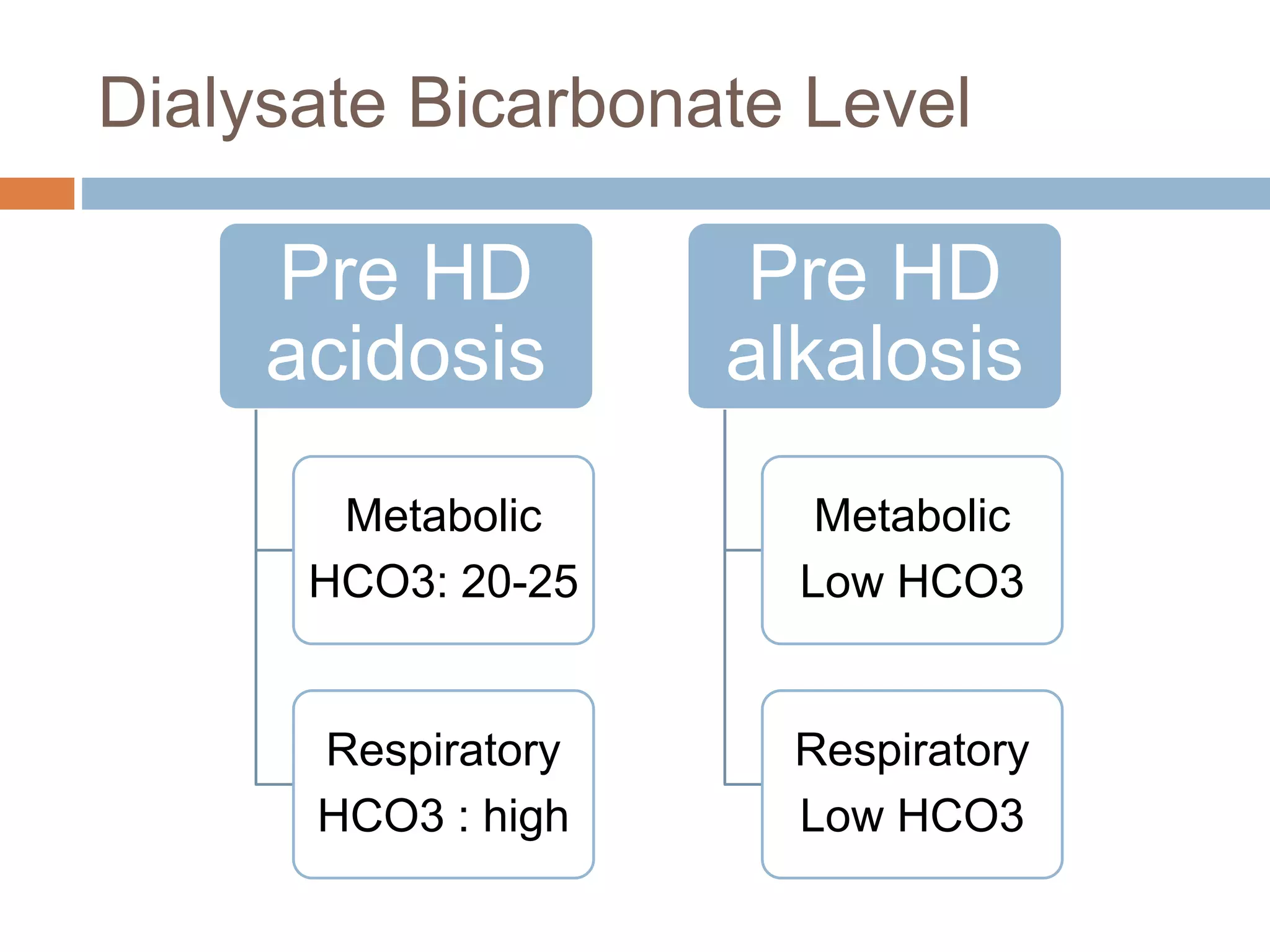
Dialysate Bicarbonate Level
Pre HD
acidosis
Metabolic
HCO3: 20-25
Respiratory
HCO3 : high
Pre HD
alkalosis
Metabolic
Low HCO3
Respiratory
Low HCO3
Dialysis Solution Sodium Level
 Hyponatremia
 Pre HD sodium>130 mmol/l
 Dialysate sodium = 140+ (140- prehd s. Na+)
 Pre HD sodium <130 mmol/l
 Dialysate sodium level 15-20 mmol above plasma
level.
 Hyper-natremia
 Safest approach – 1st dialyze with dialysate sodium
level close (within 2 mmol) to that of plasma.
 Slow administration of slightly hyponatremic fluids.
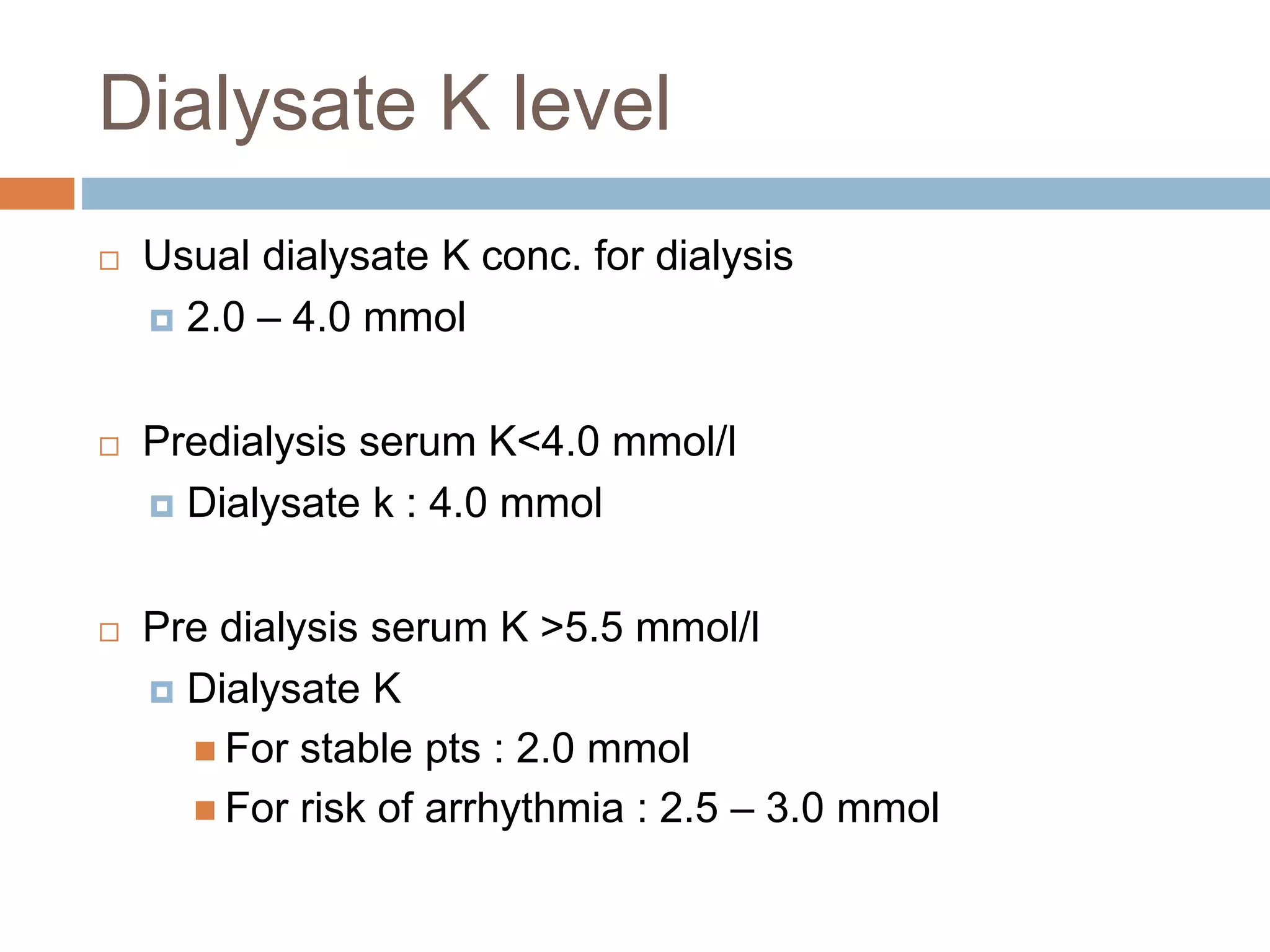
Dialysate K level
 Usual dialysate K conc. for dialysis
 2.0 – 4.0 mmol
 Predialysis serum K<4.0 mmol/l
 Dialysate k : 4.0 mmol
 Pre dialysis serum K >5.5 mmol/l
 Dialysate K
 For stable pts : 2.0 mmol
 For risk of arrhythmia : 2.5 – 3.0 mmol
 Pre dialysis serum K > 7.0 mmol/l
 Dialysate K : <2.0 mmol
 Monitor plasma K hourly
 K rebound
 Increase in serum K is seen withi 1 – 2 hr after HD
 Do not treat post dialysis hypokalemia with K
supplements
Dialysate Calcium Level
 Normal level for HD
 1.25 – 1.75 mmol (3.0 – 3.5 meq/l)
 Dialysis solution Ca<1.5 mmol (3.0 meq/l) in AKI
 Pre dispose to hypotension during HD
 Predialysis hypocalcemia
 Use high dialysis soution calcium
 Dialytic treatment of acute hypercalcemia
 Dialysate calcium : 1.25 to 1.75 mmol (2.5 – 3.5 eq/l)
 Frequent measurement of serum ionised calcium and
physical examination to avoid the complications.
Dialysate Magnesium Levels
 Usual dialysate Mg level :
 0.25 – 0.75 mmol (0.5 to 1.5 meq/l)
 Study for BP control in acute dialysis
 Dialysate Mg – 0.375 mmol (0.75meq/l) is better than
0.75 mmol (1.5 meq/l) (Roy and Danziger,1996).
 Best dialysate Mg for acute dialysis in terms of blood
pressure control is unknown.
Dialysate Dextrose Level
 100 – 200 mg/dl
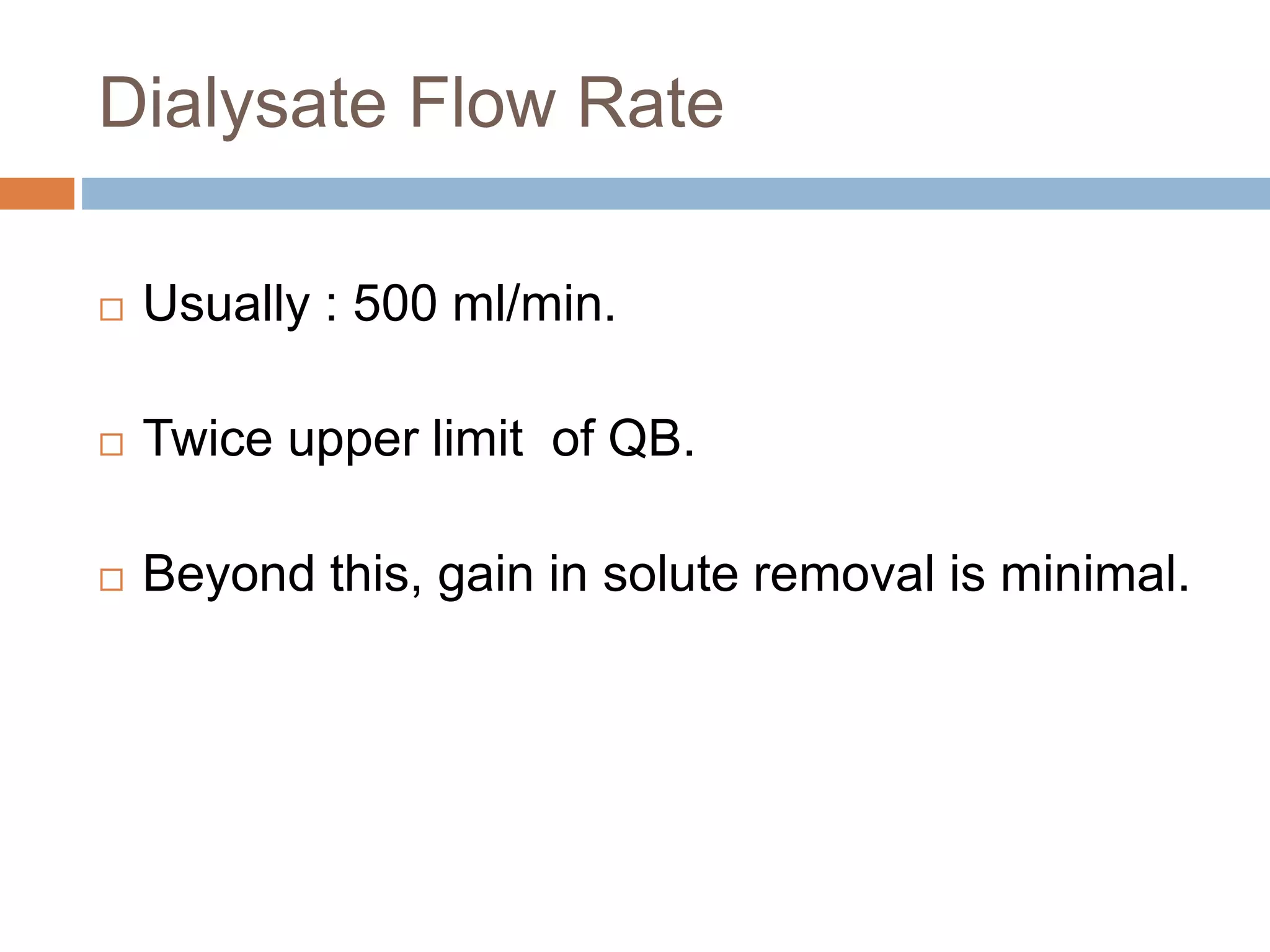
Dialysate Flow Rate
 Usually : 500 ml/min.
 Twice upper limit of QB.
 Beyond this, gain in solute removal is minimal.
Dialysate Temperature
 Usually 35 to 37 degree 0C.
 Lower range should be used in hypotension
prone patients.
UF Orders
 Fluid removal rate of 10 ml/kg/hr is usually well
tolerated by most of the fluid overloaded pts.
Thank You
Chronic Hemodialysis
Prescription
Dialysis prescription

Dialysis prescription

  • 1.
    Presenter – Dr.Prem Mohan Jha Moderator – Dr. Garima Aggarwal Dialysis Prescription
  • 2.
  • 3.
    Elements Of HDPrescription 1. Session Length 2. Blood Flow Rate 3. Dialyzer 4. Dialysate Composition 5. Dialysate Flow Rate 6. Dialysate Temperature 7. Ultrafiltration Orders 8. Anticoagulation
  • 4.
    HD Session Length& Blood Flow Rate  Most important determinant of the amount of dialysis  Initial dialysis session  For initial 1 or 2 sessions, specially when pre-dialysis SUN >125 mg/dl  Both dialysis session length and blood flow rate should be reduced  Target URR <40%  QB – 250 ml/min for adults. 200 ml/min for small pts.  2 hour length sessions.
  • 5.
     To preventDDS, aim for urea clearance of –  30% for 1st treatment (Kt/V= 0.7)  50% for 2nd treatment (Kt/V = 1.0)  70% for 3rd and subsequent treatments (Kt/V = 1.2)  For initial BUN <100 mg/dl, aim for urea clearance of  50% for 1st tt  70% for 2nd and subsequent tt
  • 6.
     2nd hemodialysis Increased to 3 hrs, when pre dialysis sun<100 mg/dl  Length of single dialysis treatment rarely exceeds 6 hours unless dialysis for drug overdose.
  • 7.
     A typical3 – 4 hr acute dialysis session will deliver a spKt/V of only 0.9 with eKt/V of 0.7.  This low level of Kt/V, if given 3/week, is a/w high mortality in chronic stable pts.  Options-  Dialyse sick patients of AKI on daily basis (6/week) with each session length of 3 – 4 hrs.  Mortality is reduced( schiffl- 2002).
  • 8.
     VA/NIH (2008)study compared outcomes in acute pts dialysed either 3 or 6 times per week.  The intensity in 3/week group was substantially higher (Kt/V of 1.3 or more) than in the schiffl artcle.  For this reason the KIGO workgroup on AKI 2012, recommened Kt/V of 1.3 or more for each HD session for acute pts on 3/wk HD.
  • 9.
     We canverify HD adequacy by  URR  Measured by  Blood test  Ionic coductance  UV absorption technology
  • 10.
    Choosing A Dialyzer Membrane material –  Not studied as a separate factor  Ultrafiltration coefficient (Kuf)-  Use dialyzers of high water permeability ( Kuf >6.0).
  • 11.
    Choosing A Dialyzercontd.  Dialyzer urea clearance  For first couple of HD sessions we should avoid using very high efficiency dialyzers.  A dialyzer with a K0A of 500 – 600 ml/min is recommended.  After initial 1 – 2 sessions, particularly when high QB is being used, normal sized dialyzer should be used.
  • 12.
    The Dialysis Solution Bicarbonate = 25 mmol/l  Sodium = 145 mmol/l  Potassium = 3.5 mmol/l  Calcium = 1.5 mmol/l  Magnesium = 0.375 mmol/l  Dextrose = 100 mg/dl  No phosphorus  May be altered as per circumstances.
  • 13.
    Dialysate Bicarbonate Level PreHD acidosis Metabolic HCO3: 20-25 Respiratory HCO3 : high Pre HD alkalosis Metabolic Low HCO3 Respiratory Low HCO3
  • 14.
    Dialysis Solution SodiumLevel  Hyponatremia  Pre HD sodium>130 mmol/l  Dialysate sodium = 140+ (140- prehd s. Na+)  Pre HD sodium <130 mmol/l  Dialysate sodium level 15-20 mmol above plasma level.
  • 15.
     Hyper-natremia  Safestapproach – 1st dialyze with dialysate sodium level close (within 2 mmol) to that of plasma.  Slow administration of slightly hyponatremic fluids.
  • 16.
    Dialysate K level Usual dialysate K conc. for dialysis  2.0 – 4.0 mmol  Predialysis serum K<4.0 mmol/l  Dialysate k : 4.0 mmol  Pre dialysis serum K >5.5 mmol/l  Dialysate K  For stable pts : 2.0 mmol  For risk of arrhythmia : 2.5 – 3.0 mmol
  • 17.
     Pre dialysisserum K > 7.0 mmol/l  Dialysate K : <2.0 mmol  Monitor plasma K hourly  K rebound  Increase in serum K is seen withi 1 – 2 hr after HD  Do not treat post dialysis hypokalemia with K supplements
  • 18.
    Dialysate Calcium Level Normal level for HD  1.25 – 1.75 mmol (3.0 – 3.5 meq/l)  Dialysis solution Ca<1.5 mmol (3.0 meq/l) in AKI  Pre dispose to hypotension during HD  Predialysis hypocalcemia  Use high dialysis soution calcium
  • 19.
     Dialytic treatmentof acute hypercalcemia  Dialysate calcium : 1.25 to 1.75 mmol (2.5 – 3.5 eq/l)  Frequent measurement of serum ionised calcium and physical examination to avoid the complications.
  • 20.
    Dialysate Magnesium Levels Usual dialysate Mg level :  0.25 – 0.75 mmol (0.5 to 1.5 meq/l)  Study for BP control in acute dialysis  Dialysate Mg – 0.375 mmol (0.75meq/l) is better than 0.75 mmol (1.5 meq/l) (Roy and Danziger,1996).  Best dialysate Mg for acute dialysis in terms of blood pressure control is unknown.
  • 21.
  • 22.
    Dialysate Flow Rate Usually : 500 ml/min.  Twice upper limit of QB.  Beyond this, gain in solute removal is minimal.
  • 23.
    Dialysate Temperature  Usually35 to 37 degree 0C.  Lower range should be used in hypotension prone patients.
  • 24.
    UF Orders  Fluidremoval rate of 10 ml/kg/hr is usually well tolerated by most of the fluid overloaded pts.
  • 25.
  • 26.