Dialysis EmergenciesDialysis Emergencies
Dr. Osama El-ShahatDr. Osama El-Shahat
Head of Nephrology Department
New Mansoura General Hospital (international)(international)
ISN Educational Ambassador
ObjectivesObjectives
Indications of Acute Dialysis
Complications of Dialysis
Overview of certain drug overdoses and acute
management
Indications for RRTIndications for RRT
Renal Indications
Life-threatening indications
Hyperkalemia
Metabolic Acidosis
Pulmonary edema
Uremic complications
Non Renal Indications
Fluid removal in congestive heart
failure& Fluid management in
multiorgan failure
Cytokine manipulation in sepsis
Treatment of drug overdose
Nutrition support
HyperkalemiaHyperkalemia
Renal failure is the most common cause of
Hyperkalemia in E.R.
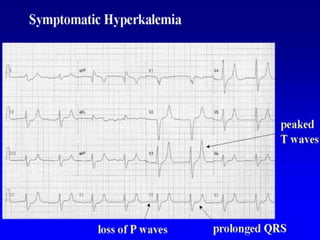
Clinically significant Hyperkalemia occurs in
10–15% of patients requiring hemodialysis
(H.D.).
The rate of rise of serum K in ARF is usually
rapid and RX must be aggressive.
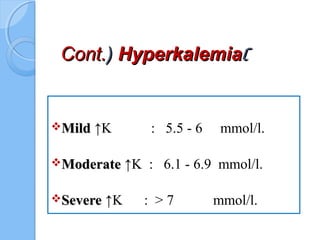
))Cont.Cont.)) HyperkalemiaHyperkalemia
MildMild ↑K : 5.5 - 6 mmol/l.
ModerateModerate ↑K : 6.1 - 6.9 mmol/l.
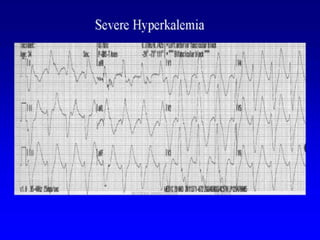
SevereSevere ↑K : > 7 mmol/l.
))ContCont.).) HyperkalemiaHyperkalemia
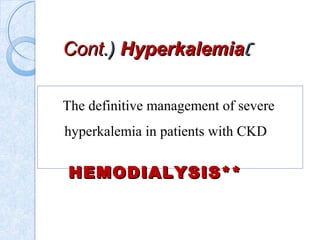
The definitive management of severe
hyperkalemia in patients with CKD
HEMODIALYSIS**HEMODIALYSIS**
))ContCont.).) HyperkalemiaHyperkalemia
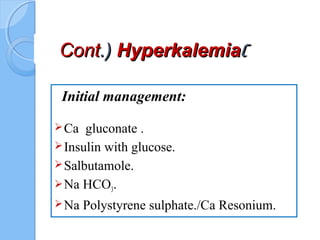
Initial management:
Ca gluconate .
Insulin with glucose.
Salbutamole.
Na HCO3.
Na Polystyrene sulphate./Ca Resonium.
ManagementManagement
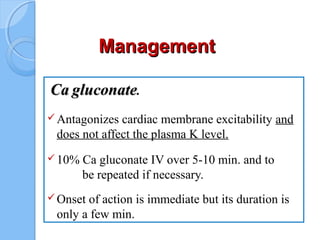
CaCa gluconategluconate.
Antagonizes cardiac membrane excitability and
does not affect the plasma K level.
10% Ca gluconate IV over 5-10 min. and to
be repeated if necessary.
Onset of action is immediate but its duration is
only a few min.
ManagementManagement
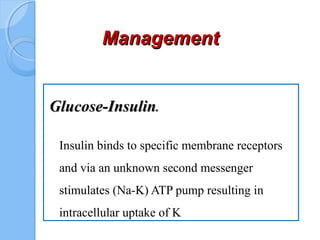
Glucose-InsulinGlucose-Insulin.
Insulin binds to specific membrane receptors
and via an unknown second messenger
stimulates (Na-K) ATP pump resulting in
intracellular uptake of K
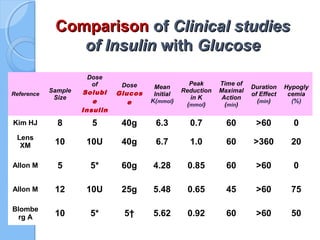
ComparisonComparison ofof Clinical studiesClinical studies
of Insulinof Insulin withwith GlucoseGlucose
Reference
Sample
Size
Dose
of
Solubl
e
Insulin
Dose
Glucos
e
Mean
Initial
K(mmol)
Peak
Reduction
in K
(mmol)
Time of
Maximal
Action
(min)
Duration
of Effect
(min)
Hypogly
cemia
(%)
Kim HJ 8 5 40g 6.3 0.7 60 >60 0
Lens
XM 10 10U 40g 6.7 1.0 60 >360 20
Allon M 5 5* 60g 4.28 0.85 60 >60 0
Allon M 12 10U 25g 5.48 0.65 45 >60 75
Blombe
rg A 10 5* 5† 5.62 0.92 60 >60 50
ManagementManagement ((ContCont((
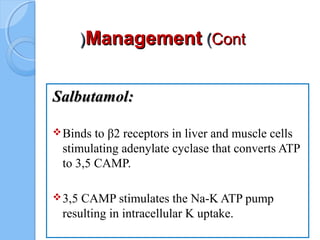
Salbutamol:Salbutamol:
Binds to β2 receptors in liver and muscle cells
stimulating adenylate cyclase that converts ATP
to 3,5 CAMP.
3,5 CAMP stimulates the Na-K ATP pump
resulting in intracellular K uptake.
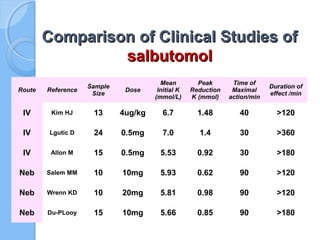
Comparison of Clinical Studies ofComparison of Clinical Studies of
salbutomolsalbutomol
Route Reference
Sample
Size
Dose
Mean
Initial K
(mmol/L)
Peak
Reduction
K (mmol)
Time of
Maximal
action/min
Duration of
effect /min
IV Kim HJ 13 4ug/kg 6.7 1.48 40 >120
IV Lgutic D 24 0.5mg 7.0 1.4 30 >360
IV Allon M 15 0.5mg 5.53 0.92 30 >180
Neb Salem MM 10 10mg 5.93 0.62 90 >120
Neb Wrenn KD 10 20mg 5.81 0.98 90 >120
Neb Du-PLooy 15 10mg 5.66 0.85 90 >180
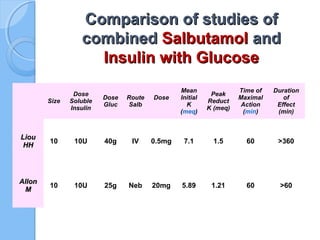
Comparison of studies ofComparison of studies of
combinedcombined SalbutamolSalbutamol andand
Insulin with GlucoseInsulin with Glucose
Size
Dose
Soluble
Insulin
Dose
Gluc
Route
Salb
Dose
Mean
Initial
K
(meq)
Peak
Reduct
K (meq)
Time of
Maximal
Action
(min)
Duration
of
Effect
(min)
LiouLiou
HHHH
10 10U 40g IV 0.5mg 7.1 1.5 60 >360
AllonAllon
MM
10 10U 25g Neb 20mg 5.89 1.21 60 >60
ManagementManagement ((ContCont((
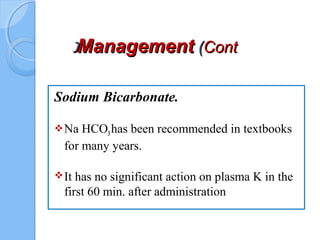
Sodium Bicarbonate.
Na HCO3has been recommended in textbooks
for many years.
It has no significant action on plasma K in the
first 60 min. after administration
ManagementManagement ((ContCont((
Sodium polystyrene sulphonateSodium polystyrene sulphonate
(KayexelateKayexelate)
It may be indicated if HD is delayed (>2-3 Hs).
50 g kayexalate in 100-200 ml of 30% sorbitol
or 10% glucose at 37o
C is given rectally and
left at least 60 min.
The onset of action is slow ( 1-2 hours ).
ManagementManagement ((ContCont((
HemodialysisHemodialysis.
The definitive and most effective measure in
treatment of hyperkalemia.
Indicated in severe hyperkalemia.
K concentrations show a rebound after dialysis
has finished and this rebound may require
several hours to reach a plateau.
Fluid OverloadFluid Overload
 Interventions that are useful in patients with
functioning kidneys also are useful in patients
with ESRD before dialysis can be initiated.
 Patients on CAPD with volume overload are
managed differently.
Serious Complications OfSerious Complications Of HemodialysisHemodialysis..
Central line related complications.
Disequilibrium syndrome.
Dialyzer reaction type A (anaphylactic).
Hemolysis.
Air embolism.
Disequilibrium SyndromeDisequilibrium Syndrome
 During or immediately after dialysis.
 Acute increase in brain water or acute changes in
pH of CSF during dialysis.
 Minor symptoms: nausea, vomiting, dizziness,
headache, blurred vision, restlessness, cramps,
tremors.
 Major symptoms: confusion, psychosis, seizures,
coma.
Disequilibrium SyndromeDisequilibrium Syndrome ((contcont((
Management.
If seizures, obtundation or coma occur
during dialysis.
Stop dialysis.
Protect airway.
Blood work for Gluc, Ca, U&E.
Differential diagnosis?
Disequilibrium SyndromeDisequilibrium Syndrome ((contcont((
Management.
Treat hypoglycemia.
Seizures (valium – phenytoin).
Prevention is better
short dialysis session
small surface area dialyzer
avoid low Na dialysate.
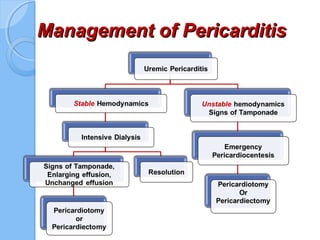
PericarditisPericarditis
Dialysis associated pericarditis
Etiological factorsEtiological factors::
Infections. (bacterial , viral)
Hypercatabolic state
Volume overload
Hyperparathyroidism
Hyperuricemia
Malnutrition
Management of PericarditisManagement of Pericarditis
Drug OverdoseDrug Overdose
Recognition of poisoning and drug
overdose require high index of suspicion
and careful clinical evaluation.
Multiple drugs overdose is common.
Role of DialysisRole of Dialysis
inin
Drug OverdoseDrug Overdose
Peritoneal DialysisPeritoneal Dialysis ((P.DP.D..((
Not very effective in removing drugs from the
blood.
It is 1/8 to 1/4 as effective as hemodialysis.
When HD is difficult to be used quickly as in
small children, P.D. can be used.
HemodialysisHemodialysis
Great for water soluble drugs especially those
of low MW .
(Salicylates, Ethanol, Methanol, & Lithium)
Not very useful in removing lipid soluble drugs
or with drugs with extensive protein binding
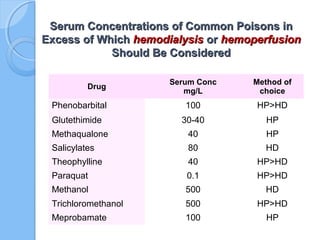
Serum Concentrations of Common Poisons inSerum Concentrations of Common Poisons in
Excess of WhichExcess of Which hemodialysishemodialysis oror hemoperfusionhemoperfusion
Should Be ConsideredShould Be Considered
Drug
Serum Conc
mg/L
Method of
choice
Phenobarbital 100 HP>HD
Glutethimide 30-40 HP
Methaqualone 40 HP
Salicylates 80 HD
Theophylline 40 HP>HD
Paraquat 0.1 HP>HD
Methanol 500 HD
Trichloromethanol 500 HP>HD
Meprobamate 100 HP
ConclusionConclusion
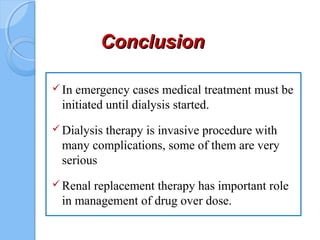
 In emergency cases medical treatment must be
initiated until dialysis started.
 Dialysis therapy is invasive procedure with
many complications, some of them are very
serious
 Renal replacement therapy has important role
in management of drug over dose.
Dialysis emergencies

Dialysis emergencies

  • 1.
    Dialysis EmergenciesDialysis Emergencies Dr.Osama El-ShahatDr. Osama El-Shahat Head of Nephrology Department New Mansoura General Hospital (international)(international) ISN Educational Ambassador
  • 2.
    ObjectivesObjectives Indications of AcuteDialysis Complications of Dialysis Overview of certain drug overdoses and acute management
  • 3.
    Indications for RRTIndicationsfor RRT Renal Indications Life-threatening indications Hyperkalemia Metabolic Acidosis Pulmonary edema Uremic complications Non Renal Indications Fluid removal in congestive heart failure& Fluid management in multiorgan failure Cytokine manipulation in sepsis Treatment of drug overdose Nutrition support
  • 4.
    HyperkalemiaHyperkalemia Renal failure isthe most common cause of Hyperkalemia in E.R. Clinically significant Hyperkalemia occurs in 10–15% of patients requiring hemodialysis (H.D.). The rate of rise of serum K in ARF is usually rapid and RX must be aggressive.
  • 5.
    ))Cont.Cont.)) HyperkalemiaHyperkalemia MildMild ↑K: 5.5 - 6 mmol/l. ModerateModerate ↑K : 6.1 - 6.9 mmol/l. SevereSevere ↑K : > 7 mmol/l.
  • 8.
    ))ContCont.).) HyperkalemiaHyperkalemia The definitivemanagement of severe hyperkalemia in patients with CKD HEMODIALYSIS**HEMODIALYSIS**
  • 9.
    ))ContCont.).) HyperkalemiaHyperkalemia Initial management: Cagluconate . Insulin with glucose. Salbutamole. Na HCO3. Na Polystyrene sulphate./Ca Resonium.
  • 10.
    ManagementManagement CaCa gluconategluconate. Antagonizes cardiacmembrane excitability and does not affect the plasma K level. 10% Ca gluconate IV over 5-10 min. and to be repeated if necessary. Onset of action is immediate but its duration is only a few min.
  • 11.
    ManagementManagement Glucose-InsulinGlucose-Insulin. Insulin binds tospecific membrane receptors and via an unknown second messenger stimulates (Na-K) ATP pump resulting in intracellular uptake of K
  • 12.
    ComparisonComparison ofof ClinicalstudiesClinical studies of Insulinof Insulin withwith GlucoseGlucose Reference Sample Size Dose of Solubl e Insulin Dose Glucos e Mean Initial K(mmol) Peak Reduction in K (mmol) Time of Maximal Action (min) Duration of Effect (min) Hypogly cemia (%) Kim HJ 8 5 40g 6.3 0.7 60 >60 0 Lens XM 10 10U 40g 6.7 1.0 60 >360 20 Allon M 5 5* 60g 4.28 0.85 60 >60 0 Allon M 12 10U 25g 5.48 0.65 45 >60 75 Blombe rg A 10 5* 5† 5.62 0.92 60 >60 50
  • 13.
    ManagementManagement ((ContCont(( Salbutamol:Salbutamol: Binds toβ2 receptors in liver and muscle cells stimulating adenylate cyclase that converts ATP to 3,5 CAMP. 3,5 CAMP stimulates the Na-K ATP pump resulting in intracellular K uptake.
  • 14.
    Comparison of ClinicalStudies ofComparison of Clinical Studies of salbutomolsalbutomol Route Reference Sample Size Dose Mean Initial K (mmol/L) Peak Reduction K (mmol) Time of Maximal action/min Duration of effect /min IV Kim HJ 13 4ug/kg 6.7 1.48 40 >120 IV Lgutic D 24 0.5mg 7.0 1.4 30 >360 IV Allon M 15 0.5mg 5.53 0.92 30 >180 Neb Salem MM 10 10mg 5.93 0.62 90 >120 Neb Wrenn KD 10 20mg 5.81 0.98 90 >120 Neb Du-PLooy 15 10mg 5.66 0.85 90 >180
  • 15.
    Comparison of studiesofComparison of studies of combinedcombined SalbutamolSalbutamol andand Insulin with GlucoseInsulin with Glucose Size Dose Soluble Insulin Dose Gluc Route Salb Dose Mean Initial K (meq) Peak Reduct K (meq) Time of Maximal Action (min) Duration of Effect (min) LiouLiou HHHH 10 10U 40g IV 0.5mg 7.1 1.5 60 >360 AllonAllon MM 10 10U 25g Neb 20mg 5.89 1.21 60 >60
  • 16.
    ManagementManagement ((ContCont(( Sodium Bicarbonate. NaHCO3has been recommended in textbooks for many years. It has no significant action on plasma K in the first 60 min. after administration
  • 17.
    ManagementManagement ((ContCont(( Sodium polystyrenesulphonateSodium polystyrene sulphonate (KayexelateKayexelate) It may be indicated if HD is delayed (>2-3 Hs). 50 g kayexalate in 100-200 ml of 30% sorbitol or 10% glucose at 37o C is given rectally and left at least 60 min. The onset of action is slow ( 1-2 hours ).
  • 18.
    ManagementManagement ((ContCont(( HemodialysisHemodialysis. The definitiveand most effective measure in treatment of hyperkalemia. Indicated in severe hyperkalemia. K concentrations show a rebound after dialysis has finished and this rebound may require several hours to reach a plateau.
  • 19.
    Fluid OverloadFluid Overload Interventions that are useful in patients with functioning kidneys also are useful in patients with ESRD before dialysis can be initiated.  Patients on CAPD with volume overload are managed differently.
  • 20.
    Serious Complications OfSeriousComplications Of HemodialysisHemodialysis.. Central line related complications. Disequilibrium syndrome. Dialyzer reaction type A (anaphylactic). Hemolysis. Air embolism.
  • 21.
    Disequilibrium SyndromeDisequilibrium Syndrome During or immediately after dialysis.  Acute increase in brain water or acute changes in pH of CSF during dialysis.  Minor symptoms: nausea, vomiting, dizziness, headache, blurred vision, restlessness, cramps, tremors.  Major symptoms: confusion, psychosis, seizures, coma.
  • 22.
    Disequilibrium SyndromeDisequilibrium Syndrome((contcont(( Management. If seizures, obtundation or coma occur during dialysis. Stop dialysis. Protect airway. Blood work for Gluc, Ca, U&E. Differential diagnosis?
  • 23.
    Disequilibrium SyndromeDisequilibrium Syndrome((contcont(( Management. Treat hypoglycemia. Seizures (valium – phenytoin). Prevention is better short dialysis session small surface area dialyzer avoid low Na dialysate.
  • 24.
    PericarditisPericarditis Dialysis associated pericarditis EtiologicalfactorsEtiological factors:: Infections. (bacterial , viral) Hypercatabolic state Volume overload Hyperparathyroidism Hyperuricemia Malnutrition
  • 25.
  • 26.
    Drug OverdoseDrug Overdose Recognitionof poisoning and drug overdose require high index of suspicion and careful clinical evaluation. Multiple drugs overdose is common.
  • 27.
    Role of DialysisRoleof Dialysis inin Drug OverdoseDrug Overdose
  • 28.
    Peritoneal DialysisPeritoneal Dialysis((P.DP.D..(( Not very effective in removing drugs from the blood. It is 1/8 to 1/4 as effective as hemodialysis. When HD is difficult to be used quickly as in small children, P.D. can be used.
  • 29.
    HemodialysisHemodialysis Great for watersoluble drugs especially those of low MW . (Salicylates, Ethanol, Methanol, & Lithium) Not very useful in removing lipid soluble drugs or with drugs with extensive protein binding
  • 30.
    Serum Concentrations ofCommon Poisons inSerum Concentrations of Common Poisons in Excess of WhichExcess of Which hemodialysishemodialysis oror hemoperfusionhemoperfusion Should Be ConsideredShould Be Considered Drug Serum Conc mg/L Method of choice Phenobarbital 100 HP>HD Glutethimide 30-40 HP Methaqualone 40 HP Salicylates 80 HD Theophylline 40 HP>HD Paraquat 0.1 HP>HD Methanol 500 HD Trichloromethanol 500 HP>HD Meprobamate 100 HP
  • 31.
    ConclusionConclusion  In emergencycases medical treatment must be initiated until dialysis started.  Dialysis therapy is invasive procedure with many complications, some of them are very serious  Renal replacement therapy has important role in management of drug over dose.