


‫خرد‬ ‫و‬ ‫جان‬ ‫خداوند‬ ‫نام‬ ‫به‬‫کزین‬‫برنگذرد‬ ‫اندیشه‬ ‫برتر‬
‫رهنمای‬ ‫ده‬ ‫روزی‬ ‫خداوند‬ ‫جای‬ ‫خداوند‬ ‫و‬ ‫نام‬ ‫خداوند‬
Renal Replacement
Therapy in critical care unit
Mansoor Masjedi ; MD & FCCM
Ass. professor of anesthesia & critical care
Nemazee hosp. ,General & Central ICU , Azar -93
Learning Objectives
 Definition and nomenclature of RRT
 Principle of CRRT
 Technique of CRRT
 Applications of CRRT
 Results of CRRT
 Complications of CRRT
 Summary
History of Renal Replacement Therapy
 The use of artificial kidneys began during the Korean War,
when it was called “dialysis”, derived from Greek and
meaning “to pass across”.
 Since 50 yrs ago named ,
“Renal Replacement Therapies (RRT)” to describe :
 Hemodialysis
 Peritoneal dialysis
 Continuous hemofiltration
 Continuous hemodialfiltration
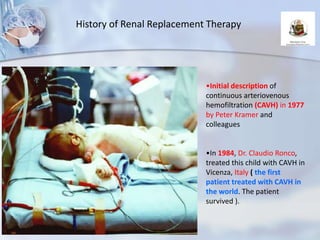
•Initial description of
continuous arteriovenous
hemofiltration (CAVH) in 1977
by Peter Kramer and
colleagues
•In 1984, Dr. Claudio Ronco,
treated this child with CAVH in
Vicenza, Italy ( the first
patient treated with CAVH in
the world. The patient
survived ).
History of Renal Replacement Therapy
Intensivist Nephrologist
Maintain tissue O2 delivery Fluid management
Increased cardiac output
Enhance ventilation Solute control
Maintain blood pressure
Prevent hypermetabolism
Provide adequate nutrition Acid-base balance
Treat primary process Electrolyte balance
* Acute Renal Failure in ICU
Goals for treatment
Indications to Start and Stop
Renal Replacement Therapies
i. Indications for the initiation of RRT
ii. Biochemical or clinical marker that is
achieved by the therapy
iii. Techniques and timing of weaning
patients from RRT
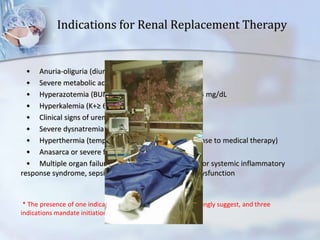
Indications for Renal Replacement Therapy
• Anuria-oliguria (diuresis ≤ 200 mL in 12 hr)
• Severe metabolic acidosis (pH < 7.10)
• Hyperazotemia (BUN ≥ 80 mg/dL) or creatinine > 4 mg/dL
• Hyperkalemia (K+≥ 6.5 mEq/L)
• Clinical signs of uremic toxicity
• Severe dysnatremia (Na+≤ 115 or ≥ 160 mEq/L)
• Hyperthermia (temperature > 40°C without response to medical therapy)
• Anasarca or severe fluid overload
• Multiple organ failure with renal dysfunction and/or systemic inflammatory
response syndrome, sepsis, or septic shock with renal dysfunction
* The presence of one indication suggests, two indications strongly suggest, and three
indications mandate initiation of renal replacement therapy.
Techniques and Modalities
So, I’ve decided to dialyse the pt,
what modes are available to me?
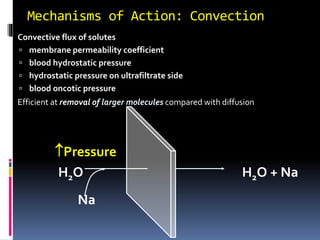
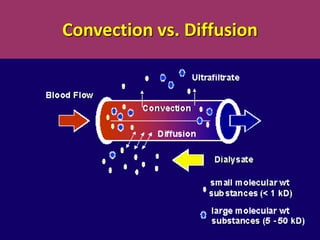
Mechanisms of Action: Convection
 Convective flux of solutes
 membrane permeability coefficient
 blood hydrostatic pressure
 hydrostatic pressure on ultrafiltrate side
 blood oncotic pressure
 Efficient at removal of larger molecules compared with diffusion
Pressure
Na
H2O H2O + Na
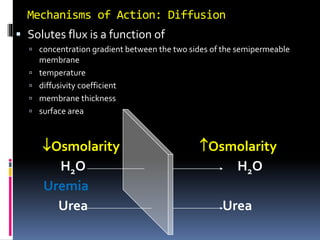
Mechanisms of Action: Diffusion
 Solutes flux is a function of
 concentration gradient between the two sides of the semipermeable
membrane
 temperature
 diffusivity coefficient
 membrane thickness
 surface area
Osmolarity
H2O H2O
Osmolarity
Urea Urea
Uremia
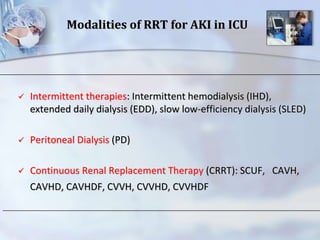
Modalities of RRT for AKI in ICU
 Intermittent therapies: Intermittent hemodialysis (IHD),
extended daily dialysis (EDD), slow low-efficiency dialysis (SLED)
 Peritoneal Dialysis (PD)
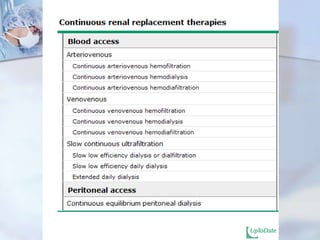
 Continuous Renal Replacement Therapy (CRRT): SCUF, CAVH,
CAVHD, CAVHDF, CVVH, CVVHD, CVVHDF
Continuous v/s Intermittent RRT
 Hemodynamic stability
 Superior management of volume
overload and nutritional
requirements
 Clearance of inflammatory
mediators (septic patients,
particularly convective modes of
continuous therapy )
 In acute brain injury or fulminant
hepatic failure, continuous
therapy may be associated with
better preservation of cerebral
perfusion
 Removes much more water and
solute per hour
 Does not require continuous
anticoagulation
 Does not require complete
patient immobilization
Definition of CRRT
 CRRT represents a family of modalities
that provide continuous support for
severely ill patients with AKI.
 These include continuous hemofiltration,
hemodialysis, and hemodiafiltration,
which involve both convective and
diffusive therapies.
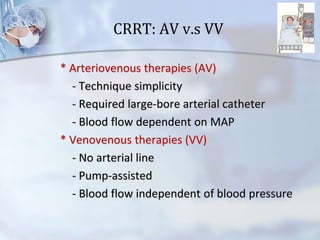
CRRT: AV v.s VV
* Arteriovenous therapies (AV)
- Technique simplicity
- Required large-bore arterial catheter
- Blood flow dependent on MAP
* Venovenous therapies (VV)
- No arterial line
- Pump-assisted
- Blood flow independent of blood pressure
Vascular access
 Circuit failure is more often due to inadequacy of the vascular
access than to insufficient anticoagulation
 Cannulation of the right internal jugular vein, with the tip of
the catheter reaching the right atrium, is associated with
circuit blood flow rates of up to 300 mL/min
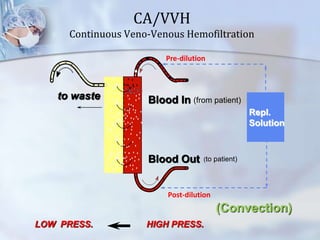
Blood In
Blood Out
to waste (from patient)
(to patient)
HIGH PRESS.LOW PRESS.
Repl.
Solution
CA/VVH
Continuous Veno-Venous Hemofiltration
(Convection)
Post-dilution
Pre-dilution
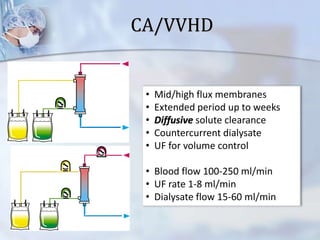
CA/VVHD
• Mid/high flux membranes
• Extended period up to weeks
• Diffusive solute clearance
• Countercurrent dialysate
• UF for volume control
• Blood flow 100-250 ml/min
• UF rate 1-8 ml/min
• Dialysate flow 15-60 ml/min
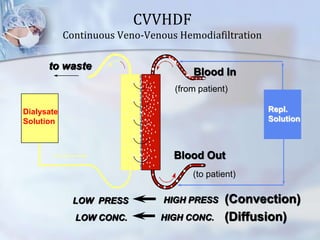
Repl.
Solution
Dialysate
Solution
Blood In
Blood Out
to waste
(from patient)
(to patient)
HIGH PRESSLOW PRESS
HIGH CONC.LOW CONC.
CVVHDF
Continuous Veno-Venous Hemodiafiltration
(Diffusion)
(Convection)
Anticoagulation
 Circuit Set-up Optimization
 Unfractioned Heparin
 Low-Molecular-Weight Heparins
 Prostacyclin (PGI2)
 Citrate
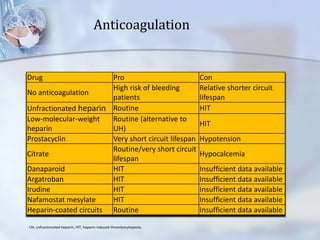
Anticoagulation
Drug Pro Con
No anticoagulation
High risk of bleeding
patients
Relative shorter circuit
lifespan
Unfractionated heparin Routine HIT
Low-molecular-weight
heparin
Routine (alternative to
UH)
HIT
Prostacyclin Very short circuit lifespan Hypotension
Citrate
Routine/very short circuit
lifespan
Hypocalcemia
Danaparoid HIT Insufficient data available
Argatroban HIT Insufficient data available
Irudine HIT Insufficient data available
Nafamostat mesylate HIT Insufficient data available
Heparin-coated circuits Routine Insufficient data available
UH, unfractionated heparin; HIT, heparin-induced thrombocytopenia.
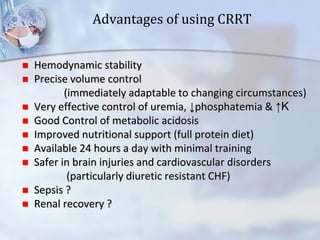
Advantages of using CRRT
 Hemodynamic stability
 Precise volume control
(immediately adaptable to changing circumstances)
 Very effective control of uremia, ↓phosphatemia & ↑K
 Good Control of metabolic acidosis
 Improved nutritional support (full protein diet)
 Available 24 hours a day with minimal training
 Safer in brain injuries and cardiovascular disorders
(particularly diuretic resistant CHF)
 Sepsis ?
 Renal recovery ?
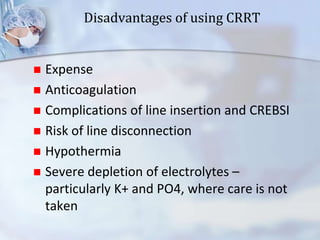
Disadvantages of using CRRT
 Expense
 Anticoagulation
 Complications of line insertion and CREBSI
 Risk of line disconnection
 Hypothermia
 Severe depletion of electrolytes –
particularly K+ and PO4, where care is not
taken
RRTs in Different Clinical Conditions
 Sepsis and Multiple Organ Dysfunction Syndrome
 Ultrafiltration During Cardiopulmonary Bypass
 Congestive Heart Failure
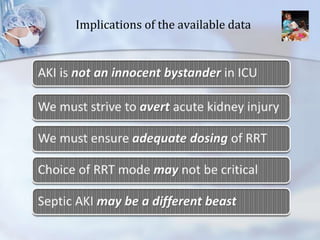
Implications of the available data
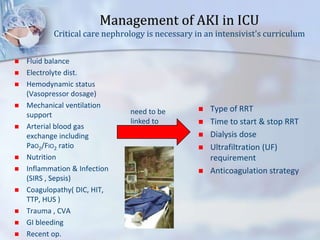
Management of AKI in ICU
Critical care nephrology is necessary in an intensivist's curriculum
 Fluid balance
 Electrolyte dist.
 Hemodynamic status
(Vasopressor dosage)
 Mechanical ventilation
support
 Arterial blood gas
exchange including
PaO2/FIO2 ratio
 Nutrition
 Inflammation & Infection
(SIRS , Sepsis)
 Coagulopathy( DIC, HIT,
TTP, HUS )
 Trauma , CVA
 GI bleeding
 Recent op.
 Type of RRT
 Time to start & stop RRT
 Dialysis dose
 Ultrafiltration (UF)
requirement
 Anticoagulation strategy
need to be
linked to
Convection vs. Diffusion
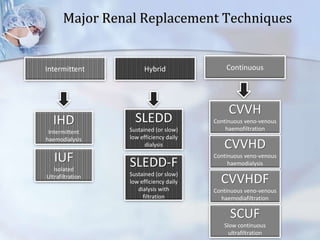
Major Renal Replacement Techniques
Intermittent ContinuousHybrid
IHD
Intermittent
haemodialysis
IUF
Isolated
Ultrafiltration
SLEDD
Sustained (or slow)
low efficiency daily
dialysis
SLEDD-F
Sustained (or slow)
low efficiency daily
dialysis with
filtration
CVVH
Continuous veno-venous
haemofiltration
CVVHD
Continuous veno-venous
haemodialysis
CVVHDF
Continuous veno-venous
haemodiafiltration
SCUF
Slow continuous
ultrafiltration
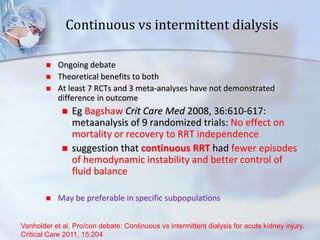
Continuous vs intermittent dialysis
 Ongoing debate
 Theoretical benefits to both
 At least 7 RCTs and 3 meta-analyses have not demonstrated
difference in outcome
 Eg Bagshaw Crit Care Med 2008, 36:610-617:
metaanalysis of 9 randomized trials: No effect on
mortality or recovery to RRT independence
 suggestion that continuous RRT had fewer episodes
of hemodynamic instability and better control of
fluid balance
 May be preferable in specific subpopulations
Vanholder et al. Pro/con debate: Continuous vs intermittent dialysis for acute kidney injury.
Critical Care 2011, 15:204
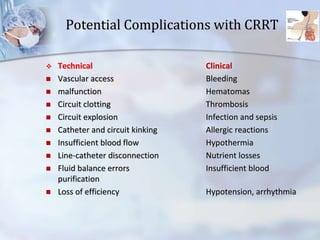
Potential Complications with CRRT
 Technical Clinical
 Vascular access Bleeding
 malfunction Hematomas
 Circuit clotting Thrombosis
 Circuit explosion Infection and sepsis
 Catheter and circuit kinking Allergic reactions
 Insufficient blood flow Hypothermia
 Line-catheter disconnection Nutrient losses
 Fluid balance errors Insufficient blood
purification
 Loss of efficiency Hypotension, arrhythmia
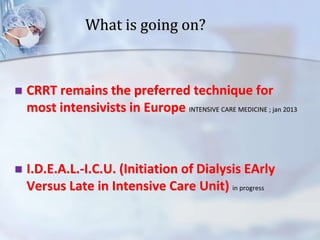
What is going on?
 CRRT remains the preferred technique for
most intensivists in Europe INTENSIVE CARE MEDICINE ; jan 2013
 I.D.E.A.L.-I.C.U. (Initiation of Dialysis EArly
Versus Late in Intensive Care Unit) in progress
Any ?
THANKS FOR YOUR ATTENTION & HAVE A NICE TIME

CRRT for ICU nurses

  • 1.
    ‫خرد‬ ‫و‬ ‫جان‬‫خداوند‬ ‫نام‬ ‫به‬‫کزین‬‫برنگذرد‬ ‫اندیشه‬ ‫برتر‬ ‫رهنمای‬ ‫ده‬ ‫روزی‬ ‫خداوند‬ ‫جای‬ ‫خداوند‬ ‫و‬ ‫نام‬ ‫خداوند‬
  • 2.
    Renal Replacement Therapy incritical care unit Mansoor Masjedi ; MD & FCCM Ass. professor of anesthesia & critical care Nemazee hosp. ,General & Central ICU , Azar -93
  • 3.
    Learning Objectives  Definitionand nomenclature of RRT  Principle of CRRT  Technique of CRRT  Applications of CRRT  Results of CRRT  Complications of CRRT  Summary
  • 4.
    History of RenalReplacement Therapy  The use of artificial kidneys began during the Korean War, when it was called “dialysis”, derived from Greek and meaning “to pass across”.  Since 50 yrs ago named , “Renal Replacement Therapies (RRT)” to describe :  Hemodialysis  Peritoneal dialysis  Continuous hemofiltration  Continuous hemodialfiltration
  • 5.
    •Initial description of continuousarteriovenous hemofiltration (CAVH) in 1977 by Peter Kramer and colleagues •In 1984, Dr. Claudio Ronco, treated this child with CAVH in Vicenza, Italy ( the first patient treated with CAVH in the world. The patient survived ). History of Renal Replacement Therapy
  • 6.
    Intensivist Nephrologist Maintain tissueO2 delivery Fluid management Increased cardiac output Enhance ventilation Solute control Maintain blood pressure Prevent hypermetabolism Provide adequate nutrition Acid-base balance Treat primary process Electrolyte balance * Acute Renal Failure in ICU Goals for treatment
  • 7.
    Indications to Startand Stop Renal Replacement Therapies i. Indications for the initiation of RRT ii. Biochemical or clinical marker that is achieved by the therapy iii. Techniques and timing of weaning patients from RRT
  • 8.
    Indications for RenalReplacement Therapy • Anuria-oliguria (diuresis ≤ 200 mL in 12 hr) • Severe metabolic acidosis (pH < 7.10) • Hyperazotemia (BUN ≥ 80 mg/dL) or creatinine > 4 mg/dL • Hyperkalemia (K+≥ 6.5 mEq/L) • Clinical signs of uremic toxicity • Severe dysnatremia (Na+≤ 115 or ≥ 160 mEq/L) • Hyperthermia (temperature > 40°C without response to medical therapy) • Anasarca or severe fluid overload • Multiple organ failure with renal dysfunction and/or systemic inflammatory response syndrome, sepsis, or septic shock with renal dysfunction * The presence of one indication suggests, two indications strongly suggest, and three indications mandate initiation of renal replacement therapy.
  • 9.
    Techniques and Modalities So,I’ve decided to dialyse the pt, what modes are available to me?
  • 10.
    Mechanisms of Action:Convection  Convective flux of solutes  membrane permeability coefficient  blood hydrostatic pressure  hydrostatic pressure on ultrafiltrate side  blood oncotic pressure  Efficient at removal of larger molecules compared with diffusion Pressure Na H2O H2O + Na
  • 11.
    Mechanisms of Action:Diffusion  Solutes flux is a function of  concentration gradient between the two sides of the semipermeable membrane  temperature  diffusivity coefficient  membrane thickness  surface area Osmolarity H2O H2O Osmolarity Urea Urea Uremia
  • 12.
    Modalities of RRTfor AKI in ICU  Intermittent therapies: Intermittent hemodialysis (IHD), extended daily dialysis (EDD), slow low-efficiency dialysis (SLED)  Peritoneal Dialysis (PD)  Continuous Renal Replacement Therapy (CRRT): SCUF, CAVH, CAVHD, CAVHDF, CVVH, CVVHD, CVVHDF
  • 13.
    Continuous v/s IntermittentRRT  Hemodynamic stability  Superior management of volume overload and nutritional requirements  Clearance of inflammatory mediators (septic patients, particularly convective modes of continuous therapy )  In acute brain injury or fulminant hepatic failure, continuous therapy may be associated with better preservation of cerebral perfusion  Removes much more water and solute per hour  Does not require continuous anticoagulation  Does not require complete patient immobilization
  • 14.
    Definition of CRRT CRRT represents a family of modalities that provide continuous support for severely ill patients with AKI.  These include continuous hemofiltration, hemodialysis, and hemodiafiltration, which involve both convective and diffusive therapies.
  • 15.
    CRRT: AV v.sVV * Arteriovenous therapies (AV) - Technique simplicity - Required large-bore arterial catheter - Blood flow dependent on MAP * Venovenous therapies (VV) - No arterial line - Pump-assisted - Blood flow independent of blood pressure
  • 16.
    Vascular access  Circuitfailure is more often due to inadequacy of the vascular access than to insufficient anticoagulation  Cannulation of the right internal jugular vein, with the tip of the catheter reaching the right atrium, is associated with circuit blood flow rates of up to 300 mL/min
  • 18.
    Blood In Blood Out towaste (from patient) (to patient) HIGH PRESS.LOW PRESS. Repl. Solution CA/VVH Continuous Veno-Venous Hemofiltration (Convection) Post-dilution Pre-dilution
  • 19.
    CA/VVHD • Mid/high fluxmembranes • Extended period up to weeks • Diffusive solute clearance • Countercurrent dialysate • UF for volume control • Blood flow 100-250 ml/min • UF rate 1-8 ml/min • Dialysate flow 15-60 ml/min
  • 20.
    Repl. Solution Dialysate Solution Blood In Blood Out towaste (from patient) (to patient) HIGH PRESSLOW PRESS HIGH CONC.LOW CONC. CVVHDF Continuous Veno-Venous Hemodiafiltration (Diffusion) (Convection)
  • 21.
    Anticoagulation  Circuit Set-upOptimization  Unfractioned Heparin  Low-Molecular-Weight Heparins  Prostacyclin (PGI2)  Citrate
  • 22.
    Anticoagulation Drug Pro Con Noanticoagulation High risk of bleeding patients Relative shorter circuit lifespan Unfractionated heparin Routine HIT Low-molecular-weight heparin Routine (alternative to UH) HIT Prostacyclin Very short circuit lifespan Hypotension Citrate Routine/very short circuit lifespan Hypocalcemia Danaparoid HIT Insufficient data available Argatroban HIT Insufficient data available Irudine HIT Insufficient data available Nafamostat mesylate HIT Insufficient data available Heparin-coated circuits Routine Insufficient data available UH, unfractionated heparin; HIT, heparin-induced thrombocytopenia.
  • 23.
    Advantages of usingCRRT  Hemodynamic stability  Precise volume control (immediately adaptable to changing circumstances)  Very effective control of uremia, ↓phosphatemia & ↑K  Good Control of metabolic acidosis  Improved nutritional support (full protein diet)  Available 24 hours a day with minimal training  Safer in brain injuries and cardiovascular disorders (particularly diuretic resistant CHF)  Sepsis ?  Renal recovery ?
  • 24.
    Disadvantages of usingCRRT  Expense  Anticoagulation  Complications of line insertion and CREBSI  Risk of line disconnection  Hypothermia  Severe depletion of electrolytes – particularly K+ and PO4, where care is not taken
  • 25.
    RRTs in DifferentClinical Conditions  Sepsis and Multiple Organ Dysfunction Syndrome  Ultrafiltration During Cardiopulmonary Bypass  Congestive Heart Failure
  • 27.
    Implications of theavailable data
  • 28.
    Management of AKIin ICU Critical care nephrology is necessary in an intensivist's curriculum  Fluid balance  Electrolyte dist.  Hemodynamic status (Vasopressor dosage)  Mechanical ventilation support  Arterial blood gas exchange including PaO2/FIO2 ratio  Nutrition  Inflammation & Infection (SIRS , Sepsis)  Coagulopathy( DIC, HIT, TTP, HUS )  Trauma , CVA  GI bleeding  Recent op.  Type of RRT  Time to start & stop RRT  Dialysis dose  Ultrafiltration (UF) requirement  Anticoagulation strategy need to be linked to
  • 29.
  • 30.
    Major Renal ReplacementTechniques Intermittent ContinuousHybrid IHD Intermittent haemodialysis IUF Isolated Ultrafiltration SLEDD Sustained (or slow) low efficiency daily dialysis SLEDD-F Sustained (or slow) low efficiency daily dialysis with filtration CVVH Continuous veno-venous haemofiltration CVVHD Continuous veno-venous haemodialysis CVVHDF Continuous veno-venous haemodiafiltration SCUF Slow continuous ultrafiltration
  • 31.
    Continuous vs intermittentdialysis  Ongoing debate  Theoretical benefits to both  At least 7 RCTs and 3 meta-analyses have not demonstrated difference in outcome  Eg Bagshaw Crit Care Med 2008, 36:610-617: metaanalysis of 9 randomized trials: No effect on mortality or recovery to RRT independence  suggestion that continuous RRT had fewer episodes of hemodynamic instability and better control of fluid balance  May be preferable in specific subpopulations Vanholder et al. Pro/con debate: Continuous vs intermittent dialysis for acute kidney injury. Critical Care 2011, 15:204
  • 32.
    Potential Complications withCRRT  Technical Clinical  Vascular access Bleeding  malfunction Hematomas  Circuit clotting Thrombosis  Circuit explosion Infection and sepsis  Catheter and circuit kinking Allergic reactions  Insufficient blood flow Hypothermia  Line-catheter disconnection Nutrient losses  Fluid balance errors Insufficient blood purification  Loss of efficiency Hypotension, arrhythmia
  • 33.
    What is goingon?  CRRT remains the preferred technique for most intensivists in Europe INTENSIVE CARE MEDICINE ; jan 2013  I.D.E.A.L.-I.C.U. (Initiation of Dialysis EArly Versus Late in Intensive Care Unit) in progress
  • 34.
  • 35.
    THANKS FOR YOURATTENTION & HAVE A NICE TIME