

SEMINAR
ON
CONTINOUS RENAL
REPLACEMENT THERAPY
CRRT
Presented by
Ms JINUMOL
M.sc second year
NUINS
INTRODUCTION
Continuous renal replacement therapy ( CRRT) is a slow and
continuous extracorpeal blood purification therapy .CRRT mimics the
functions of kidney in regulating water, electrolytes and toxic
products by the continuous slow removal of solutes and fluids. CRRT
is indicated in patients who meet criteria for hemodialysis therapy
but cannot tolerate the hemodialysis due to hemodynamic instability.
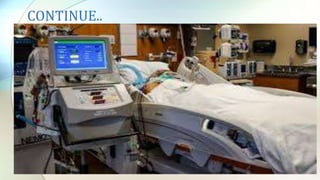
CONTINUE..
DEFINITION
CRRT is a method for treating renal failure, it provide means by which
uremic toxins and fluids are removed, while acid- base status and
electrolytes are adjusted slowly and continuously in hemodynamically
unstable patients.
PRINCIPLES
• CONVECTION
• ULTRAFILTRATION
• DIFFUSION
INDICATIONS
• OLIGURIA
• ANURIA
• UREAMIC NEUROPATHY
• UREAMIC ENCEPHALOPATHY
• UREMIC PERICARDITIS
• HEMODYNAMIC INSTABILITY
• EASY TO REGULATE FLUID VOLUME
FEATURES OF CRRT
It is continuous
Solute removal can occur by convection ( no dialysate required) in
addition to osmosis.
It causes less hemodynamic instability. E.g. hypotension
It doesn’t require constant monitoring by a specialized Hemodialysis
nurse. Even ICU nurses can monitor the patient.
CONTINUE…
It doesn't require complicated H.D equipment, but a blood pump is needed
for venovenous therapies.
Vascular access for CRRT is achieved the use of double lumen catheter, placed
in the femoral or jugular vein.
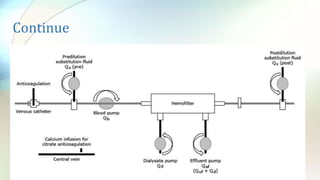
A blood pump propels the blood through the circuit
A highly preamble hollow fiber, hemofilter removes the plasma water and
non protein solutes which are collectively termed as ultrafilterate.
The ultrafiltration rate ( UFR ) may ranges from 0 – 500 ml/hour.
VASCULAR ACESS
CRRT require reliable vascular access capable of delivering blood flow
of at least 200 to 250ml/mt.
The standard is a double lumen tunnelled or non tunnelled dialysis
catheter.
Access site is right internal jugular vein , although femoral vein is also
used if necessary.
Subclavian catheter should be avoided if possible ( due to the risk of
subclavian vein stenosis)
DIALYSATE FLUIDS
• The major 2 important fluids used in CRRT are Lactate based solution
and Bicarbonate fluids.
• These solutions are prepared and packaged in CRRT mode and typically
stored in 5 L bags which are hung below the machine.
• Dialysate fluids are designed to mimic normal blood chemistry , so as
to encourage the correction amount of diffusion in the system.
PROCESS OF CRRT
Double lumen catheter placed over the jugular vein or femoral vein
is considered as vascular access for CRRT.
Blood pump propels the blood through the circuit.
A highly Preamble hollow fiber hemofilter removes the plasma,
water and non-protein solutes which are collectively called as
ultrafiltrate.
Continue..
Under the influence of hydrostatic & osmotic pressure ,water and
nonprotein solutes passes out of filter into the extra capillary space and
drains through the ultrafiltrate port into a collection bag (Drainage Bag)
The remaining fluids continues through the filter and return to the
patient via the return port of double lumen catheter.
As ultrafiltrate drains out of the hemofilter, fluid and electrolyte
replacements can be infused through a port located before or after the
filter, as the blood returns to the patient.
Continue..
Replacement fluid is designed to replace solutes such as sodium,
chloride, bicarbonate and glucose.
The infusion rate of replacement fluid is determined by the degree
of fluid and electrolyte imbalance.
Continue
Types
1. Slow continuous ultrafiltration ( SCUF)
2. Continuous venovenus hemofiltration (CVVH)
3. Continuous venovenus Hemodialysis
4. Continuous venovenus hemodiafilteration
Slow continuous ultrafiltration ( SCUF)
• This mode of CRRT uses the principle of ultrafiltration purely to remove
excess fluid from the body and therefore is used to safely treat the
fluid over load.
• The fluid removed are generally not replaced.
• It works by pumping the patient blood through a filter which seprates
the fluid and molecules according to the size of filter pores.
Continuous venovenus hemofiltration (CVVH)
• Uses the principle of ultrafiltration
• Filter used in CVVH is differ from SCUF, The size of pores in the filter is
increased thus allowing further molecules to pass into the ultrafilterate.
• The fluid that is filtered from the blood is replaced by a suitable fluid with
chemistry similar to normal blood, which is applied in either pre or post
dilution
Continue…
• Replacement fluid is infused into the infusion port,(Pre-dilution
pump) before hemofilter allow for the greater clearance of urea and
can decrease filter clotting.
• The use of infusion port located after , the filter ( post dilution pump)
dilutes intravascular fluids, decreasing the concentration of unwanted
solutes such as BUN, creatine and potassium.
Continue…
• Anticoagulants are needed to prevent blood clotting and may be
infused as bolus at the starting of CRRT or through an infusion
port(pre-dilution pump) before the hemofilter.
Continuous venovenus Hemodialysis
• This modes of CRRT uses the principle of molecules across
semiperamble membrane, along the concentration gradient.
• A dialysate with similar chemistry to normal blood flow is pumped
counter current to the blood through the filter
• Any molecules that are in greater in the blood are drawn across into
dialysate
• In this mode replacement fluids are not administered
Continuous venovenus hemodiafilteration
• This mode of CRRT is able to combine ultrafiltration, convection and
diffusion to enable the ultimate removal and replacement of solutes
within the blood.
• Ultrafiltration and convection also help with fluid and solute removal
with fluid being either partially or fully replaced.
Continue..
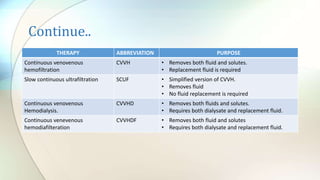
THERAPY ABBREVIATION PURPOSE
Continuous venovenous
hemofiltration
CVVH • Removes both fluid and solutes.
• Replacement fluid is required
Slow continuous ultrafiltration SCUF • Simplified version of CVVH.
• Removes fluid
• No fluid replacement is required
Continuous venovenous
Hemodialysis.
CVVHD • Removes both fluids and solutes.
• Requires both dialysate and replacement fluid.
Continuous venevenous
hemodiafilteration
CVVHDF • Removes both fluid and solutes
• Requires both dialysate and replacement fluid.
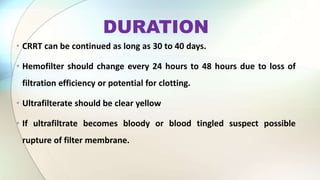
DURATION
• CRRT can be continued as long as 30 to 40 days.
• Hemofilter should change every 24 hours to 48 hours due to loss of
filtration efficiency or potential for clotting.
• Ultrafilterate should be clear yellow
• If ultrafiltrate becomes bloody or blood tingled suspect possible
rupture of filter membrane.
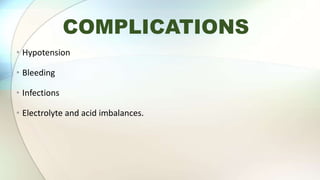
COMPLICATIONS
• Hypotension
• Bleeding
• Infections
• Electrolyte and acid imbalances.
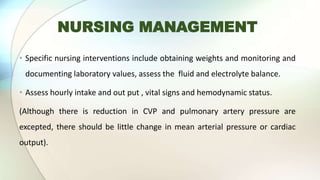
NURSING MANAGEMENT
• Specific nursing interventions include obtaining weights and monitoring and
documenting laboratory values, assess the fluid and electrolyte balance.
• Assess hourly intake and out put , vital signs and hemodynamic status.
(Although there is reduction in CVP and pulmonary artery pressure are
excepted, there should be little change in mean arterial pressure or cardiac
output).
Continue..
• Assess and maintain the patency of CRRT. If the problem is
resolved. This to withdraw the treatment should be taken.
• CRRT is discontinued and needles are removed.
CONCLUSION
CRRT is an effective alternative renal replacement therapy for the
removal of wastes, excess plasma, water in critically ill patients
especially those who are hypotensive and can’t tolerate the rapid
and electrolyte shift of Hemodialysis. It provide continuous control
of fluid status, maintain hemodynamic stability, provide protein
rich nutrition while achieving uremic control , maintain electrolyte
balances .
SUMMARY
• Definition
• Features
• Indications
• Vascular accesses.
• Types
• Nursing Management.
Research study
• Study of Continuous Renal Replacement Therapy and Acute
Peritoneal Dialysis in Hemodynamic Unstable Patients
• RESULTS
This study showing comparable survival outcome in acute PD and
CRRT gives evidence that either of the modalities can be adopted
in hemodynamically unstable patients requiring RRT depending on
the resources available.
BIBLIOGRAPHY
• Ignatavicius “ Textbook of Medical – Surgical nursing “ Elsevier’s
Publications, New york , 7th Edition.
• https://www.freseniusmedicalcare.asia/en/healthcare-
professionals/acute.../crrt-set-ups/
• https://www.uptodate.com/contents/continuous-renal-
replacement-therapy-in-acute-kidney-injury
• www.asahikasei.co.jp/medical/en/apheresis/product/crrt/about
/

Seminar on CRRT

  • 1.
  • 2.
    INTRODUCTION Continuous renal replacementtherapy ( CRRT) is a slow and continuous extracorpeal blood purification therapy .CRRT mimics the functions of kidney in regulating water, electrolytes and toxic products by the continuous slow removal of solutes and fluids. CRRT is indicated in patients who meet criteria for hemodialysis therapy but cannot tolerate the hemodialysis due to hemodynamic instability.
  • 3.
  • 4.
    DEFINITION CRRT is amethod for treating renal failure, it provide means by which uremic toxins and fluids are removed, while acid- base status and electrolytes are adjusted slowly and continuously in hemodynamically unstable patients.
  • 5.
  • 6.
    INDICATIONS • OLIGURIA • ANURIA •UREAMIC NEUROPATHY • UREAMIC ENCEPHALOPATHY • UREMIC PERICARDITIS • HEMODYNAMIC INSTABILITY • EASY TO REGULATE FLUID VOLUME
  • 7.
    FEATURES OF CRRT Itis continuous Solute removal can occur by convection ( no dialysate required) in addition to osmosis. It causes less hemodynamic instability. E.g. hypotension It doesn’t require constant monitoring by a specialized Hemodialysis nurse. Even ICU nurses can monitor the patient.
  • 8.
    CONTINUE… It doesn't requirecomplicated H.D equipment, but a blood pump is needed for venovenous therapies. Vascular access for CRRT is achieved the use of double lumen catheter, placed in the femoral or jugular vein. A blood pump propels the blood through the circuit A highly preamble hollow fiber, hemofilter removes the plasma water and non protein solutes which are collectively termed as ultrafilterate. The ultrafiltration rate ( UFR ) may ranges from 0 – 500 ml/hour.
  • 9.
    VASCULAR ACESS CRRT requirereliable vascular access capable of delivering blood flow of at least 200 to 250ml/mt. The standard is a double lumen tunnelled or non tunnelled dialysis catheter. Access site is right internal jugular vein , although femoral vein is also used if necessary. Subclavian catheter should be avoided if possible ( due to the risk of subclavian vein stenosis)
  • 10.
    DIALYSATE FLUIDS • Themajor 2 important fluids used in CRRT are Lactate based solution and Bicarbonate fluids. • These solutions are prepared and packaged in CRRT mode and typically stored in 5 L bags which are hung below the machine. • Dialysate fluids are designed to mimic normal blood chemistry , so as to encourage the correction amount of diffusion in the system.
  • 11.
    PROCESS OF CRRT Doublelumen catheter placed over the jugular vein or femoral vein is considered as vascular access for CRRT. Blood pump propels the blood through the circuit. A highly Preamble hollow fiber hemofilter removes the plasma, water and non-protein solutes which are collectively called as ultrafiltrate.
  • 12.
    Continue.. Under the influenceof hydrostatic & osmotic pressure ,water and nonprotein solutes passes out of filter into the extra capillary space and drains through the ultrafiltrate port into a collection bag (Drainage Bag) The remaining fluids continues through the filter and return to the patient via the return port of double lumen catheter. As ultrafiltrate drains out of the hemofilter, fluid and electrolyte replacements can be infused through a port located before or after the filter, as the blood returns to the patient.
  • 13.
    Continue.. Replacement fluid isdesigned to replace solutes such as sodium, chloride, bicarbonate and glucose. The infusion rate of replacement fluid is determined by the degree of fluid and electrolyte imbalance.
  • 14.
  • 15.
    Types 1. Slow continuousultrafiltration ( SCUF) 2. Continuous venovenus hemofiltration (CVVH) 3. Continuous venovenus Hemodialysis 4. Continuous venovenus hemodiafilteration
  • 16.
    Slow continuous ultrafiltration( SCUF) • This mode of CRRT uses the principle of ultrafiltration purely to remove excess fluid from the body and therefore is used to safely treat the fluid over load. • The fluid removed are generally not replaced. • It works by pumping the patient blood through a filter which seprates the fluid and molecules according to the size of filter pores.
  • 17.
    Continuous venovenus hemofiltration(CVVH) • Uses the principle of ultrafiltration • Filter used in CVVH is differ from SCUF, The size of pores in the filter is increased thus allowing further molecules to pass into the ultrafilterate. • The fluid that is filtered from the blood is replaced by a suitable fluid with chemistry similar to normal blood, which is applied in either pre or post dilution
  • 18.
    Continue… • Replacement fluidis infused into the infusion port,(Pre-dilution pump) before hemofilter allow for the greater clearance of urea and can decrease filter clotting. • The use of infusion port located after , the filter ( post dilution pump) dilutes intravascular fluids, decreasing the concentration of unwanted solutes such as BUN, creatine and potassium.
  • 19.
    Continue… • Anticoagulants areneeded to prevent blood clotting and may be infused as bolus at the starting of CRRT or through an infusion port(pre-dilution pump) before the hemofilter.
  • 20.
    Continuous venovenus Hemodialysis •This modes of CRRT uses the principle of molecules across semiperamble membrane, along the concentration gradient. • A dialysate with similar chemistry to normal blood flow is pumped counter current to the blood through the filter • Any molecules that are in greater in the blood are drawn across into dialysate • In this mode replacement fluids are not administered
  • 21.
    Continuous venovenus hemodiafilteration •This mode of CRRT is able to combine ultrafiltration, convection and diffusion to enable the ultimate removal and replacement of solutes within the blood. • Ultrafiltration and convection also help with fluid and solute removal with fluid being either partially or fully replaced.
  • 22.
    Continue.. THERAPY ABBREVIATION PURPOSE Continuousvenovenous hemofiltration CVVH • Removes both fluid and solutes. • Replacement fluid is required Slow continuous ultrafiltration SCUF • Simplified version of CVVH. • Removes fluid • No fluid replacement is required Continuous venovenous Hemodialysis. CVVHD • Removes both fluids and solutes. • Requires both dialysate and replacement fluid. Continuous venevenous hemodiafilteration CVVHDF • Removes both fluid and solutes • Requires both dialysate and replacement fluid.
  • 23.
    DURATION • CRRT canbe continued as long as 30 to 40 days. • Hemofilter should change every 24 hours to 48 hours due to loss of filtration efficiency or potential for clotting. • Ultrafilterate should be clear yellow • If ultrafiltrate becomes bloody or blood tingled suspect possible rupture of filter membrane.
  • 24.
    COMPLICATIONS • Hypotension • Bleeding •Infections • Electrolyte and acid imbalances.
  • 25.
    NURSING MANAGEMENT • Specificnursing interventions include obtaining weights and monitoring and documenting laboratory values, assess the fluid and electrolyte balance. • Assess hourly intake and out put , vital signs and hemodynamic status. (Although there is reduction in CVP and pulmonary artery pressure are excepted, there should be little change in mean arterial pressure or cardiac output).
  • 26.
    Continue.. • Assess andmaintain the patency of CRRT. If the problem is resolved. This to withdraw the treatment should be taken. • CRRT is discontinued and needles are removed.
  • 27.
    CONCLUSION CRRT is aneffective alternative renal replacement therapy for the removal of wastes, excess plasma, water in critically ill patients especially those who are hypotensive and can’t tolerate the rapid and electrolyte shift of Hemodialysis. It provide continuous control of fluid status, maintain hemodynamic stability, provide protein rich nutrition while achieving uremic control , maintain electrolyte balances .
  • 28.
    SUMMARY • Definition • Features •Indications • Vascular accesses. • Types • Nursing Management.
  • 29.
    Research study • Studyof Continuous Renal Replacement Therapy and Acute Peritoneal Dialysis in Hemodynamic Unstable Patients • RESULTS This study showing comparable survival outcome in acute PD and CRRT gives evidence that either of the modalities can be adopted in hemodynamically unstable patients requiring RRT depending on the resources available.
  • 30.
    BIBLIOGRAPHY • Ignatavicius “Textbook of Medical – Surgical nursing “ Elsevier’s Publications, New york , 7th Edition. • https://www.freseniusmedicalcare.asia/en/healthcare- professionals/acute.../crrt-set-ups/ • https://www.uptodate.com/contents/continuous-renal- replacement-therapy-in-acute-kidney-injury • www.asahikasei.co.jp/medical/en/apheresis/product/crrt/about /