• The skull is a bony structure in the head of most
vertebrates (in particular, craniates) that supports
the structures of the face and forms a
protective cavity for the brain.
• The skull is composed of two parts:
the cranium and the mandible.
• The skull forms the anterior most portion of
the skeleton and is a product of encephalization,
housing the brain, many sensory structures (eyes,
ears, nasal cavity), and the feeding system.
Skull is dicondylic i.e. each exoccipital bears an occipital condyle to articulate with
atlas vertebra
Skull of rabbit has 2 parts:
1) POSTERIOR CRANIAL PART:
• It is shorter and fairly well developed.
2) ANTERIOR FACIAL PART:
• It is longer , deflected at an angle of about 60 degree and comprises mainly the
jaws
The orbits are situated just behind the junction of the cranial and facial regions and
are quite large.
Skull is tropibasic i.e. a vertical interorbital septum lies between two orbits so that
the cranium does not extend forward into orbital region.
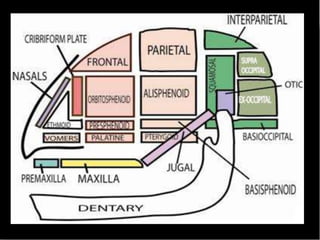
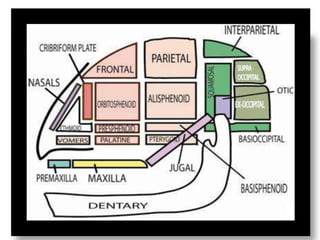
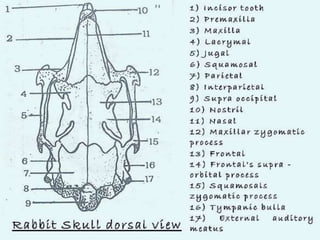
Skull of rabbit consists of cranium, sense capsules, upper jaw, lower jaw, and hyoid
apparatus.
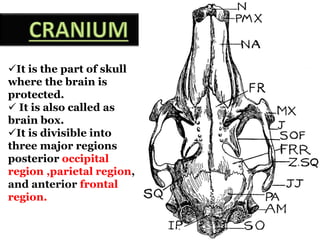
It is the part of skull
where the brain is
protected.
 It is also called as
brain box.
It is divisible into
three major regions
posterior occipital
region ,parietal region,
and anterior frontal
region.
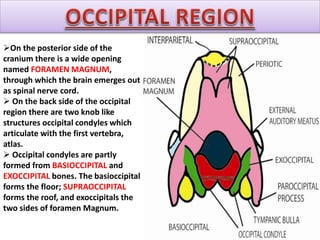
On the posterior side of the
cranium there is a wide opening
named FORAMEN MAGNUM,
through which the brain emerges out
as spinal nerve cord.
 On the back side of the occipital
region there are two knob like
structures occipital condyles which
articulate with the first vertebra,
atlas.
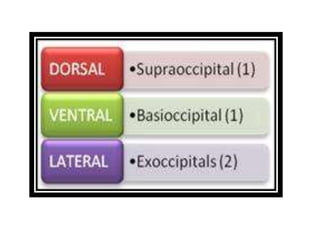
 Occipital condyles are partly
formed from BASIOCCIPITAL and
EXOCCIPITAL bones. The basioccipital
forms the floor; SUPRAOCCIPITAL
forms the roof, and exoccipitals the
two sides of foramen Magnum.
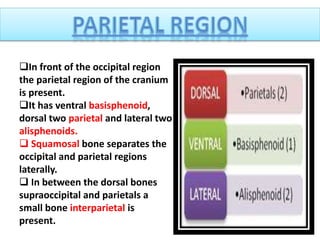
In front of the occipital region
the parietal region of the cranium
is present.
It has ventral basisphenoid,
dorsal two parietal and lateral two
alisphenoids.
 Squamosal bone separates the
occipital and parietal regions
laterally.
 In between the dorsal bones
supraoccipital and parietals a
small bone interparietal is
present.
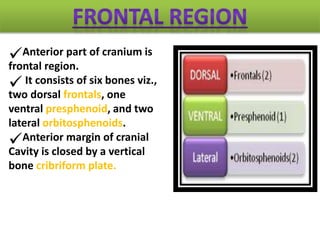
Anterior part of cranium is
frontal region.
It consists of six bones viz.,
two dorsal frontals, one
ventral presphenoid, and two
lateral orbitosphenoids.
Anterior margin of cranial
Cavity is closed by a vertical
bone cribriform plate.
The skull of rabbit has three types of sensory
capsules:
Olfactory capsules
Optic capsules
Auditory capsules.
A pair of olfactory capsules is present in front of the frontal region of the
cranium.
They are dorsally covered by a pair of nasals, ventrally by a pair of vomers,
and laterally by pre maxillae, maxillae and palatines.
 The right and left cavities of olfactory capsules are separated by a
partition called mesethmoid.
Three pairs of much folded process called turbinals project into the
olfactory capsules. These increase the internal surface of the olfactory
capsules.
The arrangement of turbinals is dorsal (nasoturbinals), middle
(ethmoturbinals) and ventral (maxilloturbinals).
The dorsal turbinals bear olfactory epithelium and middle, ventral
turbinals covered by respiratory epithelium.
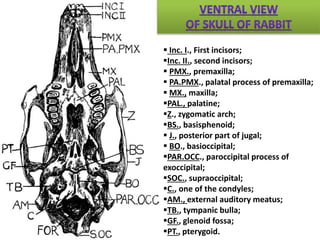
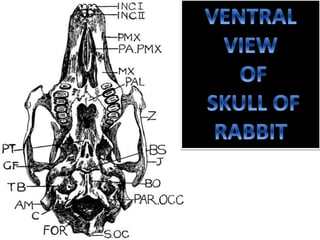
 Inc. I., First incisors;
Inc. II., second incisors;
 PMX., premaxilla;
 PA.PMX., palatal process of premaxilla;
 MX., maxilla;
PAL., palatine;
Z., zygomatic arch;
BS., basisphenoid;
 J., posterior part of jugal;
 BO., basioccipital;
PAR.OCC., paroccipital process of
exoccipital;
SOC., supraoccipital;
C., one of the condyles;
AM., external auditory meatus;
TB., tympanic bulla;
GF., glenoid fossa;
PT., pterygoid.
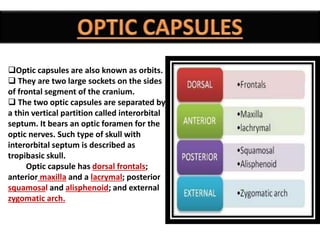
Optic capsules are also known as orbits.
 They are two large sockets on the sides
of frontal segment of the cranium.
 The two optic capsules are separated by
a thin vertical partition called interorbital
septum. It bears an optic foramen for the
optic nerves. Such type of skull with
interorbital septum is described as
tropibasic skull.
Optic capsule has dorsal frontals;
anterior maxilla and a lacrymal; posterior
squamosal and alisphenoid; and external
zygomatic arch.
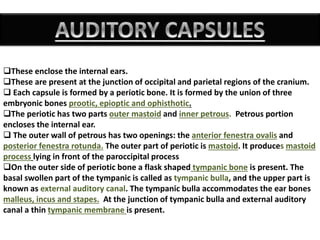
These enclose the internal ears.
These are present at the junction of occipital and parietal regions of the cranium.
 Each capsule is formed by a periotic bone. It is formed by the union of three
embryonic bones prootic, epioptic and ophisthotic.
The periotic has two parts outer mastoid and inner petrous. Petrous portion
encloses the internal ear.
 The outer wall of petrous has two openings: the anterior fenestra ovalis and
posterior fenestra rotunda. The outer part of periotic is mastoid. It produces mastoid
process lying in front of the paroccipital process
On the outer side of periotic bone a flask shaped tympanic bone is present. The
basal swollen part of the tympanic is called as tympanic bulla, and the upper part is
known as external auditory canal. The tympanic bulla accommodates the ear bones
malleus, incus and stapes. At the junction of tympanic bulla and external auditory
canal a thin tympanic membrane is present.
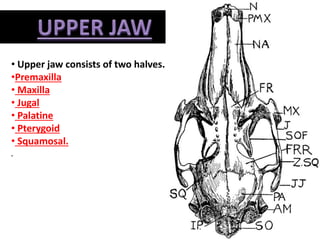
• Upper jaw consists of two halves. Each half is formed of six bones;
•Premaxilla
• Maxilla
• Jugal
• Palatine
• Pterygoid
• Squamosal.
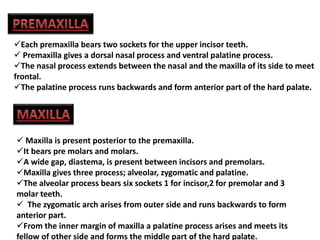
Each premaxilla bears two sockets for the upper incisor teeth.
 Premaxilla gives a dorsal nasal process and ventral palatine process.
The nasal process extends between the nasal and the maxilla of its side to meet
frontal.
The palatine process runs backwards and form anterior part of the hard palate.
 Maxilla is present posterior to the premaxilla.
It bears pre molars and molars.
A wide gap, diastema, is present between incisors and premolars.
Maxilla gives three process; alveolar, zygomatic and palatine.
The alveolar process bears six sockets 1 for incisor,2 for premolar and 3
molar teeth.
 The zygomatic arch arises from outer side and runs backwards to form
anterior part.
From the inner margin of maxilla a palatine process arises and meets its
fellow of other side and forms the middle part of the hard palate.
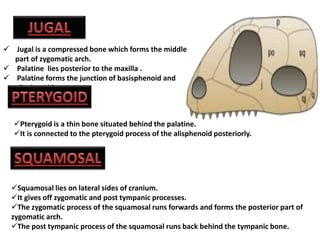
 Jugal is a compressed bone which forms the middle
part of zygomatic arch.
 Palatine lies posterior to the maxilla .
 Palatine forms the junction of basisphenoid and
alisphenoid.
Pterygoid is a thin bone situated behind the palatine.
It is connected to the pterygoid process of the alisphenoid posteriorly.
Squamosal lies on lateral sides of cranium.
It gives off zygomatic and post tympanic processes.
The zygomatic process of the squamosal runs forwards and forms the posterior part of
zygomatic arch.
The post tympanic process of the squamosal runs back behind the tympanic bone.
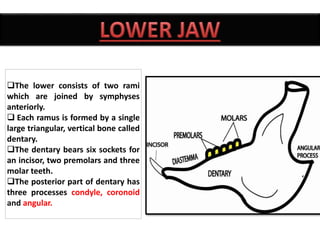
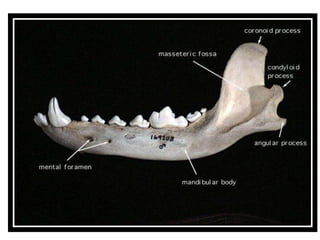
The lower consists of two rami
which are joined by symphyses
anteriorly.
 Each ramus is formed by a single
large triangular, vertical bone called
dentary.
The dentary bears six sockets for
an incisor, two premolars and three
molar teeth.
The posterior part of dentary has
three processes condyle, coronoid
and angular.
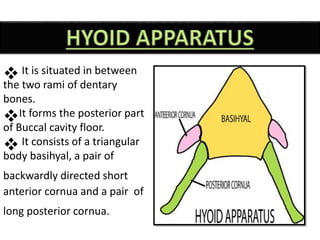
 It is situated in between
the two rami of dentary
bones.
It forms the posterior part
of Buccal cavity floor.
 It consists of a triangular
body basihyal, a pair of
backwardly directed short
anterior cornua and a pair of
long posterior cornua.
Skull of rabbit

Skull of rabbit

  • 2.
    • The skullis a bony structure in the head of most vertebrates (in particular, craniates) that supports the structures of the face and forms a protective cavity for the brain. • The skull is composed of two parts: the cranium and the mandible. • The skull forms the anterior most portion of the skeleton and is a product of encephalization, housing the brain, many sensory structures (eyes, ears, nasal cavity), and the feeding system.
  • 3.
    Skull is dicondylici.e. each exoccipital bears an occipital condyle to articulate with atlas vertebra Skull of rabbit has 2 parts: 1) POSTERIOR CRANIAL PART: • It is shorter and fairly well developed. 2) ANTERIOR FACIAL PART: • It is longer , deflected at an angle of about 60 degree and comprises mainly the jaws The orbits are situated just behind the junction of the cranial and facial regions and are quite large. Skull is tropibasic i.e. a vertical interorbital septum lies between two orbits so that the cranium does not extend forward into orbital region. Skull of rabbit consists of cranium, sense capsules, upper jaw, lower jaw, and hyoid apparatus.
  • 4.
    It is thepart of skull where the brain is protected.  It is also called as brain box. It is divisible into three major regions posterior occipital region ,parietal region, and anterior frontal region.
  • 5.
    On the posteriorside of the cranium there is a wide opening named FORAMEN MAGNUM, through which the brain emerges out as spinal nerve cord.  On the back side of the occipital region there are two knob like structures occipital condyles which articulate with the first vertebra, atlas.  Occipital condyles are partly formed from BASIOCCIPITAL and EXOCCIPITAL bones. The basioccipital forms the floor; SUPRAOCCIPITAL forms the roof, and exoccipitals the two sides of foramen Magnum.
  • 7.
    In front ofthe occipital region the parietal region of the cranium is present. It has ventral basisphenoid, dorsal two parietal and lateral two alisphenoids.  Squamosal bone separates the occipital and parietal regions laterally.  In between the dorsal bones supraoccipital and parietals a small bone interparietal is present.
  • 8.
    Anterior part ofcranium is frontal region. It consists of six bones viz., two dorsal frontals, one ventral presphenoid, and two lateral orbitosphenoids. Anterior margin of cranial Cavity is closed by a vertical bone cribriform plate.
  • 10.
    The skull ofrabbit has three types of sensory capsules: Olfactory capsules Optic capsules Auditory capsules.
  • 11.
    A pair ofolfactory capsules is present in front of the frontal region of the cranium. They are dorsally covered by a pair of nasals, ventrally by a pair of vomers, and laterally by pre maxillae, maxillae and palatines.  The right and left cavities of olfactory capsules are separated by a partition called mesethmoid. Three pairs of much folded process called turbinals project into the olfactory capsules. These increase the internal surface of the olfactory capsules. The arrangement of turbinals is dorsal (nasoturbinals), middle (ethmoturbinals) and ventral (maxilloturbinals). The dorsal turbinals bear olfactory epithelium and middle, ventral turbinals covered by respiratory epithelium.
  • 12.
     Inc. I.,First incisors; Inc. II., second incisors;  PMX., premaxilla;  PA.PMX., palatal process of premaxilla;  MX., maxilla; PAL., palatine; Z., zygomatic arch; BS., basisphenoid;  J., posterior part of jugal;  BO., basioccipital; PAR.OCC., paroccipital process of exoccipital; SOC., supraoccipital; C., one of the condyles; AM., external auditory meatus; TB., tympanic bulla; GF., glenoid fossa; PT., pterygoid.
  • 13.
    Optic capsules arealso known as orbits.  They are two large sockets on the sides of frontal segment of the cranium.  The two optic capsules are separated by a thin vertical partition called interorbital septum. It bears an optic foramen for the optic nerves. Such type of skull with interorbital septum is described as tropibasic skull. Optic capsule has dorsal frontals; anterior maxilla and a lacrymal; posterior squamosal and alisphenoid; and external zygomatic arch.
  • 14.
    These enclose theinternal ears. These are present at the junction of occipital and parietal regions of the cranium.  Each capsule is formed by a periotic bone. It is formed by the union of three embryonic bones prootic, epioptic and ophisthotic. The periotic has two parts outer mastoid and inner petrous. Petrous portion encloses the internal ear.  The outer wall of petrous has two openings: the anterior fenestra ovalis and posterior fenestra rotunda. The outer part of periotic is mastoid. It produces mastoid process lying in front of the paroccipital process On the outer side of periotic bone a flask shaped tympanic bone is present. The basal swollen part of the tympanic is called as tympanic bulla, and the upper part is known as external auditory canal. The tympanic bulla accommodates the ear bones malleus, incus and stapes. At the junction of tympanic bulla and external auditory canal a thin tympanic membrane is present.
  • 16.
    • Upper jawconsists of two halves. Each half is formed of six bones; •Premaxilla • Maxilla • Jugal • Palatine • Pterygoid • Squamosal.
  • 17.
    Each premaxilla bearstwo sockets for the upper incisor teeth.  Premaxilla gives a dorsal nasal process and ventral palatine process. The nasal process extends between the nasal and the maxilla of its side to meet frontal. The palatine process runs backwards and form anterior part of the hard palate.  Maxilla is present posterior to the premaxilla. It bears pre molars and molars. A wide gap, diastema, is present between incisors and premolars. Maxilla gives three process; alveolar, zygomatic and palatine. The alveolar process bears six sockets 1 for incisor,2 for premolar and 3 molar teeth.  The zygomatic arch arises from outer side and runs backwards to form anterior part. From the inner margin of maxilla a palatine process arises and meets its fellow of other side and forms the middle part of the hard palate.
  • 19.
     Jugal isa compressed bone which forms the middle part of zygomatic arch.  Palatine lies posterior to the maxilla .  Palatine forms the junction of basisphenoid and alisphenoid. Pterygoid is a thin bone situated behind the palatine. It is connected to the pterygoid process of the alisphenoid posteriorly. Squamosal lies on lateral sides of cranium. It gives off zygomatic and post tympanic processes. The zygomatic process of the squamosal runs forwards and forms the posterior part of zygomatic arch. The post tympanic process of the squamosal runs back behind the tympanic bone.
  • 21.
    The lower consistsof two rami which are joined by symphyses anteriorly.  Each ramus is formed by a single large triangular, vertical bone called dentary. The dentary bears six sockets for an incisor, two premolars and three molar teeth. The posterior part of dentary has three processes condyle, coronoid and angular.
  • 23.
     It issituated in between the two rami of dentary bones. It forms the posterior part of Buccal cavity floor.  It consists of a triangular body basihyal, a pair of backwardly directed short anterior cornua and a pair of long posterior cornua.