PEARL CULTURE
DR. C. BEULAH JAYARANI
M.Sc., M.A, M.Ed, M.Phil (Edn), M.Phil (ZOO), NET, Ph.D (Edn)
ASST. PROFESSOR,
LOYOLA COLLEGE OF EDUCATION, CHENNAI - 34
INTRODUCTION
Pearl is a white, highly shining globular
found within the shell of an oyster.
Sedentary animals.
First cultured in 1973 in Tuticorin.
Found along the coast of kanyakumari
and in Gulf of kutch.
Genus(Pinctada, Lamellidens).
“Lingha pearl”.
7/14/2021 Dr. C. Beulah Jayarani 2
CLASSIFICATION
• Kingdom: Animalia
• Phylum : Mollusca
• Class : Bivalvia
• Order : Ostreida
• Superfamily : Ostreoidea
• Family : Ostreidae
• Genus :Crassostrea
• Species : rhizophorae
7/14/2021 Dr. C. Beulah Jayarani 3
ANATOMY OF PEARL OYSTER
7/14/2021 Dr. C. Beulah Jayarani 4
PEARL CULTURE
• A cultured pearl is a pearl initiated by a mussel or
oyster farmer under controlled conditions using two
very different groups of bivalve mollusks - the
freshwater river mussels and saltwater pearl oysters
MOLLUSKS
7/14/2021 Dr. C. Beulah Jayarani 5
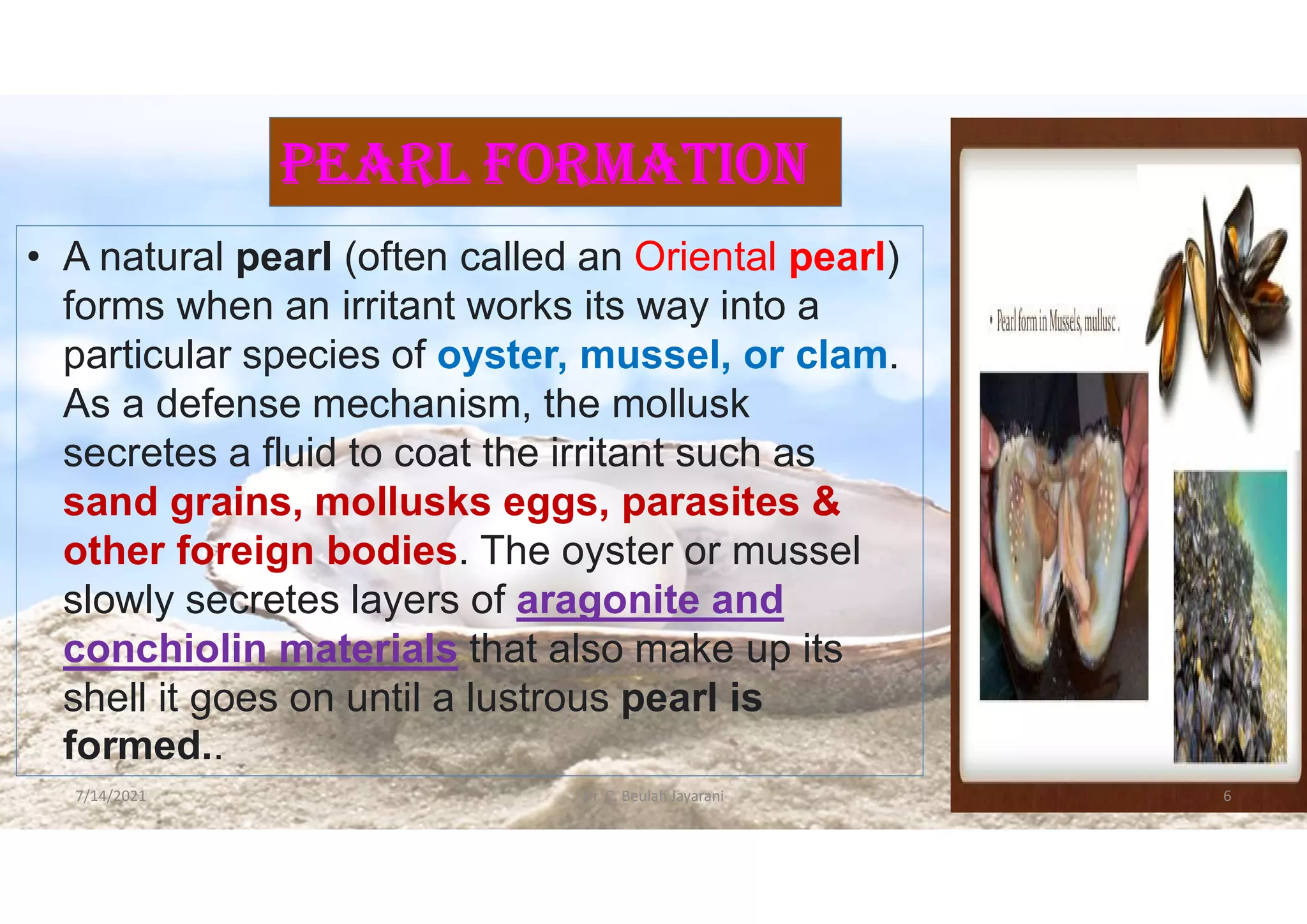
PEARL FORMATION
• A natural pearl (often called an Oriental pearl)
forms when an irritant works its way into a
particular species of oyster, mussel, or clam.
As a defense mechanism, the mollusk
secretes a fluid to coat the irritant such as
sand grains, mollusks eggs, parasites &
other foreign bodies. The oyster or mussel
slowly secretes layers of aragonite and
conchiolin materials that also make up its
shell it goes on until a lustrous pearl is
formed..
7/14/2021 Dr. C. Beulah Jayarani 6
7/14/2021 Dr. C. Beulah Jayarani 7
HISTORY OF PEARL CULTURE
• The history of Japan's pearl culturing
industry started with Kokichi Mikimoto,
who dreamed of producing gem-
quality pearls using the Akoya oyster. In
1899 he started selling ornaments using
Hanen blisters for the first time and
carved out a new market in which
cultured pearls were handled as jewelry.
7/14/2021 Dr. C. Beulah Jayarani 8
IMPLANTATION
• Single implantation in the gonad near the intestinal loop.
• Double implantation close to hepato-pancreases.
7/14/2021 Dr. C. Beulah Jayarani 9
STEPS INVOLVED IN PEARL CULTURE
Construction of farm.
Collection of oysters.
Rearing of oysters.
Preparation of the graft tissue.
Insertion of nucleus.
Harvesting of pearl.
Clearing of pearls.
7/14/2021 Dr. C. Beulah Jayarani 10
1. CONSTRUCTION OF PEARL FARM
Construction of a pearl farm includes three steps.
They are,
• Selection of farm site
• Construction of farm
• Well-planned work schedule
7/14/2021 Dr. C. Beulah Jayarani 11
CLIMATIC CONDITION FOR THE CULTURE
Temperature – 20 to 25° C
Salinity (above 30 ppt)
Bottom (Gravelly)
Depth (Optimum depth – 15 m)
Good phytoplankton production
Moderate water current
7/14/2021 Dr. C. Beulah Jayarani 12
NARCOTIZATION
• Narcotization of selected oysters by sprinkling Menthol in the
sea water
7/14/2021 Dr. C. Beulah Jayarani 13
2. COLLECTION OF OYSTERS
From July to November, the spats are easily
available.
7/14/2021 Dr. C. Beulah Jayarani 14
Special type of cages
(84 ×54 × 20 cm)
7/14/2021 Dr. C. Beulah Jayarani 15
The divers set out to the bottom of the sea, to collect the oysters.
7/14/2021 Dr. C. Beulah Jayarani 16
NURSING
7/14/2021 Dr. C. Beulah Jayarani 17
3.REARING OF OYSTERS
The collected oysters are
cleaned and placed in culture
cages.
10-20 days
Stocked and reared in special
type of cage called as rearing
cage.
7/14/2021 Dr. C. Beulah Jayarani 18
4.INSERTION OF NUCLEUS
Following steps are done in
insertion of nucleus
a. Fitness of oyster for operation
b. Insertion of graft tissues
c. Preparation of nucleus
d. Insertion of nucleus
e. Post operation care
7/14/2021 Dr. C. Beulah Jayarani 19
A. FITNESS OF OYSTER FOR OPERATION
AGE: 1.5 to 2 years
WEIGHT: 25g (40mm)
STAGE OF MATURITY- spent resting stage
OVER ALL HEALTH: Good & free from infections
7/14/2021 Dr. C. Beulah Jayarani 20
b. INSERTION OF GRAFT TISSUE
• The piece of tissue which is
inserted inside the mantle is
called as “Graft tissue”.
• A donor oyster is sacrificed
to obtain mantle.
• 2-3 mm of square mantel
pieces are prepared
• Mantle is needed by the
host oyster to accept the
nucleus.
7/14/2021 Dr. C. Beulah Jayarani 21
C. THE NUCLEUS - HEART OF THE PEARL
Any small particle may function as nucleus.
7/14/2021 Dr. C. Beulah Jayarani 22
D. INSERTION OF NUCLEUS
STEP 1: oysters are fixed in a desk clamp position of right valve facing
upward.
7/14/2021 Dr. C. Beulah Jayarani 23
STEP 2: mantle folds are touched smoothly, followed by incision in
the epithelium of the foot.
7/14/2021 Dr. C. Beulah Jayarani 24
STEP 3: in the slender channel, one graft tissue which functions as
the bed for the nucleus.
7/14/2021 Dr. C. Beulah Jayarani 25
E. POST OPERATION CARE
Suspended in the floating rafts to a depth of 2 to 3 meters for about 6-7 days to
recover from the shock. This period is called as the recovery period.
7/14/2021 Dr. C. Beulah Jayarani 26
4. HARVESTING OF PEARL
Pearls are harvested after 3 years of the insertion of nucleus from
December to February
7/14/2021 Dr. C. Beulah Jayarani 27
5. CLEARING OF PEARLS
After taking out the pearls from the oyster shell, they are washed,
cleared with soap solution.
7/14/2021 Dr. C. Beulah Jayarani 28
COMPOSITION OF PEARL
• Pearl comprises of
Water 2-4%
organic matter 3.5-5.9%
calcium carbonate 90%
Residue 0.1-0.8%
7/14/2021 Dr. C. Beulah Jayarani 29
ECONOMIC IMPORTANCE
• 1. Importance to cultivators
Sells meat, shells & mostly pearls
• 2. Importance to businesses
• Provide oysters to restaurant
• Provides pearls for jewellery
• Provides oysters shells can be used as ornamental
• 3. Importance to employment
7/14/2021 Dr. C. Beulah Jayarani 30
REFERENCE
“SCIENCE READER”
 Tamil Nadu text book
 NCERT Books
7/14/2021 Dr. C. Beulah Jayarani 31

Pearl culture

  • 1.
    PEARL CULTURE DR. C.BEULAH JAYARANI M.Sc., M.A, M.Ed, M.Phil (Edn), M.Phil (ZOO), NET, Ph.D (Edn) ASST. PROFESSOR, LOYOLA COLLEGE OF EDUCATION, CHENNAI - 34
  • 2.
    INTRODUCTION Pearl is awhite, highly shining globular found within the shell of an oyster. Sedentary animals. First cultured in 1973 in Tuticorin. Found along the coast of kanyakumari and in Gulf of kutch. Genus(Pinctada, Lamellidens). “Lingha pearl”. 7/14/2021 Dr. C. Beulah Jayarani 2
  • 3.
    CLASSIFICATION • Kingdom: Animalia •Phylum : Mollusca • Class : Bivalvia • Order : Ostreida • Superfamily : Ostreoidea • Family : Ostreidae • Genus :Crassostrea • Species : rhizophorae 7/14/2021 Dr. C. Beulah Jayarani 3
  • 4.
    ANATOMY OF PEARLOYSTER 7/14/2021 Dr. C. Beulah Jayarani 4
  • 5.
    PEARL CULTURE • Acultured pearl is a pearl initiated by a mussel or oyster farmer under controlled conditions using two very different groups of bivalve mollusks - the freshwater river mussels and saltwater pearl oysters MOLLUSKS 7/14/2021 Dr. C. Beulah Jayarani 5
  • 6.
    PEARL FORMATION • Anatural pearl (often called an Oriental pearl) forms when an irritant works its way into a particular species of oyster, mussel, or clam. As a defense mechanism, the mollusk secretes a fluid to coat the irritant such as sand grains, mollusks eggs, parasites & other foreign bodies. The oyster or mussel slowly secretes layers of aragonite and conchiolin materials that also make up its shell it goes on until a lustrous pearl is formed.. 7/14/2021 Dr. C. Beulah Jayarani 6
  • 7.
    7/14/2021 Dr. C.Beulah Jayarani 7
  • 8.
    HISTORY OF PEARLCULTURE • The history of Japan's pearl culturing industry started with Kokichi Mikimoto, who dreamed of producing gem- quality pearls using the Akoya oyster. In 1899 he started selling ornaments using Hanen blisters for the first time and carved out a new market in which cultured pearls were handled as jewelry. 7/14/2021 Dr. C. Beulah Jayarani 8
  • 9.
    IMPLANTATION • Single implantationin the gonad near the intestinal loop. • Double implantation close to hepato-pancreases. 7/14/2021 Dr. C. Beulah Jayarani 9
  • 10.
    STEPS INVOLVED INPEARL CULTURE Construction of farm. Collection of oysters. Rearing of oysters. Preparation of the graft tissue. Insertion of nucleus. Harvesting of pearl. Clearing of pearls. 7/14/2021 Dr. C. Beulah Jayarani 10
  • 11.
    1. CONSTRUCTION OFPEARL FARM Construction of a pearl farm includes three steps. They are, • Selection of farm site • Construction of farm • Well-planned work schedule 7/14/2021 Dr. C. Beulah Jayarani 11
  • 12.
    CLIMATIC CONDITION FORTHE CULTURE Temperature – 20 to 25° C Salinity (above 30 ppt) Bottom (Gravelly) Depth (Optimum depth – 15 m) Good phytoplankton production Moderate water current 7/14/2021 Dr. C. Beulah Jayarani 12
  • 13.
    NARCOTIZATION • Narcotization ofselected oysters by sprinkling Menthol in the sea water 7/14/2021 Dr. C. Beulah Jayarani 13
  • 14.
    2. COLLECTION OFOYSTERS From July to November, the spats are easily available. 7/14/2021 Dr. C. Beulah Jayarani 14
  • 15.
    Special type ofcages (84 ×54 × 20 cm) 7/14/2021 Dr. C. Beulah Jayarani 15
  • 16.
    The divers setout to the bottom of the sea, to collect the oysters. 7/14/2021 Dr. C. Beulah Jayarani 16
  • 17.
    NURSING 7/14/2021 Dr. C.Beulah Jayarani 17
  • 18.
    3.REARING OF OYSTERS Thecollected oysters are The collected oysters are cleaned and placed in culture cages. 10-20 days Stocked and reared in special type of cage called as rearing cage. 7/14/2021 Dr. C. Beulah Jayarani 18
  • 19.
    4.INSERTION OF NUCLEUS Followingsteps are done in insertion of nucleus a. Fitness of oyster for operation b. Insertion of graft tissues c. Preparation of nucleus d. Insertion of nucleus e. Post operation care 7/14/2021 Dr. C. Beulah Jayarani 19
  • 20.
    A. FITNESS OFOYSTER FOR OPERATION AGE: 1.5 to 2 years WEIGHT: 25g (40mm) STAGE OF MATURITY- spent resting stage OVER ALL HEALTH: Good & free from infections 7/14/2021 Dr. C. Beulah Jayarani 20
  • 21.
    b. INSERTION OFGRAFT TISSUE • The piece of tissue which is inserted inside the mantle is called as “Graft tissue”. • A donor oyster is sacrificed to obtain mantle. • 2-3 mm of square mantel pieces are prepared • Mantle is needed by the host oyster to accept the nucleus. 7/14/2021 Dr. C. Beulah Jayarani 21
  • 22.
    C. THE NUCLEUS- HEART OF THE PEARL Any small particle may function as nucleus. 7/14/2021 Dr. C. Beulah Jayarani 22
  • 23.
    D. INSERTION OFNUCLEUS STEP 1: oysters are fixed in a desk clamp position of right valve facing upward. 7/14/2021 Dr. C. Beulah Jayarani 23
  • 24.
    STEP 2: mantlefolds are touched smoothly, followed by incision in the epithelium of the foot. 7/14/2021 Dr. C. Beulah Jayarani 24
  • 25.
    STEP 3: inthe slender channel, one graft tissue which functions as the bed for the nucleus. 7/14/2021 Dr. C. Beulah Jayarani 25
  • 26.
    E. POST OPERATIONCARE Suspended in the floating rafts to a depth of 2 to 3 meters for about 6-7 days to recover from the shock. This period is called as the recovery period. 7/14/2021 Dr. C. Beulah Jayarani 26
  • 27.
    4. HARVESTING OFPEARL Pearls are harvested after 3 years of the insertion of nucleus from December to February 7/14/2021 Dr. C. Beulah Jayarani 27
  • 28.
    5. CLEARING OFPEARLS After taking out the pearls from the oyster shell, they are washed, cleared with soap solution. 7/14/2021 Dr. C. Beulah Jayarani 28
  • 29.
    COMPOSITION OF PEARL •Pearl comprises of Water 2-4% organic matter 3.5-5.9% calcium carbonate 90% Residue 0.1-0.8% 7/14/2021 Dr. C. Beulah Jayarani 29
  • 30.
    ECONOMIC IMPORTANCE • 1.Importance to cultivators Sells meat, shells & mostly pearls • 2. Importance to businesses • Provide oysters to restaurant • Provides pearls for jewellery • Provides oysters shells can be used as ornamental • 3. Importance to employment 7/14/2021 Dr. C. Beulah Jayarani 30
  • 31.
    REFERENCE “SCIENCE READER”  TamilNadu text book  NCERT Books 7/14/2021 Dr. C. Beulah Jayarani 31