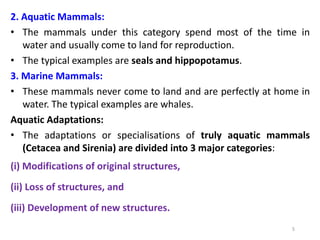
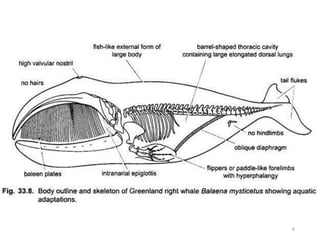
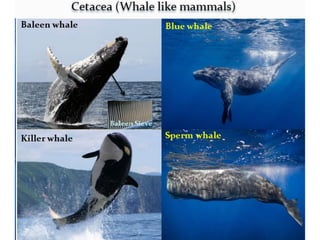
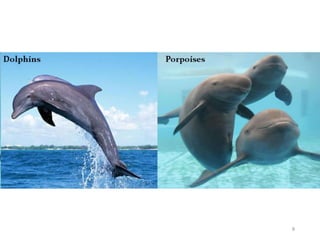
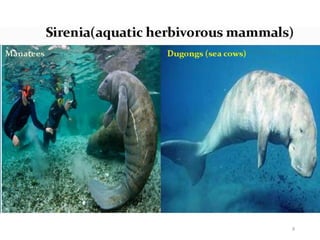
Aquatic mammals have evolved from terrestrial ancestors and retain adaptations for air-breathing, with categories including amphibious, fully aquatic, and marine mammals. Their adaptations for aquatic life include streamlined body shapes, modified forelimbs as flippers, and unique respiratory systems to facilitate life in water. Various structural losses, such as the absence of hair and reduced hind limbs, showcase their specialized evolution to thrive in aquatic environments.




![Jaw suspension in vertebrates [autosaved]](https://cdn.slidesharecdn.com/ss_thumbnails/jawsuspensioninvertebratesautosaved-201219155254-thumbnail.jpg?width=640&height=640&fit=bounds)


![谷歌留痕技术 [ 𝙩𝙤𝙥 𝟮𝟯𝟯. 𝙘 𝙤𝙢 ]](https://cdn.slidesharecdn.com/ss_thumbnails/top233-260130174328-3833018c-thumbnail.jpg?width=640&height=640&fit=bounds)


