DR. ANU KUMAR SHARMA
ASSOCIATE PROFESSOR
 Introduction
 Historical background
 Why induced breeding?
 Collection of Pituitary gland
 Preservation and storage
 Points to be kept mind
 Doses of Pituitary gland extract
 Synthetic hormones & Doses
 Spawning
 Factors influencing Induced Breeding
 References
 Induced Breeding is a technique whereby ripe fish
breeders are stimulated by Pituitary hormone or
other synthetic hormones, introduced to breed in
captive condition.
 This process of Breeding is also known as
Hypophysation.
 This technique of Induced breeding was first evolved in
Argentina after producing extract by B.A Hussy in 1930.
Brazilian was the first country to develop a technique for
hypophysation in 1934.
 In India first attempt was made by Hamid khan in 1937 on
Cirrhinus mrigala.
 Dr. Heeralal choudhary applied this technique in Minor
carps in 1955.
 Alikhuni and Choudhary (1962) succeeded in inducing
breeding in Labeo rohita, Cirrhinus mrigala, C. reba,
Punctius sarana.
 Spawn collected from natural water is not pure.
 Presence of some undesirable wild species.
 Sorting of pure seeds is quite impossible.
 Availability of seeds is quite uncertain.
 Induced breeding fulfill any quantity of demand in
any time.
 Carps attain full maturity in confined water but do not
breed.
 Easily learnt by layman without much training.
 Cost of expenditure is low than natural collection of
spawns.
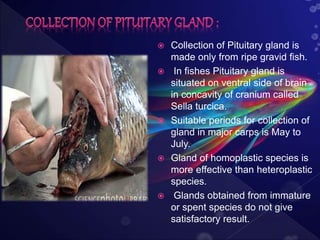
 Collection of Pituitary gland is
made only from ripe gravid fish.
 In fishes Pituitary gland is
situated on ventral side of brain
in concavity of cranium called
Sella turcica.
 Suitable periods for collection of
gland in major carps is May to
July.
 Gland of homoplastic species is
more effective than heteroplastic
species.
 Glands obtained from immature
or spent species do not give
satisfactory result.
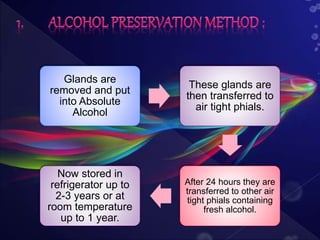
Glands are
removed and put
into Absolute
Alcohol
These glands are
then transferred to
air tight phials.
After 24 hours they are
transferred to other air
tight phials containing
fresh alcohol.
Now stored in
refrigerator up to
2-3 years or at
room temperature
up to 1 year.
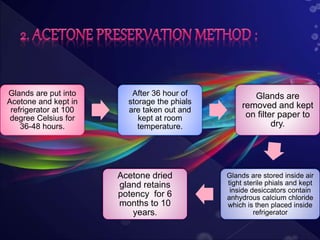
Glands are put into
Acetone and kept in
refrigerator at 100
degree Celsius for
36-48 hours.
After 36 hour of
storage the phials
are taken out and
kept at room
temperature.
Glands are
removed and kept
on filter paper to
dry.
Glands are stored inside air
tight sterile phials and kept
inside desiccators contain
anhydrous calcium chloride
which is then placed inside
refrigerator
Acetone dried
gland retains
potency for 6
months to 10
years.
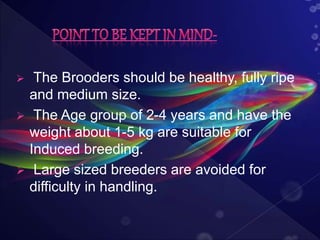
 The Brooders should be healthy, fully ripe
and medium size.
 The Age group of 2-4 years and have the
weight about 1-5 kg are suitable for
Induced breeding.
 Large sized breeders are avoided for
difficulty in handling.
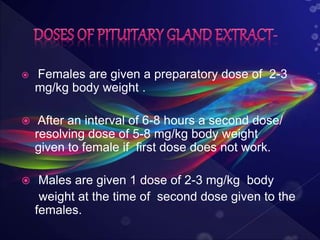
 Females are given a preparatory dose of 2-3
mg/kg body weight .
 After an interval of 6-8 hours a second dose/
resolving dose of 5-8 mg/kg body weight
given to female if first dose does not work.
 Males are given 1 dose of 2-3 mg/kg body
weight at the time of second dose given to the
females.
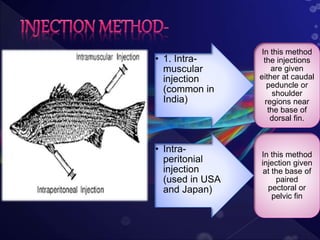
• 1. Intra-
muscular
injection
(common in
India)
In this method
the injections
are given
either at caudal
peduncle or
shoulder
regions near
the base of
dorsal fin.
• Intra-
peritonial
injection
(used in USA
and Japan)
In this method
injection given
at the base of
paired
pectoral or
pelvic fin
 H.C.G (Human chorionic gonadotropin)
 OVAPRIM
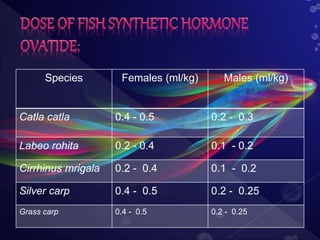
 OVATIDE
Species Females (ml/kg) Males (ml/kg)
Catla catla 0.4 - 0.5 0.2 - 0.3
Labeo rohita 0.2 - 0.4 0.1 - 0.2
Cirrhinus mrigala 0.2 - 0.4 0.1 - 0.2
Silver carp 0.4 - 0.5 0.2 - 0.25
Grass carp 0.4 - 0.5 0.2 - 0.25
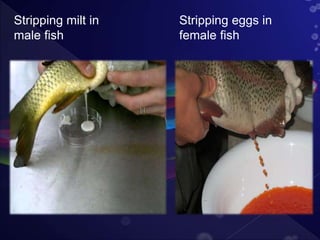
Stripping milt in
male fish
Stripping eggs in
female fish

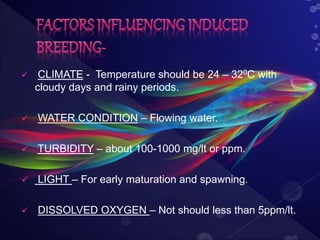
 CLIMATE - Temperature should be 24 – 320C with
cloudy days and rainy periods.
 WATER CONDITION – Flowing water.
 TURBIDITY – about 100-1000 mg/lt or ppm.
 LIGHT – For early maturation and spawning.
 DISSOLVED OXYGEN – Not should less than 5ppm/lt.
 Fish and Fisheries of India – V. G. Jhingran.
 A textbook of Fish and Fisheries – Pandey
and Shukla.
 http://www.yourarticlelibrary.com/
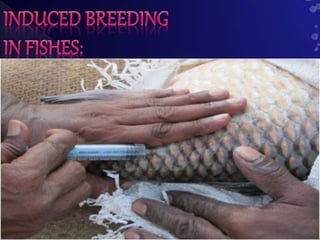
Induced breeding

Induced breeding

  • 1.
    DR. ANU KUMARSHARMA ASSOCIATE PROFESSOR
  • 3.
     Introduction  Historicalbackground  Why induced breeding?  Collection of Pituitary gland  Preservation and storage  Points to be kept mind  Doses of Pituitary gland extract  Synthetic hormones & Doses  Spawning  Factors influencing Induced Breeding  References
  • 4.
     Induced Breedingis a technique whereby ripe fish breeders are stimulated by Pituitary hormone or other synthetic hormones, introduced to breed in captive condition.  This process of Breeding is also known as Hypophysation.
  • 5.
     This techniqueof Induced breeding was first evolved in Argentina after producing extract by B.A Hussy in 1930. Brazilian was the first country to develop a technique for hypophysation in 1934.  In India first attempt was made by Hamid khan in 1937 on Cirrhinus mrigala.  Dr. Heeralal choudhary applied this technique in Minor carps in 1955.  Alikhuni and Choudhary (1962) succeeded in inducing breeding in Labeo rohita, Cirrhinus mrigala, C. reba, Punctius sarana.
  • 6.
     Spawn collectedfrom natural water is not pure.  Presence of some undesirable wild species.  Sorting of pure seeds is quite impossible.  Availability of seeds is quite uncertain.  Induced breeding fulfill any quantity of demand in any time.  Carps attain full maturity in confined water but do not breed.  Easily learnt by layman without much training.  Cost of expenditure is low than natural collection of spawns.
  • 7.
     Collection ofPituitary gland is made only from ripe gravid fish.  In fishes Pituitary gland is situated on ventral side of brain in concavity of cranium called Sella turcica.  Suitable periods for collection of gland in major carps is May to July.  Gland of homoplastic species is more effective than heteroplastic species.  Glands obtained from immature or spent species do not give satisfactory result.
  • 9.
    Glands are removed andput into Absolute Alcohol These glands are then transferred to air tight phials. After 24 hours they are transferred to other air tight phials containing fresh alcohol. Now stored in refrigerator up to 2-3 years or at room temperature up to 1 year.
  • 10.
    Glands are putinto Acetone and kept in refrigerator at 100 degree Celsius for 36-48 hours. After 36 hour of storage the phials are taken out and kept at room temperature. Glands are removed and kept on filter paper to dry. Glands are stored inside air tight sterile phials and kept inside desiccators contain anhydrous calcium chloride which is then placed inside refrigerator Acetone dried gland retains potency for 6 months to 10 years.
  • 11.
     The Broodersshould be healthy, fully ripe and medium size.  The Age group of 2-4 years and have the weight about 1-5 kg are suitable for Induced breeding.  Large sized breeders are avoided for difficulty in handling.
  • 12.
     Females aregiven a preparatory dose of 2-3 mg/kg body weight .  After an interval of 6-8 hours a second dose/ resolving dose of 5-8 mg/kg body weight given to female if first dose does not work.  Males are given 1 dose of 2-3 mg/kg body weight at the time of second dose given to the females.
  • 13.
    • 1. Intra- muscular injection (commonin India) In this method the injections are given either at caudal peduncle or shoulder regions near the base of dorsal fin. • Intra- peritonial injection (used in USA and Japan) In this method injection given at the base of paired pectoral or pelvic fin
  • 14.
     H.C.G (Humanchorionic gonadotropin)  OVAPRIM  OVATIDE
  • 15.
    Species Females (ml/kg)Males (ml/kg) Catla catla 0.4 - 0.5 0.2 - 0.3 Labeo rohita 0.2 - 0.4 0.1 - 0.2 Cirrhinus mrigala 0.2 - 0.4 0.1 - 0.2 Silver carp 0.4 - 0.5 0.2 - 0.25 Grass carp 0.4 - 0.5 0.2 - 0.25
  • 16.
    Stripping milt in malefish Stripping eggs in female fish
  • 17.
  • 18.
     CLIMATE -Temperature should be 24 – 320C with cloudy days and rainy periods.  WATER CONDITION – Flowing water.  TURBIDITY – about 100-1000 mg/lt or ppm.  LIGHT – For early maturation and spawning.  DISSOLVED OXYGEN – Not should less than 5ppm/lt.
  • 19.
     Fish andFisheries of India – V. G. Jhingran.  A textbook of Fish and Fisheries – Pandey and Shukla.  http://www.yourarticlelibrary.com/