Lecture 5:
          Dictionaries
         Steven Skiena

Department of Computer Science
 State University of New York
 Stony Brook, NY 11794–4400

http://www.cs.sunysb.edu/∼skiena
Dictionary / Dynamic Set Operations
Perhaps the most important class of data structures maintain
a set of items, indexed by keys.
 • Search(S,k) – A query that, given a set S and a key value
   k, returns a pointer x to an element in S such that key[x]
   = k, or nil if no such element belongs to S.
 • Insert(S,x) – A modifying operation that augments the set
   S with the element x.
 • Delete(S,x) – Given a pointer x to an element in the set S,
   remove x from S. Observe we are given a pointer to an
   element x, not a key value.
• Min(S), Max(S) – Returns the element of the totally
   ordered set S which has the smallest (largest) key.
 • Next(S,x), Previous(S,x) – Given an element x whose key
   is from a totally ordered set S, returns the next largest
   (smallest) element in S, or NIL if x is the maximum
   (minimum) element.
There are a variety of implementations of these dictionary
operations, each of which yield different time bounds for
various operations.
Problem of the Day
What is the asymptotic worst-case running times for each of
the seven fundamental dictionary operations when the data
structure is implemented as
 • A singly-linked unsorted list,
 • A doubly-linked unsorted list,
 • A singly-linked sorted list, and finally
 • A doubly-linked sorted list.
Solution Blank

                      singly   singly doubly doubly
                      unsorted sorted unsorted sorted
  Search(L, k)
  Insert(L, x)
  Delete(L, x)
  Successor(L, x)
  Predecessor(L, x)
  Minimum(L)
  Maximum(L)
Solution

                      singly     double     singly   doubly
 Dictionary operation unsorted   unsorted   sorted   sorted
 Search(L, k)         O(n)       O(n)       O(n)     O(n)
 Insert(L, x)         O(1)       O(1)       O(n)     O(n)
 Delete(L, x)         O(n)∗      O(1)       O(n)∗    O(1)
 Successor(L, x)      O(n)       O(n)       O(1)     O(1)
 Predecessor(L, x)    O(n)       O(n)       O(n)∗    O(1)
 Minimum(L)           O(n)       O(n)       O(1)     O(1)
 Maximum(L)           O(n)       O(n)       O(1)∗    O(1)
Binary Search Trees
Binary search trees provide a data structure which efficiently
supports all six dictionary operations.
A binary tree is a rooted tree where each node contains at
most two children.
Each child can be identified as either a left or right child.

                             parent


                      left            right
Binary Search Trees
A binary search tree labels each node x in a binary tree such
that all nodes in the left subtree of x have keys < x and all
nodes in the right subtree of x have key’s > x.
                          2


                              3


                                  7


                              6       8


                          5


The search tree labeling enables us to find where any key is.
Implementing Binary Search Trees

typedef struct tree {
      item type item;
      struct tree *parent;
      struct tree *left;
      struct tree *right;
} tree;


The parent link is optional, since we can store the pointer on
a stack when we encounter it.
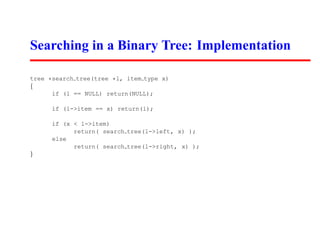
Searching in a Binary Tree: Implementation

tree *search tree(tree *l, item type x)
{
      if (l == NULL) return(NULL);

      if (l->item == x) return(l);

      if (x < l->item)
            return( search tree(l->left, x) );
      else
            return( search tree(l->right, x) );
}
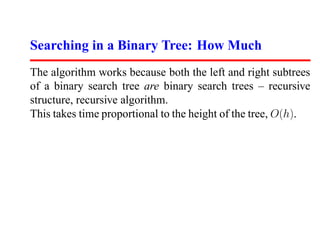
Searching in a Binary Tree: How Much
The algorithm works because both the left and right subtrees
of a binary search tree are binary search trees – recursive
structure, recursive algorithm.
This takes time proportional to the height of the tree, O(h).
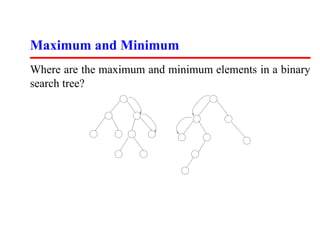
Maximum and Minimum
Where are the maximum and minimum elements in a binary
search tree?
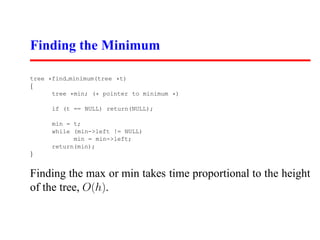
Finding the Minimum

tree *find minimum(tree *t)
{
      tree *min; (* pointer to minimum *)

      if (t == NULL) return(NULL);

      min = t;
      while (min->left != NULL)
            min = min->left;
      return(min);
}


Finding the max or min takes time proportional to the height
of the tree, O(h).
Where is the Predecessor: Internal Node

                                   X


                      PREDECESSOR(X)   SUCCESSOR(X)


If X has two children, its predecessor is the maximum value
in its left subtree and its successor the minimum value in its
right subtree.
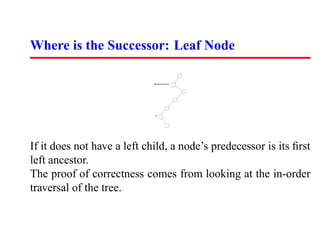
Where is the Successor: Leaf Node

                             predecessor(x)


                             X


If it does not have a left child, a node’s predecessor is its first
left ancestor.
The proof of correctness comes from looking at the in-order
traversal of the tree.
In-Order Traversal

void traverse tree(tree *l)
{
      if (l != NULL) {
            traverse tree(l->left);
            process item(l->item);
            traverse tree(l->right);
      } }


                                       H

                                  A
                                           F

                                   B               G

                                       D


                                  C            E
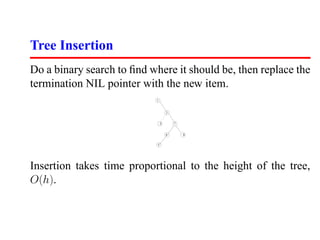
Tree Insertion
Do a binary search to find where it should be, then replace the
termination NIL pointer with the new item.
                            1


                                    3


                                2       7


                                    6       8


                            5


Insertion takes time proportional to the height of the tree,
O(h).
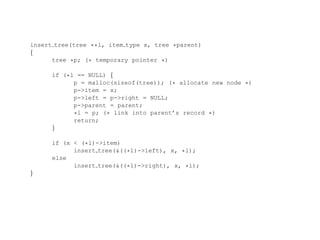
insert tree(tree **l, item type x, tree *parent)
{
      tree *p; (* temporary pointer *)

      if (*l == NULL) {
            p = malloc(sizeof(tree)); (* allocate new node *)
            p->item = x;
            p->left = p->right = NULL;
            p->parent = parent;
            *l = p; (* link into parent’s record *)
            return;
      }

      if (x < (*l)->item)
            insert tree(&((*l)->left), x, *l);
      else
            insert tree(&((*l)->right), x, *l);
}
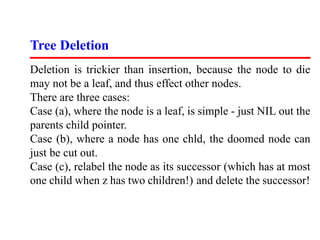
Tree Deletion
Deletion is trickier than insertion, because the node to die
may not be a leaf, and thus effect other nodes.
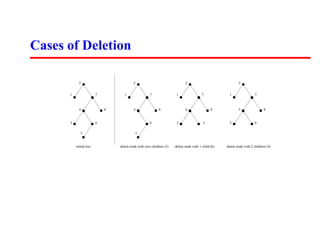
There are three cases:
Case (a), where the node is a leaf, is simple - just NIL out the
parents child pointer.
Case (b), where a node has one chld, the doomed node can
just be cut out.
Case (c), relabel the node as its successor (which has at most
one child when z has two children!) and delete the successor!
Cases of Deletion

            2                             2                                  2                               2


      1                  7          1                7                 1                 7             1                7


            4                8            4                 8                4                 8             5                 8


      3                  6                           6                 3                  5            3                6

             5                             5


          initial tree           delete node with zero children (3)   delete node with 1 child (6)   delete node with 2 children (4)
Binary Search Trees as Dictionaries
All six of our dictionary operations, when implemented with
binary search trees, take O(h), where h is the height of the
tree.
The best height we could hope to get is lg n, if the tree was
perfectly balanced, since
                          lg n
                                 2i ≈ n
                          i=0
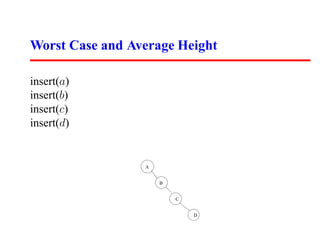
But if we get unlucky with our order of insertion or deletion,
we could get linear height!
Worst Case and Average Height

insert(a)
insert(b)
insert(c)
insert(d)


                 A


                     B


                         C


                             D
Tree Insertion Analysis
In fact, binary search trees constructed with random insertion
orders on average have Θ(lg n) height.
The worst case is linear, however.
Our analysis of Quicksort will later explain why the expected
height is Θ(lg n).
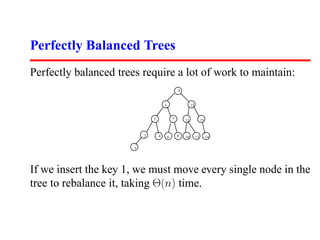
Perfectly Balanced Trees
Perfectly balanced trees require a lot of work to maintain:
                                                   9


                                       5                    13


                               3               7       11             15


                           2       4       6       8   10        12        14

                       1


If we insert the key 1, we must move every single node in the
tree to rebalance it, taking Θ(n) time.
Balanced Search Trees
Therefore, when we talk about ”balanced” trees, we mean
trees whose height is O(lg n), so all dictionary operations
(insert, delete, search, min/max, successor/predecessor) take
O(lg n) time.
Extra care must be taken on insertion and deletion to
guarantee such performance, by rearranging things when they
get too lopsided.
Red-Black trees, AVL trees, 2-3 trees, splay trees, and B-trees
are examples of balanced search trees used in practice and
discussed in most data structure texts.

Skiena algorithm 2007 lecture05 dictionary data structure trees

  • 1.
    Lecture 5: Dictionaries Steven Skiena Department of Computer Science State University of New York Stony Brook, NY 11794–4400 http://www.cs.sunysb.edu/∼skiena
  • 2.
    Dictionary / DynamicSet Operations Perhaps the most important class of data structures maintain a set of items, indexed by keys. • Search(S,k) – A query that, given a set S and a key value k, returns a pointer x to an element in S such that key[x] = k, or nil if no such element belongs to S. • Insert(S,x) – A modifying operation that augments the set S with the element x. • Delete(S,x) – Given a pointer x to an element in the set S, remove x from S. Observe we are given a pointer to an element x, not a key value.
  • 3.
    • Min(S), Max(S)– Returns the element of the totally ordered set S which has the smallest (largest) key. • Next(S,x), Previous(S,x) – Given an element x whose key is from a totally ordered set S, returns the next largest (smallest) element in S, or NIL if x is the maximum (minimum) element. There are a variety of implementations of these dictionary operations, each of which yield different time bounds for various operations.
  • 4.
    Problem of theDay What is the asymptotic worst-case running times for each of the seven fundamental dictionary operations when the data structure is implemented as • A singly-linked unsorted list, • A doubly-linked unsorted list, • A singly-linked sorted list, and finally • A doubly-linked sorted list.
  • 5.
    Solution Blank singly singly doubly doubly unsorted sorted unsorted sorted Search(L, k) Insert(L, x) Delete(L, x) Successor(L, x) Predecessor(L, x) Minimum(L) Maximum(L)
  • 6.
    Solution singly double singly doubly Dictionary operation unsorted unsorted sorted sorted Search(L, k) O(n) O(n) O(n) O(n) Insert(L, x) O(1) O(1) O(n) O(n) Delete(L, x) O(n)∗ O(1) O(n)∗ O(1) Successor(L, x) O(n) O(n) O(1) O(1) Predecessor(L, x) O(n) O(n) O(n)∗ O(1) Minimum(L) O(n) O(n) O(1) O(1) Maximum(L) O(n) O(n) O(1)∗ O(1)
  • 7.
    Binary Search Trees Binarysearch trees provide a data structure which efficiently supports all six dictionary operations. A binary tree is a rooted tree where each node contains at most two children. Each child can be identified as either a left or right child. parent left right
  • 8.
    Binary Search Trees Abinary search tree labels each node x in a binary tree such that all nodes in the left subtree of x have keys < x and all nodes in the right subtree of x have key’s > x. 2 3 7 6 8 5 The search tree labeling enables us to find where any key is.
  • 9.
    Implementing Binary SearchTrees typedef struct tree { item type item; struct tree *parent; struct tree *left; struct tree *right; } tree; The parent link is optional, since we can store the pointer on a stack when we encounter it.
  • 10.
    Searching in aBinary Tree: Implementation tree *search tree(tree *l, item type x) { if (l == NULL) return(NULL); if (l->item == x) return(l); if (x < l->item) return( search tree(l->left, x) ); else return( search tree(l->right, x) ); }
  • 11.
    Searching in aBinary Tree: How Much The algorithm works because both the left and right subtrees of a binary search tree are binary search trees – recursive structure, recursive algorithm. This takes time proportional to the height of the tree, O(h).
  • 12.
    Maximum and Minimum Whereare the maximum and minimum elements in a binary search tree?
  • 13.
    Finding the Minimum tree*find minimum(tree *t) { tree *min; (* pointer to minimum *) if (t == NULL) return(NULL); min = t; while (min->left != NULL) min = min->left; return(min); } Finding the max or min takes time proportional to the height of the tree, O(h).
  • 14.
    Where is thePredecessor: Internal Node X PREDECESSOR(X) SUCCESSOR(X) If X has two children, its predecessor is the maximum value in its left subtree and its successor the minimum value in its right subtree.
  • 15.
    Where is theSuccessor: Leaf Node predecessor(x) X If it does not have a left child, a node’s predecessor is its first left ancestor. The proof of correctness comes from looking at the in-order traversal of the tree.
  • 16.
    In-Order Traversal void traversetree(tree *l) { if (l != NULL) { traverse tree(l->left); process item(l->item); traverse tree(l->right); } } H A F B G D C E
  • 17.
    Tree Insertion Do abinary search to find where it should be, then replace the termination NIL pointer with the new item. 1 3 2 7 6 8 5 Insertion takes time proportional to the height of the tree, O(h).
  • 18.
    insert tree(tree **l,item type x, tree *parent) { tree *p; (* temporary pointer *) if (*l == NULL) { p = malloc(sizeof(tree)); (* allocate new node *) p->item = x; p->left = p->right = NULL; p->parent = parent; *l = p; (* link into parent’s record *) return; } if (x < (*l)->item) insert tree(&((*l)->left), x, *l); else insert tree(&((*l)->right), x, *l); }
  • 19.
    Tree Deletion Deletion istrickier than insertion, because the node to die may not be a leaf, and thus effect other nodes. There are three cases: Case (a), where the node is a leaf, is simple - just NIL out the parents child pointer. Case (b), where a node has one chld, the doomed node can just be cut out. Case (c), relabel the node as its successor (which has at most one child when z has two children!) and delete the successor!
  • 20.
    Cases of Deletion 2 2 2 2 1 7 1 7 1 7 1 7 4 8 4 8 4 8 5 8 3 6 6 3 5 3 6 5 5 initial tree delete node with zero children (3) delete node with 1 child (6) delete node with 2 children (4)
  • 21.
    Binary Search Treesas Dictionaries All six of our dictionary operations, when implemented with binary search trees, take O(h), where h is the height of the tree. The best height we could hope to get is lg n, if the tree was perfectly balanced, since lg n 2i ≈ n i=0 But if we get unlucky with our order of insertion or deletion, we could get linear height!
  • 22.
    Worst Case andAverage Height insert(a) insert(b) insert(c) insert(d) A B C D
  • 23.
    Tree Insertion Analysis Infact, binary search trees constructed with random insertion orders on average have Θ(lg n) height. The worst case is linear, however. Our analysis of Quicksort will later explain why the expected height is Θ(lg n).
  • 24.
    Perfectly Balanced Trees Perfectlybalanced trees require a lot of work to maintain: 9 5 13 3 7 11 15 2 4 6 8 10 12 14 1 If we insert the key 1, we must move every single node in the tree to rebalance it, taking Θ(n) time.
  • 25.
    Balanced Search Trees Therefore,when we talk about ”balanced” trees, we mean trees whose height is O(lg n), so all dictionary operations (insert, delete, search, min/max, successor/predecessor) take O(lg n) time. Extra care must be taken on insertion and deletion to guarantee such performance, by rearranging things when they get too lopsided. Red-Black trees, AVL trees, 2-3 trees, splay trees, and B-trees are examples of balanced search trees used in practice and discussed in most data structure texts.