Analysis of Algorithms
CS477/677
Binary Search Trees
Instructor: George Bebis
(Appendix B5.2, Chapter 12)
2.
2
Binary Search Trees
•Tree representation:
– A linked data structure in which
each node is an object
• Node representation:
– Key field
– Satellite data
– Left: pointer to left child
– Right: pointer to right child
– p: pointer to parent (p [root [T]] =
NIL)
• Satisfies the binary-search-tree
property !!
Left child Right child
L R
parent
key data
3.
3
Binary Search TreeProperty
• Binary search tree property:
– If y is in left subtree of x,
then key [y] ≤ key [x]
– If y is in right subtree of x,
then key [y] ≥ key [x]
2
3
5
5
7
9
4.
4
Binary Search Trees
•Support many dynamic set operations
– SEARCH, MINIMUM, MAXIMUM, PREDECESSOR,
SUCCESSOR, INSERT, DELETE
• Running time of basic operations on binary
search trees
– On average: (lgn)
• The expected height of the tree is lgn
– In the worst case: (n)
• The tree is a linear chain of n nodes
6
Traversing a BinarySearch Tree
• Inorder tree walk:
– Root is printed between the values of its left and
right subtrees: left, root, right
– Keys are printed in sorted order
• Preorder tree walk:
– root printed first: root, left, right
• Postorder tree walk:
– root printed last: left, right, root
2
3
5
5
7
9
Preorder: 5 3 2 5 7 9
Inorder: 2 3 5 5 7 9
Postorder: 2 5 3 9 7 5
7.
7
Traversing a BinarySearch Tree
Alg: INORDER-TREE-WALK(x)
1. if x NIL
2. then INORDER-TREE-WALK ( left [x] )
3. print key [x]
4. INORDER-TREE-WALK ( right [x] )
• E.g.:
• Running time:
(n), where n is the size of the tree rooted at x
2
3
5
5
7
9
Output: 2 3 5 5 7 9
8.
8
Searching for aKey
• Given a pointer to the root of a tree and a key k:
– Return a pointer to a node with key k
if one exists
– Otherwise return NIL
• Idea
– Starting at the root: trace down a path by comparing k with the
key of the current node:
• If the keys are equal: we have found the key
• If k < key[x] search in the left subtree of x
• If k > key[x] search in the right subtree of x
2
3
4
5
7
9
10
Searching for aKey
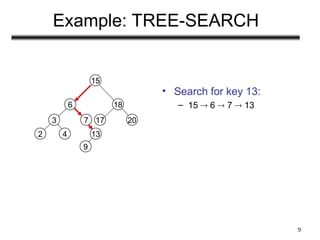
Alg: TREE-SEARCH(x, k)
1. if x = NIL or k = key [x]
2. then return x
3. if k < key [x]
4. then return TREE-SEARCH(left [x], k )
5. else return TREE-SEARCH(right [x], k )
Running Time: O (h),
h – the height of the tree
2
3
4
5
7
9
11.
11
Finding the Minimum
ina Binary Search Tree
• Goal: find the minimum value in a BST
– Following left child pointers from the root,
until a NIL is encountered
Alg: TREE-MINIMUM(x)
1. while left [x] NIL
2. do x left [x]
←
3. return x
Running time: O(h), h – height of tree
3
2 4
6
7
13
15
18
17 20
9
Minimum = 2
12.
12
Finding the Maximum
ina Binary Search Tree
3
2 4
6
7
13
15
18
17 20
9
Maximum = 20
• Goal: find the maximum value in a BST
– Following right child pointers from the root,
until a NIL is encountered
Alg: TREE-MAXIMUM(x)
1. while right [x] NIL
2. do x right [x]
←
3. return x
• Running time: O(h), h – height of tree
13.
13
Successor
Def: successor (x) = y, such that key [y] is the
smallest key > key [x]
• E.g.: successor (15) =
successor (13) =
successor (9) =
• Case 1: right (x) is non empty
– successor (x ) = the minimum in right (x)
• Case 2: right (x) is empty
– go up the tree until the current node is a left child:
successor (x ) is the parent of the current node
– if you cannot go further (and you reached the root):
x is the largest element
3
2 4
6
7
13
15
18
17 20
9
17
15
13
x
y
14.
14
Finding the Successor
Alg:TREE-SUCCESSOR(x)
1. if right [x] NIL
2. then return TREE-MINIMUM(right [x])
3. y p[x]
←
4. while y NIL and x = right [y]
5. do x y
←
6. y p[y]
←
7. return y
Running time: O (h), h – height of the tree
3
2 4
6
7
13
15
18
17 20
9
y
x
15.
15
Predecessor
Def: predecessor (x) = y, such that key [y] is the
biggest key < key [x]
• E.g.: predecessor (15) =
predecessor (9) =
predecessor (7) =
• Case 1: left (x) is non empty
– predecessor (x ) = the maximum in left (x)
• Case 2: left (x) is empty
– go up the tree until the current node is a right child:
predecessor (x ) is the parent of the current node
– if you cannot go further (and you reached the root):
x is the smallest element
3
2 4
6
7
13
15
18
17 20
9
13
7
6
x
y
16.
16
13
Insertion
• Goal:
– Insertvalue v into a binary search tree
• Idea:
– If key [x] < v move to the right child of x,
else move to the left child of x
– When x is NIL, we found the correct position
– If v < key [y] insert the new node as y’s left child
else insert it as y’s right child
– Begining at the root, go down the tree and maintain:
• Pointer x : traces the downward path (current node)
• Pointer y : parent of x (“trailing pointer” )
2
1 3
5
9
12
18
15 19
17
Insert value 13
17.
17
Example: TREE-INSERT
2
1 3
5
9
12
18
1519
17
x=root[T], y=NIL
Insert 13:
2
1 3
5
9
12
18
15 19
17
x
2
1 3
5
9
12
18
15 19
17
x
x = NIL
y = 15
13
2
1 3
5
9
12
18
15 19
17
y
y
18.
18
Alg: TREE-INSERT(T, z)
1.y NIL
←
2. x root [T]
←
3. while x ≠ NIL
4. do y x
←
5. if key [z] < key [x]
6. then x left [x]
←
7. else x right [x]
←
8. p[z] y
←
9. if y = NIL
10. then root [T] z
← Tree T was empty
11. else if key [z] < key [y]
12. then left [y] z
←
13. else right [y] z
←
2
1 3
5
9
12
18
15 19
17
13
Running time: O(h)
19.
19
Deletion
• Goal:
– Deletea given node z from a binary search tree
• Idea:
– Case 1: z has no children
• Delete z by making the parent of z point to NIL
15
16
20
18 23
6
5
12
3
7
10 13
delete
15
16
20
18 23
6
5
12
3
7
10
z
20.
20
Deletion
• Case 2:z has one child
– Delete z by making the parent of z point to z’s child,
instead of to z
15
16
20
18 23
6
5
12
3
7
10 13
delete 15
20
18 23
6
5
12
3
7
10
z
21.
21
Deletion
• Case 3:z has two children
– z’s successor (y) is the minimum node in z’s right subtree
– y has either no children or one right child (but no left child)
– Delete y from the tree (via Case 1 or 2)
– Replace z’s key and satellite data with y’s.
15
16
20
18 23
6
5
12
3
7
10 13
delete z
y
15
16
20
18 23
7
6
12
3
10 13
6
22.
22
TREE-DELETE(T, z)
1. ifleft[z] = NIL or right[z] = NIL
2. then y z
←
3. else y ← TREE-SUCCESSOR(z)
4. if left[y] NIL
5. then x left[y]
←
6. else x right[y]
←
7. if x NIL
8. then p[x] p[y]
←
z has one child
z has 2 children
15
16
20
18 23
6
5
12
3
7
10 13
y
x
23.
23
TREE-DELETE(T, z) –cont.
9. if p[y] = NIL
10. then root[T] x
←
11. else if y = left[p[y]]
12. then left[p[y]] x
←
13. else right[p[y]] x
←
14. if y z
15. then key[z] key[y]
←
16. copy y’s satellite data into z
17. return y
15
16
20
18 23
6
5
12
3
7
10 13
y
x
Running time: O(h)
24.
24
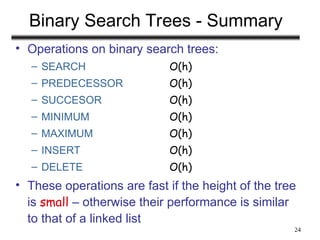
Binary Search Trees- Summary
• Operations on binary search trees:
– SEARCH O(h)
– PREDECESSOR O(h)
– SUCCESOR O(h)
– MINIMUM O(h)
– MAXIMUM O(h)
– INSERT O(h)
– DELETE O(h)
• These operations are fast if the height of the tree
is small – otherwise their performance is similar
to that of a linked list
25.
25
Problems
• Exercise 12.1-2(page 256) What is the
difference between the MAX-HEAP property and
the binary search tree property?
• Exercise 12.1-2 (page 256) Can the min-heap
property be used to print out the keys of an n-
node tree in sorted order in O(n) time?
• Can you use the heap property to design an
efficient algorithm that searches for an item in a
binary tree?
26.
26
Problems
• Let xbe the root node of a binary search tree
(BST). Write an algorithm BSTHeight(x) that
determines the height of the tree. What would be
its running time?
Alg: BSTHeight(x)
if (x==NULL)
return -1;
else
return max (BSTHeight(left[x]),
BSTHeight(right[x]))+1;
27.
27
Problems
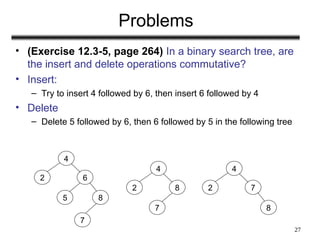
• (Exercise 12.3-5,page 264) In a binary search tree, are
the insert and delete operations commutative?
• Insert:
– Try to insert 4 followed by 6, then insert 6 followed by 4
• Delete
– Delete 5 followed by 6, then 6 followed by 5 in the following tree
4
2 6
5 8
7
4
2 8
7
4
2 7
8
![2
Binary Search Trees
• Tree representation:
– A linked data structure in which
each node is an object
• Node representation:
– Key field
– Satellite data
– Left: pointer to left child
– Right: pointer to right child
– p: pointer to parent (p [root [T]] =
NIL)
• Satisfies the binary-search-tree
property !!
Left child Right child
L R
parent
key data](https://image.slidesharecdn.com/binarysearchtrees1-250901030446-a66dae43/85/Binary-Search-Trees-Examples-and-Analysis-ppt-2-320.jpg)
![3
Binary Search Tree Property
• Binary search tree property:
– If y is in left subtree of x,
then key [y] ≤ key [x]
– If y is in right subtree of x,
then key [y] ≥ key [x]
2
3
5
5
7
9](https://image.slidesharecdn.com/binarysearchtrees1-250901030446-a66dae43/85/Binary-Search-Trees-Examples-and-Analysis-ppt-3-320.jpg)


![7
Traversing a Binary Search Tree
Alg: INORDER-TREE-WALK(x)
1. if x NIL
2. then INORDER-TREE-WALK ( left [x] )
3. print key [x]
4. INORDER-TREE-WALK ( right [x] )
• E.g.:
• Running time:
(n), where n is the size of the tree rooted at x
2
3
5
5
7
9
Output: 2 3 5 5 7 9](https://image.slidesharecdn.com/binarysearchtrees1-250901030446-a66dae43/85/Binary-Search-Trees-Examples-and-Analysis-ppt-7-320.jpg)
![8
Searching for a Key
• Given a pointer to the root of a tree and a key k:
– Return a pointer to a node with key k
if one exists
– Otherwise return NIL
• Idea
– Starting at the root: trace down a path by comparing k with the
key of the current node:
• If the keys are equal: we have found the key
• If k < key[x] search in the left subtree of x
• If k > key[x] search in the right subtree of x
2
3
4
5
7
9](https://image.slidesharecdn.com/binarysearchtrees1-250901030446-a66dae43/85/Binary-Search-Trees-Examples-and-Analysis-ppt-8-320.jpg)
![10
Searching for a Key
Alg: TREE-SEARCH(x, k)
1. if x = NIL or k = key [x]
2. then return x
3. if k < key [x]
4. then return TREE-SEARCH(left [x], k )
5. else return TREE-SEARCH(right [x], k )
Running Time: O (h),
h – the height of the tree
2
3
4
5
7
9](https://image.slidesharecdn.com/binarysearchtrees1-250901030446-a66dae43/85/Binary-Search-Trees-Examples-and-Analysis-ppt-10-320.jpg)
![11
Finding the Minimum
in a Binary Search Tree
• Goal: find the minimum value in a BST
– Following left child pointers from the root,
until a NIL is encountered
Alg: TREE-MINIMUM(x)
1. while left [x] NIL
2. do x left [x]
←
3. return x
Running time: O(h), h – height of tree
3
2 4
6
7
13
15
18
17 20
9
Minimum = 2](https://image.slidesharecdn.com/binarysearchtrees1-250901030446-a66dae43/85/Binary-Search-Trees-Examples-and-Analysis-ppt-11-320.jpg)
![12
Finding the Maximum
in a Binary Search Tree
3
2 4
6
7
13
15
18
17 20
9
Maximum = 20
• Goal: find the maximum value in a BST
– Following right child pointers from the root,
until a NIL is encountered
Alg: TREE-MAXIMUM(x)
1. while right [x] NIL
2. do x right [x]
←
3. return x
• Running time: O(h), h – height of tree](https://image.slidesharecdn.com/binarysearchtrees1-250901030446-a66dae43/85/Binary-Search-Trees-Examples-and-Analysis-ppt-12-320.jpg)
![13
Successor
Def: successor (x ) = y, such that key [y] is the
smallest key > key [x]
• E.g.: successor (15) =
successor (13) =
successor (9) =
• Case 1: right (x) is non empty
– successor (x ) = the minimum in right (x)
• Case 2: right (x) is empty
– go up the tree until the current node is a left child:
successor (x ) is the parent of the current node
– if you cannot go further (and you reached the root):
x is the largest element
3
2 4
6
7
13
15
18
17 20
9
17
15
13
x
y](https://image.slidesharecdn.com/binarysearchtrees1-250901030446-a66dae43/85/Binary-Search-Trees-Examples-and-Analysis-ppt-13-320.jpg)
![14
Finding the Successor
Alg: TREE-SUCCESSOR(x)
1. if right [x] NIL
2. then return TREE-MINIMUM(right [x])
3. y p[x]
←
4. while y NIL and x = right [y]
5. do x y
←
6. y p[y]
←
7. return y
Running time: O (h), h – height of the tree
3
2 4
6
7
13
15
18
17 20
9
y
x](https://image.slidesharecdn.com/binarysearchtrees1-250901030446-a66dae43/85/Binary-Search-Trees-Examples-and-Analysis-ppt-14-320.jpg)
![15
Predecessor
Def: predecessor (x ) = y, such that key [y] is the
biggest key < key [x]
• E.g.: predecessor (15) =
predecessor (9) =
predecessor (7) =
• Case 1: left (x) is non empty
– predecessor (x ) = the maximum in left (x)
• Case 2: left (x) is empty
– go up the tree until the current node is a right child:
predecessor (x ) is the parent of the current node
– if you cannot go further (and you reached the root):
x is the smallest element
3
2 4
6
7
13
15
18
17 20
9
13
7
6
x
y](https://image.slidesharecdn.com/binarysearchtrees1-250901030446-a66dae43/85/Binary-Search-Trees-Examples-and-Analysis-ppt-15-320.jpg)
![16
13
Insertion
• Goal:
– Insert value v into a binary search tree
• Idea:
– If key [x] < v move to the right child of x,
else move to the left child of x
– When x is NIL, we found the correct position
– If v < key [y] insert the new node as y’s left child
else insert it as y’s right child
– Begining at the root, go down the tree and maintain:
• Pointer x : traces the downward path (current node)
• Pointer y : parent of x (“trailing pointer” )
2
1 3
5
9
12
18
15 19
17
Insert value 13](https://image.slidesharecdn.com/binarysearchtrees1-250901030446-a66dae43/85/Binary-Search-Trees-Examples-and-Analysis-ppt-16-320.jpg)
![17
Example: TREE-INSERT
2
1 3
5
9
12
18
15 19
17
x=root[T], y=NIL
Insert 13:
2
1 3
5
9
12
18
15 19
17
x
2
1 3
5
9
12
18
15 19
17
x
x = NIL
y = 15
13
2
1 3
5
9
12
18
15 19
17
y
y](https://image.slidesharecdn.com/binarysearchtrees1-250901030446-a66dae43/85/Binary-Search-Trees-Examples-and-Analysis-ppt-17-320.jpg)
![18
Alg: TREE-INSERT(T, z)
1. y NIL
←
2. x root [T]
←
3. while x ≠ NIL
4. do y x
←
5. if key [z] < key [x]
6. then x left [x]
←
7. else x right [x]
←
8. p[z] y
←
9. if y = NIL
10. then root [T] z
← Tree T was empty
11. else if key [z] < key [y]
12. then left [y] z
←
13. else right [y] z
←
2
1 3
5
9
12
18
15 19
17
13
Running time: O(h)](https://image.slidesharecdn.com/binarysearchtrees1-250901030446-a66dae43/85/Binary-Search-Trees-Examples-and-Analysis-ppt-18-320.jpg)


![22
TREE-DELETE(T, z)
1. if left[z] = NIL or right[z] = NIL
2. then y z
←
3. else y ← TREE-SUCCESSOR(z)
4. if left[y] NIL
5. then x left[y]
←
6. else x right[y]
←
7. if x NIL
8. then p[x] p[y]
←
z has one child
z has 2 children
15
16
20
18 23
6
5
12
3
7
10 13
y
x](https://image.slidesharecdn.com/binarysearchtrees1-250901030446-a66dae43/85/Binary-Search-Trees-Examples-and-Analysis-ppt-22-320.jpg)
![23
TREE-DELETE(T, z) – cont.
9. if p[y] = NIL
10. then root[T] x
←
11. else if y = left[p[y]]
12. then left[p[y]] x
←
13. else right[p[y]] x
←
14. if y z
15. then key[z] key[y]
←
16. copy y’s satellite data into z
17. return y
15
16
20
18 23
6
5
12
3
7
10 13
y
x
Running time: O(h)](https://image.slidesharecdn.com/binarysearchtrees1-250901030446-a66dae43/85/Binary-Search-Trees-Examples-and-Analysis-ppt-23-320.jpg)

![26
Problems
• Let x be the root node of a binary search tree
(BST). Write an algorithm BSTHeight(x) that
determines the height of the tree. What would be
its running time?
Alg: BSTHeight(x)
if (x==NULL)
return -1;
else
return max (BSTHeight(left[x]),
BSTHeight(right[x]))+1;](https://image.slidesharecdn.com/binarysearchtrees1-250901030446-a66dae43/85/Binary-Search-Trees-Examples-and-Analysis-ppt-26-320.jpg)