Binary Search Tree
Preliminaries
Search
 Array
 List
 Stack?
 Queue?
 For large amounts of input, the linear access
  time of lists is prohibitive
Preliminaries
Tree
 A collection of nodes
 The collection can be empty
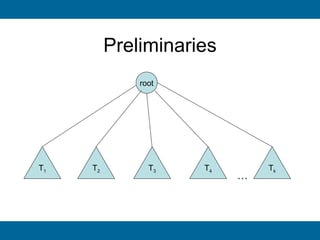
 Otherwise, the tree consists of a distinguished
  node r, called the root, and zero or more
  (sub)trees T1, T2, T3, …, Tk, each of whose
  roots are connected by a directed edge to r.
 The root of each subtree is said to be a child
  of r, and r is the parent of each subtree root
Preliminaries
              root


T1   T2         T3   T4       Tk
                          …
Preliminaries
Tree
 A tree is a collection of n nodes, one of which
  is the root, and n-1 edges.
   Each edge connects some node to its parent and
    every node except the root has one parent
Preliminaries
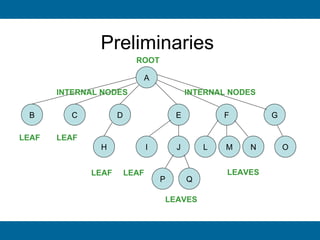
                           ROOT

                            A
       INTERNAL NODES                       INTERNAL NODES

 B       C           D                  E           F        G

LEAF   LEAF
               H                I       J       L   M   N        O


              LEAF       LEAF                       LEAVES
                                    P       Q

                                    LEAVES
Binary Tree
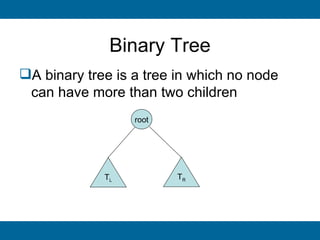
A binary tree is a tree in which no node
 can have more than two children
                  root


             TL          TR
Binary Tree
            A


    D               E


H       I       J       L


    P               Q
Implementation
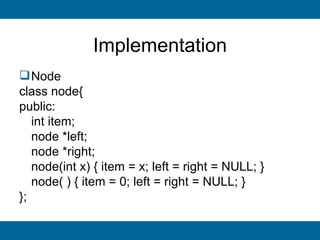
 Node
class node{
public:
   int item;
   node *left;
   node *right;
   node(int x) { item = x; left = right = NULL; }
   node( ) { item = 0; left = right = NULL; }
};
Expression Trees
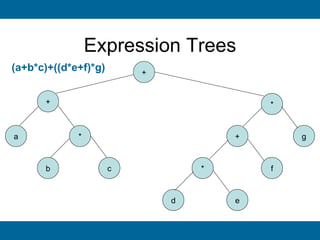
(a+b*c)+((d*e+f)*g)       +


      +                                   *


a            *                        +       g


      b               c           *       f


                              d       e
Binary Search Tree
 An application of binary trees is their use in
  searching
 Let us assume that each node in the tree is
  assigned a key value, and assume that this is an
  integer
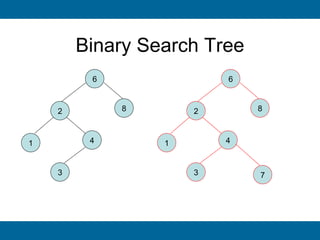
 The property that makes a binary tree into a
  binary search tree is that for every node, X, in
  the tree, the values of all keys in the left subtree
  are smaller than the key value in X, and the
  values of all keys in the right subtree are larger
  than the key value in X.
Binary Search Tree
         6               6


    2        8       2       8


1        4       1       4


    3                3       7
Binary Search Tree
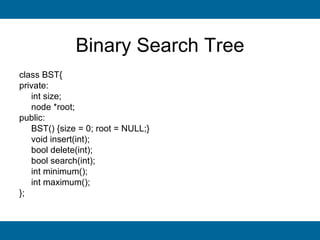
class BST{
private:
   int size;
   node *root;
public:
   BST() {size = 0; root = NULL;}
   void insert(int);
   bool delete(int);
   bool search(int);
   int minimum();
   int maximum();
};
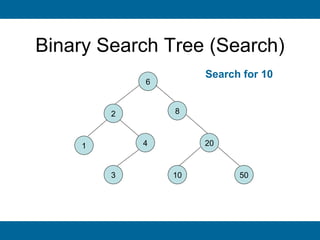
Binary Search Tree (Search)
                      Search for 10
             6


         2       8


     1       4        20


         3       10         50
Binary Search Tree (Search)
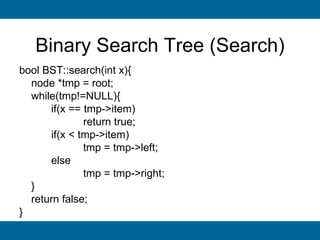
bool BST::search(int x){
  node *tmp = root;
  while(tmp!=NULL){
      if(x == tmp->item)
              return true;
      if(x < tmp->item)
              tmp = tmp->left;
      else
              tmp = tmp->right;
  }
  return false;
}
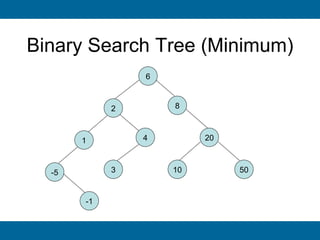
Binary Search Tree (Minimum)
                6


            2       8


       1        4        20


  -5        3       10        50


       -1
Binary Search Tree (Minimum)
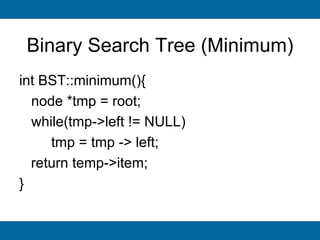
int BST::minimum(){
  node *tmp = root;
  while(tmp->left != NULL)
     tmp = tmp -> left;
  return temp->item;
}
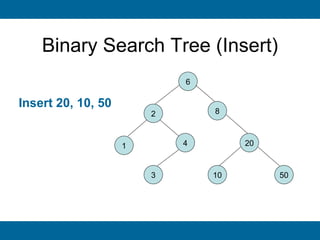
Binary Search Tree (Insert)
                            6

Insert 20, 10, 50
                        2       8


                    1       4        20


                        3       10        50
Binary Search Tree (Insert)
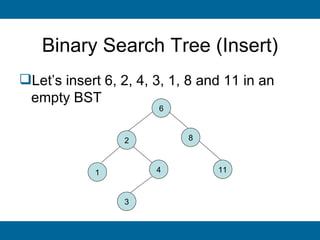
Let’s insert 6, 2, 4, 3, 1, 8 and 11 in an
 empty BST
                       6


                 2          8


            1          4         11


                 3
Binary Search Tree (Insert)
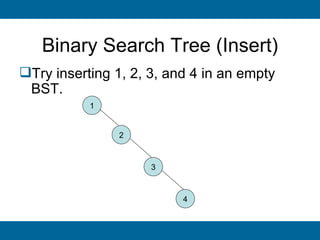
Try inserting 1, 2, 3, and 4 in an empty
 BST.
           1


                2


                     3


                          4
Binary Search Tree (Insert)
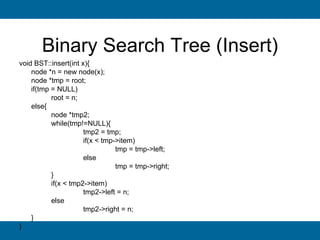
void BST::insert(int x){
    node *n = new node(x);
    node *tmp = root;
    if(tmp = NULL)
           root = n;
    else{
           node *tmp2;
           while(tmp!=NULL){
                      tmp2 = tmp;
                      if(x < tmp->item)
                                 tmp = tmp->left;
                      else
                                 tmp = tmp->right;
           }
           if(x < tmp2->item)
                      tmp2->left = n;
           else
                      tmp2->right = n;
    }
}
BST (Delete)
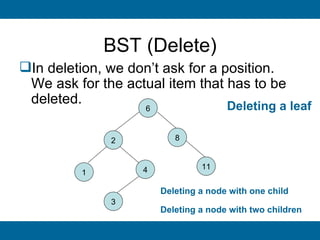
In deletion, we don’t ask for a position.
 We ask for the actual item that has to be
 deleted.                         Deleting a leaf
                     6


               2            8


                    4             11
          1

                         Deleting a node with one child
               3
                         Deleting a node with two children
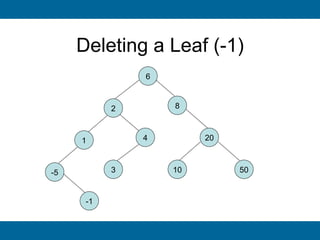
Deleting a Leaf (-1)
               6


           2       8


     1         4        20


-5         3       10        50


      -1
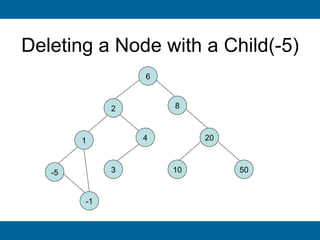
Deleting a Node with a Child(-5)
                 6


             2       8


        1        4        20


   -5        3       10        50


        -1
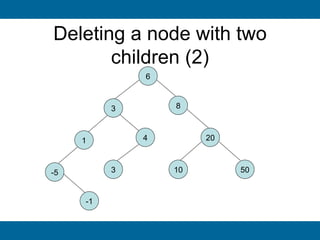
Deleting a node with two
       children (2)
              6


          3
          2       8


     1        4        20


-5        3       10        50


     -1
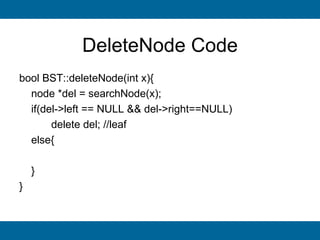
DeleteNode Code
bool BST::deleteNode(int x){
  node *del = searchNode(x);
  if(del->left == NULL && del->right==NULL)
       delete del; //leaf
  else{

    }
}
One Child
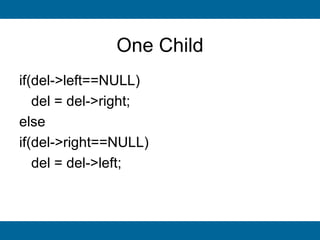
if(del->left==NULL)
   del = del->right;
else
if(del->right==NULL)
   del = del->left;
Two Children
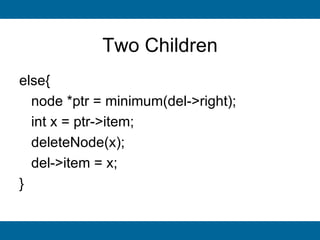
else{
  node *ptr = minimum(del->right);
  int x = ptr->item;
  deleteNode(x);
  del->item = x;
}
Running of Operations
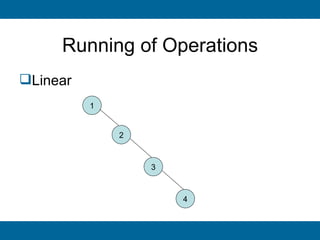
Linear
          1


              2


                  3


                      4
Discussion
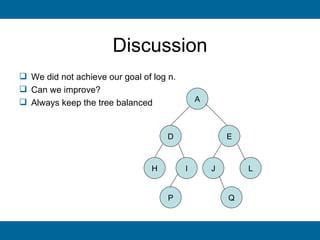
 We did not achieve our goal of log n.
 Can we improve?
 Always keep the tree balanced               A


                                     D                E


                                 H        I       J       L


                                     P                Q
Adelson-Velski Landis (AVL)
             Tree
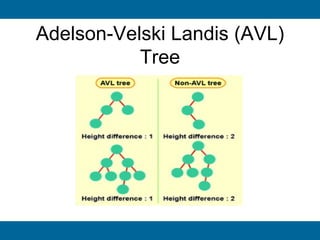
An AVL tree is a binary search tree where
 every node of the tree satisfies the
 following property:
  The height of the left and right subtrees of a
   node differs by at most one.
Adelson-Velski Landis (AVL)
           Tree
Adelson-Velski Landis (AVL)
              Tree
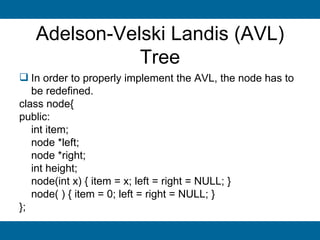
 In order to properly implement the AVL, the node has to
   be redefined.
class node{
public:
   int item;
   node *left;
   node *right;
   int height;
   node(int x) { item = x; left = right = NULL; }
   node( ) { item = 0; left = right = NULL; }
};
Adelson-Velski Landis (AVL)
               Tree
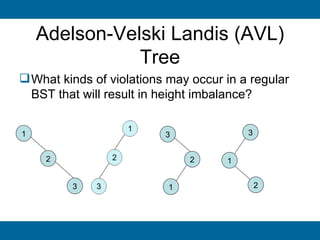
 What kinds of violations may occur in a regular
  BST that will result in height imbalance?


1                         3              3


     2                         2     1


         3                 1                 2
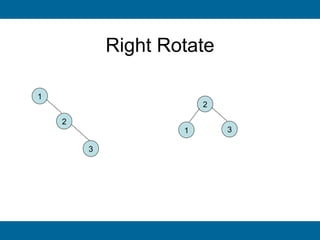
Right Rotate

1
                        2

    2
                    1       3

        3
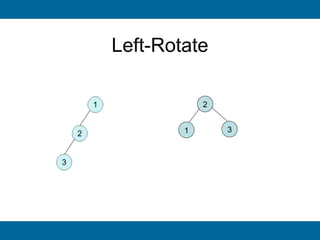
Left-Rotate

            2


        1       3
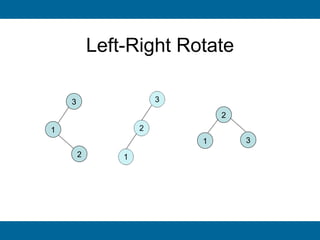
Left-Right Rotate

    3
                             2
1
                         1       3
        2
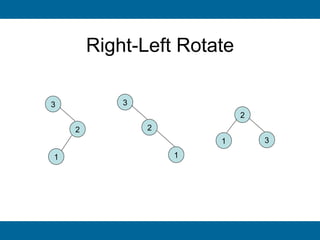
Right-Left Rotate

3           3
                            2
    2           2
                        1       3

1                   1
Challenge
Insert the following items in an AVL
  10, 20, 30, 40, 50, 60, 70, 80, 71, 61, 51, 41,
   31, 21, 11
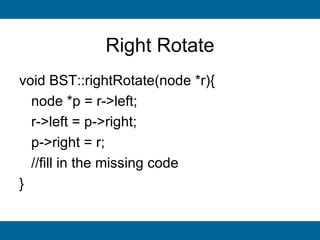
Right Rotate
void BST::rightRotate(node *r){
  node *p = r->left;
  r->left = p->right;
  p->right = r;
  //fill in the missing code
}
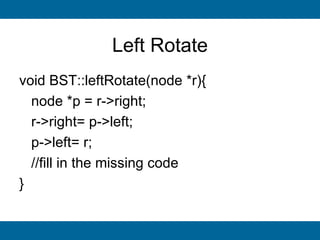
Left Rotate
void BST::leftRotate(node *r){
  node *p = r->right;
  r->right= p->left;
  p->left= r;
  //fill in the missing code
}
Other Rotations
I leave this as an exercise
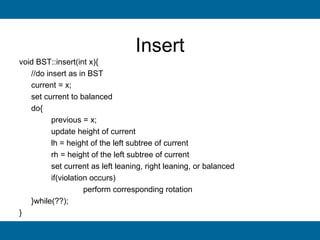
Insert
void BST::insert(int x){
   //do insert as in BST
   current = x;
   set current to balanced
   do{
          previous = x;
          update height of current
          lh = height of the left subtree of current
          rh = height of the left subtree of current
          set current as left leaning, right leaning, or balanced
          if(violation occurs)
                     perform corresponding rotation
   }while(??);
}

Binary Search Tree and AVL

  • 1.
  • 2.
    Preliminaries Search Array List Stack? Queue? For large amounts of input, the linear access time of lists is prohibitive
  • 3.
    Preliminaries Tree A collectionof nodes The collection can be empty Otherwise, the tree consists of a distinguished node r, called the root, and zero or more (sub)trees T1, T2, T3, …, Tk, each of whose roots are connected by a directed edge to r. The root of each subtree is said to be a child of r, and r is the parent of each subtree root
  • 4.
    Preliminaries root T1 T2 T3 T4 Tk …
  • 5.
    Preliminaries Tree A treeis a collection of n nodes, one of which is the root, and n-1 edges. Each edge connects some node to its parent and every node except the root has one parent
  • 6.
    Preliminaries ROOT A INTERNAL NODES INTERNAL NODES B C D E F G LEAF LEAF H I J L M N O LEAF LEAF LEAVES P Q LEAVES
  • 7.
    Binary Tree A binarytree is a tree in which no node can have more than two children root TL TR
  • 8.
    Binary Tree A D E H I J L P Q
  • 9.
    Implementation  Node class node{ public: int item; node *left; node *right; node(int x) { item = x; left = right = NULL; } node( ) { item = 0; left = right = NULL; } };
  • 10.
    Expression Trees (a+b*c)+((d*e+f)*g) + + * a * + g b c * f d e
  • 11.
    Binary Search Tree An application of binary trees is their use in searching  Let us assume that each node in the tree is assigned a key value, and assume that this is an integer  The property that makes a binary tree into a binary search tree is that for every node, X, in the tree, the values of all keys in the left subtree are smaller than the key value in X, and the values of all keys in the right subtree are larger than the key value in X.
  • 12.
    Binary Search Tree 6 6 2 8 2 8 1 4 1 4 3 3 7
  • 13.
    Binary Search Tree classBST{ private: int size; node *root; public: BST() {size = 0; root = NULL;} void insert(int); bool delete(int); bool search(int); int minimum(); int maximum(); };
  • 14.
    Binary Search Tree(Search) Search for 10 6 2 8 1 4 20 3 10 50
  • 15.
    Binary Search Tree(Search) bool BST::search(int x){ node *tmp = root; while(tmp!=NULL){ if(x == tmp->item) return true; if(x < tmp->item) tmp = tmp->left; else tmp = tmp->right; } return false; }
  • 16.
    Binary Search Tree(Minimum) 6 2 8 1 4 20 -5 3 10 50 -1
  • 17.
    Binary Search Tree(Minimum) int BST::minimum(){ node *tmp = root; while(tmp->left != NULL) tmp = tmp -> left; return temp->item; }
  • 18.
    Binary Search Tree(Insert) 6 Insert 20, 10, 50 2 8 1 4 20 3 10 50
  • 19.
    Binary Search Tree(Insert) Let’s insert 6, 2, 4, 3, 1, 8 and 11 in an empty BST 6 2 8 1 4 11 3
  • 20.
    Binary Search Tree(Insert) Try inserting 1, 2, 3, and 4 in an empty BST. 1 2 3 4
  • 21.
    Binary Search Tree(Insert) void BST::insert(int x){ node *n = new node(x); node *tmp = root; if(tmp = NULL) root = n; else{ node *tmp2; while(tmp!=NULL){ tmp2 = tmp; if(x < tmp->item) tmp = tmp->left; else tmp = tmp->right; } if(x < tmp2->item) tmp2->left = n; else tmp2->right = n; } }
  • 22.
    BST (Delete) In deletion,we don’t ask for a position. We ask for the actual item that has to be deleted. Deleting a leaf 6 2 8 4 11 1 Deleting a node with one child 3 Deleting a node with two children
  • 23.
    Deleting a Leaf(-1) 6 2 8 1 4 20 -5 3 10 50 -1
  • 24.
    Deleting a Nodewith a Child(-5) 6 2 8 1 4 20 -5 3 10 50 -1
  • 25.
    Deleting a nodewith two children (2) 6 3 2 8 1 4 20 -5 3 10 50 -1
  • 26.
    DeleteNode Code bool BST::deleteNode(intx){ node *del = searchNode(x); if(del->left == NULL && del->right==NULL) delete del; //leaf else{ } }
  • 27.
    One Child if(del->left==NULL) del = del->right; else if(del->right==NULL) del = del->left;
  • 28.
    Two Children else{ node *ptr = minimum(del->right); int x = ptr->item; deleteNode(x); del->item = x; }
  • 29.
  • 30.
    Discussion  We didnot achieve our goal of log n.  Can we improve?  Always keep the tree balanced A D E H I J L P Q
  • 31.
    Adelson-Velski Landis (AVL) Tree An AVL tree is a binary search tree where every node of the tree satisfies the following property: The height of the left and right subtrees of a node differs by at most one.
  • 32.
  • 33.
    Adelson-Velski Landis (AVL) Tree  In order to properly implement the AVL, the node has to be redefined. class node{ public: int item; node *left; node *right; int height; node(int x) { item = x; left = right = NULL; } node( ) { item = 0; left = right = NULL; } };
  • 34.
    Adelson-Velski Landis (AVL) Tree  What kinds of violations may occur in a regular BST that will result in height imbalance? 1 3 3 2 2 1 3 1 2
  • 35.
    Right Rotate 1 2 2 1 3 3
  • 36.
  • 37.
    Left-Right Rotate 3 2 1 1 3 2
  • 38.
    Right-Left Rotate 3 3 2 2 2 1 3 1 1
  • 39.
    Challenge Insert the followingitems in an AVL 10, 20, 30, 40, 50, 60, 70, 80, 71, 61, 51, 41, 31, 21, 11
  • 40.
    Right Rotate void BST::rightRotate(node*r){ node *p = r->left; r->left = p->right; p->right = r; //fill in the missing code }
  • 41.
    Left Rotate void BST::leftRotate(node*r){ node *p = r->right; r->right= p->left; p->left= r; //fill in the missing code }
  • 42.
    Other Rotations I leavethis as an exercise
  • 43.
    Insert void BST::insert(int x){ //do insert as in BST current = x; set current to balanced do{ previous = x; update height of current lh = height of the left subtree of current rh = height of the left subtree of current set current as left leaning, right leaning, or balanced if(violation occurs) perform corresponding rotation }while(??); }