*
What Is Binary Tree?
*A binary tree is made of nodes, where each node
contains a "left" pointer, a "right" pointer, and a
data element. The "root" pointer points to the
topmost node in the tree. The left and right
pointers recursively point to smaller "sub-trees" on
either side. A null pointer represents a binary tree
with no elements -- the empty tree. The formal
recursive definition is: a binary tree is either empty
(represented by a null pointer), or is made of a
single node, where the left and right pointers
(recursive definition ahead) each point to a binary
tree.
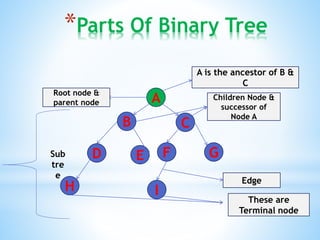
*Parts Of Binary Tree
A
B C
FD GE
H I
Root node &
parent node
Children Node &
successor of
Node A
Sub
tre
e
A is the ancestor of B &
C
Edge
These are
Terminal node
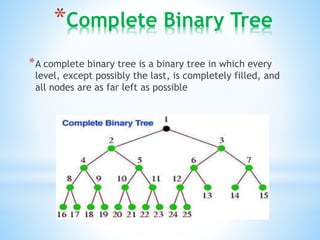
*Complete Binary Tree
*A complete binary tree is a binary tree in which every
level, except possibly the last, is completely filled, and
all nodes are as far left as possible
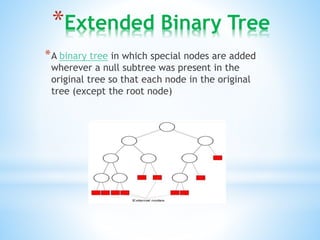
*Extended Binary Tree
*A binary tree in which special nodes are added
wherever a null subtree was present in the
original tree so that each node in the original
tree (except the root node)
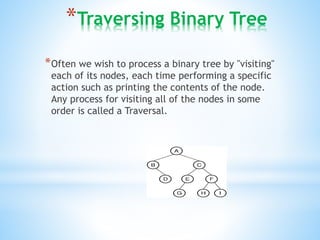
*Traversing Binary Tree
*Often we wish to process a binary tree by "visiting"
each of its nodes, each time performing a specific
action such as printing the contents of the node.
Any process for visiting all of the nodes in some
order is called a Traversal.
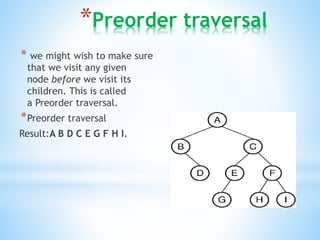
*Preorder traversal
* we might wish to make sure
that we visit any given
node before we visit its
children. This is called
a Preorder traversal.
*Preorder traversal
Result:A B D C E G F H I.
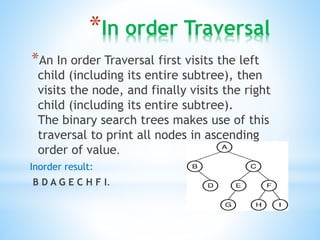
*In order Traversal
*An In order Traversal first visits the left
child (including its entire subtree), then
visits the node, and finally visits the right
child (including its entire subtree).
The binary search trees makes use of this
traversal to print all nodes in ascending
order of value.
Inorder result:
B D A G E C H F I.
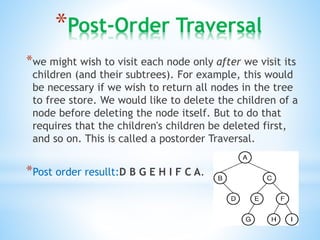
*Post-Order Traversal
*we might wish to visit each node only after we visit its
children (and their subtrees). For example, this would
be necessary if we wish to return all nodes in the tree
to free store. We would like to delete the children of a
node before deleting the node itself. But to do that
requires that the children's children be deleted first,
and so on. This is called a postorder Traversal.
*Post order resullt:D B G E H I F C A.
*Depth Of Node
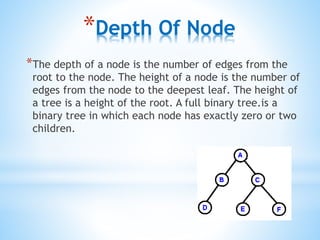
*The depth of a node is the number of edges from the
root to the node. The height of a node is the number of
edges from the node to the deepest leaf. The height of
a tree is a height of the root. A full binary tree.is a
binary tree in which each node has exactly zero or two
children.
*Degree Of Tree
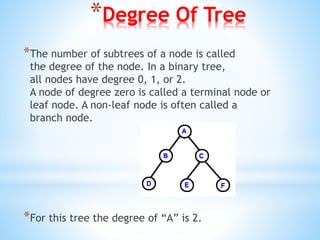
*The number of subtrees of a node is called
the degree of the node. In a binary tree,
all nodes have degree 0, 1, or 2.
A node of degree zero is called a terminal node or
leaf node. A non-leaf node is often called a
branch node.
*For this tree the degree of “A” is 2.
*Height Of Tree
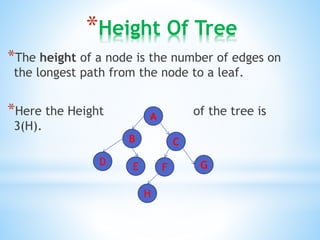
*The height of a node is the number of edges on
the longest path from the node to a leaf.
*Here the Height of the tree is
3(H).
A
CB
GD E F
H
*Binary Search Tree
*A binary search tree (BST) is a binary
tree where each node has a Comparable
key (and an associated value) and satisfies
the restriction that the key in any node is
larger than the keys in all nodes in that
node's left subtree and smaller than the
keys in all nodes in that node's right
subtree.
*Heap
*A binary heap is a complete binary tree
which satisfies the heap ordering property.
The ordering can be one of two.
1.Max heap
2.Min heap
*Max Heap
*A max-heap is a complete binary tree in which the value in each
internal node is greater than or equal to the values in the
children of that node.
*Min Heap
*the value of each node is greater than or equal
to the value of its parent, with the minimum-
value element at the root.

Binary tree and Binary search tree

  • 1.
  • 2.
    What Is BinaryTree? *A binary tree is made of nodes, where each node contains a "left" pointer, a "right" pointer, and a data element. The "root" pointer points to the topmost node in the tree. The left and right pointers recursively point to smaller "sub-trees" on either side. A null pointer represents a binary tree with no elements -- the empty tree. The formal recursive definition is: a binary tree is either empty (represented by a null pointer), or is made of a single node, where the left and right pointers (recursive definition ahead) each point to a binary tree.
  • 3.
    *Parts Of BinaryTree A B C FD GE H I Root node & parent node Children Node & successor of Node A Sub tre e A is the ancestor of B & C Edge These are Terminal node
  • 4.
    *Complete Binary Tree *Acomplete binary tree is a binary tree in which every level, except possibly the last, is completely filled, and all nodes are as far left as possible
  • 5.
    *Extended Binary Tree *Abinary tree in which special nodes are added wherever a null subtree was present in the original tree so that each node in the original tree (except the root node)
  • 6.
    *Traversing Binary Tree *Oftenwe wish to process a binary tree by "visiting" each of its nodes, each time performing a specific action such as printing the contents of the node. Any process for visiting all of the nodes in some order is called a Traversal.
  • 7.
    *Preorder traversal * wemight wish to make sure that we visit any given node before we visit its children. This is called a Preorder traversal. *Preorder traversal Result:A B D C E G F H I.
  • 8.
    *In order Traversal *AnIn order Traversal first visits the left child (including its entire subtree), then visits the node, and finally visits the right child (including its entire subtree). The binary search trees makes use of this traversal to print all nodes in ascending order of value. Inorder result: B D A G E C H F I.
  • 9.
    *Post-Order Traversal *we mightwish to visit each node only after we visit its children (and their subtrees). For example, this would be necessary if we wish to return all nodes in the tree to free store. We would like to delete the children of a node before deleting the node itself. But to do that requires that the children's children be deleted first, and so on. This is called a postorder Traversal. *Post order resullt:D B G E H I F C A.
  • 10.
    *Depth Of Node *Thedepth of a node is the number of edges from the root to the node. The height of a node is the number of edges from the node to the deepest leaf. The height of a tree is a height of the root. A full binary tree.is a binary tree in which each node has exactly zero or two children.
  • 11.
    *Degree Of Tree *Thenumber of subtrees of a node is called the degree of the node. In a binary tree, all nodes have degree 0, 1, or 2. A node of degree zero is called a terminal node or leaf node. A non-leaf node is often called a branch node. *For this tree the degree of “A” is 2.
  • 12.
    *Height Of Tree *Theheight of a node is the number of edges on the longest path from the node to a leaf. *Here the Height of the tree is 3(H). A CB GD E F H
  • 13.
    *Binary Search Tree *Abinary search tree (BST) is a binary tree where each node has a Comparable key (and an associated value) and satisfies the restriction that the key in any node is larger than the keys in all nodes in that node's left subtree and smaller than the keys in all nodes in that node's right subtree.
  • 14.
    *Heap *A binary heapis a complete binary tree which satisfies the heap ordering property. The ordering can be one of two. 1.Max heap 2.Min heap
  • 15.
    *Max Heap *A max-heapis a complete binary tree in which the value in each internal node is greater than or equal to the values in the children of that node.
  • 16.
    *Min Heap *the valueof each node is greater than or equal to the value of its parent, with the minimum- value element at the root.