Topic :- Granularity of TT Process
(API, excipients, finished products, packaging materials)
1
Ganesh Devane
Active Pharmaceutical Ingredients (API)
The complete API master file, Drug Master File (DMF) and relevant
auxiliary information of API which are important for the manufacturing
process should be provided by the SU to RU.
Some important information is mentioned below.
Details of API manufacturer and supplier.
Detail scheme of synthesis, process outline, raw materials, process
control. Intermediate products.
2
Granularity: the scale or level of detail in a set of data.
•Disintegration profile.
•Nature of hygroscopicity.
•Water content.
•Loss on drying.
•Limit of impurities.
• Environmental factors.
• Stability studies.
• Storage and handling guidance mentioned in Pharmacopoeias.
•Physicochemical parameters like solubility, partition coefficient of Determination).
•Particle size distribution.
•Bulk and tap density with detail method of evaluation
3
Complete information of API for formulation process.
It includes: -
Excipients
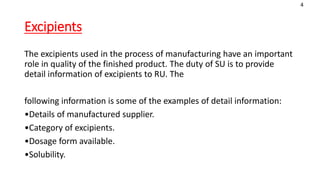
The excipients used in the process of manufacturing have an important
role in quality of the finished product. The duty of SU is to provide
detail information of excipients to RU. The
following information is some of the examples of detail information:
•Details of manufactured supplier.
•Category of excipients.
•Dosage form available.
•Solubility.
4
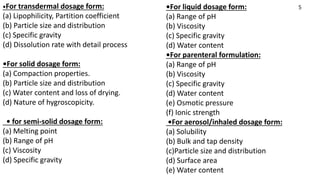
•For liquid dosage form:
(a) Range of pH
(b) Viscosity
(c) Specific gravity
(d) Water content
•For parenteral formulation:
(a) Range of pH
(b) Viscosity
(c) Specific gravity
(d) Water content
(e) Osmotic pressure
(f) Ionic strength
•For aerosol/inhaled dosage form:
(a) Solubility
(b) Bulk and tap density
(c)Particle size and distribution
(d) Surface area
(e) Water content
•For transdermal dosage form:
(a) Lipophilicity, Partition coefficient
(b) Particle size and distribution
(c) Specific gravity
(d) Dissolution rate with detail process
•For solid dosage form:
(a) Compaction properties.
(b) Particle size and distribution
(c) Water content and loss of drying.
(d) Nature of hygroscopicity.
• for semi-solid dosage form:
(a) Melting point
(b) Range of pH
(c) Viscosity
(d) Specific gravity
5
Finished Products :-
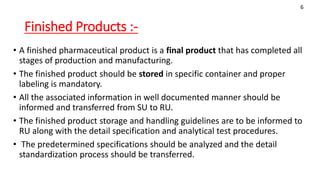
• A finished pharmaceutical product is a final product that has completed all
stages of production and manufacturing.
• The finished product should be stored in specific container and proper
labeling is mandatory.
• All the associated information in well documented manner should be
informed and transferred from SU to RU.
• The finished product storage and handling guidelines are to be informed to
RU along with the detail specification and analytical test procedures.
• The predetermined specifications should be analyzed and the detail
standardization process should be transferred.
6
Packaging :-
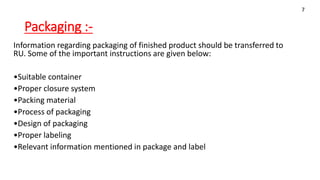
Information regarding packaging of finished product should be transferred to
RU. Some of the important instructions are given below:
•Suitable container
•Proper closure system
•Packing material
•Process of packaging
•Design of packaging
•Proper labeling
•Relevant information mentioned in package and label
7
• The information provided by SU should be analyzed at RU for packaging
either the packaging is suitable, safe, protective and compatible to the
finished product or not.
• Packaging should be suggested in such a manner that the final product
should not decompose or affected by the environmental factors.
• The product should not be oxidized and should be protected from sunlight.
• The formation of undesired substance can make the product spurious and
toxic.
• The container should not react with the product and the efficacy of the
product should not be altered by any means after packaging.
______________________________________________________________________________
8
Reference :-
Dr. K.P. Sampath Kumar ,Dr. Debjit Bhowmik, Rishab Bhanot , Shambaditya Goswami
Industrial Pharmacy – II, Page no 2.6 - 2.8

Granularity of tt pro.

  • 1.
    Topic :- Granularityof TT Process (API, excipients, finished products, packaging materials) 1 Ganesh Devane
  • 2.
    Active Pharmaceutical Ingredients(API) The complete API master file, Drug Master File (DMF) and relevant auxiliary information of API which are important for the manufacturing process should be provided by the SU to RU. Some important information is mentioned below. Details of API manufacturer and supplier. Detail scheme of synthesis, process outline, raw materials, process control. Intermediate products. 2 Granularity: the scale or level of detail in a set of data.
  • 3.
    •Disintegration profile. •Nature ofhygroscopicity. •Water content. •Loss on drying. •Limit of impurities. • Environmental factors. • Stability studies. • Storage and handling guidance mentioned in Pharmacopoeias. •Physicochemical parameters like solubility, partition coefficient of Determination). •Particle size distribution. •Bulk and tap density with detail method of evaluation 3 Complete information of API for formulation process. It includes: -
  • 4.
    Excipients The excipients usedin the process of manufacturing have an important role in quality of the finished product. The duty of SU is to provide detail information of excipients to RU. The following information is some of the examples of detail information: •Details of manufactured supplier. •Category of excipients. •Dosage form available. •Solubility. 4
  • 5.
    •For liquid dosageform: (a) Range of pH (b) Viscosity (c) Specific gravity (d) Water content •For parenteral formulation: (a) Range of pH (b) Viscosity (c) Specific gravity (d) Water content (e) Osmotic pressure (f) Ionic strength •For aerosol/inhaled dosage form: (a) Solubility (b) Bulk and tap density (c)Particle size and distribution (d) Surface area (e) Water content •For transdermal dosage form: (a) Lipophilicity, Partition coefficient (b) Particle size and distribution (c) Specific gravity (d) Dissolution rate with detail process •For solid dosage form: (a) Compaction properties. (b) Particle size and distribution (c) Water content and loss of drying. (d) Nature of hygroscopicity. • for semi-solid dosage form: (a) Melting point (b) Range of pH (c) Viscosity (d) Specific gravity 5
  • 6.
    Finished Products :- •A finished pharmaceutical product is a final product that has completed all stages of production and manufacturing. • The finished product should be stored in specific container and proper labeling is mandatory. • All the associated information in well documented manner should be informed and transferred from SU to RU. • The finished product storage and handling guidelines are to be informed to RU along with the detail specification and analytical test procedures. • The predetermined specifications should be analyzed and the detail standardization process should be transferred. 6
  • 7.
    Packaging :- Information regardingpackaging of finished product should be transferred to RU. Some of the important instructions are given below: •Suitable container •Proper closure system •Packing material •Process of packaging •Design of packaging •Proper labeling •Relevant information mentioned in package and label 7
  • 8.
    • The informationprovided by SU should be analyzed at RU for packaging either the packaging is suitable, safe, protective and compatible to the finished product or not. • Packaging should be suggested in such a manner that the final product should not decompose or affected by the environmental factors. • The product should not be oxidized and should be protected from sunlight. • The formation of undesired substance can make the product spurious and toxic. • The container should not react with the product and the efficacy of the product should not be altered by any means after packaging. ______________________________________________________________________________ 8
  • 9.
    Reference :- Dr. K.P.Sampath Kumar ,Dr. Debjit Bhowmik, Rishab Bhanot , Shambaditya Goswami Industrial Pharmacy – II, Page no 2.6 - 2.8