Unit V
Quality Management
System
Content
 Concept of quality
 Total Quality Management
 Quality by Design
 Six sigma concept
 Out of specification
 Change control
 Introduction to ISO 9000 series of quality systems standards,
 ISO 14000,
 NABL
 GLP
1.Concept of quality
Quality is the degree to which an object or entity (e.g., process, product,
or service) satisfies a specified set of attributes or requirements. ...
Quality is the degree to which a set of inherent characteristics fulfils
requirements.
Definition:-
Every pharmaceutical product must meet identity, strength, safety, and
purity to achieve the desired effectiveness of the product.
Importance of Quality:
 Lower costs (less labor, rework, scrap)
 Motivated employees
 Market Share
 Reputation
 International competitiveness
 Revenues generation increased (ultimate goal)
 Provide high quality of drug product
 Reduce the no of recalls, returned
 Achieve success in business
2.Total Quality Management (TQM)
 Total –Made up of the whole(or) Complete.
 Quality –Degree of Excellence a product or service provides to the
customer in present and future.
 Management –Act , art, or manner of handling , controlling,
directing, etc.
 TQM is the art of managing the whole to achieve excellence
 Definition: Total Quality Management(TQM) is a management
strategy aimed at embedding awareness of quality in all organizational
processes.
 A core definition of total quality management (TQM) describes a
management approach to long-term success through customer
satisfaction.
 In a TQM effort, all members of an organization participate in
improving processes, products, services, and the culture in which
they work.
 Characteristics :
• Technological Strength, hardness, surface finish
• Time – oriented Reliability, maintainability - availability
• Contractual Guarantee.
8 Principles Of Total Quality Management:
1. Customer-focused:
2. Total employee involvement:
3. Process-centered:
4. Integrated system:
5. Strategic and systematic approach:
6. Continual improvement:
7. Fact-based decision making:
8. Communications:
Total Quality Management and Continuous Improvement
 TQM is the management process used to make continuous
improvements to all functions.
 TQM represents an ongoing, continuous commitment to
improvement.
 The foundation of total quality is a management philosophy that
supports meeting customer requirements through continuous
improvement.
Quality Cost
1. Prevention Cost –
2. Appraisal Cost-
3. Internal Failure Cost –
4. External Failure Cost –
Benefits of quality
 Improved quality
 Employee participation
 Less migration of employee
 Team work
 Internal external customer satisfaction
 Productivity with connectivity
 Profitability & increase market share
3.Quality by Design (QbD)
 QbD it is the part of ICH guideline Q8 pharmaceutical Development in
that Q8(R2).
 Quality by Design means designing and developing the pharmaceutical
product development stage to achieve characterisation in the product.
Objective of QbD
 The main objective of QbD is to achieve the quality products.
 To achieve positive performance testing.
 Ensures combination of product and process knowledge gained
during development.
 From knowledge of data process desired attributes may be
constructed.
Benefits of QBD for Industry
 Eliminate batch failures.
 Minimize deviations and costly investigations.
 Empowerment of technical staff.
 Increase manufacturing efficiency, reduce costs and project
rejections and waste.
 Better understanding of the process.
 Continuous improvement.
 Ensure better design of product with less problem.
Primary QbD Documents
1. Risk Assessment Report(s)
1. Performed throughout QbD Process
2. Particularly important to process development
2. Quality Target Product Profile (QTPP)
1. Defines the desired product characteristics and sets development goals.
3. Control Strategy Summary
1. Defines the process, its inputs and outputs, and how it is controlled.
4. PPQ Report(s)
1. Formal verification that the process Control Strategy has been defined appropriately and repeatedly
produces the desired results.
5. Continued Process Verification (CPV) Reports
1. Assuring that during routine commercial production, the process remains in a state of control (FDA);
involves feedback loops into the QbD “process” where intentional process changes and/or observed
variability is assessed for risk, characterized, re-validated, etc
4.Six sigma concept
 Six sigma is a business statistical Strategy.
 Is to identifying defects and removing them from the process of
products to improve quality.
 A defect is defined as any process output that does not meet
customer specifications.
 Statistical measure to objectively evaluate processes.
History of Six Sigma
 The Six sigma was founded by Motorola in the 1970s.
 Out of senior executive Art Sundry's criticism of Motorola’s bad
quality.
 They founded a connection between increases in quality and
decreases in costs of production.
 Bill Smith, “Father of six sigma” introduce this quality
improvement Methodology to Motorola
What Is Six Sigma?
 Six Sigma is a quality-control methodology developed in 1986 by
Motorola, Inc.
 The method uses a data-driven review to limit mistakes or defects
in a corporate or business process.
 Six Sigma emphasizes cycle-time improvement while at the same
time reducing manufacturing defects to a level of no more than
3.4 occurrences per million units or events.
 In other words, the system is a method to work faster with fewer
mistakes.
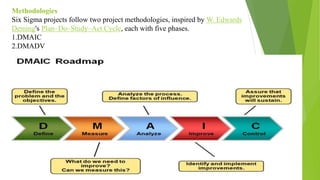
Methodologies
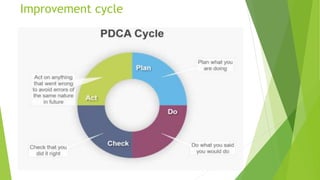
Six Sigma projects follow two project methodologies, inspired by W. Edwards
Deming's Plan–Do–Study–Act Cycle, each with five phases.
1.DMAIC
2.DMADV
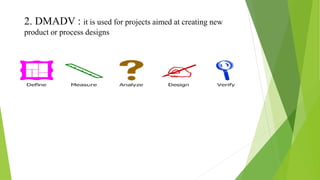
2. DMADV : it is used for projects aimed at creating new
product or process designs
Improvement cycle
 Software used for Six Sigma
 Arena
 ARIS Six Sigma
 Bonita Open Solution BPMN2 standard and KPIs for statistic
monitoring
 JMP
 Mathematical
 MATLAB or GNU Octave
 Microsoft Visio
 STATA
 STATISTICA
Case Study
 Six Sigma was introduced into Korea in 1997.
 The First National Quality Prize of Six Sigma was given to two
companies.
 One is Samsung and other is LG electronics ; which are virtually the
leader of six sigma in Korea. Samsung SDI was founded in 1970 as a
producer of the black/white Braun tube.
 It began to produce the color Braun tube from 1980, and now it is the
number one company for braun tubes in the world. The market share of
Braun tubes is 22%. The major products are CDT (color display tube),
CPT (color picture tube), LCD (liquid crystal display), VFD (vacuum
fluorescent display), C/F (color filter), li-ion battery and PDP (plasma
display panel).
 The total sales volume is about $4.4 billion and the total number of
employees is about 18,000 including 8,000 domestic employees. It has six
overseas subsidiaries in Mexico, China, Germany, Malaysia and Brazil.
5.Out of specification
 Definition If the analytical result(s) of a batch or material is/are
falling out side of the established specification ranges, is called /
considered as Out of Specification.
Or
 The term OOS test results includes all suspect results that fall outside
the predetermined Specification
Out of Specifications
There are lot of guidelines are available for defining to handle the
OOS products/materials/batches as:
MHRA guideline for OOS
CDER guideline for OOS
PIC/S guideline for OOS
 The OOS may be observed during the analysis of:
1. Stability study
2. Finished API
3. Intermediates
4. In-process
5. Raw materials
6. Packing materials
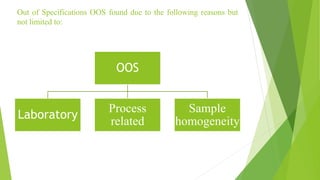
Out of Specifications OOS found due to the following reasons but
not limited to:
OOS
Laboratory
Process
related
Sample
homogeneity
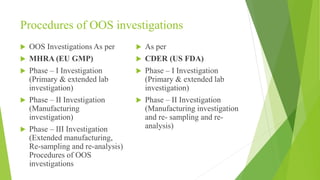
Procedures of OOS investigations
 OOS Investigations As per
 MHRA (EU GMP)
 Phase – I Investigation
(Primary & extended lab
investigation)
 Phase – II Investigation
(Manufacturing
investigation)
 Phase – III Investigation
(Extended manufacturing,
Re-sampling and re-analysis)
Procedures of OOS
investigations
 As per
 CDER (US FDA)
 Phase – I Investigation
(Primary & extended lab
investigation)
 Phase – II Investigation
(Manufacturing investigation
and re- sampling and re-
analysis)
1. MHRA (EU GMP)
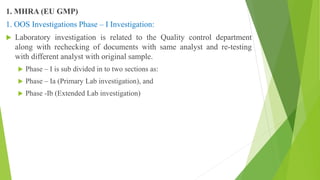
1. OOS Investigations Phase – I Investigation:
 Laboratory investigation is related to the Quality control department
along with rechecking of documents with same analyst and re-testing
with different analyst with original sample.
 Phase – I is sub divided in to two sections as:
 Phase – Ia (Primary Lab investigation), and
 Phase -Ib (Extended Lab investigation)
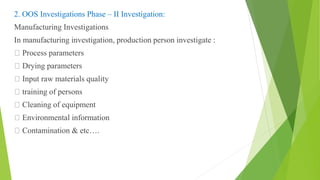
2. OOS Investigations Phase – II Investigation:
Manufacturing Investigations
In manufacturing investigation, production person investigate :
Process parameters
Drying parameters
Input raw materials quality
training of persons
Cleaning of equipment
Environmental information
Contamination & etc….
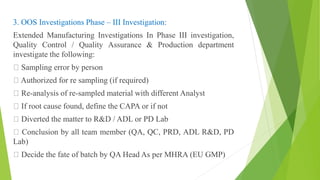
3. OOS Investigations Phase – III Investigation:
Extended Manufacturing Investigations In Phase III investigation,
Quality Control / Quality Assurance & Production department
investigate the following:
Sampling error by person
Authorized for re sampling (if required)
Re-analysis of re-sampled material with different Analyst
If root cause found, define the CAPA or if not
Diverted the matter to R&D / ADL or PD Lab
Conclusion by all team member (QA, QC, PRD, ADL R&D, PD
Lab)
Decide the fate of batch by QA Head As per MHRA (EU GMP)
2. CDER (US FDA)
OOS Investigations
1. Phase – I Investigation: Laboratory investigation is related to the
Quality control department along with rechecking of documents
with same analyst and re-testing with different analyst with original
sample.
2. Phase – II Investigation: Manufacturing investigation Process related
investigation is to be carried out by Production department along
with re-sampling and re- analysis.
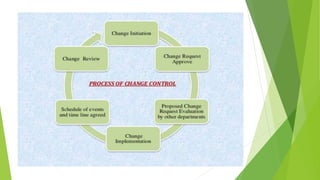
6.Change control
 A Process that ensures that changes to materials, methods,
equipment, software etc are properly documented , reviewed ,
approved and traceable is known as Change control
WHY IT IS IMPORTANT CHANGE CONTROL IS:
 cGMP Requirement
 Regulatory Requirement
 If change is not controlled , not implemented properly then any
Product hazard may occur
When Change control has to taken :
 Change control has to taken for the following criteria mentioned below (But not Limited to)
 Change in Manufacturing process;
 Change in Product formulation;
 Change in HVAC systems / Air handling systems / air filtration systems;
 Change in Batch / lot size;
 Change in Manufacturing, packaging and analytical equipment;
 Change in Facilities & Utilities;
 Change in Raw Materials, Intermediates, Packaging materials;
 Change in Analytical testing methods & specification,
 Change in Water systems;
 Change in Manufacturing Site;
 Change in Stability (shelf life, retest period, storage and transport conditions);
 Change in Pharmacopoeia or existing monograph
 Artwork related changes
 Changes in Computer Systems and Software.
 Addition, deletion of new equipment or new product.
 Changes in Batch documents (BMR and BPR)
 Changes in Standard Operating Procedure (SOP)
 Changes in Calibration schedule and Preventive Maintenance for all instruments
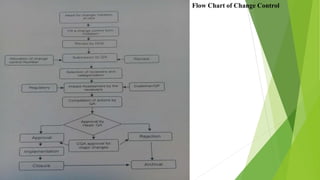
Flow Chart of Change Control
Change control example
“CHANGE IN COATING PROCESS FROM SOLVENT COATING
TO AQUEOUS COATING “
Products Dapakan 500mg film coated tablet.
Opadry OIC 7000 is afterwards coated with Opadry II.
RISK ASSESSMENT
1: May be colour variation , this should be Monitored.
2: And is this change/variation acceptable?
3: How much weight is gained?
4: Is there any change in thickness?
5: Process validation for initial 3 Batches
7.Introduction to ISO 9000 series of quality
systems standards,
 ISO (International Organization for Standardization) has published
22027 International Standards.
 ISO 9000 is one among the most popular standards of ISO.
 ISO 9000 is
 A series of Quality Management System (QMS) standards,
 Provide guidance and tools for companies and organizations,
 To ensure that their products and services consistently meet customer’s
requirements,
 For Consistent improvement in quality.
HISTORY OF ISO 9000
 Originally published in 1987 by the International Organization for
Standardization (ISO).
 Underwent major revision in 2000 with the concept of process
management.
 Revised again in 2008 which re-narrated ISO 9001:2000 with few
clarifications to the existing requirements of ISO 9001:2000.
 Current versions of ISO 9000 and ISO 9001 were published in
September 2015
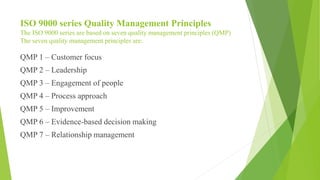
ISO 9000 series Quality Management Principles
The ISO 9000 series are based on seven quality management principles (QMP)
The seven quality management principles are:
QMP 1 – Customer focus
QMP 2 – Leadership
QMP 3 – Engagement of people
QMP 4 – Process approach
QMP 5 – Improvement
QMP 6 – Evidence-based decision making
QMP 7 – Relationship management
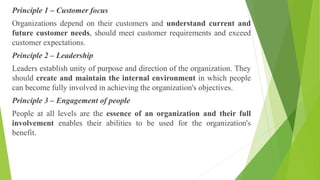
Principle 1 – Customer focus
Organizations depend on their customers and understand current and
future customer needs, should meet customer requirements and exceed
customer expectations.
Principle 2 – Leadership
Leaders establish unity of purpose and direction of the organization. They
should create and maintain the internal environment in which people
can become fully involved in achieving the organization's objectives.
Principle 3 – Engagement of people
People at all levels are the essence of an organization and their full
involvement enables their abilities to be used for the organization's
benefit.
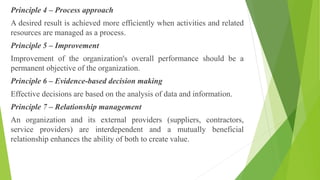
Principle 4 – Process approach
A desired result is achieved more efficiently when activities and related
resources are managed as a process.
Principle 5 – Improvement
Improvement of the organization's overall performance should be a
permanent objective of the organization.
Principle 6 – Evidence-based decision making
Effective decisions are based on the analysis of data and information.
Principle 7 – Relationship management
An organization and its external providers (suppliers, contractors,
service providers) are interdependent and a mutually beneficial
relationship enhances the ability of both to create value.
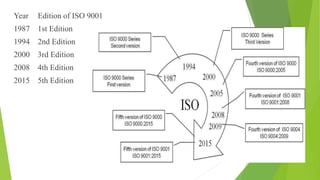
Year Edition of ISO 9001
1987 1st Edition
1994 2nd Edition
2000 3rd Edition
2008 4th Edition
2015 5th Edition
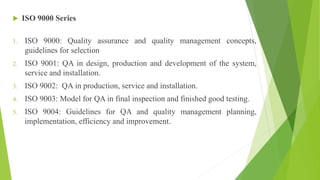
 ISO 9000 Series
1. ISO 9000: Quality assurance and quality management concepts,
guidelines for selection
2. ISO 9001: QA in design, production and development of the system,
service and installation.
3. ISO 9002: QA in production, service and installation.
4. ISO 9003: Model for QA in final inspection and finished good testing.
5. ISO 9004: Guidelines for QA and quality management planning,
implementation, efficiency and improvement.
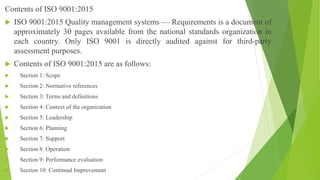
Contents of ISO 9001:2015
 ISO 9001:2015 Quality management systems — Requirements is a document of
approximately 30 pages available from the national standards organization in
each country. Only ISO 9001 is directly audited against for third-party
assessment purposes.
 Contents of ISO 9001:2015 are as follows:
 Section 1: Scope
 Section 2: Normative references
 Section 3: Terms and definitions
 Section 4: Context of the organization
 Section 5: Leadership
 Section 6: Planning
 Section 7: Support
 Section 8: Operation
 Section 9: Performance evaluation
 Section 10: Continual Improvement
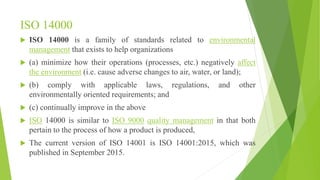
ISO 14000
 ISO 14000 is a family of standards related to environmental
management that exists to help organizations
 (a) minimize how their operations (processes, etc.) negatively affect
the environment (i.e. cause adverse changes to air, water, or land);
 (b) comply with applicable laws, regulations, and other
environmentally oriented requirements; and
 (c) continually improve in the above
 ISO 14000 is similar to ISO 9000 quality management in that both
pertain to the process of how a product is produced,
 The current version of ISO 14001 is ISO 14001:2015, which was
published in September 2015.
Brief history of environmental management
systems
 In March 1992, BSI Group published the world's first environmental
management systems standard, BS 7750, as part of a response to
growing concerns about protecting the environment.
 As of 2017, more than 300,000 certifications to ISO 14001 can be
found in 171 countries.
 The ISO 14000 series is based on a voluntary approach to
environmental regulation.
 The series includes the ISO 14001 standard, which provides
guidelines for the establishment or improvement of an EMS.
 ISO 14001 is known as a generic management system standard,
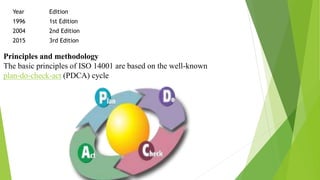
Year Edition
1996 1st Edition
2004 2nd Edition
2015 3rd Edition
Principles and methodology
The basic principles of ISO 14001 are based on the well-known
plan-do-check-act (PDCA) cycle
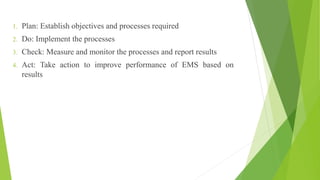
1. Plan: Establish objectives and processes required
2. Do: Implement the processes
3. Check: Measure and monitor the processes and report results
4. Act: Take action to improve performance of EMS based on
results
Benefits
 Better management control
 Number of economic benefits
 Minimizing the risk of regulatory and environmental liability
 Reduction in waste, consumption of resources, and operating costs
 Better marketability.
 Better utilization of resources.
 Environmental responsibilities.
 Better quality of finished goods and products.
 Customers’ satisfaction.
 Enhancement of the reputation and reliability of the organization.
 Improvement of the relationship among management, employees,
customers and investors.
 Reduction in cost.
NABL (National Accreditation Board for Testing
and Calibration Laboratories)
 Constituted for providing accreditation to the Government, industry
associations and individual industry or organizations.
 NABL provides accreditation in all major fields of Science and
Engineering such as
1. Biological, 2. Fluid Flow,
3. Chemical, 4.Electrical,
5. Electronics, 6.Mechanical,
7. Fluid-Flow, 8.Non-Destructive,
9. Photometry, 10.Radiological,
11. Thermal & Forensics disciplines under testing facilities and Electro-
Technical, 12. Mechanical, 13. Thermal,
14.Optical & Radiological disciplines under Calibration facilities.
 In the field of Medical Testing laboratories accreditation is
granted in Clinical Biochemistry, Clinical Pathology,
Haematology & Immunohematology, Microbiology & Serology,
Histopathology, Cytopathology, Genetics, Nuclear Medicine (In-
vitro tests only) disciplines.
 NABL and ISO Principles
 Accreditation Systems: ISO/IEC 17011 (2017)
 Testing and Calibration Laboratories: ISO/IEC 17025 (2005) and
ISO/IEC 17025 (2017)
 Medical Laboratories: ISO 15189 (2012
 PTP (Proficiency Testing Providers): SO/IEC 17043 (2010)
 RMP (Reference Material Producers): ISO 17034 (2016)
 NABL maintains the relationship with several international
bodies like:
1. International Laboratory Accreditation Co-operation (ILAC).
2. Asia Pacific Accreditation Co-operation (APAC).
Advantages of NABL
1. Increases credibility of the testing reports (issued by the specific lab).
2. Building up of confidence for the organization in calibrating and testing the
reports.
3. Accreditation ensures the quality assurance systems of the organization.
4. Customers’ satisfaction.
5. Customers of these accredited organizations/ laboratories can have greater access
for their products, in both domestic and international markets.
6. Market acceptability and increased potential in business.
7. Elimination of need of re-testing.
8. Monitoring of maintenance of efficacy for long time.
9. Improvement in the process.
10. Employee’s/Staff’s education and training can be overlooked.
11. Increases market opportunity for RMPs
GLP
Good Laboratory Practice is a quality system concerned with the
organizational process and the conditions under which a study is planned,
performed, monitored, recorded, archived and reported.
Why GLP?
 Development of quality test data
 Mutual acceptance of data
 Avoid duplication of data
 Avoid technical barriers to trade
 Protection of human health and the environment
Scope
 Non-clinical safety testing of test items contained in
 Pharmaceutical products
 Pesticide products
 Cosmetic products
 Veterinary drugs
 Food and feed additives
 Industrial chemicals
The GLP Principles
1.Test facility organization and personnel
2.Quality Assurance (QA) program
3.Facilities
4.Apparatus materials and reagents
5.Test systems
6.Test and reference items
7.Standard Operating Procedures (SOP’s)
8.Performance of the study
9.Reporting of study results
10.Storage and retention of records and materials
1.Test Facility Organization and Personnel Study Personnel
Responsibilities
• Should have the Knowledge of the GLP principles.
• Access to the study plan and appropriate SOP’s.
• Comply with the instructions of the SOP’s.
• Record raw data.
• Study personnel are responsible for the quality of their data.
• Exercise health precautions to minimize risk.
• Ensure the integrity of the study.
2.Quality Assurance Program Responsibilities of the QA
Personnel
• Access to the updated study plans and SOP’s.
• Documented verification of the compliance of study plan to the
GLP principles.
• Inspections to determine compliance of the study with GLP
principles.
• Three types of inspection.
– Study-based inspections.
– Facility-based inspections.
– Process-based inspections.
• Inspection of the final reports for accurate and full description.
• Report the inspection results to the management.
• Statements
3.Facilities
• Suitable size, construction and location.
• Adequate degree of separation of the different activities.
• Isolation of test systems and individual projects to protect from
biological hazards.
• Suitable rooms for the diagnosis, treatment and control of diseases.
• Storage rooms.
4. Apparatus, Materials and Reagents
• Apparatus of appropriate design and adequate capacity.
• Documented Inspection, cleaning, maintenance and calibration of
apparatus.
• Apparatus and materials not to interfere with the test systems.
• Chemicals, reagent and solutions should be labeled to indicate
identity, expiry and specific storage instructions.
5. Test Systems
• Physical and chemical test systems.
• Biological test systems.
• Records of source, date of arrival, and arrival conditions of test
systems.
• Proper identification of test systems in their container or when
removed.
• Cleaning and sanitization of containers.
• Pest control agents to be documented.
6. Test and Reference Items
• Receipt, handling, sampling and storage
• Characterization.
• Known stability of test and reference items.
• Stability of the test item in its vehicle (container).
• Experiments to determine stability in tank mixers used in the field
studies.
• Samples for analytical purposes for each batch.
7.Standard Operating Procedures (SOP)
• Written procedures for a laboratories program.
• They define how to carry out protocol- specified activities.
• Most often written in a chronological listing of action steps.
• They are written to explain how the procedures are suppose to
work.
• Routine inspection, cleaning, maintenance, testing and
calibration. Actions to be taken in response to equipment failure.
• Keeping records, reporting, storage, mixing, and retrieval of data.
Definition of raw data.
• Analytical methods.
8. Performance of the Study
• Prepare the Study plan.
• Content of the study plan.
› Identification of the study.
› Records.
› Dates.
› Reference to test methods.
› Information concerning the sponsor and facility.
• Conduct of the study.
9. Reporting of Study Results
• Information on sponsor and test facility.
• Experimental starting and completion dates.
• A Quality Assurance Program Statement.
• Description of materials and test methods.
• Results.
• Storage (samples, reference items, raw data, final reports) etc.
10. Storage and Retention of Records and Materials
– The study plan, raw data, samples.
– Inspection data and master schedules.
– SOPs.
– Maintenance and calibration data.
– If any study material is disposed of before expiry the reason to be
justified and documented.
– Index of materials retained.
References
 https://en.wikipedia.org/wiki/Six_Sigma
 https://www.researchgate.net/publication/281241436_Handling_of_Out
_of_Specification_Results
 https://www.pharmaguideline.com/2010/03/sop-for-out-of-
specification-oos.html
 https://www.pharmaguideline.com/2010/11/what-is-change-control.html
 https://pharmaceuticalupdates.com/2020/05/16/change-control-
procedure/
 https://en.wikipedia.org/wiki/ISO_9000
 https://en.wikipedia.org/wiki/ISO_14000
 Pharmaceutical quality assurances, Manohar Potdar, nirali
publication.

quality management system.pptx

  • 1.
  • 2.
    Content  Concept ofquality  Total Quality Management  Quality by Design  Six sigma concept  Out of specification  Change control  Introduction to ISO 9000 series of quality systems standards,  ISO 14000,  NABL  GLP
  • 3.
    1.Concept of quality Qualityis the degree to which an object or entity (e.g., process, product, or service) satisfies a specified set of attributes or requirements. ... Quality is the degree to which a set of inherent characteristics fulfils requirements. Definition:- Every pharmaceutical product must meet identity, strength, safety, and purity to achieve the desired effectiveness of the product.
  • 4.
    Importance of Quality: Lower costs (less labor, rework, scrap)  Motivated employees  Market Share  Reputation  International competitiveness  Revenues generation increased (ultimate goal)  Provide high quality of drug product  Reduce the no of recalls, returned  Achieve success in business
  • 5.
    2.Total Quality Management(TQM)  Total –Made up of the whole(or) Complete.  Quality –Degree of Excellence a product or service provides to the customer in present and future.  Management –Act , art, or manner of handling , controlling, directing, etc.  TQM is the art of managing the whole to achieve excellence
  • 6.
     Definition: TotalQuality Management(TQM) is a management strategy aimed at embedding awareness of quality in all organizational processes.  A core definition of total quality management (TQM) describes a management approach to long-term success through customer satisfaction.  In a TQM effort, all members of an organization participate in improving processes, products, services, and the culture in which they work.  Characteristics : • Technological Strength, hardness, surface finish • Time – oriented Reliability, maintainability - availability • Contractual Guarantee.
  • 7.
    8 Principles OfTotal Quality Management: 1. Customer-focused: 2. Total employee involvement: 3. Process-centered: 4. Integrated system: 5. Strategic and systematic approach: 6. Continual improvement: 7. Fact-based decision making: 8. Communications:
  • 8.
    Total Quality Managementand Continuous Improvement  TQM is the management process used to make continuous improvements to all functions.  TQM represents an ongoing, continuous commitment to improvement.  The foundation of total quality is a management philosophy that supports meeting customer requirements through continuous improvement.
  • 9.
    Quality Cost 1. PreventionCost – 2. Appraisal Cost- 3. Internal Failure Cost – 4. External Failure Cost –
  • 10.
    Benefits of quality Improved quality  Employee participation  Less migration of employee  Team work  Internal external customer satisfaction  Productivity with connectivity  Profitability & increase market share
  • 11.
    3.Quality by Design(QbD)  QbD it is the part of ICH guideline Q8 pharmaceutical Development in that Q8(R2).  Quality by Design means designing and developing the pharmaceutical product development stage to achieve characterisation in the product.
  • 12.
    Objective of QbD The main objective of QbD is to achieve the quality products.  To achieve positive performance testing.  Ensures combination of product and process knowledge gained during development.  From knowledge of data process desired attributes may be constructed.
  • 13.
    Benefits of QBDfor Industry  Eliminate batch failures.  Minimize deviations and costly investigations.  Empowerment of technical staff.  Increase manufacturing efficiency, reduce costs and project rejections and waste.  Better understanding of the process.  Continuous improvement.  Ensure better design of product with less problem.
  • 14.
    Primary QbD Documents 1.Risk Assessment Report(s) 1. Performed throughout QbD Process 2. Particularly important to process development 2. Quality Target Product Profile (QTPP) 1. Defines the desired product characteristics and sets development goals. 3. Control Strategy Summary 1. Defines the process, its inputs and outputs, and how it is controlled. 4. PPQ Report(s) 1. Formal verification that the process Control Strategy has been defined appropriately and repeatedly produces the desired results. 5. Continued Process Verification (CPV) Reports 1. Assuring that during routine commercial production, the process remains in a state of control (FDA); involves feedback loops into the QbD “process” where intentional process changes and/or observed variability is assessed for risk, characterized, re-validated, etc
  • 15.
    4.Six sigma concept Six sigma is a business statistical Strategy.  Is to identifying defects and removing them from the process of products to improve quality.  A defect is defined as any process output that does not meet customer specifications.  Statistical measure to objectively evaluate processes.
  • 16.
    History of SixSigma  The Six sigma was founded by Motorola in the 1970s.  Out of senior executive Art Sundry's criticism of Motorola’s bad quality.  They founded a connection between increases in quality and decreases in costs of production.  Bill Smith, “Father of six sigma” introduce this quality improvement Methodology to Motorola
  • 17.
    What Is SixSigma?  Six Sigma is a quality-control methodology developed in 1986 by Motorola, Inc.  The method uses a data-driven review to limit mistakes or defects in a corporate or business process.  Six Sigma emphasizes cycle-time improvement while at the same time reducing manufacturing defects to a level of no more than 3.4 occurrences per million units or events.  In other words, the system is a method to work faster with fewer mistakes.
  • 18.
    Methodologies Six Sigma projectsfollow two project methodologies, inspired by W. Edwards Deming's Plan–Do–Study–Act Cycle, each with five phases. 1.DMAIC 2.DMADV
  • 19.
    2. DMADV :it is used for projects aimed at creating new product or process designs
  • 20.
  • 21.
     Software usedfor Six Sigma  Arena  ARIS Six Sigma  Bonita Open Solution BPMN2 standard and KPIs for statistic monitoring  JMP  Mathematical  MATLAB or GNU Octave  Microsoft Visio  STATA  STATISTICA
  • 22.
    Case Study  SixSigma was introduced into Korea in 1997.  The First National Quality Prize of Six Sigma was given to two companies.  One is Samsung and other is LG electronics ; which are virtually the leader of six sigma in Korea. Samsung SDI was founded in 1970 as a producer of the black/white Braun tube.  It began to produce the color Braun tube from 1980, and now it is the number one company for braun tubes in the world. The market share of Braun tubes is 22%. The major products are CDT (color display tube), CPT (color picture tube), LCD (liquid crystal display), VFD (vacuum fluorescent display), C/F (color filter), li-ion battery and PDP (plasma display panel).  The total sales volume is about $4.4 billion and the total number of employees is about 18,000 including 8,000 domestic employees. It has six overseas subsidiaries in Mexico, China, Germany, Malaysia and Brazil.
  • 23.
    5.Out of specification Definition If the analytical result(s) of a batch or material is/are falling out side of the established specification ranges, is called / considered as Out of Specification. Or  The term OOS test results includes all suspect results that fall outside the predetermined Specification
  • 24.
    Out of Specifications Thereare lot of guidelines are available for defining to handle the OOS products/materials/batches as: MHRA guideline for OOS CDER guideline for OOS PIC/S guideline for OOS
  • 25.
     The OOSmay be observed during the analysis of: 1. Stability study 2. Finished API 3. Intermediates 4. In-process 5. Raw materials 6. Packing materials
  • 26.
    Out of SpecificationsOOS found due to the following reasons but not limited to: OOS Laboratory Process related Sample homogeneity
  • 27.
    Procedures of OOSinvestigations  OOS Investigations As per  MHRA (EU GMP)  Phase – I Investigation (Primary & extended lab investigation)  Phase – II Investigation (Manufacturing investigation)  Phase – III Investigation (Extended manufacturing, Re-sampling and re-analysis) Procedures of OOS investigations  As per  CDER (US FDA)  Phase – I Investigation (Primary & extended lab investigation)  Phase – II Investigation (Manufacturing investigation and re- sampling and re- analysis)
  • 28.
    1. MHRA (EUGMP) 1. OOS Investigations Phase – I Investigation:  Laboratory investigation is related to the Quality control department along with rechecking of documents with same analyst and re-testing with different analyst with original sample.  Phase – I is sub divided in to two sections as:  Phase – Ia (Primary Lab investigation), and  Phase -Ib (Extended Lab investigation)
  • 29.
    2. OOS InvestigationsPhase – II Investigation: Manufacturing Investigations In manufacturing investigation, production person investigate : Process parameters Drying parameters Input raw materials quality training of persons Cleaning of equipment Environmental information Contamination & etc….
  • 30.
    3. OOS InvestigationsPhase – III Investigation: Extended Manufacturing Investigations In Phase III investigation, Quality Control / Quality Assurance & Production department investigate the following: Sampling error by person Authorized for re sampling (if required) Re-analysis of re-sampled material with different Analyst If root cause found, define the CAPA or if not Diverted the matter to R&D / ADL or PD Lab Conclusion by all team member (QA, QC, PRD, ADL R&D, PD Lab) Decide the fate of batch by QA Head As per MHRA (EU GMP)
  • 31.
    2. CDER (USFDA) OOS Investigations 1. Phase – I Investigation: Laboratory investigation is related to the Quality control department along with rechecking of documents with same analyst and re-testing with different analyst with original sample. 2. Phase – II Investigation: Manufacturing investigation Process related investigation is to be carried out by Production department along with re-sampling and re- analysis.
  • 32.
    6.Change control  AProcess that ensures that changes to materials, methods, equipment, software etc are properly documented , reviewed , approved and traceable is known as Change control WHY IT IS IMPORTANT CHANGE CONTROL IS:  cGMP Requirement  Regulatory Requirement  If change is not controlled , not implemented properly then any Product hazard may occur
  • 33.
    When Change controlhas to taken :  Change control has to taken for the following criteria mentioned below (But not Limited to)  Change in Manufacturing process;  Change in Product formulation;  Change in HVAC systems / Air handling systems / air filtration systems;  Change in Batch / lot size;  Change in Manufacturing, packaging and analytical equipment;  Change in Facilities & Utilities;  Change in Raw Materials, Intermediates, Packaging materials;  Change in Analytical testing methods & specification,  Change in Water systems;  Change in Manufacturing Site;  Change in Stability (shelf life, retest period, storage and transport conditions);  Change in Pharmacopoeia or existing monograph  Artwork related changes  Changes in Computer Systems and Software.  Addition, deletion of new equipment or new product.  Changes in Batch documents (BMR and BPR)  Changes in Standard Operating Procedure (SOP)  Changes in Calibration schedule and Preventive Maintenance for all instruments
  • 34.
    Flow Chart ofChange Control
  • 36.
    Change control example “CHANGEIN COATING PROCESS FROM SOLVENT COATING TO AQUEOUS COATING “ Products Dapakan 500mg film coated tablet. Opadry OIC 7000 is afterwards coated with Opadry II. RISK ASSESSMENT 1: May be colour variation , this should be Monitored. 2: And is this change/variation acceptable? 3: How much weight is gained? 4: Is there any change in thickness? 5: Process validation for initial 3 Batches
  • 37.
    7.Introduction to ISO9000 series of quality systems standards,  ISO (International Organization for Standardization) has published 22027 International Standards.  ISO 9000 is one among the most popular standards of ISO.  ISO 9000 is  A series of Quality Management System (QMS) standards,  Provide guidance and tools for companies and organizations,  To ensure that their products and services consistently meet customer’s requirements,  For Consistent improvement in quality.
  • 38.
    HISTORY OF ISO9000  Originally published in 1987 by the International Organization for Standardization (ISO).  Underwent major revision in 2000 with the concept of process management.  Revised again in 2008 which re-narrated ISO 9001:2000 with few clarifications to the existing requirements of ISO 9001:2000.  Current versions of ISO 9000 and ISO 9001 were published in September 2015
  • 39.
    ISO 9000 seriesQuality Management Principles The ISO 9000 series are based on seven quality management principles (QMP) The seven quality management principles are: QMP 1 – Customer focus QMP 2 – Leadership QMP 3 – Engagement of people QMP 4 – Process approach QMP 5 – Improvement QMP 6 – Evidence-based decision making QMP 7 – Relationship management
  • 40.
    Principle 1 –Customer focus Organizations depend on their customers and understand current and future customer needs, should meet customer requirements and exceed customer expectations. Principle 2 – Leadership Leaders establish unity of purpose and direction of the organization. They should create and maintain the internal environment in which people can become fully involved in achieving the organization's objectives. Principle 3 – Engagement of people People at all levels are the essence of an organization and their full involvement enables their abilities to be used for the organization's benefit.
  • 41.
    Principle 4 –Process approach A desired result is achieved more efficiently when activities and related resources are managed as a process. Principle 5 – Improvement Improvement of the organization's overall performance should be a permanent objective of the organization. Principle 6 – Evidence-based decision making Effective decisions are based on the analysis of data and information. Principle 7 – Relationship management An organization and its external providers (suppliers, contractors, service providers) are interdependent and a mutually beneficial relationship enhances the ability of both to create value.
  • 42.
    Year Edition ofISO 9001 1987 1st Edition 1994 2nd Edition 2000 3rd Edition 2008 4th Edition 2015 5th Edition
  • 43.
     ISO 9000Series 1. ISO 9000: Quality assurance and quality management concepts, guidelines for selection 2. ISO 9001: QA in design, production and development of the system, service and installation. 3. ISO 9002: QA in production, service and installation. 4. ISO 9003: Model for QA in final inspection and finished good testing. 5. ISO 9004: Guidelines for QA and quality management planning, implementation, efficiency and improvement.
  • 44.
    Contents of ISO9001:2015  ISO 9001:2015 Quality management systems — Requirements is a document of approximately 30 pages available from the national standards organization in each country. Only ISO 9001 is directly audited against for third-party assessment purposes.  Contents of ISO 9001:2015 are as follows:  Section 1: Scope  Section 2: Normative references  Section 3: Terms and definitions  Section 4: Context of the organization  Section 5: Leadership  Section 6: Planning  Section 7: Support  Section 8: Operation  Section 9: Performance evaluation  Section 10: Continual Improvement
  • 45.
    ISO 14000  ISO14000 is a family of standards related to environmental management that exists to help organizations  (a) minimize how their operations (processes, etc.) negatively affect the environment (i.e. cause adverse changes to air, water, or land);  (b) comply with applicable laws, regulations, and other environmentally oriented requirements; and  (c) continually improve in the above  ISO 14000 is similar to ISO 9000 quality management in that both pertain to the process of how a product is produced,  The current version of ISO 14001 is ISO 14001:2015, which was published in September 2015.
  • 46.
    Brief history ofenvironmental management systems  In March 1992, BSI Group published the world's first environmental management systems standard, BS 7750, as part of a response to growing concerns about protecting the environment.  As of 2017, more than 300,000 certifications to ISO 14001 can be found in 171 countries.  The ISO 14000 series is based on a voluntary approach to environmental regulation.  The series includes the ISO 14001 standard, which provides guidelines for the establishment or improvement of an EMS.  ISO 14001 is known as a generic management system standard,
  • 47.
    Year Edition 1996 1stEdition 2004 2nd Edition 2015 3rd Edition Principles and methodology The basic principles of ISO 14001 are based on the well-known plan-do-check-act (PDCA) cycle
  • 48.
    1. Plan: Establishobjectives and processes required 2. Do: Implement the processes 3. Check: Measure and monitor the processes and report results 4. Act: Take action to improve performance of EMS based on results
  • 49.
    Benefits  Better managementcontrol  Number of economic benefits  Minimizing the risk of regulatory and environmental liability  Reduction in waste, consumption of resources, and operating costs  Better marketability.  Better utilization of resources.  Environmental responsibilities.  Better quality of finished goods and products.  Customers’ satisfaction.  Enhancement of the reputation and reliability of the organization.  Improvement of the relationship among management, employees, customers and investors.  Reduction in cost.
  • 50.
    NABL (National AccreditationBoard for Testing and Calibration Laboratories)  Constituted for providing accreditation to the Government, industry associations and individual industry or organizations.  NABL provides accreditation in all major fields of Science and Engineering such as 1. Biological, 2. Fluid Flow, 3. Chemical, 4.Electrical, 5. Electronics, 6.Mechanical, 7. Fluid-Flow, 8.Non-Destructive, 9. Photometry, 10.Radiological, 11. Thermal & Forensics disciplines under testing facilities and Electro- Technical, 12. Mechanical, 13. Thermal, 14.Optical & Radiological disciplines under Calibration facilities.
  • 51.
     In thefield of Medical Testing laboratories accreditation is granted in Clinical Biochemistry, Clinical Pathology, Haematology & Immunohematology, Microbiology & Serology, Histopathology, Cytopathology, Genetics, Nuclear Medicine (In- vitro tests only) disciplines.  NABL and ISO Principles  Accreditation Systems: ISO/IEC 17011 (2017)  Testing and Calibration Laboratories: ISO/IEC 17025 (2005) and ISO/IEC 17025 (2017)  Medical Laboratories: ISO 15189 (2012  PTP (Proficiency Testing Providers): SO/IEC 17043 (2010)  RMP (Reference Material Producers): ISO 17034 (2016)
  • 52.
     NABL maintainsthe relationship with several international bodies like: 1. International Laboratory Accreditation Co-operation (ILAC). 2. Asia Pacific Accreditation Co-operation (APAC).
  • 53.
    Advantages of NABL 1.Increases credibility of the testing reports (issued by the specific lab). 2. Building up of confidence for the organization in calibrating and testing the reports. 3. Accreditation ensures the quality assurance systems of the organization. 4. Customers’ satisfaction. 5. Customers of these accredited organizations/ laboratories can have greater access for their products, in both domestic and international markets. 6. Market acceptability and increased potential in business. 7. Elimination of need of re-testing. 8. Monitoring of maintenance of efficacy for long time. 9. Improvement in the process. 10. Employee’s/Staff’s education and training can be overlooked. 11. Increases market opportunity for RMPs
  • 54.
    GLP Good Laboratory Practiceis a quality system concerned with the organizational process and the conditions under which a study is planned, performed, monitored, recorded, archived and reported. Why GLP?  Development of quality test data  Mutual acceptance of data  Avoid duplication of data  Avoid technical barriers to trade  Protection of human health and the environment
  • 55.
    Scope  Non-clinical safetytesting of test items contained in  Pharmaceutical products  Pesticide products  Cosmetic products  Veterinary drugs  Food and feed additives  Industrial chemicals
  • 56.
    The GLP Principles 1.Testfacility organization and personnel 2.Quality Assurance (QA) program 3.Facilities 4.Apparatus materials and reagents 5.Test systems 6.Test and reference items 7.Standard Operating Procedures (SOP’s) 8.Performance of the study 9.Reporting of study results 10.Storage and retention of records and materials
  • 57.
    1.Test Facility Organizationand Personnel Study Personnel Responsibilities • Should have the Knowledge of the GLP principles. • Access to the study plan and appropriate SOP’s. • Comply with the instructions of the SOP’s. • Record raw data. • Study personnel are responsible for the quality of their data. • Exercise health precautions to minimize risk. • Ensure the integrity of the study.
  • 58.
    2.Quality Assurance ProgramResponsibilities of the QA Personnel • Access to the updated study plans and SOP’s. • Documented verification of the compliance of study plan to the GLP principles. • Inspections to determine compliance of the study with GLP principles. • Three types of inspection. – Study-based inspections. – Facility-based inspections. – Process-based inspections. • Inspection of the final reports for accurate and full description. • Report the inspection results to the management. • Statements
  • 59.
    3.Facilities • Suitable size,construction and location. • Adequate degree of separation of the different activities. • Isolation of test systems and individual projects to protect from biological hazards. • Suitable rooms for the diagnosis, treatment and control of diseases. • Storage rooms.
  • 60.
    4. Apparatus, Materialsand Reagents • Apparatus of appropriate design and adequate capacity. • Documented Inspection, cleaning, maintenance and calibration of apparatus. • Apparatus and materials not to interfere with the test systems. • Chemicals, reagent and solutions should be labeled to indicate identity, expiry and specific storage instructions.
  • 61.
    5. Test Systems •Physical and chemical test systems. • Biological test systems. • Records of source, date of arrival, and arrival conditions of test systems. • Proper identification of test systems in their container or when removed. • Cleaning and sanitization of containers. • Pest control agents to be documented.
  • 62.
    6. Test andReference Items • Receipt, handling, sampling and storage • Characterization. • Known stability of test and reference items. • Stability of the test item in its vehicle (container). • Experiments to determine stability in tank mixers used in the field studies. • Samples for analytical purposes for each batch.
  • 63.
    7.Standard Operating Procedures(SOP) • Written procedures for a laboratories program. • They define how to carry out protocol- specified activities. • Most often written in a chronological listing of action steps. • They are written to explain how the procedures are suppose to work. • Routine inspection, cleaning, maintenance, testing and calibration. Actions to be taken in response to equipment failure. • Keeping records, reporting, storage, mixing, and retrieval of data. Definition of raw data. • Analytical methods.
  • 64.
    8. Performance ofthe Study • Prepare the Study plan. • Content of the study plan. › Identification of the study. › Records. › Dates. › Reference to test methods. › Information concerning the sponsor and facility. • Conduct of the study. 9. Reporting of Study Results • Information on sponsor and test facility. • Experimental starting and completion dates. • A Quality Assurance Program Statement. • Description of materials and test methods. • Results. • Storage (samples, reference items, raw data, final reports) etc.
  • 65.
    10. Storage andRetention of Records and Materials – The study plan, raw data, samples. – Inspection data and master schedules. – SOPs. – Maintenance and calibration data. – If any study material is disposed of before expiry the reason to be justified and documented. – Index of materials retained.
  • 66.
    References  https://en.wikipedia.org/wiki/Six_Sigma  https://www.researchgate.net/publication/281241436_Handling_of_Out _of_Specification_Results https://www.pharmaguideline.com/2010/03/sop-for-out-of- specification-oos.html  https://www.pharmaguideline.com/2010/11/what-is-change-control.html  https://pharmaceuticalupdates.com/2020/05/16/change-control- procedure/  https://en.wikipedia.org/wiki/ISO_9000  https://en.wikipedia.org/wiki/ISO_14000  Pharmaceutical quality assurances, Manohar Potdar, nirali publication.