QUALITY RISK
MANAGEMENT (QRM)
Student Name:- Abhishek Borkar
Class- B- pharm 4th year
Shraddha Institute of Pharmacy Kondala zambre ,
Washim-444505
Guide by:
ASST.PROF .SHUBHADA BHOPALE
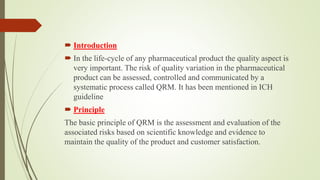
ļ‚“ Introduction
ļ‚“ In the life-cycle of any pharmaceutical product the quality aspect is
very important. The risk of quality variation in the pharmaceutical
product can be assessed, controlled and communicated by a
systematic process called QRM. It has been mentioned in ICH
guideline
ļ‚“ Principle
The basic principle of QRM is the assessment and evaluation of the
associated risks based on scientific knowledge and evidence to
maintain the quality of the product and customer satisfaction.
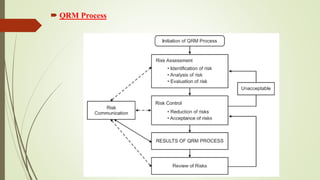
ļ‚“ QRM Process
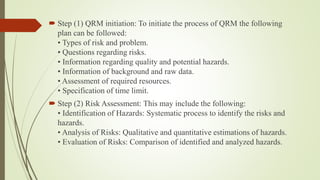
ļ‚“ Step (1) QRM initiation: To initiate the process of QRM the following
plan can be followed:
• Types of risk and problem.
• Questions regarding risks.
• Information regarding quality and potential hazards.
• Information of background and raw data.
• Assessment of required resources.
• Specification of time limit.
ļ‚“ Step (2) Risk Assessment: This may include the following:
• Identification of Hazards: Systematic process to identify the risks and
hazards.
• Analysis of Risks: Qualitative and quantitative estimations of hazards.
• Evaluation of Risks: Comparison of identified and analyzed hazards.
ļ‚“ Step (3) Risk Control: The basic purpose of risk control is to reduce or
eliminate the risks. It should be based on the following points:
• The acceptance level of risks.
• Possible steps to reduce or eliminate the risks.
• Balance among benefits, risks and resources.
(a) Reduction of Risks: The level of risk when exceeds the acceptance
criteria, the reduction of risks should be followed. Detection of risks,
risks assessment and the process control can reduce the level of risks.
(b) Acceptance of Risks: It is the decision to accept the risk.
ļ‚“ Step (4) Results of QRM and Risk Reviews: The review of result
obtained from the QRM process is a part of quality management
system. Results of QRM process should be documented, reviewed,
inspected, audited and possible change control is suggested. The
unsatisfactory review process will suggest the failure of the
investigation and the process can be started from risk assessment step.
ļ‚“ Step (5) Risk Communication: This is the communication process of the data
of risk management system. The risk management system can be
communicated at any step of risk management process (Risk assessment,
control and review process mentioned as dotted line). The well documented
result of QRM process should be submitted and communicated (in Fig. 2.1
mentioned as solid line) to the parties. This guideline is very important in
pharmaceutical industry with respect to QRM. The process is applicable for the
pharmaceutical product from manufacturing to inspection process.
ļ‚“ INFORMATION REQUIRED FOR TECHNOLOGY TRANSFER For the
technology transfer from research and development section to production, the
RU should be capable of performing and accommodating the production
capacity. The detailed process development should be transferred. At RU,
expert personnel and facility available at the site are the primary
considerations. Development of protocol by SU and RU jointly for the
technology transfer is necessary.
ļ‚“ Active Pharmaceutical Ingredients (API) :
ļ‚“ • Details of API manufacturer and supplier.
• Detail scheme of synthesis, proc• Details of intermediate products.
• Complete information of API for formulation process. It includes:
- Physicochemical parameters like solubility, partition coefficient (method of
determination).
- Particle size distribution. - Bulk and tap density with detail method of
evaluation. - Disintegration profile.
- Nature of hygroscopicity.
- Water content.
- Loss on drying.
- Limit of impurities.
• Microbiological factors.
• Environmental factors.
• Pharmacopoeial standards with method of determination.
• Stability studies.
• Storage and handling guidance mentioned in Pharmacopoeias.ess
ļ‚“ Excipients :
The excipients used in the process of manufacturing have an important role in
quality of the finished product. The duty of SU is to provide detail information of
excipients to RU. The following information is some of the examples of detail
information:
• Details of manufacturer and supplier.
• Category of excipients.
• Dosage form available.
• Descriptions.
• Solubility.
• For transdermal dosage form:
(a) Lipophilicity, Partition coefficient
(b) Particle size and distribution
(c) Specific gravity
(d) Water content and loss of drying
(e) Dissolution rate with detail process
ļ‚“ For solid dosage form:
(a) Bulk and tap density profile with detail method of evaluation
(b) Compaction properties
(c) Particle size and distribution
(d) Water content and loss of drying
(e) Nature of hygroscopicity.
ļ‚“ For semi-solid dosage form:
(a) Melting point
(b) Range of pH
(c) Viscosity
(d) Specific gravity
ļ‚“ For liquid dosage form:
(a) Range of pH
(b) Viscosity
(c) Specific gravity
(d) Water content
ļ‚“ For parenteral formulation:
(a) Range of pH
(b) Viscosity
(c) Specific gravity
(d) Water content
(e) Osmotic pressure
(f) Ionic strength
ļ‚“ • For aerosol/inhaled dosage form:
(a) Solubility
(b) Bulk and tap density
(c) Particle size and distribution
(d) Surface area
(e) Water content
ļ‚“ Process Information:
(a) Requirement of facility.
(b) Requirement of equipments.
(c) Requirement of skilled person.
(d) Detail information of raw materials.
(e) Storage guideline and handling of raw materials and finished goods.
(f) Availability of all SOPs.
(g) Manufacturing process
• Process flow charts
• Process optimization
• Detail master batch records
• Method of addition of raw materials and excipients
• Details of intermediate products
• Reaction conditions
• Environmental factors
(h) Analytical methods
• Standardization process
• Assay procedure
• Finished goods testing
(i) Validation protocols
• Process validation
• Equipment validation
(j) Annual audits and reviews
(k) Change control, critical control point and corrective actions
(l) Quality control and assurance
ļ‚“ Finished Products
A finished pharmaceutical product is a final product that has
completed all stages of production and manufacturing. The finished product
should be stored in specific container and proper labeling is mandatory. All the
associated information in well documented manner should be informed and
transferred from SU to RU. The finished product storage and handling
guidelines are to be informed to RU along with the detail specification and
analytical test procedures. The predetermined specifications should be analyzed
and the detail standardization process should be transferred.
ļ‚“ Packaging :
Information regarding packaging of finished product should be transferred to
RU. Some of the important instructions are given below:
• Suitable container
• Proper closure system
• Packing material
• Process of packaging
• Design of packaging
• Proper labeling
• Relevant information mentioned in package and label
.
ļ‚“ Documentation
Some of the important documents required in technology transfer are:
• Technology transfer protocol, qualification protocol and report.
• Training protocols and report.
• Standard Operating Procedure (SOP).
• Technology transfer report.
• Analytical methods transfer protocol
• Validation report (VR).
• Process validation report.
• Cleaning validation protocol and report.
• Validation Master Plan (VMP).
• Master batch record.
ļ‚“ Equipments :
The SU should provide the following to RU regarding equipments:
• List of equipments required.
• Specific model and makers of equipments.
• Manuals and SOPs.
• Set-up, maintenance, calibration and storage protocol.
• IQ, OQ and PQ status
…THANK YOU…

QUALITY RISK MANAGEMENT (QRM) PPT.pptx

  • 1.
    QUALITY RISK MANAGEMENT (QRM) StudentName:- Abhishek Borkar Class- B- pharm 4th year Shraddha Institute of Pharmacy Kondala zambre , Washim-444505 Guide by: ASST.PROF .SHUBHADA BHOPALE
  • 2.
    ļ‚“ Introduction ļ‚“ Inthe life-cycle of any pharmaceutical product the quality aspect is very important. The risk of quality variation in the pharmaceutical product can be assessed, controlled and communicated by a systematic process called QRM. It has been mentioned in ICH guideline ļ‚“ Principle The basic principle of QRM is the assessment and evaluation of the associated risks based on scientific knowledge and evidence to maintain the quality of the product and customer satisfaction.
  • 3.
  • 4.
    ļ‚“ Step (1)QRM initiation: To initiate the process of QRM the following plan can be followed: • Types of risk and problem. • Questions regarding risks. • Information regarding quality and potential hazards. • Information of background and raw data. • Assessment of required resources. • Specification of time limit. ļ‚“ Step (2) Risk Assessment: This may include the following: • Identification of Hazards: Systematic process to identify the risks and hazards. • Analysis of Risks: Qualitative and quantitative estimations of hazards. • Evaluation of Risks: Comparison of identified and analyzed hazards.
  • 5.
    ļ‚“ Step (3)Risk Control: The basic purpose of risk control is to reduce or eliminate the risks. It should be based on the following points: • The acceptance level of risks. • Possible steps to reduce or eliminate the risks. • Balance among benefits, risks and resources. (a) Reduction of Risks: The level of risk when exceeds the acceptance criteria, the reduction of risks should be followed. Detection of risks, risks assessment and the process control can reduce the level of risks. (b) Acceptance of Risks: It is the decision to accept the risk. ļ‚“ Step (4) Results of QRM and Risk Reviews: The review of result obtained from the QRM process is a part of quality management system. Results of QRM process should be documented, reviewed, inspected, audited and possible change control is suggested. The unsatisfactory review process will suggest the failure of the investigation and the process can be started from risk assessment step.
  • 6.
    ļ‚“ Step (5)Risk Communication: This is the communication process of the data of risk management system. The risk management system can be communicated at any step of risk management process (Risk assessment, control and review process mentioned as dotted line). The well documented result of QRM process should be submitted and communicated (in Fig. 2.1 mentioned as solid line) to the parties. This guideline is very important in pharmaceutical industry with respect to QRM. The process is applicable for the pharmaceutical product from manufacturing to inspection process. ļ‚“ INFORMATION REQUIRED FOR TECHNOLOGY TRANSFER For the technology transfer from research and development section to production, the RU should be capable of performing and accommodating the production capacity. The detailed process development should be transferred. At RU, expert personnel and facility available at the site are the primary considerations. Development of protocol by SU and RU jointly for the technology transfer is necessary.
  • 7.
    ļ‚“ Active PharmaceuticalIngredients (API) : ļ‚“ • Details of API manufacturer and supplier. • Detail scheme of synthesis, proc• Details of intermediate products. • Complete information of API for formulation process. It includes: - Physicochemical parameters like solubility, partition coefficient (method of determination). - Particle size distribution. - Bulk and tap density with detail method of evaluation. - Disintegration profile. - Nature of hygroscopicity. - Water content. - Loss on drying. - Limit of impurities. • Microbiological factors. • Environmental factors. • Pharmacopoeial standards with method of determination. • Stability studies. • Storage and handling guidance mentioned in Pharmacopoeias.ess
  • 8.
    ļ‚“ Excipients : Theexcipients used in the process of manufacturing have an important role in quality of the finished product. The duty of SU is to provide detail information of excipients to RU. The following information is some of the examples of detail information: • Details of manufacturer and supplier. • Category of excipients. • Dosage form available. • Descriptions. • Solubility. • For transdermal dosage form: (a) Lipophilicity, Partition coefficient (b) Particle size and distribution (c) Specific gravity (d) Water content and loss of drying (e) Dissolution rate with detail process
  • 9.
    ļ‚“ For soliddosage form: (a) Bulk and tap density profile with detail method of evaluation (b) Compaction properties (c) Particle size and distribution (d) Water content and loss of drying (e) Nature of hygroscopicity. ļ‚“ For semi-solid dosage form: (a) Melting point (b) Range of pH (c) Viscosity (d) Specific gravity ļ‚“ For liquid dosage form: (a) Range of pH (b) Viscosity (c) Specific gravity (d) Water content
  • 10.
    ļ‚“ For parenteralformulation: (a) Range of pH (b) Viscosity (c) Specific gravity (d) Water content (e) Osmotic pressure (f) Ionic strength ļ‚“ • For aerosol/inhaled dosage form: (a) Solubility (b) Bulk and tap density (c) Particle size and distribution (d) Surface area (e) Water content
  • 11.
    ļ‚“ Process Information: (a)Requirement of facility. (b) Requirement of equipments. (c) Requirement of skilled person. (d) Detail information of raw materials. (e) Storage guideline and handling of raw materials and finished goods. (f) Availability of all SOPs. (g) Manufacturing process • Process flow charts • Process optimization • Detail master batch records • Method of addition of raw materials and excipients • Details of intermediate products • Reaction conditions • Environmental factors
  • 12.
    (h) Analytical methods •Standardization process • Assay procedure • Finished goods testing (i) Validation protocols • Process validation • Equipment validation (j) Annual audits and reviews (k) Change control, critical control point and corrective actions (l) Quality control and assurance
  • 13.
    ļ‚“ Finished Products Afinished pharmaceutical product is a final product that has completed all stages of production and manufacturing. The finished product should be stored in specific container and proper labeling is mandatory. All the associated information in well documented manner should be informed and transferred from SU to RU. The finished product storage and handling guidelines are to be informed to RU along with the detail specification and analytical test procedures. The predetermined specifications should be analyzed and the detail standardization process should be transferred.
  • 14.
    ļ‚“ Packaging : Informationregarding packaging of finished product should be transferred to RU. Some of the important instructions are given below: • Suitable container • Proper closure system • Packing material • Process of packaging • Design of packaging • Proper labeling • Relevant information mentioned in package and label .
  • 15.
    ļ‚“ Documentation Some ofthe important documents required in technology transfer are: • Technology transfer protocol, qualification protocol and report. • Training protocols and report. • Standard Operating Procedure (SOP). • Technology transfer report. • Analytical methods transfer protocol • Validation report (VR). • Process validation report. • Cleaning validation protocol and report. • Validation Master Plan (VMP). • Master batch record.
  • 16.
    ļ‚“ Equipments : TheSU should provide the following to RU regarding equipments: • List of equipments required. • Specific model and makers of equipments. • Manuals and SOPs. • Set-up, maintenance, calibration and storage protocol. • IQ, OQ and PQ status
  • 17.