9.2: Transport in the phloem
of plants
Understanding
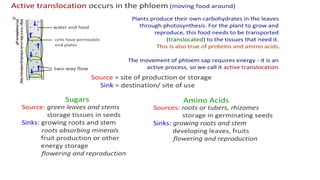
• Plants transport organic compounds
from sources to sinks.
• Incompressibility of water allows
transport along hydrostatic pressure
gradients.
• Active transport is used to load
organic compounds into phloem sieve
tubes at the source.
• High concentration of solutes in the
phloem at the source lead to water
uptake by osmosis.
• Raised hydrostatic pressure causes
the contents of the phloem to rush
towards sinks.
Applications and Skills
• A: Structure-function relationship
of phloem sieve tubes.
• S: Identification of xylem and
phloem in microscope images of
stem and root.
• S: Analysis of data from
experiments measuring phloem
transport rates using aphid stylets
and radioactively labelled carbon
dioxide.
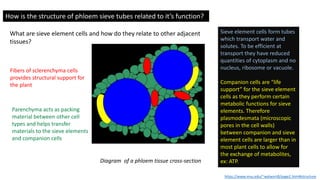
Sieve element cells form tubes
which transport water and
solutes. To be efficient at
transport they have reduced
quantities of cytoplasm and no
nucleus, ribosome or vacuole.
Companion cells are "life
support” for the sieve element
cells as they perform certain
metabolic functions for sieve
elements. Therefore
plasmodesmata (microscopic
pores in the cell walls)
between companion and sieve
element cells are larger than in
most plant cells to allow for
the exchange of metabolites,
ex: ATP.
How is the structure of phloem sieve tubes related to it’s function?
https://www.msu.edu/~walwort8/page2.html#structure
What are sieve element cells and how do they relate to other adjacent
tissues?
Diagram of a phloem tissue cross-section
Fibers of sclerenchyma cells
provides structural support for
the plant
Parenchyma acts as packing
material between other cell
types and helps transfer
materials to the sieve elements
and companion cells
Movement of Organic Molecules
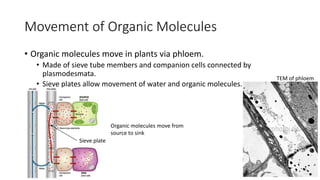
• Organic molecules move in plants via phloem.
• Made of sieve tube members and companion cells connected by
plasmodesmata.
• Sieve plates allow movement of water and organic molecules.
• Or
Sieve plate
Organic molecules move from
source to sink
TEM of phloem
http://www.uic.edu/classes/bios/bios100/lecturesf04am/lect19.htm
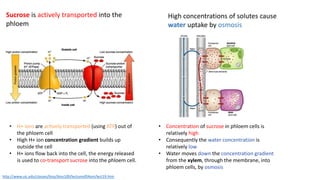
• H+ ions are actively transported (using ATP) out of
the phloem cell
• High H+ ion concentration gradient builds up
outside the cell
• H+ ions flow back into the cell, the energy released
is used to co-transport sucrose into the phloem cell.
Sucrose is actively transported into the
phloem
High concentrations of solutes cause
water uptake by osmosis
• Concentration of sucrose in phloem cells is
relatively high
• Consequently the water concentration is
relatively low
• Water moves down the concentration gradient
from the xylem, through the membrane, into
phloem cells, by osmosis
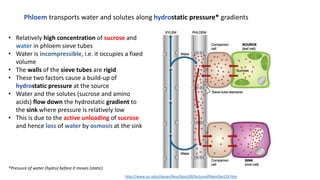
• Relatively high concentration of sucrose and
water in phloem sieve tubes
• Water is incompressible, i.e. it occupies a fixed
volume
• The walls of the sieve tubes are rigid
• These two factors cause a build-up of
hydrostatic pressure at the source
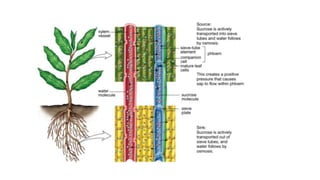
• Water and the solutes (sucrose and amino
acids) flow down the hydrostatic gradient to
the sink where pressure is relatively low
• This is due to the active unloading of sucrose
and hence loss of water by osmosis at the sink
Phloem transports water and solutes along hydrostatic pressure* gradients
http://www.uic.edu/classes/bios/bios100/lecturesf04am/lect19.htm
*Pressure of water (hydro) before it moves (static)
http://plantsinaction.science.uq.edu.au/sites/plantsinaction.science.uq.edu.au/files/imagecache/figure-medium/plate27AB.TIF-combined.jpg
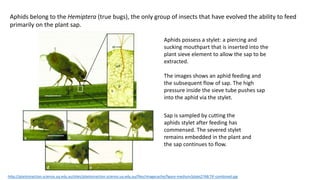
Aphids possess a stylet: a piercing and
sucking mouthpart that is inserted into the
plant sieve element to allow the sap to be
extracted.
The images shows an aphid feeding and
the subsequent flow of sap. The high
pressure inside the sieve tube pushes sap
into the aphid via the stylet.
Aphids belong to the Hemiptera (true bugs), the only group of insects that have evolved the ability to feed
primarily on the plant sap.
Sap is sampled by cutting the
aphids stylet after feeding has
commensed. The severed stylet
remains embedded in the plant and
the sap continues to flow.
http://plantsinaction.science.uq.edu.au/sites/plantsinaction.science.uq.edu.au/files/imagecache/figure-medium/plate27AB.TIF-combined.jpg
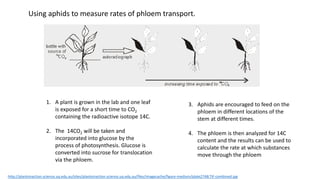
Using aphids to measure rates of phloem transport.
1. A plant is grown in the lab and one leaf
is exposed for a short time to CO2
containing the radioactive isotope 14C.
2. The 14CO2 will be taken and
incorporated into glucose by the
process of photosynthesis. Glucose is
converted into sucrose for translocation
via the phloem.
3. Aphids are encouraged to feed on the
phloem in different locations of the
stem at different times.
4. The phloem is then analyzed for 14C
content and the results can be used to
calculate the rate at which substances
move through the phloem
Identify when a seed would be a sink
and when it would be a source.
• Identify: provide an answer from a number of possibilities.
Explain why it would be necessary for
veins to be close together in leaves.
• Explain: give a detailed account including reasons or causes.
Identify when a seed would be a sink
and when it would be a source.
• Identify: provide an answer from a number of possibilities.
Explain why it would be necessary for
veins to be close together in leaves.
• Explain: give a detailed account including reasons or causes.
Veins need to be relatively close together so
that water and nutrients can easily pass to and
from them in the plant tissues. Water movement
between the phloem and xylem is especially
important in sucrose transport.
A seed is a source when it first begins
germination. At this time, it is providing nutrients
to the early plant. The seed acts as a sink when
it is being formed in the ovary of the flower.
During this time, nutrients are being deposited in
the seed.
Homework
Vocab
• Phloem
• Sieve tube member
• Companion cell
• Plasmodesmata
• Source
• Sink
• Translocation
• Phloem sap
• Plant exudate
• Pressure-flow hypothesis
• Hydrostatic pressure
• Cotransport proteins
Other
• Challenge yourself 4-9, pg 396

9.2 phloem

  • 1.
    9.2: Transport inthe phloem of plants
  • 2.
    Understanding • Plants transportorganic compounds from sources to sinks. • Incompressibility of water allows transport along hydrostatic pressure gradients. • Active transport is used to load organic compounds into phloem sieve tubes at the source. • High concentration of solutes in the phloem at the source lead to water uptake by osmosis. • Raised hydrostatic pressure causes the contents of the phloem to rush towards sinks. Applications and Skills • A: Structure-function relationship of phloem sieve tubes. • S: Identification of xylem and phloem in microscope images of stem and root. • S: Analysis of data from experiments measuring phloem transport rates using aphid stylets and radioactively labelled carbon dioxide.
  • 3.
    Sieve element cellsform tubes which transport water and solutes. To be efficient at transport they have reduced quantities of cytoplasm and no nucleus, ribosome or vacuole. Companion cells are "life support” for the sieve element cells as they perform certain metabolic functions for sieve elements. Therefore plasmodesmata (microscopic pores in the cell walls) between companion and sieve element cells are larger than in most plant cells to allow for the exchange of metabolites, ex: ATP. How is the structure of phloem sieve tubes related to it’s function? https://www.msu.edu/~walwort8/page2.html#structure What are sieve element cells and how do they relate to other adjacent tissues? Diagram of a phloem tissue cross-section Fibers of sclerenchyma cells provides structural support for the plant Parenchyma acts as packing material between other cell types and helps transfer materials to the sieve elements and companion cells
  • 4.
    Movement of OrganicMolecules • Organic molecules move in plants via phloem. • Made of sieve tube members and companion cells connected by plasmodesmata. • Sieve plates allow movement of water and organic molecules. • Or Sieve plate Organic molecules move from source to sink TEM of phloem
  • 7.
    http://www.uic.edu/classes/bios/bios100/lecturesf04am/lect19.htm • H+ ionsare actively transported (using ATP) out of the phloem cell • High H+ ion concentration gradient builds up outside the cell • H+ ions flow back into the cell, the energy released is used to co-transport sucrose into the phloem cell. Sucrose is actively transported into the phloem High concentrations of solutes cause water uptake by osmosis • Concentration of sucrose in phloem cells is relatively high • Consequently the water concentration is relatively low • Water moves down the concentration gradient from the xylem, through the membrane, into phloem cells, by osmosis
  • 8.
    • Relatively highconcentration of sucrose and water in phloem sieve tubes • Water is incompressible, i.e. it occupies a fixed volume • The walls of the sieve tubes are rigid • These two factors cause a build-up of hydrostatic pressure at the source • Water and the solutes (sucrose and amino acids) flow down the hydrostatic gradient to the sink where pressure is relatively low • This is due to the active unloading of sucrose and hence loss of water by osmosis at the sink Phloem transports water and solutes along hydrostatic pressure* gradients http://www.uic.edu/classes/bios/bios100/lecturesf04am/lect19.htm *Pressure of water (hydro) before it moves (static)
  • 9.
    http://plantsinaction.science.uq.edu.au/sites/plantsinaction.science.uq.edu.au/files/imagecache/figure-medium/plate27AB.TIF-combined.jpg Aphids possess astylet: a piercing and sucking mouthpart that is inserted into the plant sieve element to allow the sap to be extracted. The images shows an aphid feeding and the subsequent flow of sap. The high pressure inside the sieve tube pushes sap into the aphid via the stylet. Aphids belong to the Hemiptera (true bugs), the only group of insects that have evolved the ability to feed primarily on the plant sap. Sap is sampled by cutting the aphids stylet after feeding has commensed. The severed stylet remains embedded in the plant and the sap continues to flow.
  • 10.
    http://plantsinaction.science.uq.edu.au/sites/plantsinaction.science.uq.edu.au/files/imagecache/figure-medium/plate27AB.TIF-combined.jpg Using aphids tomeasure rates of phloem transport. 1. A plant is grown in the lab and one leaf is exposed for a short time to CO2 containing the radioactive isotope 14C. 2. The 14CO2 will be taken and incorporated into glucose by the process of photosynthesis. Glucose is converted into sucrose for translocation via the phloem. 3. Aphids are encouraged to feed on the phloem in different locations of the stem at different times. 4. The phloem is then analyzed for 14C content and the results can be used to calculate the rate at which substances move through the phloem
  • 11.
    Identify when aseed would be a sink and when it would be a source. • Identify: provide an answer from a number of possibilities. Explain why it would be necessary for veins to be close together in leaves. • Explain: give a detailed account including reasons or causes.
  • 12.
    Identify when aseed would be a sink and when it would be a source. • Identify: provide an answer from a number of possibilities. Explain why it would be necessary for veins to be close together in leaves. • Explain: give a detailed account including reasons or causes. Veins need to be relatively close together so that water and nutrients can easily pass to and from them in the plant tissues. Water movement between the phloem and xylem is especially important in sucrose transport. A seed is a source when it first begins germination. At this time, it is providing nutrients to the early plant. The seed acts as a sink when it is being formed in the ovary of the flower. During this time, nutrients are being deposited in the seed.
  • 13.
    Homework Vocab • Phloem • Sievetube member • Companion cell • Plasmodesmata • Source • Sink • Translocation • Phloem sap • Plant exudate • Pressure-flow hypothesis • Hydrostatic pressure • Cotransport proteins Other • Challenge yourself 4-9, pg 396