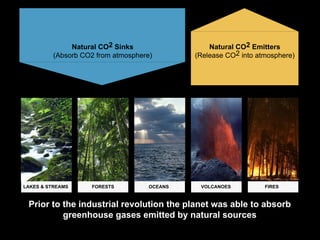
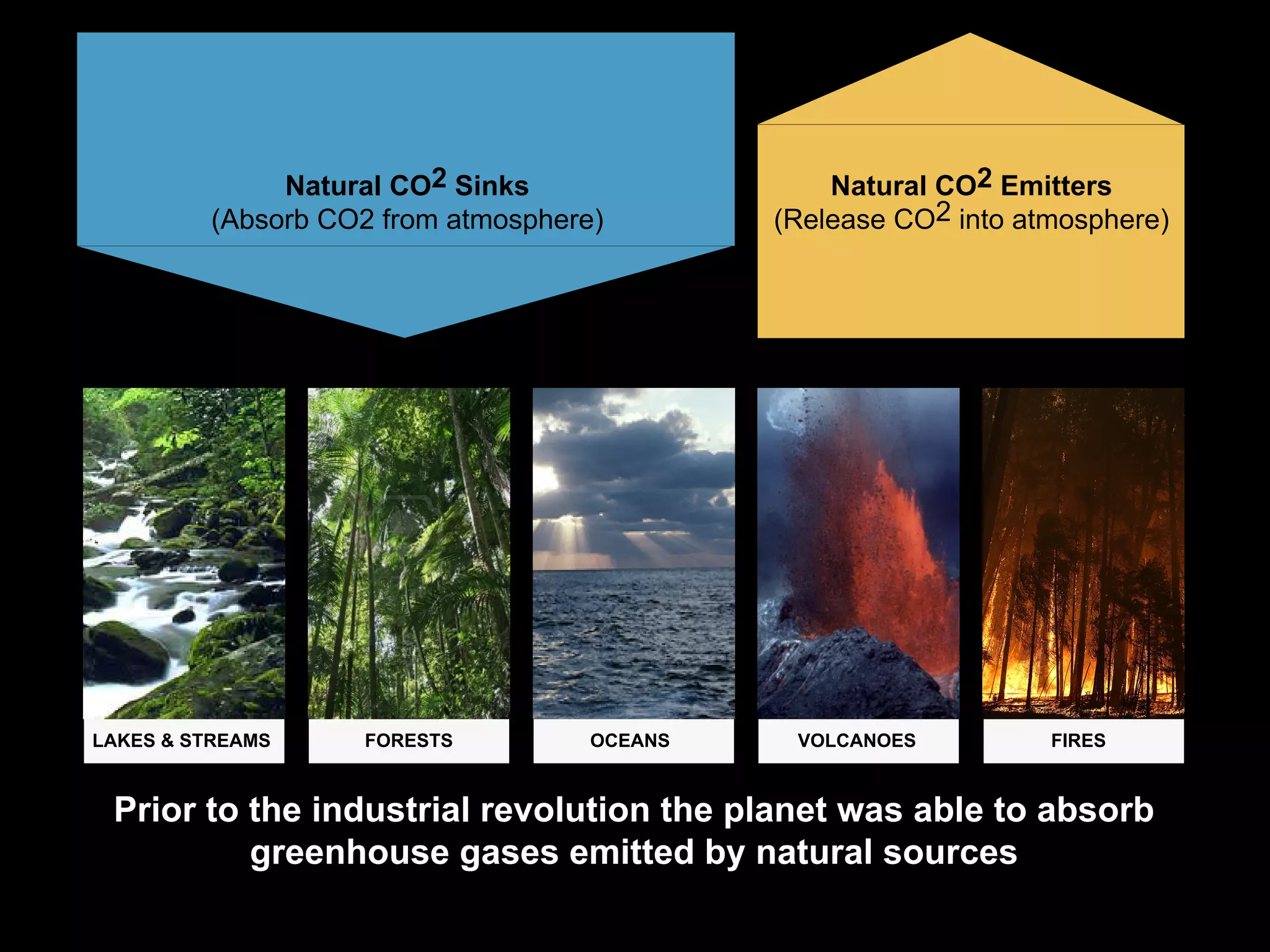
Prior to the industrial revolution the planet was able to absorb
greenhouse gases emitted by natural sources
VOLCANOES FIRESFORESTS OCEANSOCEANSLAKES & STREAMS
Natural CO2 Sinks
(Absorb CO2 from atmosphere)
Natural CO2 Emitters
(Release CO2 into atmosphere)
•  Natural	
  greenhouse	
  gases:	
  primarily	
  carbon	
  dioxide	
  (CO2)	
  
and	
  water	
  vapor	
  
•  Main	
  industrial	
  greenhouse	
  gas	
  is	
  CO2	
  from	
  burning	
  
(combus@on)	
  coal,	
  oil	
  and	
  gas	
  
•  Coal	
  has	
  the	
  highest	
  carbon	
  content	
  of	
  all	
  fossil	
  fuels	
  
•  CO2	
  from	
  coal	
  burning	
  contributed	
  slightly	
  over	
  28%	
  to	
  
atmospheric	
  greenhouse	
  gases	
  in	
  2010.	
  (
hGp://www.c2es.org/energy/source/coal)	
  
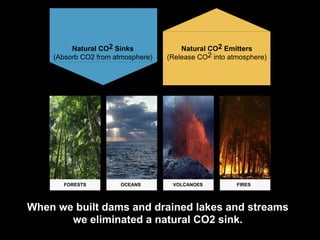
When we built dams and drained lakes and streams
we eliminated a natural CO2 sink.
VOLCANOES FIRESFORESTS OCEANSOCEANS
Natural CO2 Sinks
(Absorb CO2 from atmosphere)
Natural CO2 Emitters
(Release CO2 into atmosphere)
CO2	
  is	
  more	
  soluble	
  in	
  fresh	
  water	
  than	
  in	
  salt	
  water,	
  
but,	
  by	
  volume,	
  lakes	
  and	
  streams	
  are	
  less	
  effec@ve	
  
sinks	
  than	
  are	
  oceans	
  and	
  rainforests.	


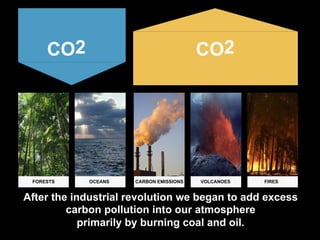
After the industrial revolution we began to add excess
carbon pollution into our atmosphere
primarily by burning coal and oil.
FORESTS OCEANSOCEANS VOLCANOES FIRESCARBON EMISSIONS
CO2 CO2
The	
  commonly	
  accepted	
  onset	
  of	
  the	
  Industrial	
  
Revolu@on	
  is	
  around	
  1850.	
  That	
  is	
  when	
  humans	
  
began	
  to	
  burn	
  fossil	
  fuels	
  to	
  generate	
  power	
  to	
  
drive	
  machinery.	
  (hGp://www.princeton.edu/
~achaney/tmve/wiki100k/docs/
Industrial_Revolu@on.html	


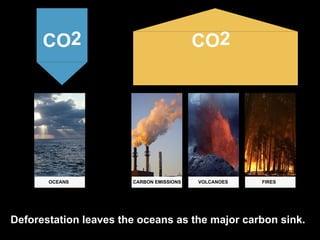
Deforestation leaves the oceans as the major carbon sink.
OCEANSOCEANS VOLCANOES FIRESCARBON EMISSIONS
CO2 CO2
“Forests	
  cover	
  31%	
  of	
  the	
  land	
  area	
  on	
  our	
  
planet.	
  …Deforesta@on	
  undermines	
  this	
  
important	
  carbon	
  sink.	
  It	
  is	
  es@mated	
  that	
  
15%	
  of	
  all	
  greenhouse	
  gas	
  emissions	
  are	
  the	
  
result	
  of	
  deforesta@on.”(hGp://
worldwildlife.org/threats/deforesta@on)	


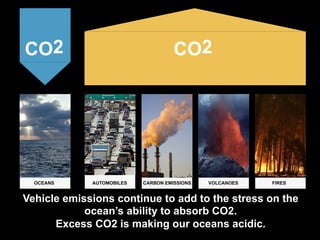
Vehicle emissions continue to add to the stress on the
ocean’s ability to absorb CO2.
Excess CO2 is making our oceans acidic.
OCEANSOCEANS VOLCANOES FIRESCARBON EMISSIONSAUTOMOBILES
CO2 CO2
Ocean	
  acidifica@on:	
  
•  hGp://www.unc.edu/~lbuckley/GCE/uploads/
Main/Doney%20et%20al%202009.pdf	
  
•  The	
  oceans	
  are	
  Earth’s	
  last,	
  great	
  defense	
  against	
  
carbon	
  pollu@on	
  and	
  they	
  are	
  being	
  stressed—
becoming	
  warmer	
  and	
  acidic.	
  
•  Contrary	
  to	
  early	
  popular	
  beliefs,	
  the	
  oceans	
  are	
  
not	
  limitless.	
  

Earth's carbon sinks and sources

  • 1.
    Prior to theindustrial revolution the planet was able to absorb greenhouse gases emitted by natural sources VOLCANOES FIRESFORESTS OCEANSOCEANSLAKES & STREAMS Natural CO2 Sinks (Absorb CO2 from atmosphere) Natural CO2 Emitters (Release CO2 into atmosphere)
  • 2.
    •  Natural  greenhouse  gases:  primarily  carbon  dioxide  (CO2)   and  water  vapor   •  Main  industrial  greenhouse  gas  is  CO2  from  burning   (combus@on)  coal,  oil  and  gas   •  Coal  has  the  highest  carbon  content  of  all  fossil  fuels   •  CO2  from  coal  burning  contributed  slightly  over  28%  to   atmospheric  greenhouse  gases  in  2010.  ( hGp://www.c2es.org/energy/source/coal)  
  • 3.
    When we builtdams and drained lakes and streams we eliminated a natural CO2 sink. VOLCANOES FIRESFORESTS OCEANSOCEANS Natural CO2 Sinks (Absorb CO2 from atmosphere) Natural CO2 Emitters (Release CO2 into atmosphere)
  • 4.
    CO2  is  more  soluble  in  fresh  water  than  in  salt  water,   but,  by  volume,  lakes  and  streams  are  less  effec@ve   sinks  than  are  oceans  and  rainforests.    
  • 5.
    After the industrialrevolution we began to add excess carbon pollution into our atmosphere primarily by burning coal and oil. FORESTS OCEANSOCEANS VOLCANOES FIRESCARBON EMISSIONS CO2 CO2
  • 6.
    The  commonly  accepted  onset  of  the  Industrial   Revolu@on  is  around  1850.  That  is  when  humans   began  to  burn  fossil  fuels  to  generate  power  to   drive  machinery.  (hGp://www.princeton.edu/ ~achaney/tmve/wiki100k/docs/ Industrial_Revolu@on.html    
  • 7.
    Deforestation leaves theoceans as the major carbon sink. OCEANSOCEANS VOLCANOES FIRESCARBON EMISSIONS CO2 CO2
  • 8.
    “Forests  cover  31%  of  the  land  area  on  our   planet.  …Deforesta@on  undermines  this   important  carbon  sink.  It  is  es@mated  that   15%  of  all  greenhouse  gas  emissions  are  the   result  of  deforesta@on.”(hGp:// worldwildlife.org/threats/deforesta@on)    
  • 9.
    Vehicle emissions continueto add to the stress on the ocean’s ability to absorb CO2. Excess CO2 is making our oceans acidic. OCEANSOCEANS VOLCANOES FIRESCARBON EMISSIONSAUTOMOBILES CO2 CO2
  • 10.
    Ocean  acidifica@on:   • hGp://www.unc.edu/~lbuckley/GCE/uploads/ Main/Doney%20et%20al%202009.pdf   •  The  oceans  are  Earth’s  last,  great  defense  against   carbon  pollu@on  and  they  are  being  stressed— becoming  warmer  and  acidic.   •  Contrary  to  early  popular  beliefs,  the  oceans  are   not  limitless.