Source Sink relationship – Phloem transport
Lecture 15
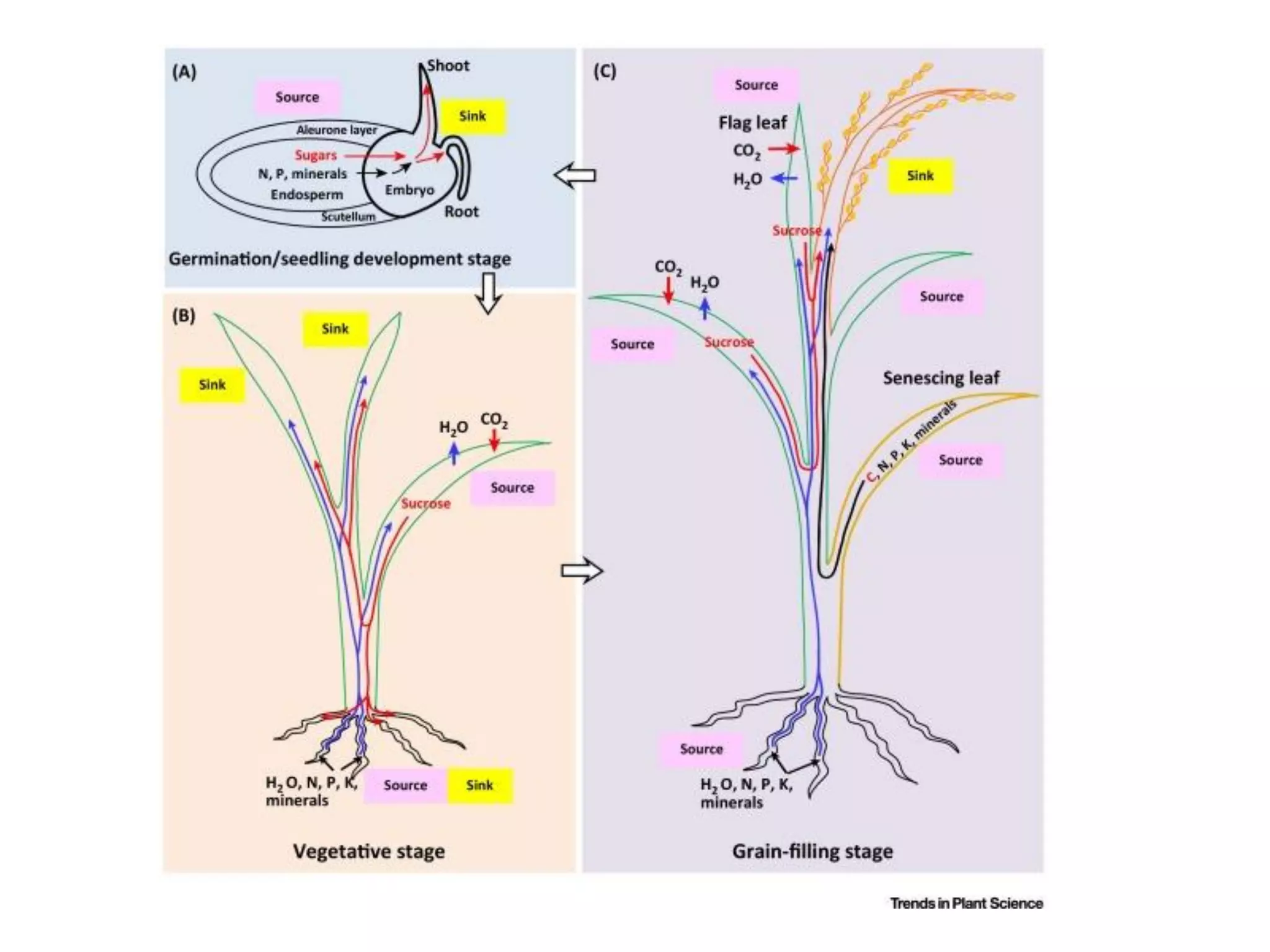
Source and sink
Source - Producers
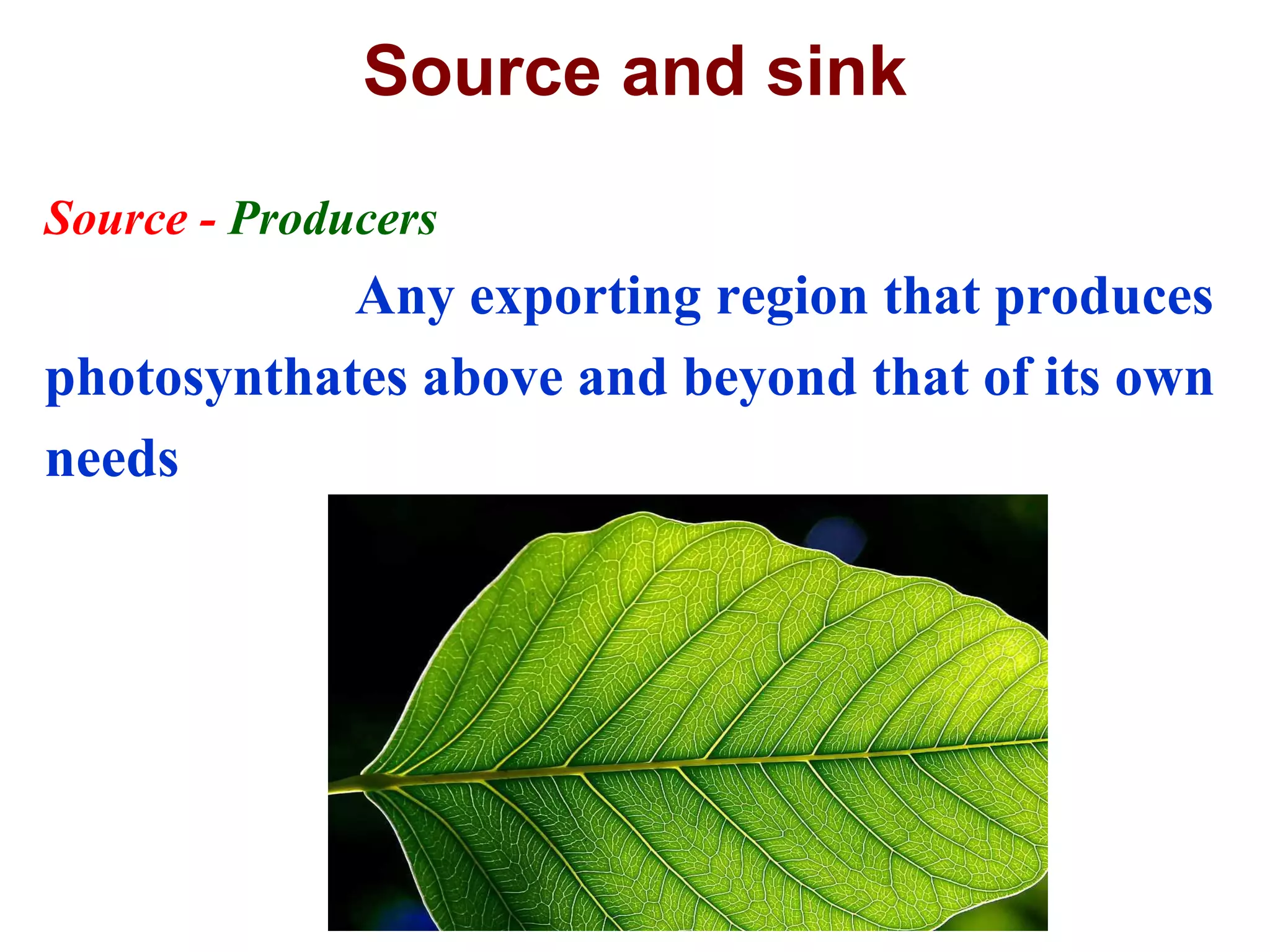
Any exporting region that produces
photosynthates above and beyond that of its own
needs
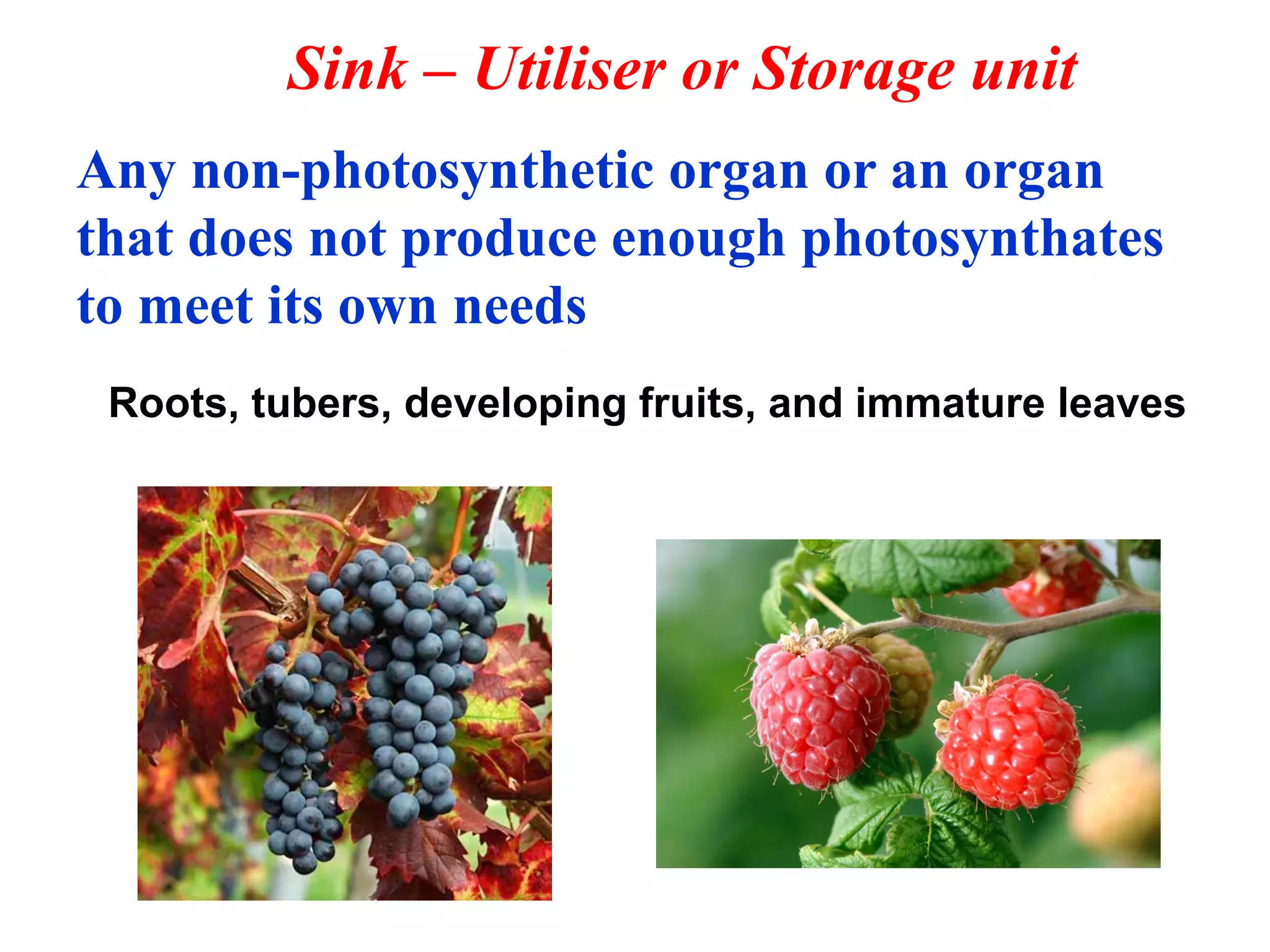
Any non-photosynthetic organ or an organ
that does not produce enough photosynthates
to meet its own needs
Sink – Utiliser or Storage unit
Roots, tubers, developing fruits, and immature leaves
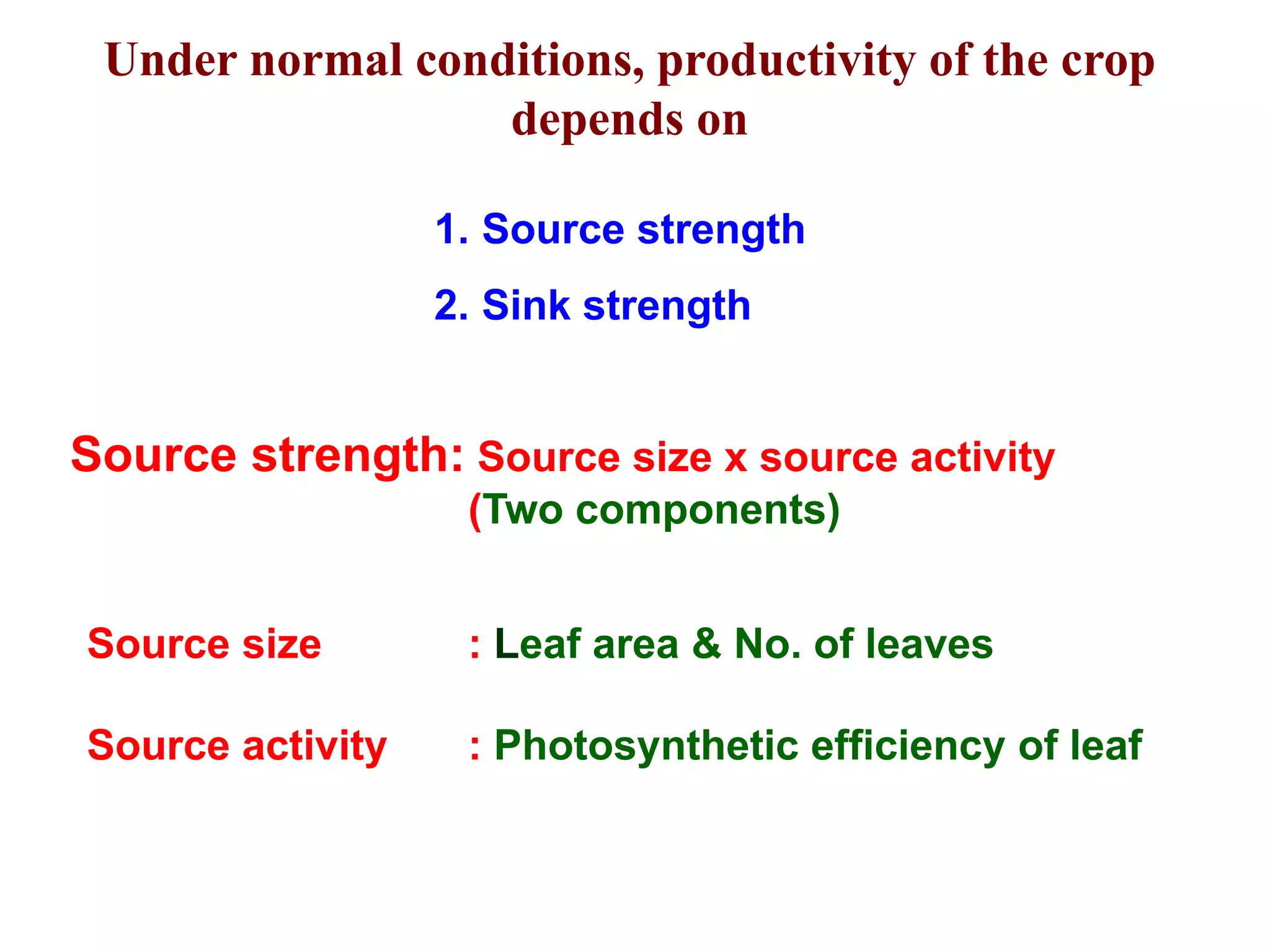
Under normal conditions, productivity of the crop
depends on
Source size : Leaf area & No. of leaves
Source activity : Photosynthetic efficiency of leaf
Source strength: Source size x source activity
(Two components)
1. Source strength
2. Sink strength
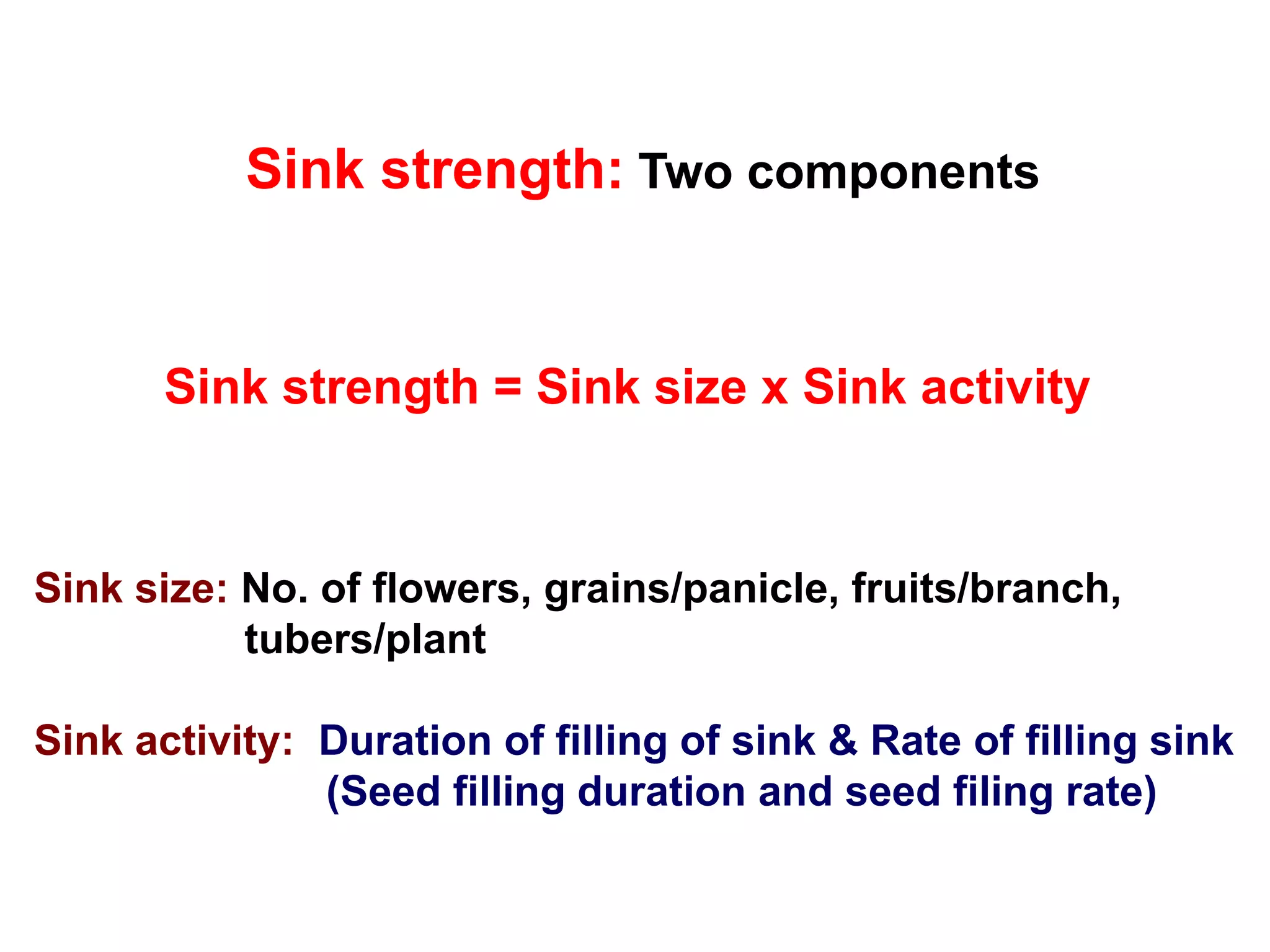
Sink size: No. of flowers, grains/panicle, fruits/branch,
tubers/plant
Sink activity: Duration of filling of sink & Rate of filling sink
(Seed filling duration and seed filing rate)
Sink strength: Two components
Sink strength = Sink size x Sink activity
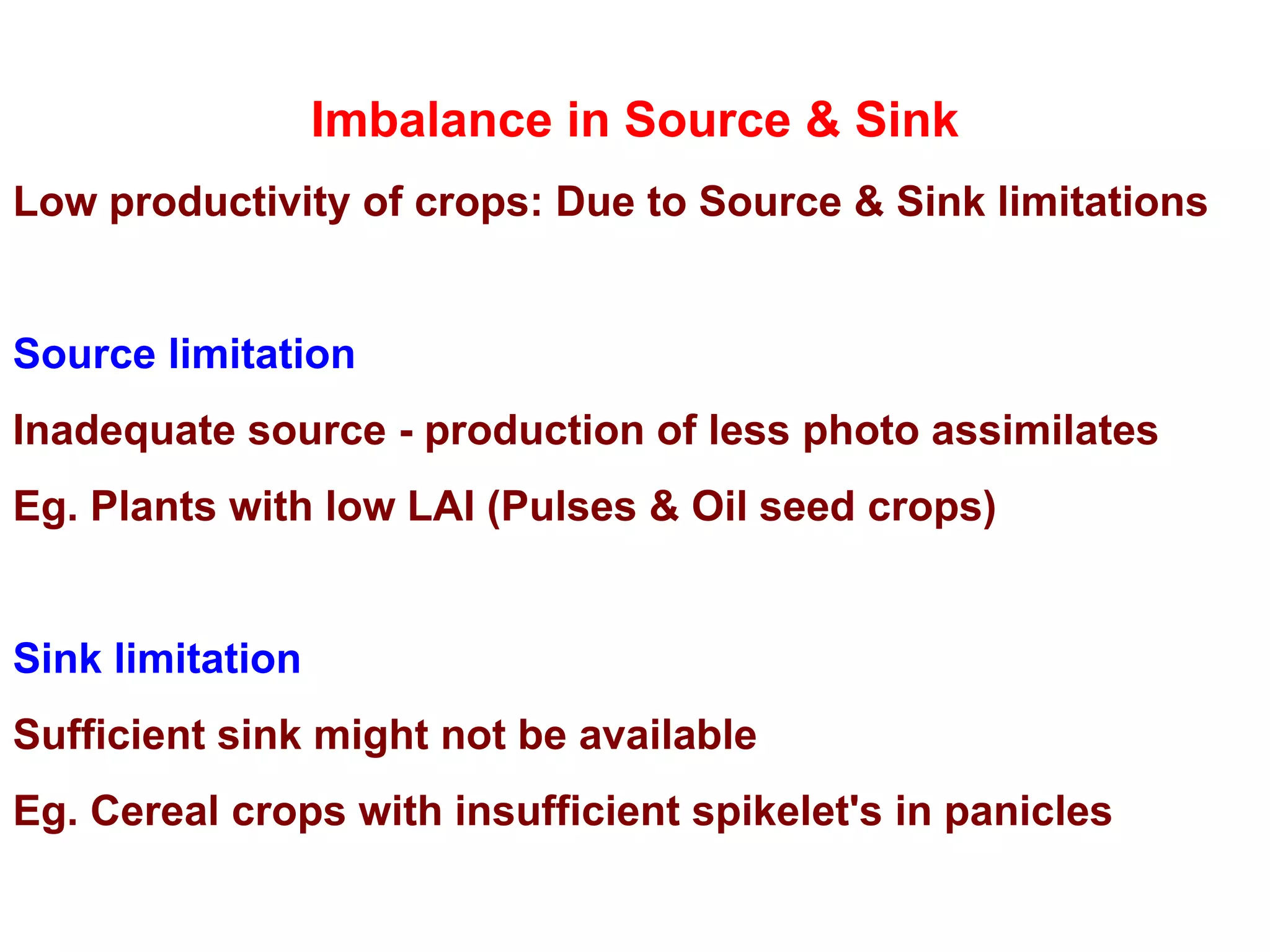
Imbalance in Source & Sink
Low productivity of crops: Due to Source & Sink limitations
Source limitation
Inadequate source - production of less photo assimilates
Eg. Plants with low LAI (Pulses & Oil seed crops)
Sink limitation
Sufficient sink might not be available
Eg. Cereal crops with insufficient spikelet's in panicles
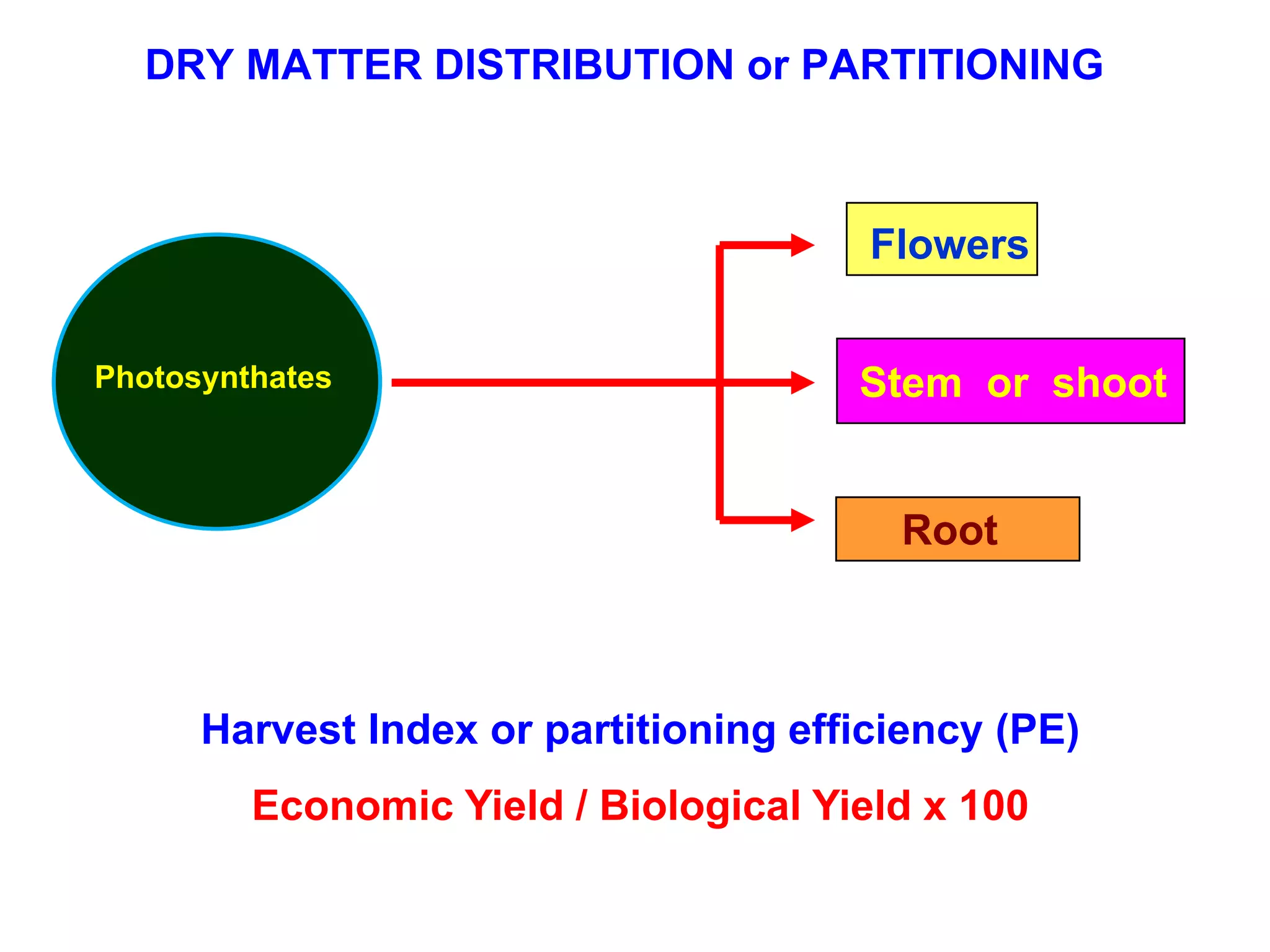
DRY MATTER DISTRIBUTION or PARTITIONING
Photosynthates
Flowers
Stem or shoot
Root
Harvest Index or partitioning efficiency (PE)
Economic Yield / Biological Yield x 100
Which part is involved in
photosynthates translocation?
Phloem
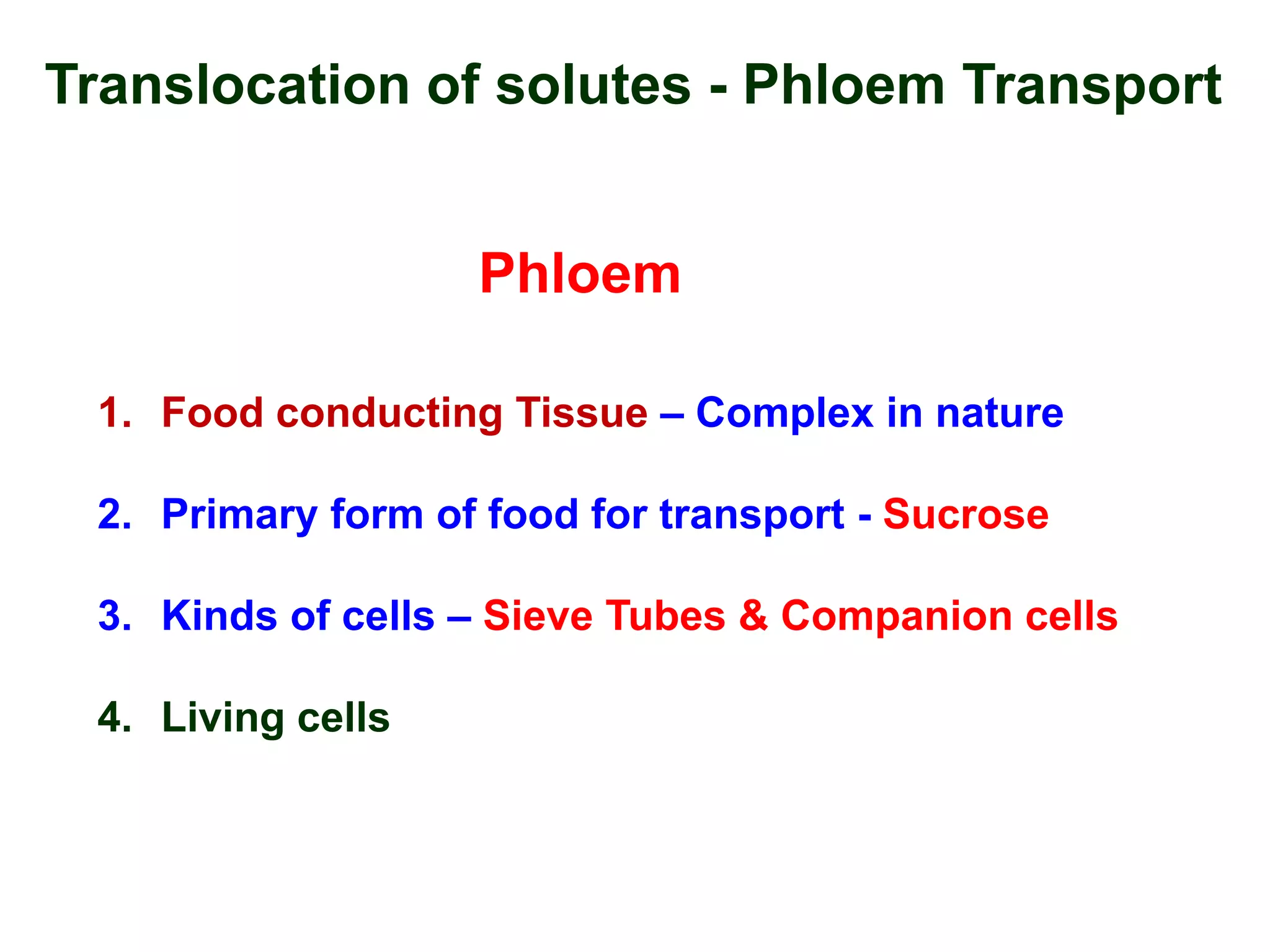
Translocation of solutes - Phloem Transport
Phloem
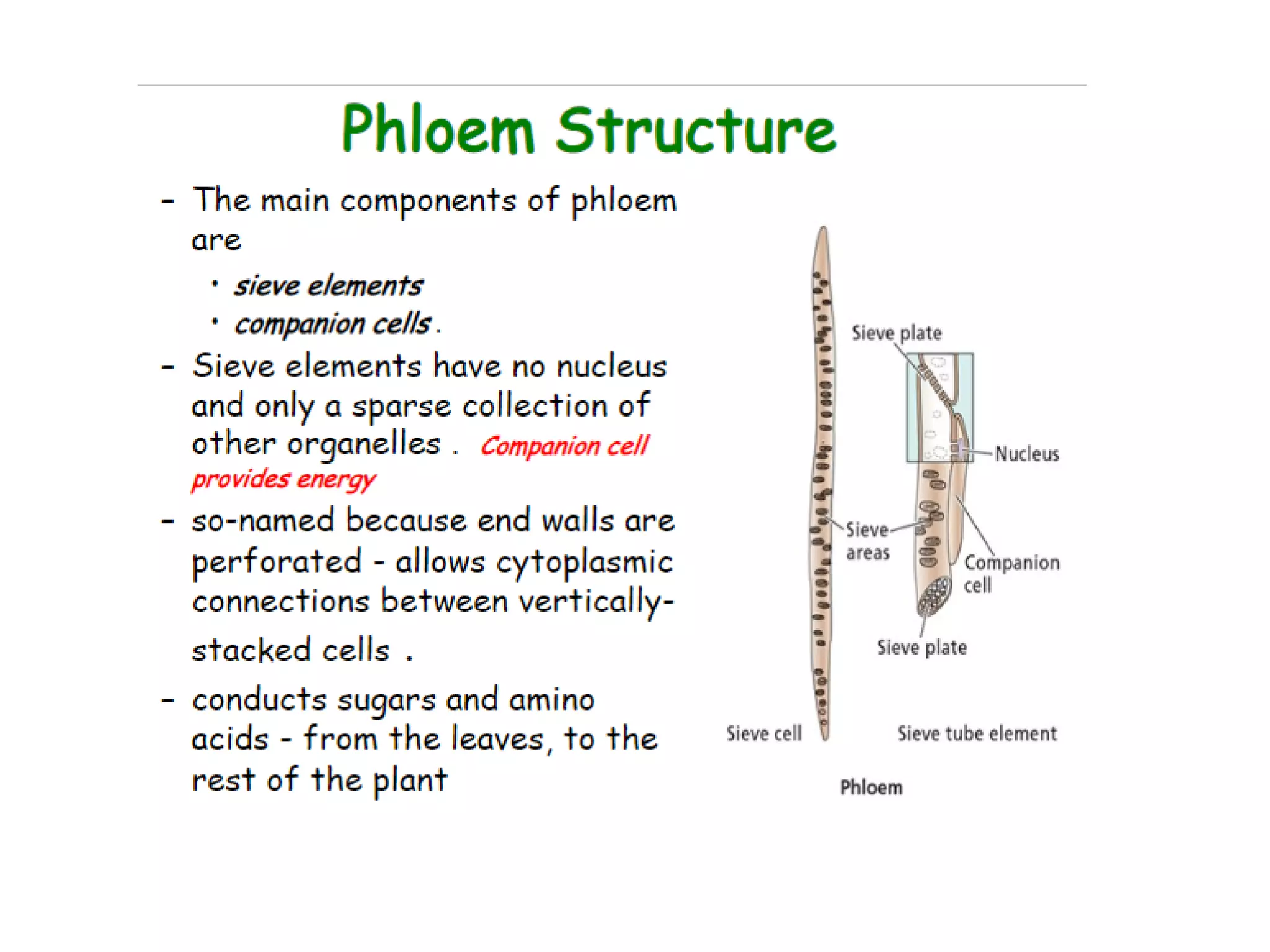
1. Food conducting Tissue – Complex in nature
2. Primary form of food for transport - Sucrose
3. Kinds of cells – Sieve Tubes & Companion cells
4. Living cells
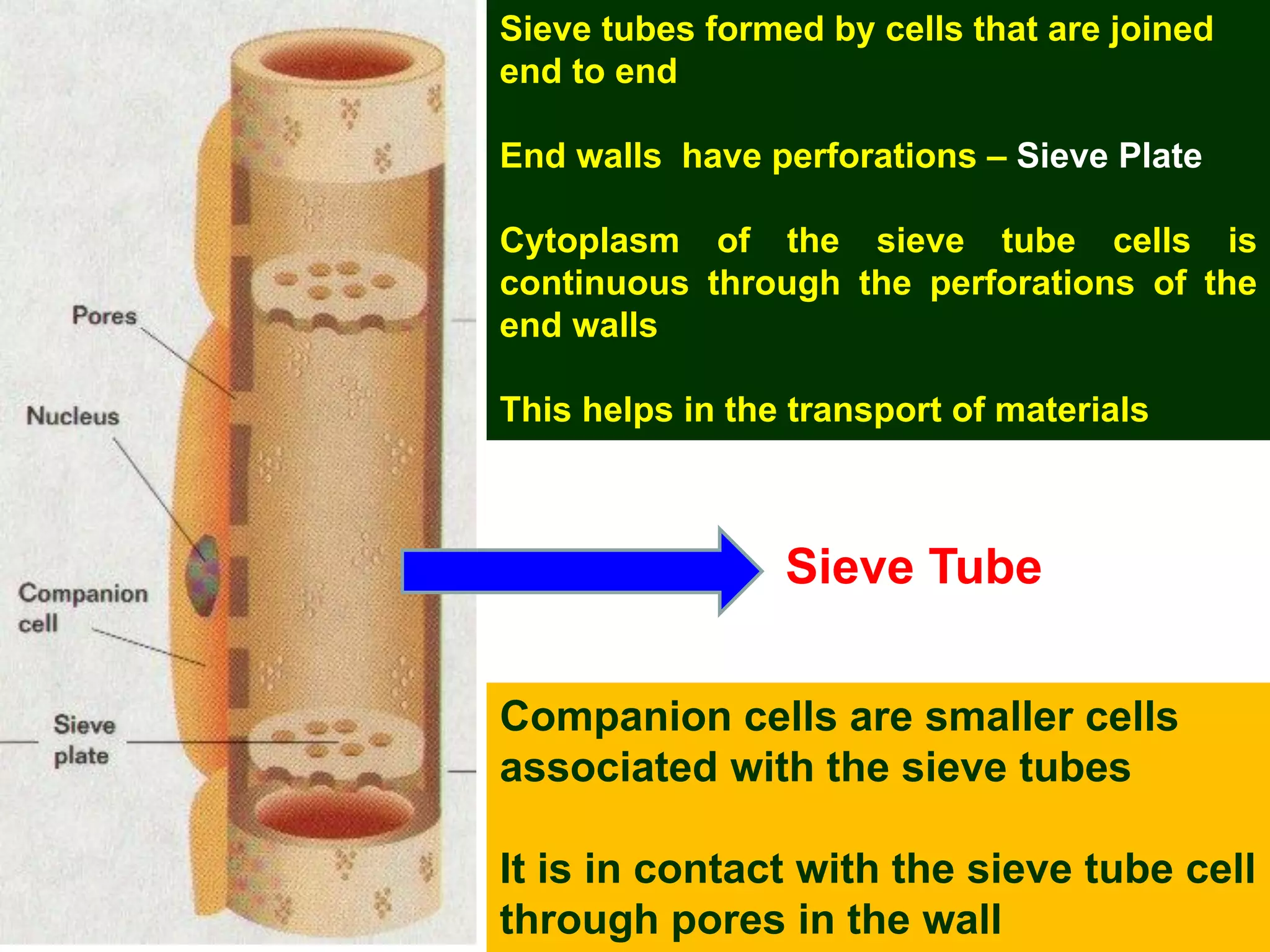
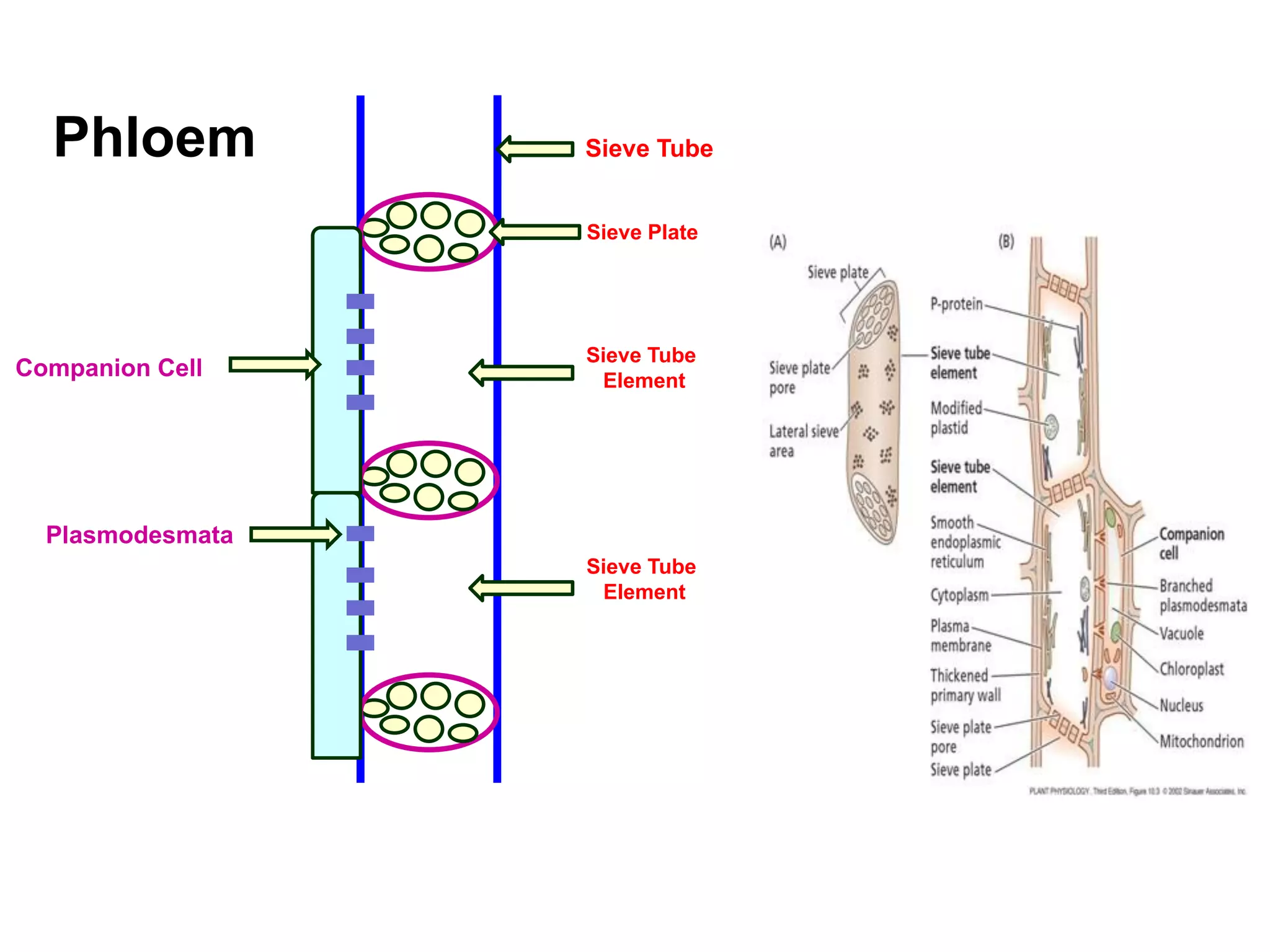
Sieve tubes formed by cells that are joined
end to end
End walls have perforations – Sieve Plate
Cytoplasm of the sieve tube cells is
continuous through the perforations of the
end walls
This helps in the transport of materials
Companion cells are smaller cells
associated with the sieve tubes
It is in contact with the sieve tube cell
through pores in the wall
Sieve Tube
Sieve Tube
Sieve Tube
Element
Sieve Tube
Element
Sieve Plate
Companion Cell
Phloem
Plasmodesmata
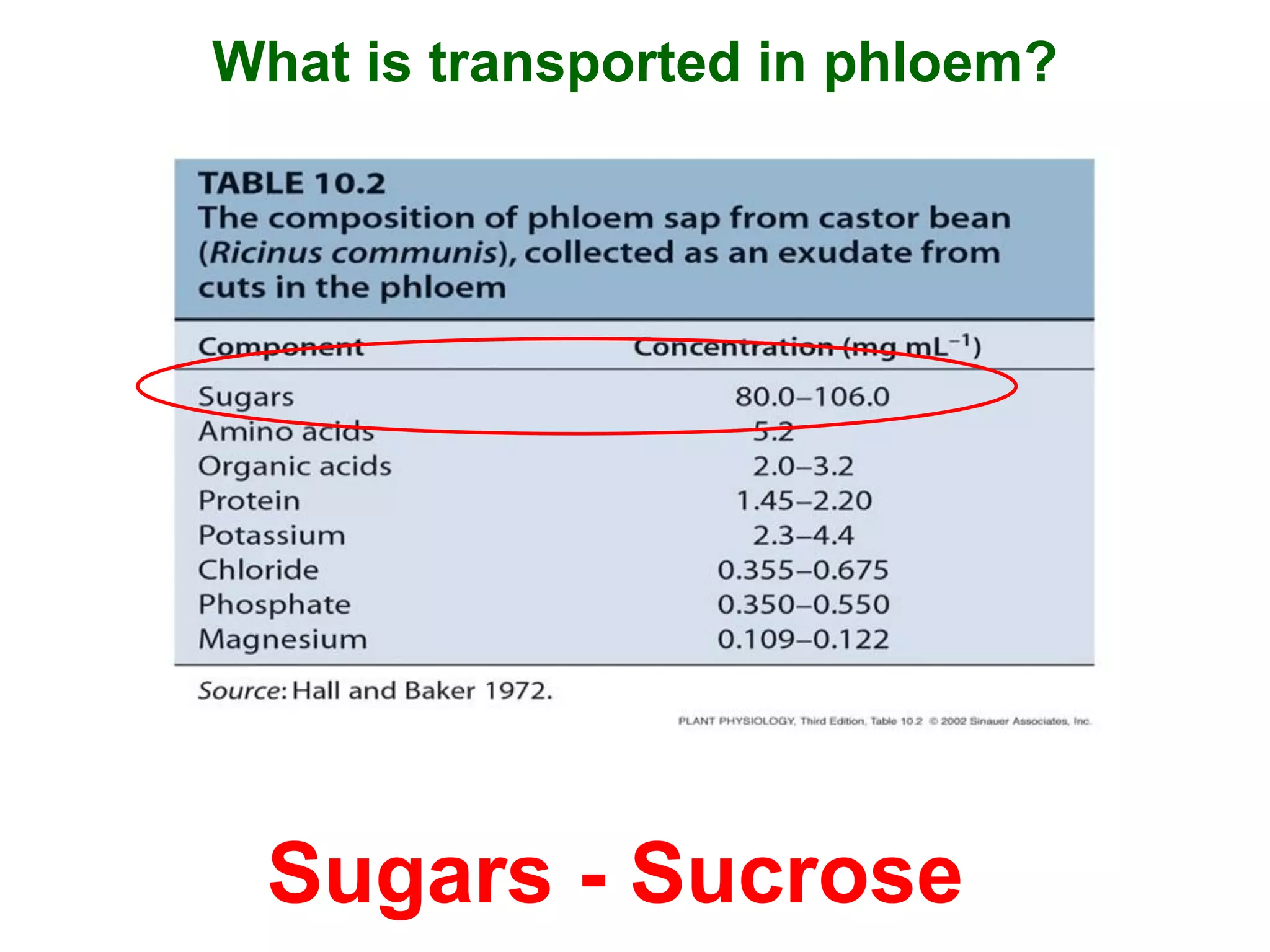
What is transported in phloem?
Sugars - Sucrose
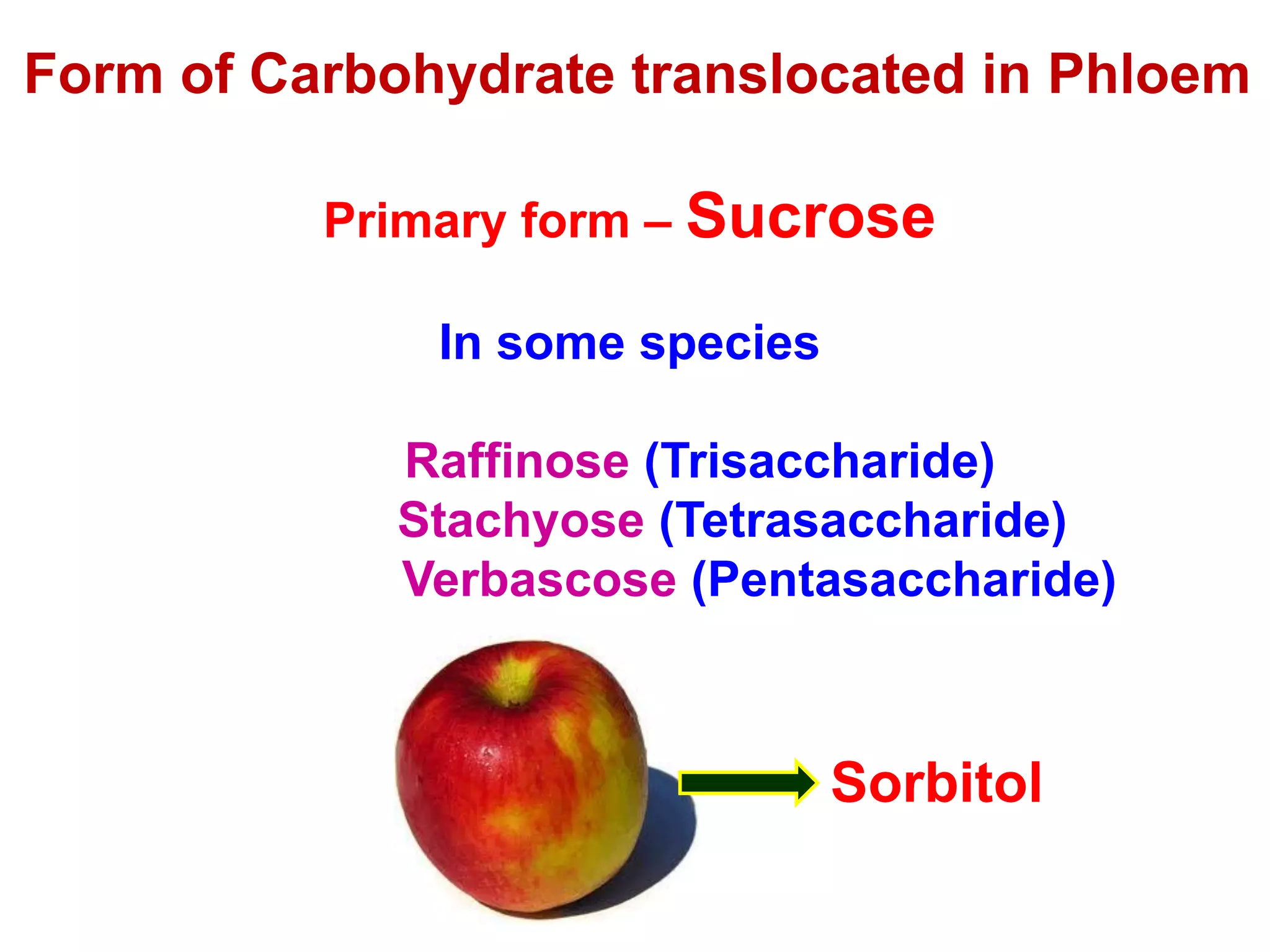
Form of Carbohydrate translocated in Phloem
Primary form – Sucrose
In some species
Raffinose (Trisaccharide)
Stachyose (Tetrasaccharide)
Verbascose (Pentasaccharide)
Sorbitol
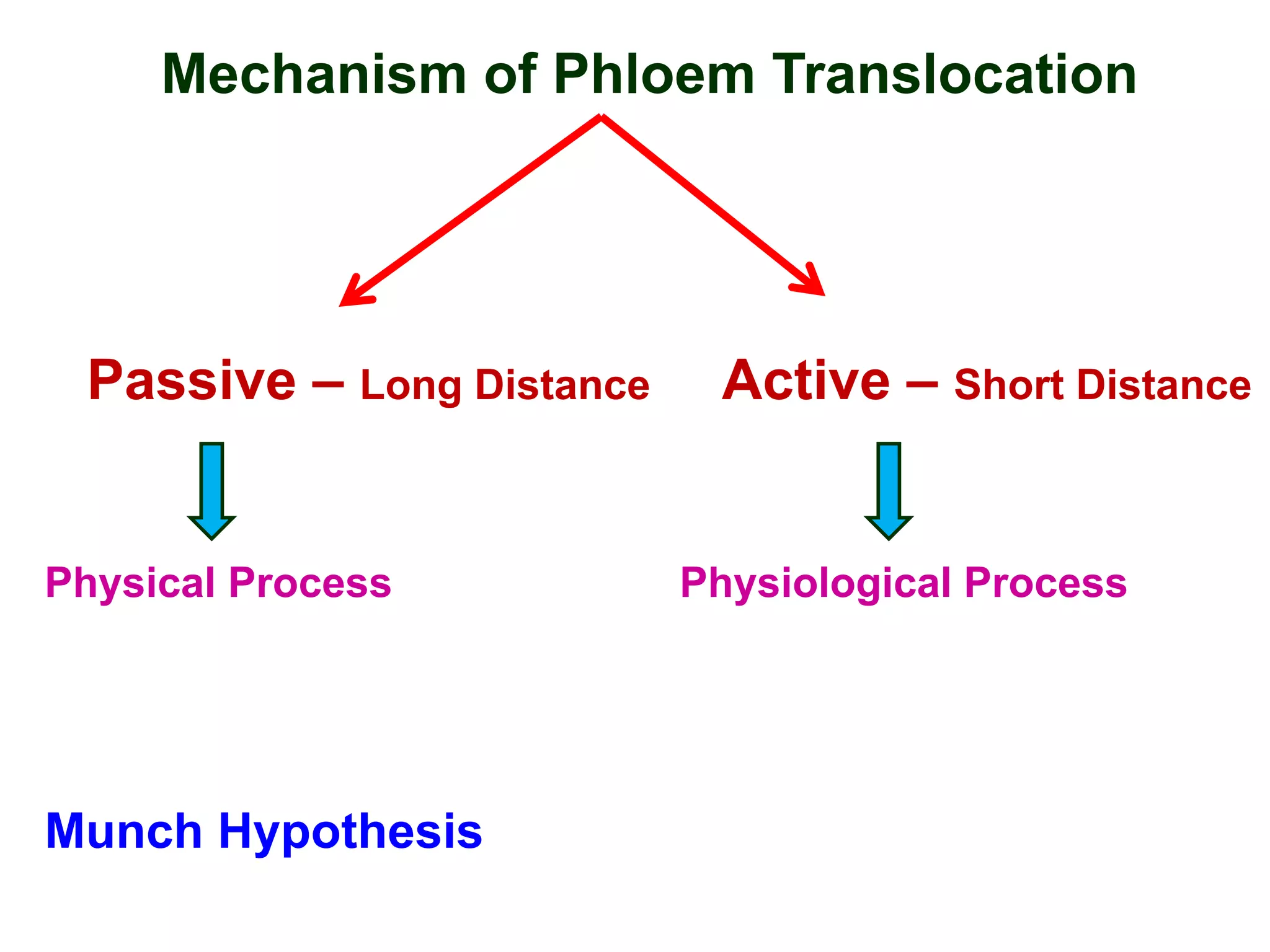
Mechanism of Phloem Translocation
Passive – Long Distance Active – Short Distance
Physical Process Physiological Process
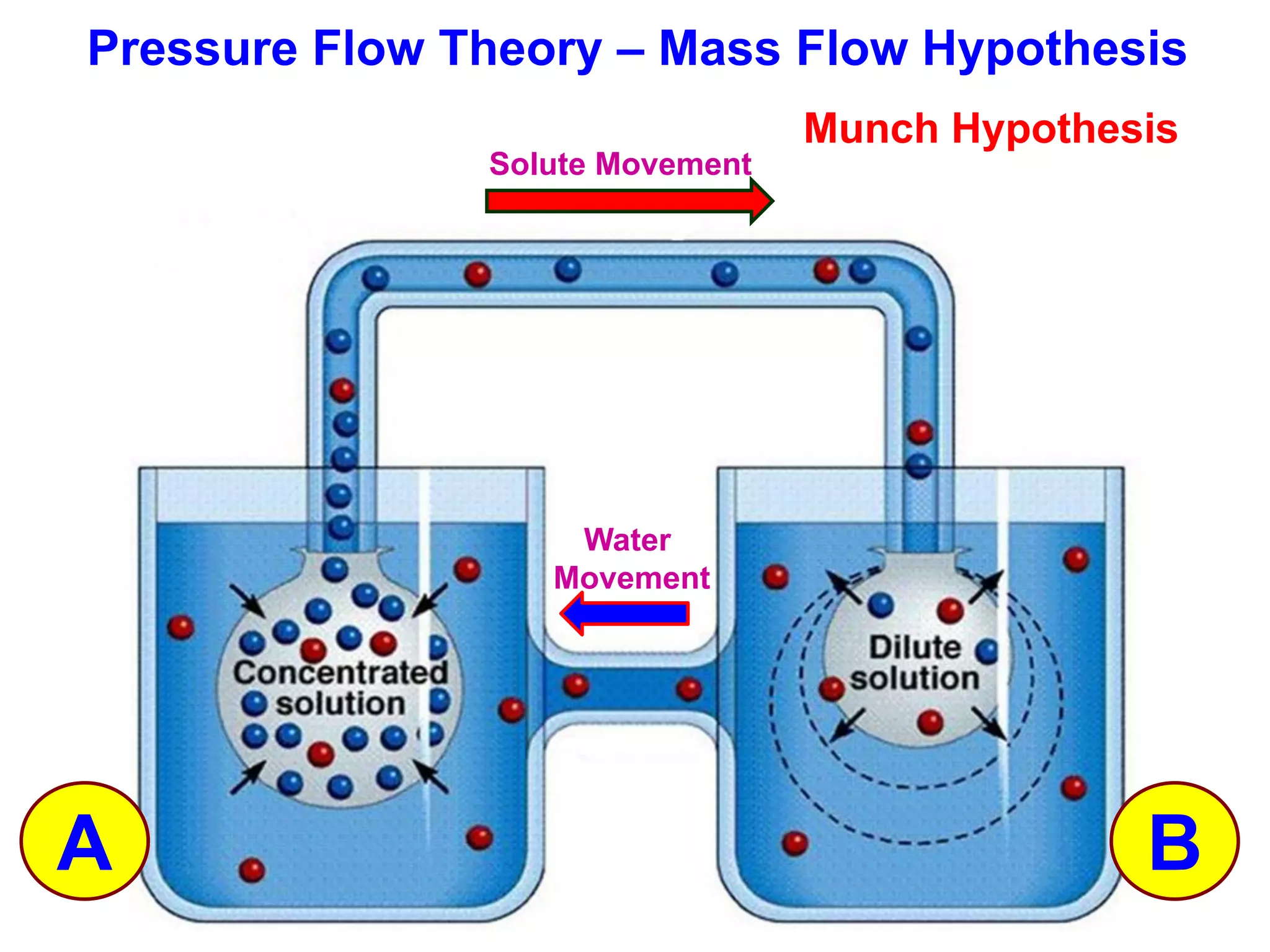
Munch Hypothesis
Solute Movement
Water
Movement
A B
Pressure Flow Theory – Mass Flow Hypothesis
Munch Hypothesis
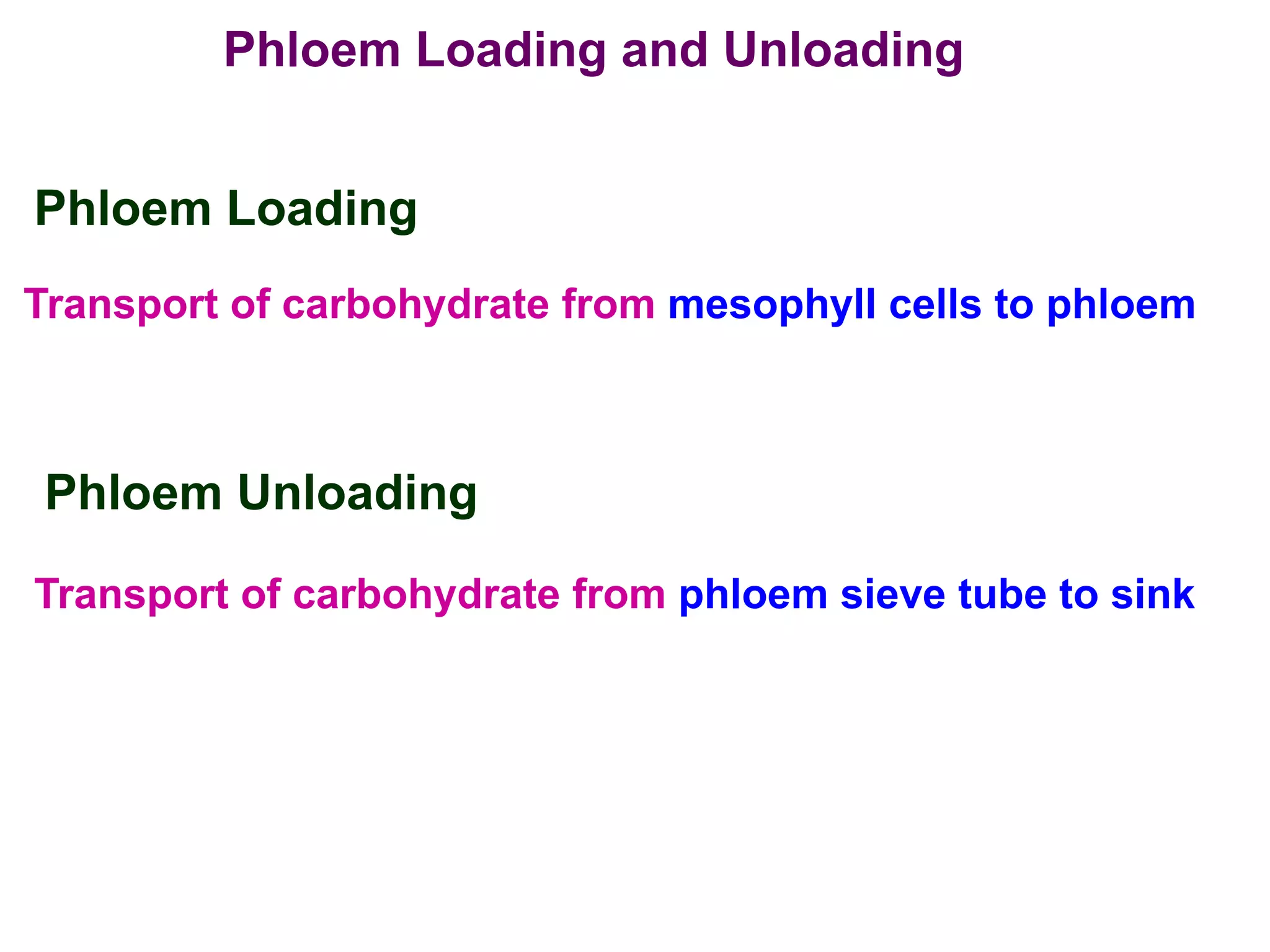
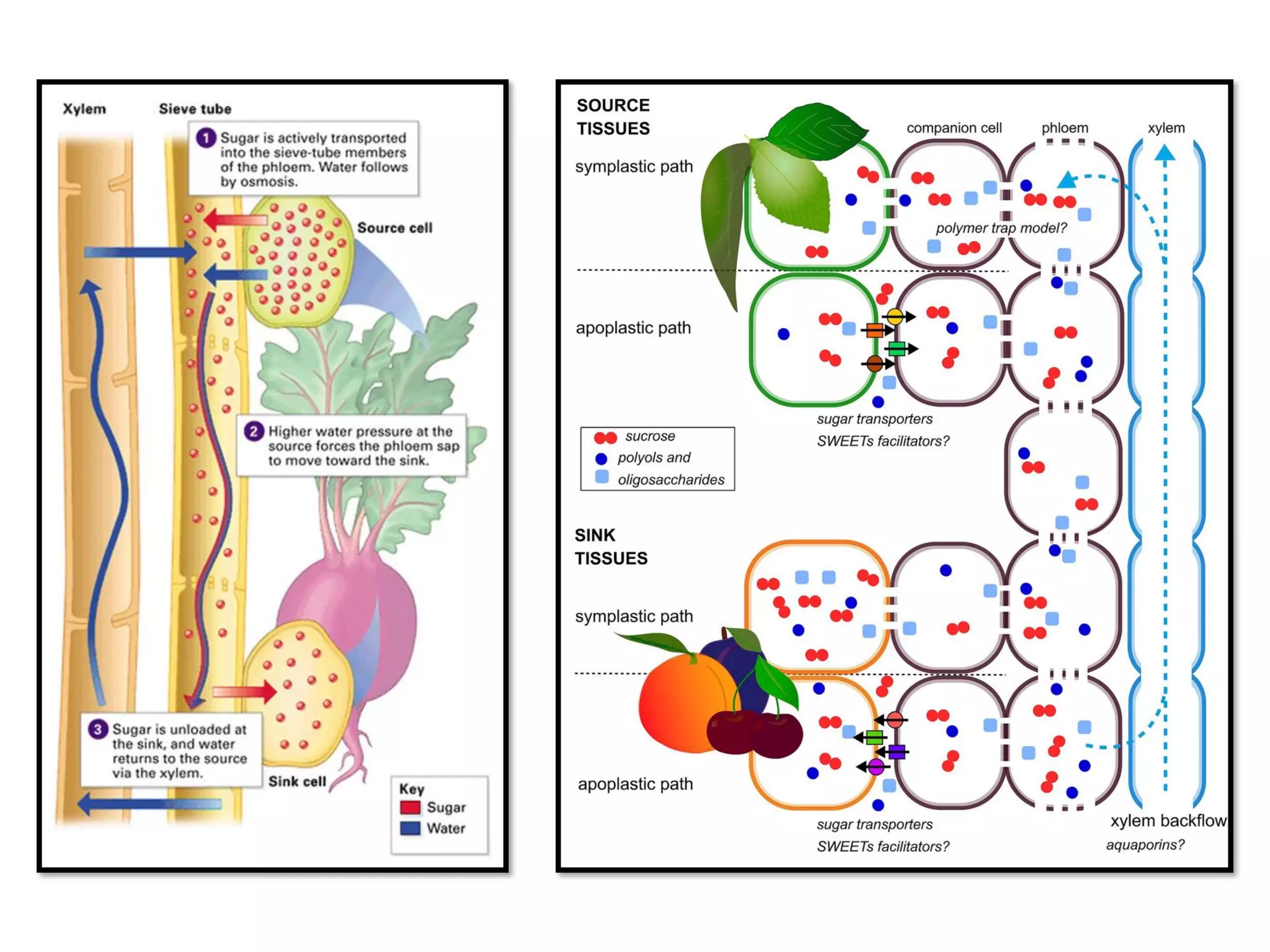
Phloem Loading and Unloading
Phloem Loading
Transport of carbohydrate from mesophyll cells to phloem
Phloem Unloading
Transport of carbohydrate from phloem sieve tube to sink
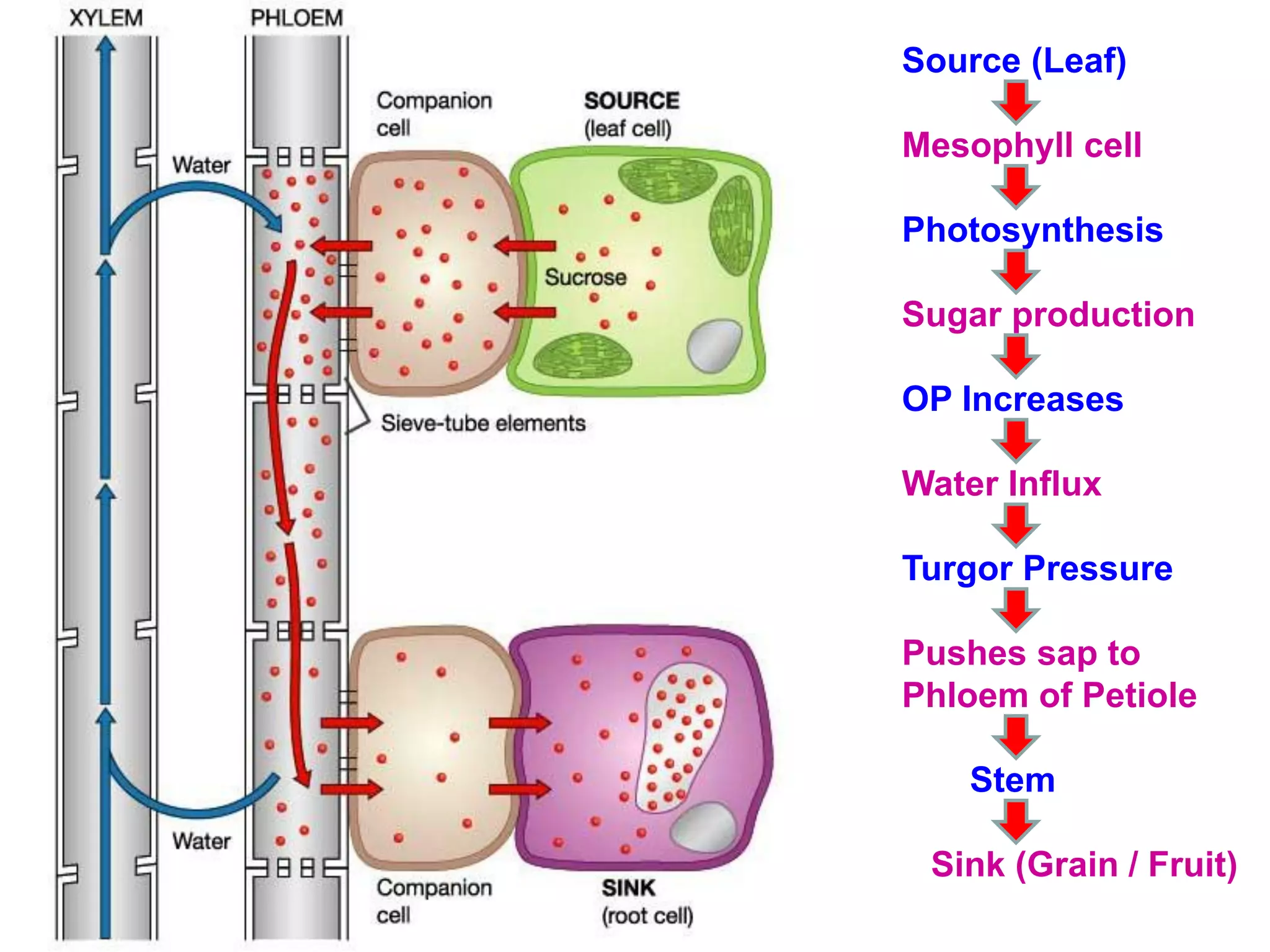
Source (Leaf)
Mesophyll cell
Photosynthesis
Sugar production
OP Increases
Water Influx
Turgor Pressure
Pushes sap to
Phloem of Petiole
Stem
Sink (Grain / Fruit)
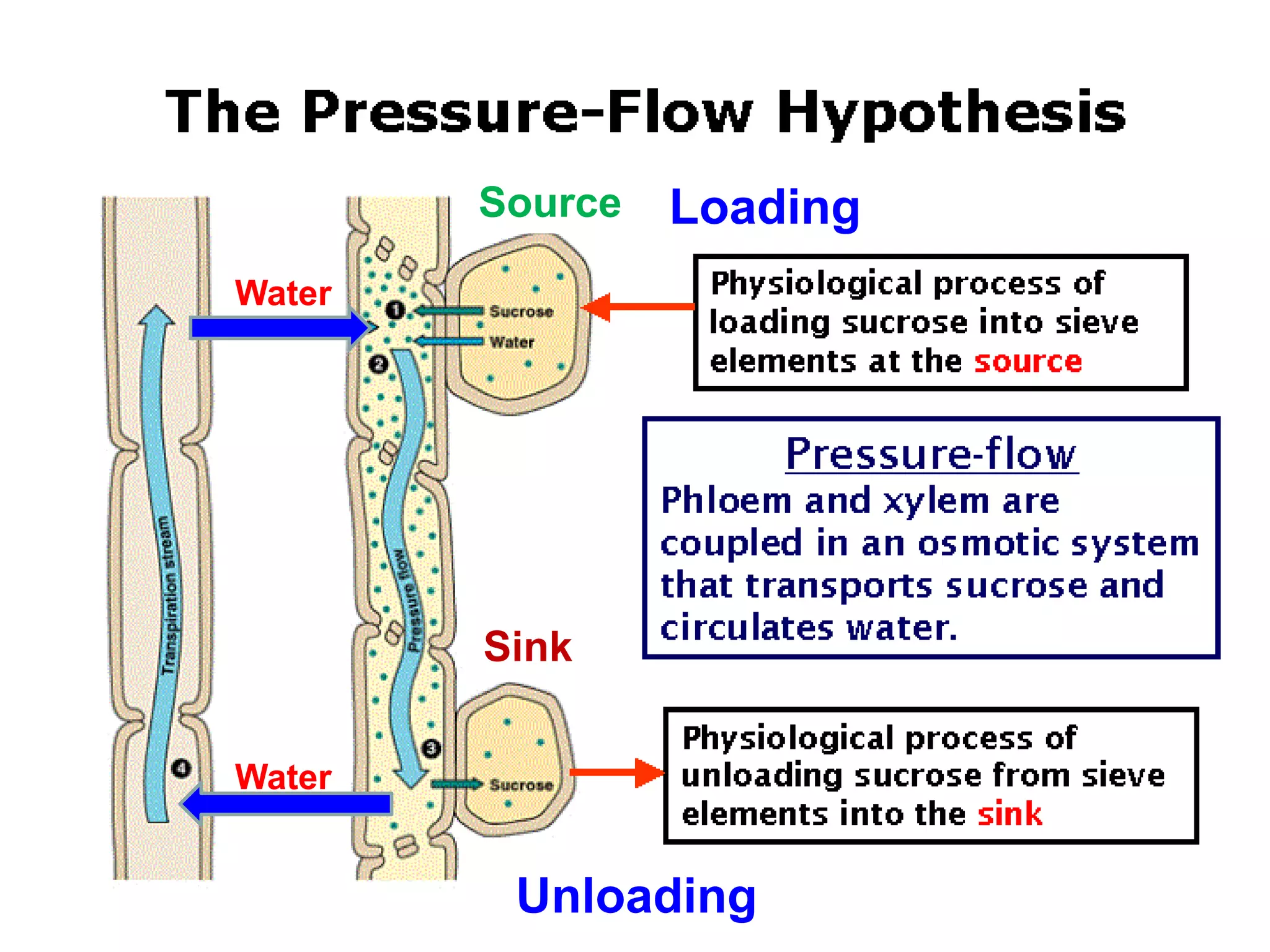
Water
Water
Source
Sink
Loading
Unloading
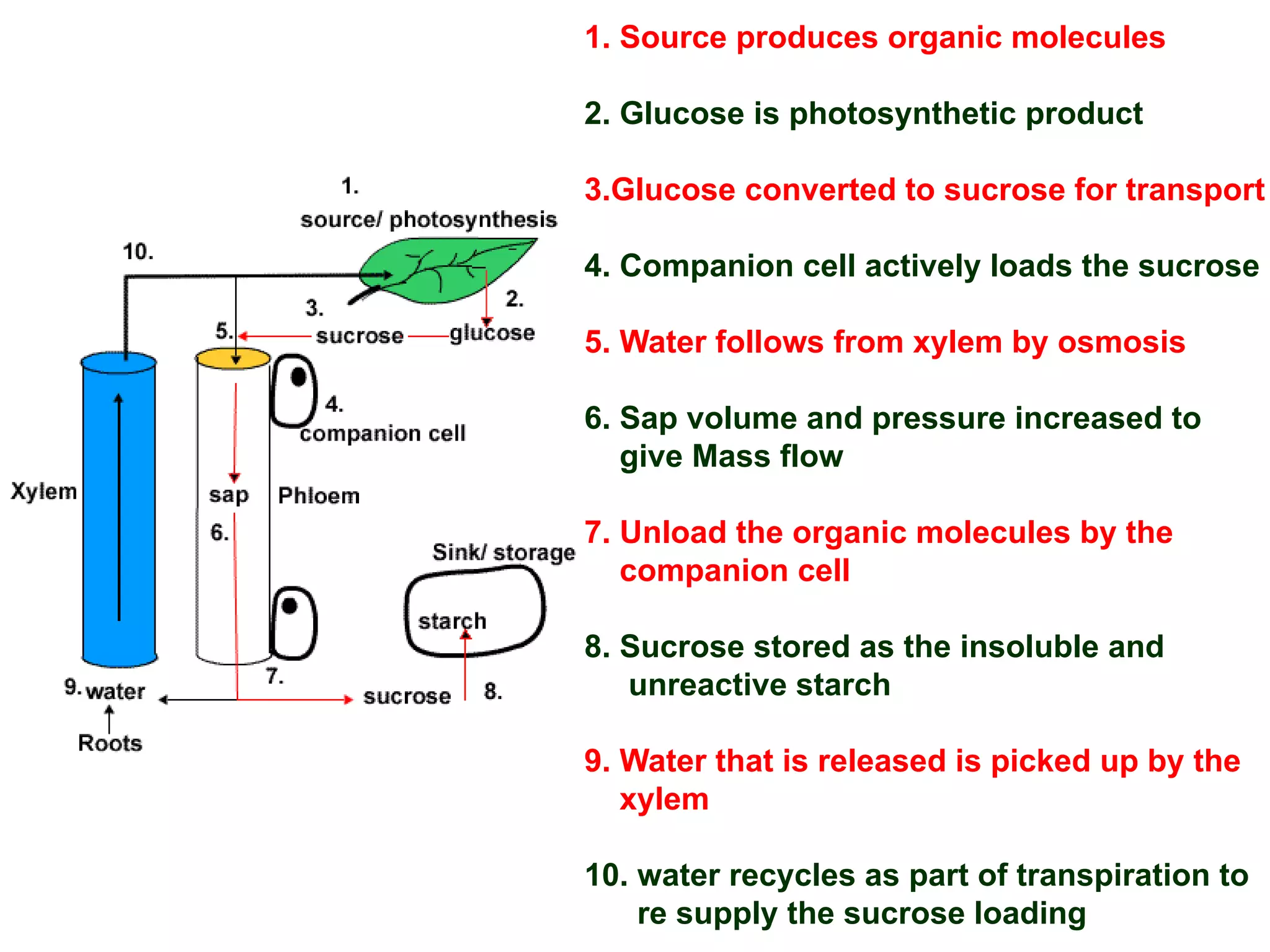
1. Source produces organic molecules
2. Glucose is photosynthetic product
3.Glucose converted to sucrose for transport
4. Companion cell actively loads the sucrose
5. Water follows from xylem by osmosis
6. Sap volume and pressure increased to
give Mass flow
7. Unload the organic molecules by the
companion cell
8. Sucrose stored as the insoluble and
unreactive starch
9. Water that is released is picked up by the
xylem
10. water recycles as part of transpiration to
re supply the sucrose loading
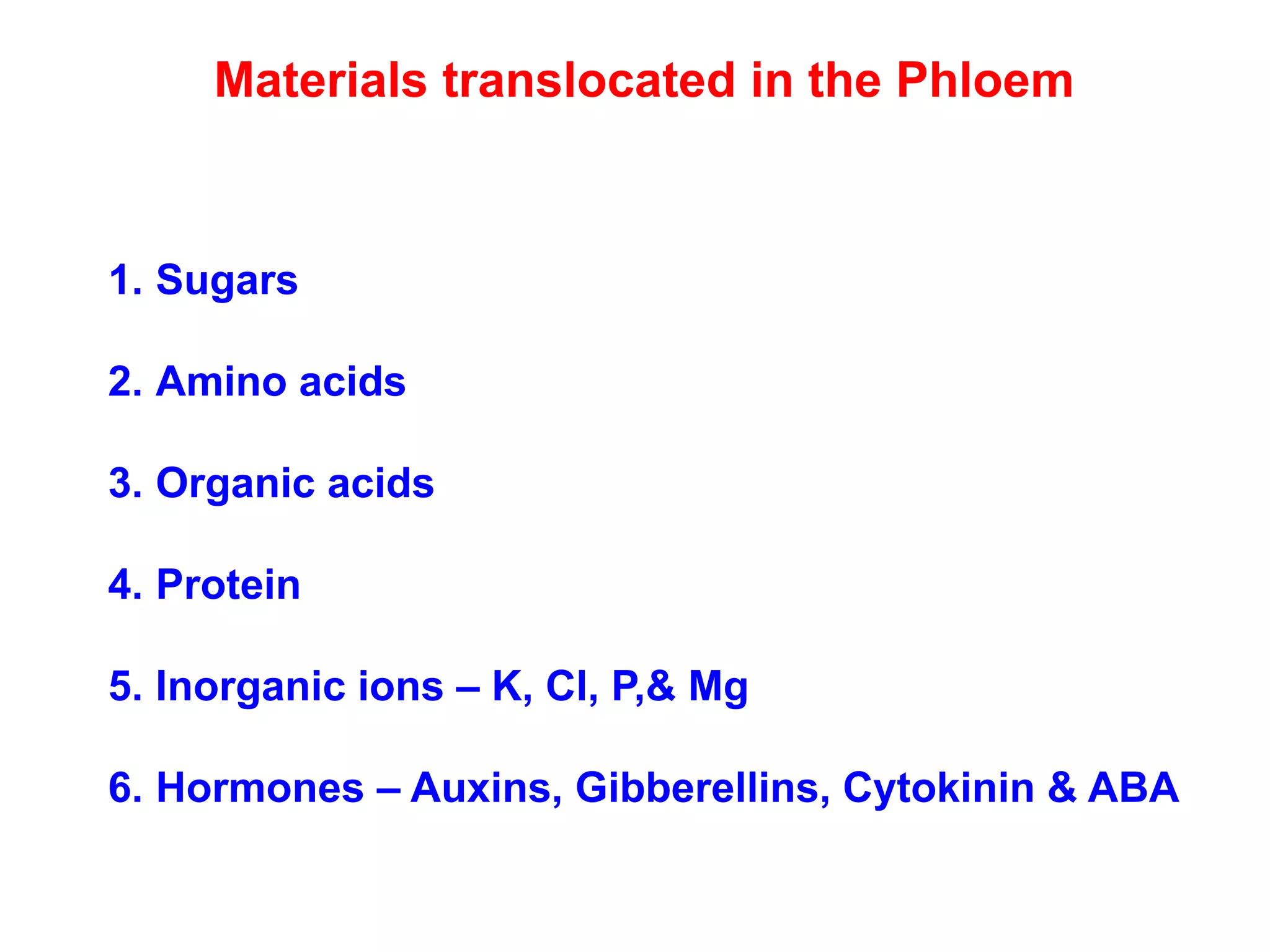
Materials translocated in the Phloem
1. Sugars
2. Amino acids
3. Organic acids
4. Protein
5. Inorganic ions – K, Cl, P,& Mg
6. Hormones – Auxins, Gibberellins, Cytokinin & ABA
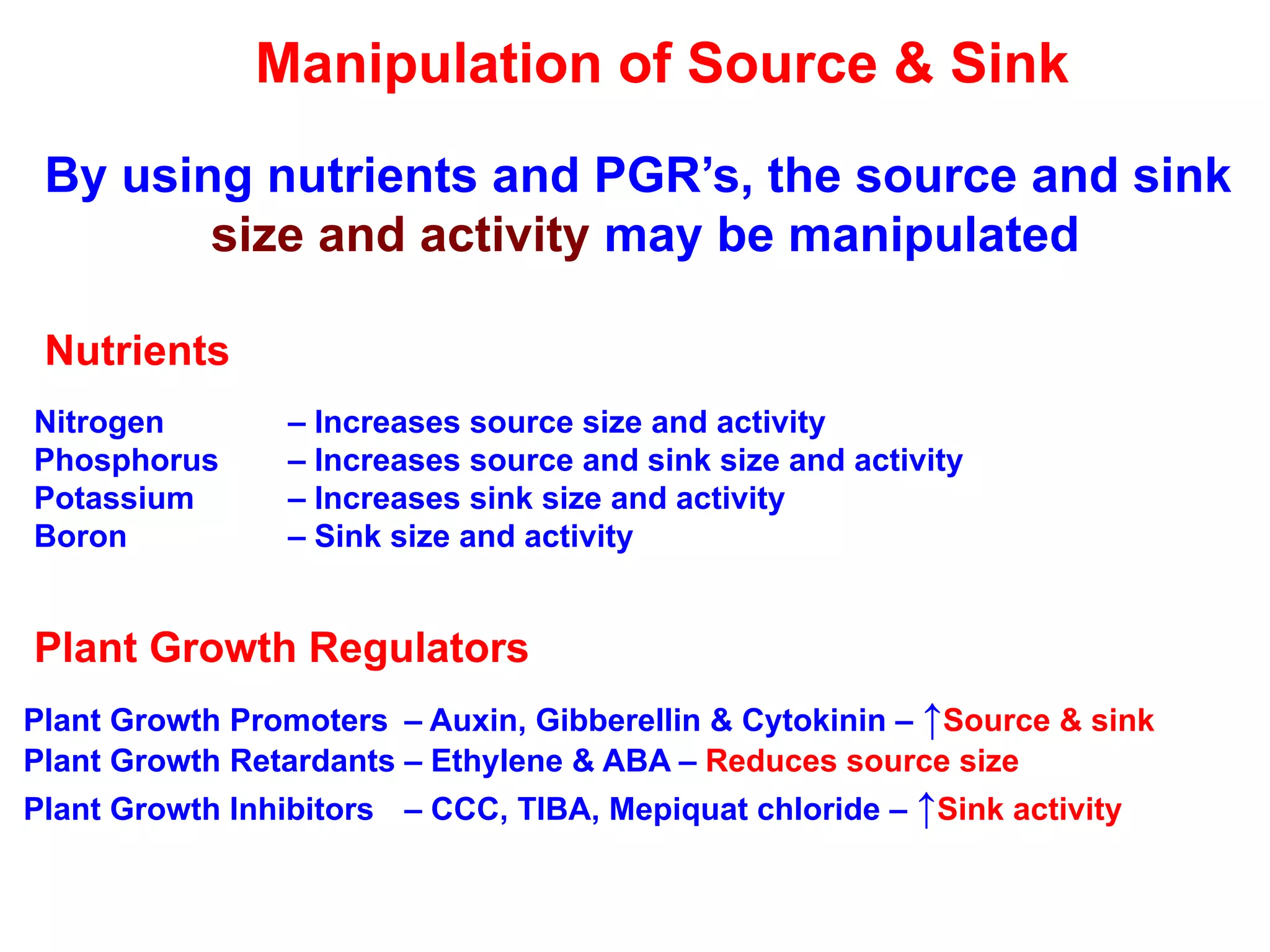
Manipulation of Source & Sink
By using nutrients and PGR’s, the source and sink
size and activity may be manipulated
Nitrogen – Increases source size and activity
Phosphorus – Increases source and sink size and activity
Potassium – Increases sink size and activity
Boron – Sink size and activity
Plant Growth Regulators
Nutrients
Plant Growth Promoters – Auxin, Gibberellin & Cytokinin – ↑Source & sink
Plant Growth Retardants – Ethylene & ABA – Reduces source size
Plant Growth Inhibitors – CCC, TIBA, Mepiquat chloride – ↑Sink activity
Thanks lot

loading.pdf

  • 1.
    Source Sink relationship– Phloem transport Lecture 15
  • 2.
    Source and sink Source- Producers Any exporting region that produces photosynthates above and beyond that of its own needs
  • 3.
    Any non-photosynthetic organor an organ that does not produce enough photosynthates to meet its own needs Sink – Utiliser or Storage unit Roots, tubers, developing fruits, and immature leaves
  • 6.
    Under normal conditions,productivity of the crop depends on Source size : Leaf area & No. of leaves Source activity : Photosynthetic efficiency of leaf Source strength: Source size x source activity (Two components) 1. Source strength 2. Sink strength
  • 7.
    Sink size: No.of flowers, grains/panicle, fruits/branch, tubers/plant Sink activity: Duration of filling of sink & Rate of filling sink (Seed filling duration and seed filing rate) Sink strength: Two components Sink strength = Sink size x Sink activity
  • 8.
    Imbalance in Source& Sink Low productivity of crops: Due to Source & Sink limitations Source limitation Inadequate source - production of less photo assimilates Eg. Plants with low LAI (Pulses & Oil seed crops) Sink limitation Sufficient sink might not be available Eg. Cereal crops with insufficient spikelet's in panicles
  • 9.
    DRY MATTER DISTRIBUTIONor PARTITIONING Photosynthates Flowers Stem or shoot Root Harvest Index or partitioning efficiency (PE) Economic Yield / Biological Yield x 100
  • 10.
    Which part isinvolved in photosynthates translocation? Phloem
  • 11.
    Translocation of solutes- Phloem Transport Phloem 1. Food conducting Tissue – Complex in nature 2. Primary form of food for transport - Sucrose 3. Kinds of cells – Sieve Tubes & Companion cells 4. Living cells
  • 12.
    Sieve tubes formedby cells that are joined end to end End walls have perforations – Sieve Plate Cytoplasm of the sieve tube cells is continuous through the perforations of the end walls This helps in the transport of materials Companion cells are smaller cells associated with the sieve tubes It is in contact with the sieve tube cell through pores in the wall Sieve Tube
  • 13.
    Sieve Tube Sieve Tube Element SieveTube Element Sieve Plate Companion Cell Phloem Plasmodesmata
  • 14.
    What is transportedin phloem? Sugars - Sucrose
  • 16.
    Form of Carbohydratetranslocated in Phloem Primary form – Sucrose In some species Raffinose (Trisaccharide) Stachyose (Tetrasaccharide) Verbascose (Pentasaccharide) Sorbitol
  • 17.
    Mechanism of PhloemTranslocation Passive – Long Distance Active – Short Distance Physical Process Physiological Process Munch Hypothesis
  • 18.
    Solute Movement Water Movement A B PressureFlow Theory – Mass Flow Hypothesis Munch Hypothesis
  • 19.
    Phloem Loading andUnloading Phloem Loading Transport of carbohydrate from mesophyll cells to phloem Phloem Unloading Transport of carbohydrate from phloem sieve tube to sink
  • 20.
    Source (Leaf) Mesophyll cell Photosynthesis Sugarproduction OP Increases Water Influx Turgor Pressure Pushes sap to Phloem of Petiole Stem Sink (Grain / Fruit)
  • 21.
  • 22.
    1. Source producesorganic molecules 2. Glucose is photosynthetic product 3.Glucose converted to sucrose for transport 4. Companion cell actively loads the sucrose 5. Water follows from xylem by osmosis 6. Sap volume and pressure increased to give Mass flow 7. Unload the organic molecules by the companion cell 8. Sucrose stored as the insoluble and unreactive starch 9. Water that is released is picked up by the xylem 10. water recycles as part of transpiration to re supply the sucrose loading
  • 24.
    Materials translocated inthe Phloem 1. Sugars 2. Amino acids 3. Organic acids 4. Protein 5. Inorganic ions – K, Cl, P,& Mg 6. Hormones – Auxins, Gibberellins, Cytokinin & ABA
  • 25.
    Manipulation of Source& Sink By using nutrients and PGR’s, the source and sink size and activity may be manipulated Nitrogen – Increases source size and activity Phosphorus – Increases source and sink size and activity Potassium – Increases sink size and activity Boron – Sink size and activity Plant Growth Regulators Nutrients Plant Growth Promoters – Auxin, Gibberellin & Cytokinin – ↑Source & sink Plant Growth Retardants – Ethylene & ABA – Reduces source size Plant Growth Inhibitors – CCC, TIBA, Mepiquat chloride – ↑Sink activity
  • 26.