PHYTOCHROMES
B. RAKAVI
(2015601709)
PLANT DEVELOPMENTAL BIOLOGY
I M.SC.(PLANT PHYSIOLOGY)
TAMILNADU AGRICULTURAL UNIVERSITY
COIMBATORE – 03, TAMILNADU
PHYTOCHROME
• Proteinaceous Pigment
• Phytochrome photoreceptors presence
• They are almost ubiquitous in green plants.
• The phytochromes absorb light with wavelength of 600-730
nm .
• Exist in two forms pfr and pr form.
• Two structures Apoprotein and chromophore.
FORMS
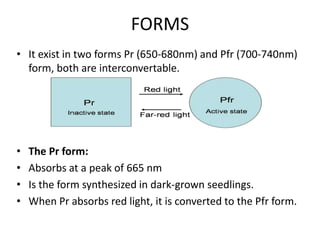
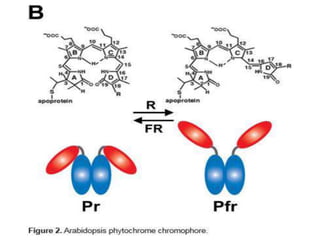
• It exist in two forms Pr (650-680nm) and Pfr (700-740nm)
form, both are interconvertable.
• The Pr form:
• Absorbs at a peak of 665 nm
• Is the form synthesized in dark-grown seedlings.
• When Pr absorbs red light, it is converted to the Pfr form.
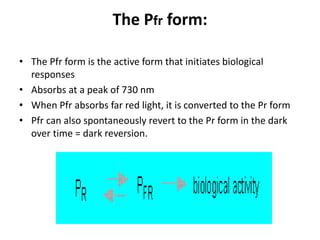
The Pfr form:
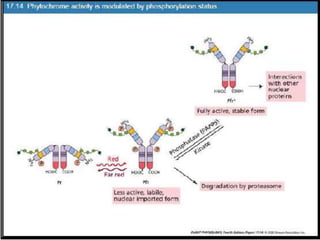
• The Pfr form is the active form that initiates biological
responses
• Absorbs at a peak of 730 nm
• When Pfr absorbs far red light, it is converted to the Pr form
• Pfr can also spontaneously revert to the Pr form in the dark
over time = dark reversion.
STRUCTURE
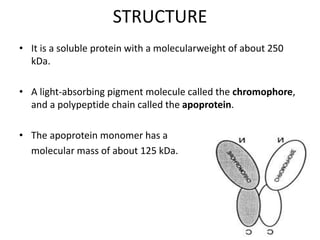
• It is a soluble protein with a molecularweight of about 250
kDa.
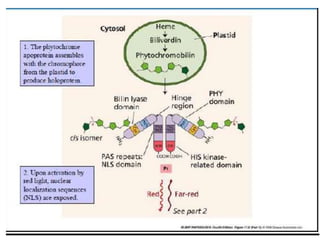
• A light-absorbing pigment molecule called the chromophore,
and a polypeptide chain called the apoprotein.
• The apoprotein monomer has a
molecular mass of about 125 kDa.
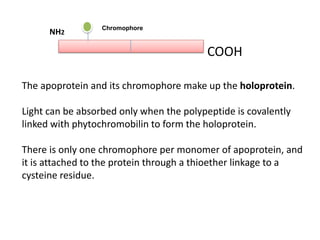
COOH
Chromophore
The apoprotein and its chromophore make up the holoprotein.
Light can be absorbed only when the polypeptide is covalently
linked with phytochromobilin to form the holoprotein.
There is only one chromophore per monomer of apoprotein, and
it is attached to the protein through a thioether linkage to a
cysteine residue.
NH2
• After absorption of light, the Pr chromophore undergoes a
cis–trans isomerization of the double bond between carbons
15 and 16.
• Phytochrome is encoded by divergent genes consist of two
types of proteins: Type I and Type II.
• Type I encoded by the PHYA gene, is abundant in etiolated
tissue. Low levels in light-grown plants because of its
instability in the Pfr form.
• Type II phytochrome (encoded by the PHYB, PHYC, PHYD, and
PHYE genes) is present at low levels in both light-grown and
dark-grown plants because its genes are constitutively
expressed at low levels.
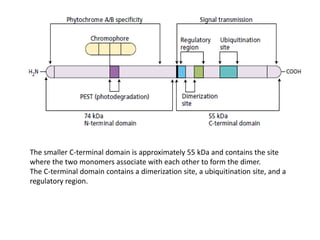
The smaller C-terminal domain is approximately 55 kDa and contains the site
where the two monomers associate with each other to form the dimer.
The C-terminal domain contains a dimerization site, a ubiquitination site, and a
regulatory region.
Light perception and signalling in
higher plants
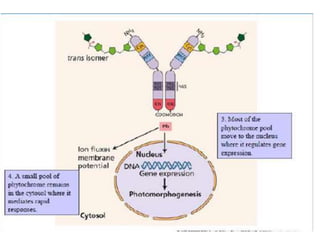
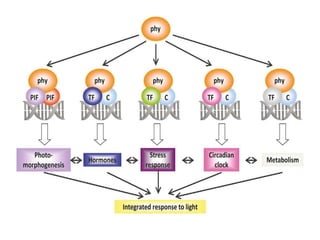
• Light-induced signal transduction.
• Perception of light by these specialised
photoreceptors.
• Ends in the regulation of the expression of genes
• Plants response at the physiological level.
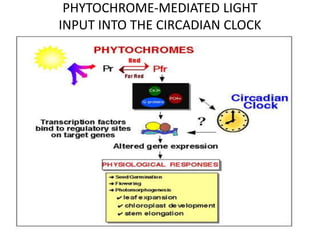
PHYTOCHROME-MEDIATED LIGHT
INPUT INTO THE CIRCADIAN CLOCK
• To entrain the clock to be in sync with the diurnal cycle,
various photoreceptors act singularly or together to transduce
the light signal into the clock.
• Several genes involved in both phytochrome-mediated light
signaling and clock function have been reported, including
GIGANTEA (GI),
EARLY FLOWERING 3 (ELF3),
ELF4,
TIME FOR COFFEE (TIC),
LIGHT INSENSITIVE PERIOD1 (LIP1)
• Elongation of hypocotyl,shoot branching,Flowering time
Phytochrome Mediated Responses in Crop Plants
1. Seed germination
2. Flowering
3. Pollen germination
4. Chlorophyll synthesis
5. Enzyme activity
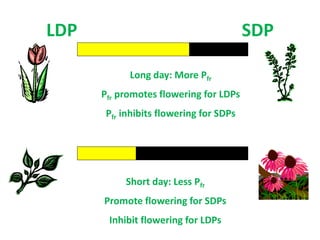
LDP SDP
Long day: More Pfr
Pfr promotes flowering for LDPs
Pfr inhibits flowering for SDPs
Short day: Less Pfr
Promote flowering for SDPs
Inhibit flowering for LDPs
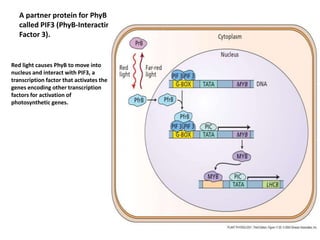
A partner protein for PhyB
called PIF3 (PhyB-Interacting
Factor 3).
Red light causes PhyB to move into
nucleus and interact with PIF3, a
transcription factor that activates the
genes encoding other transcription
factors for activation of
photosynthetic genes.
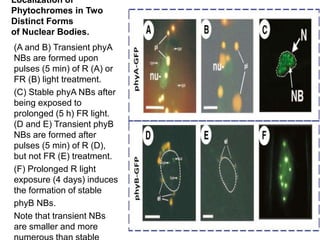
Localization of
Phytochromes in Two
Distinct Forms
of Nuclear Bodies.
(A and B) Transient phyA
NBs are formed upon
pulses (5 min) of R (A) or
FR (B) light treatment.
(C) Stable phyA NBs after
being exposed to
prolonged (5 h) FR light.
(D and E) Transient phyB
NBs are formed after
pulses (5 min) of R (D),
but not FR (E) treatment.
(F) Prolonged R light
exposure (4 days) induces
the formation of stable
phyB NBs.
Note that transient NBs
are smaller and more
References
• Phytochrome-mediated light signalling in
Arabidopsis.(www,sciencedirect.com)
• Phytochrome Signaling: Time to Tighten up theLoose Ends
Hai Wang and Haiyang Wang
• Biotechnology Research Institute, Chinese Academy of
Agricultural Sciences

Phytochromes

  • 1.
    PHYTOCHROMES B. RAKAVI (2015601709) PLANT DEVELOPMENTALBIOLOGY I M.SC.(PLANT PHYSIOLOGY) TAMILNADU AGRICULTURAL UNIVERSITY COIMBATORE – 03, TAMILNADU
  • 2.
    PHYTOCHROME • Proteinaceous Pigment •Phytochrome photoreceptors presence • They are almost ubiquitous in green plants. • The phytochromes absorb light with wavelength of 600-730 nm . • Exist in two forms pfr and pr form. • Two structures Apoprotein and chromophore.
  • 3.
    FORMS • It existin two forms Pr (650-680nm) and Pfr (700-740nm) form, both are interconvertable. • The Pr form: • Absorbs at a peak of 665 nm • Is the form synthesized in dark-grown seedlings. • When Pr absorbs red light, it is converted to the Pfr form.
  • 4.
    The Pfr form: •The Pfr form is the active form that initiates biological responses • Absorbs at a peak of 730 nm • When Pfr absorbs far red light, it is converted to the Pr form • Pfr can also spontaneously revert to the Pr form in the dark over time = dark reversion.
  • 5.
    STRUCTURE • It isa soluble protein with a molecularweight of about 250 kDa. • A light-absorbing pigment molecule called the chromophore, and a polypeptide chain called the apoprotein. • The apoprotein monomer has a molecular mass of about 125 kDa.
  • 6.
    COOH Chromophore The apoprotein andits chromophore make up the holoprotein. Light can be absorbed only when the polypeptide is covalently linked with phytochromobilin to form the holoprotein. There is only one chromophore per monomer of apoprotein, and it is attached to the protein through a thioether linkage to a cysteine residue. NH2
  • 7.
    • After absorptionof light, the Pr chromophore undergoes a cis–trans isomerization of the double bond between carbons 15 and 16. • Phytochrome is encoded by divergent genes consist of two types of proteins: Type I and Type II. • Type I encoded by the PHYA gene, is abundant in etiolated tissue. Low levels in light-grown plants because of its instability in the Pfr form. • Type II phytochrome (encoded by the PHYB, PHYC, PHYD, and PHYE genes) is present at low levels in both light-grown and dark-grown plants because its genes are constitutively expressed at low levels.
  • 8.
    The smaller C-terminaldomain is approximately 55 kDa and contains the site where the two monomers associate with each other to form the dimer. The C-terminal domain contains a dimerization site, a ubiquitination site, and a regulatory region.
  • 13.
    Light perception andsignalling in higher plants • Light-induced signal transduction. • Perception of light by these specialised photoreceptors. • Ends in the regulation of the expression of genes • Plants response at the physiological level.
  • 14.
  • 15.
    • To entrainthe clock to be in sync with the diurnal cycle, various photoreceptors act singularly or together to transduce the light signal into the clock. • Several genes involved in both phytochrome-mediated light signaling and clock function have been reported, including GIGANTEA (GI), EARLY FLOWERING 3 (ELF3), ELF4, TIME FOR COFFEE (TIC), LIGHT INSENSITIVE PERIOD1 (LIP1) • Elongation of hypocotyl,shoot branching,Flowering time
  • 16.
    Phytochrome Mediated Responsesin Crop Plants 1. Seed germination 2. Flowering 3. Pollen germination 4. Chlorophyll synthesis 5. Enzyme activity
  • 17.
    LDP SDP Long day:More Pfr Pfr promotes flowering for LDPs Pfr inhibits flowering for SDPs Short day: Less Pfr Promote flowering for SDPs Inhibit flowering for LDPs
  • 19.
    A partner proteinfor PhyB called PIF3 (PhyB-Interacting Factor 3). Red light causes PhyB to move into nucleus and interact with PIF3, a transcription factor that activates the genes encoding other transcription factors for activation of photosynthetic genes.
  • 20.
    Localization of Phytochromes inTwo Distinct Forms of Nuclear Bodies. (A and B) Transient phyA NBs are formed upon pulses (5 min) of R (A) or FR (B) light treatment. (C) Stable phyA NBs after being exposed to prolonged (5 h) FR light. (D and E) Transient phyB NBs are formed after pulses (5 min) of R (D), but not FR (E) treatment. (F) Prolonged R light exposure (4 days) induces the formation of stable phyB NBs. Note that transient NBs are smaller and more
  • 22.
    References • Phytochrome-mediated lightsignalling in Arabidopsis.(www,sciencedirect.com) • Phytochrome Signaling: Time to Tighten up theLoose Ends Hai Wang and Haiyang Wang • Biotechnology Research Institute, Chinese Academy of Agricultural Sciences