IMPACT OF PHOTOSYNTHESIS ON
CROP YIELD
Bidhan chandra krishi Vishwavidyalaya
Department of Plant Physiology
Faculty of Agriculture,
Mohanpur-741252, Nadia, West Bengal, India.
Seminar -I Course No. PPH:591
Mohammed. Anwar Ali
M.Sc(Ag), 3rd semester
Department of Plant Physiology
Seminar leader & Chairman
Prof. Anjan Kumar Pal
Department of Plant Physiology
INTRODUCTION
Photosynthesis is the process in which plants
capture energy from sunlight and convert it to
biochemical energy for plant growth and
development.
Alteration of biomass allocation:
Green revolution increased fertilizer use efficiency,
reduced risk of lodging, But Canopy collapse
causes significant yield losses(Stapper and
Fischer 1990).
Even though modern cultivars yield more but have
similar total above ground biomass(Austin et
al.,1980,1989).
 As per Gifford and Evans(1981) over the course
of evolution carbon partioning was improved,
and there is no much scope for improvement
in carbon allocation.
 So the focus is on increasing photosynthetic and
growth rates for further increase in Harvest
Index.
PAR IN SOLAR RADIATION:
(Photosynthetically active radiation)
The gaseous molecules (CO2, H2O, methane, nitrous oxide
etc) absorb radiant energy at 900-950, 1100-1150, 1350-
1450, 1800-1950 nm.
Where as ozone and oxygen removes much of the energy
below 400 nm.
Photons above 740 nm wave length does not have sufficient
energy to drive plant photosynthesis.
Total solar radiation within the active band (400 nm-700nm) is
48.7% i.e.51.3% of the incident solar energy is unavailable for
photosynthesis.
ENERGY LOSS BY REFLECTANCE OF
PHOTOSYNTHETICALLY ACTIVE LIGHT:
Plants are not perfect absorber of PAR (400-700
nm).
Maximum limit of interception is 90%.
Minimum loss by reflection is 4.9%.
Presence of non photosynthetic pigments lowers
photosynthesis conversion efficiency
(Beadle,C.L.,Long,S.P.1985).
LOSS OF ENERGY IN RAPID
RELAXATION OF HIGHER EXCITED
STATES OF CHLOROPHYLL:
Energy of photon in blue region (400 nm) is
greater than that of red region (700 nm).
In PAR (400-700 nm) average energy per mole of
photon is 205 kJ.
The minimum of 6.6% of incident solar energy lost
as heat due to relation of higher excited states of
chlorophyll.
The theoretical limits of solar energy utilization
efficiency in photosynthesis and the efficiency
attained by crop plants provide possibilities and
scope for improvement.
Theoretical maximum is 11%(40 of 27%).
Energy conversion efficiency would be 27% of
the absorbed short wave length light.
Increasing the amount of PAR intercepted and
or the efficiency of the photosynthetic tissues to
use the intercepted radiation.
Source: Annual review of plant Biology. 2010.61, 235-261.
These values are for full spectrum @ leaf
temperature 30°C, atmospheric [CO2 Erratum]
of 387 ppm
For PAR (400-700 nm) the values for C3 & C4
will be 9.4% & 12.3%.
POTENTIAL RADIATION USE
EFFICIENCY OF CROPS (eC)
In theory, a maximum εc of about 0.051 is possible in C3 plants and
0.060 in C4 plants.
An εi * of 0.9 and a η * of 0.6 are high and probably near maximal, the
maximum εc * reported is around 0.024 for C3 crops and 0.034 for C4
(Monteith 1977; Beadle & Long 1985).
* (εi is the efficiency with which that radiation is intercepted by the crop;
εc is the efficiency with which the intercepted radiation is converted into biomass;
η is the harvest index or the efficiency with which biomass is partitioned into the
harvested product).
Yield potential (Yp)
Yield potential (Yp) is defined as the yield of a
cultivar when grown in environments to which it is
adapted with nutrients and water non-limiting, and
with pests, diseases, weeds, lodging and other
stresses effectively controlled (Evans and Fisher
1999).
Opportunities for the further
improvements in Yp.
Yield of a crop is a function of biomass ×HI
crops such as wheat, rice, maize, barley and oat (HI)
reaches near 50% average.
Photosynthesis is the only remaining major trait
available for any further increase in Yp.
Focus to increase total biomass.
LEAF PHOTOSYNTHESIS: A TARGET
FOR IMPROVEMENT
Leaf photosynthetic rate is measured with advent
of transportable infrared CO2 analysers.
lack of correlation between crop yield and leaf
photosynthetic rate.
limitations
Photosynthesis is often limited by sink capacity.
The potential of leaf photosynthetic rate in
improving potential crop yield can only be
evaluated when other factors, in particular leaf
canopy size and architecture are held constant.
Lack of correlation between leaf photosynthesis
and yield.
Differences among photosynthetic
types (C3, C4 and CAM plants):
• In plant canopies, leaf temperatures can fluctuate
rapidly but data based on temperature response
curves of net CO2 assimilation, for CAM plants,
data for CO2 fixation at night were pooled,
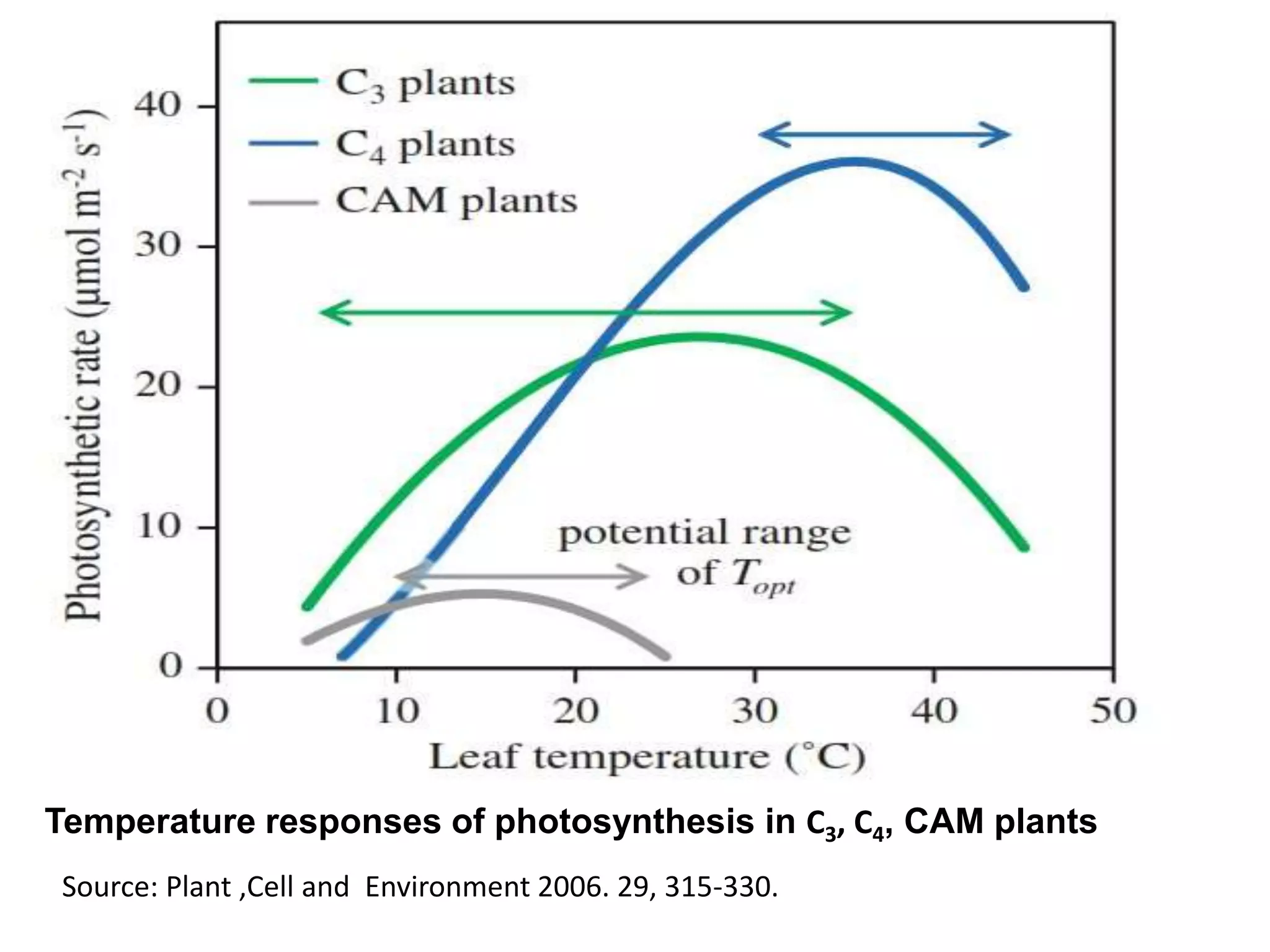
• C3 plants exhibits a T opt 10–35°C, potential
range is broad.
• CAM plants show low CO2 fixation rates, T opt is
also low.
• C4 plants exhibit higher T opt and maximum
photosynthetic rate at T opt than C3 plants.
• C4 photosynthesis is sharply depressed at low
temperatures.
Source: Plant ,Cell and Environment 2006. 29, 315-330.
Temperature responses of photosynthesis in C3, C4, CAM plants
link between photosynthesis and yield in
light of elevated [CO2] experiments
Increase in [CO2] has two effects on C3 plants:
1.An increase in leaf photosynthesis,
2.Decrease in stomatal conductance to
watervapor (gs).
Elevated [CO2] increases net leaf photosynthetic
rate primarily by;
(1)competitive inhibition
(2)acceleration of carboxylation
Evidence for independent increase in yield
because of increased leaf photosynthesis
(1) In C3 plants large increases in yield occurred
under elevated [CO2] with little change in leaf
area.
(2) C4 plants show similar reductions in gs to
C3 plants when grown at elevated [CO2], but
show no or little increase in net
photosynthesis.
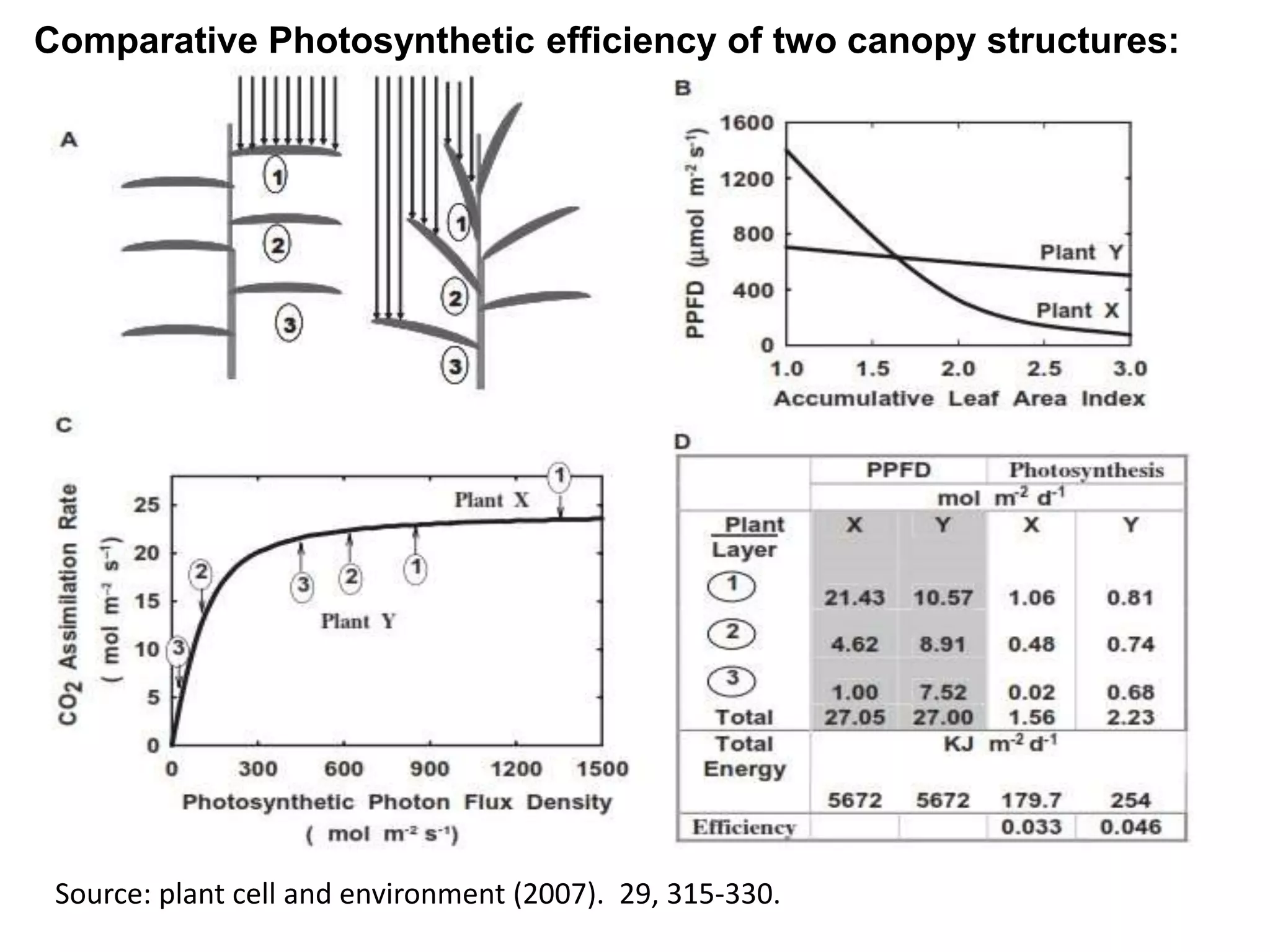
Source: plant cell and environment (2007). 29, 315-330.
Comparative Photosynthetic efficiency of two canopy structures:
CONCLUSION
As there is no more scope for further improvement
in carbon allocation so the focus should be shifted
to photosynthesis and growth rates.
Partioning is where the flexibility has been in the
past its better to aim at further increase in harvest
index.
Impact of photosynthesis on crop yield

Impact of photosynthesis on crop yield

  • 1.
    IMPACT OF PHOTOSYNTHESISON CROP YIELD Bidhan chandra krishi Vishwavidyalaya Department of Plant Physiology Faculty of Agriculture, Mohanpur-741252, Nadia, West Bengal, India. Seminar -I Course No. PPH:591 Mohammed. Anwar Ali M.Sc(Ag), 3rd semester Department of Plant Physiology Seminar leader & Chairman Prof. Anjan Kumar Pal Department of Plant Physiology
  • 2.
    INTRODUCTION Photosynthesis is theprocess in which plants capture energy from sunlight and convert it to biochemical energy for plant growth and development.
  • 3.
    Alteration of biomassallocation: Green revolution increased fertilizer use efficiency, reduced risk of lodging, But Canopy collapse causes significant yield losses(Stapper and Fischer 1990). Even though modern cultivars yield more but have similar total above ground biomass(Austin et al.,1980,1989).
  • 4.
     As perGifford and Evans(1981) over the course of evolution carbon partioning was improved, and there is no much scope for improvement in carbon allocation.  So the focus is on increasing photosynthetic and growth rates for further increase in Harvest Index.
  • 5.
    PAR IN SOLARRADIATION: (Photosynthetically active radiation) The gaseous molecules (CO2, H2O, methane, nitrous oxide etc) absorb radiant energy at 900-950, 1100-1150, 1350- 1450, 1800-1950 nm. Where as ozone and oxygen removes much of the energy below 400 nm. Photons above 740 nm wave length does not have sufficient energy to drive plant photosynthesis. Total solar radiation within the active band (400 nm-700nm) is 48.7% i.e.51.3% of the incident solar energy is unavailable for photosynthesis.
  • 7.
    ENERGY LOSS BYREFLECTANCE OF PHOTOSYNTHETICALLY ACTIVE LIGHT: Plants are not perfect absorber of PAR (400-700 nm). Maximum limit of interception is 90%. Minimum loss by reflection is 4.9%. Presence of non photosynthetic pigments lowers photosynthesis conversion efficiency (Beadle,C.L.,Long,S.P.1985).
  • 8.
    LOSS OF ENERGYIN RAPID RELAXATION OF HIGHER EXCITED STATES OF CHLOROPHYLL: Energy of photon in blue region (400 nm) is greater than that of red region (700 nm). In PAR (400-700 nm) average energy per mole of photon is 205 kJ. The minimum of 6.6% of incident solar energy lost as heat due to relation of higher excited states of chlorophyll.
  • 9.
    The theoretical limitsof solar energy utilization efficiency in photosynthesis and the efficiency attained by crop plants provide possibilities and scope for improvement. Theoretical maximum is 11%(40 of 27%). Energy conversion efficiency would be 27% of the absorbed short wave length light. Increasing the amount of PAR intercepted and or the efficiency of the photosynthetic tissues to use the intercepted radiation.
  • 10.
    Source: Annual reviewof plant Biology. 2010.61, 235-261. These values are for full spectrum @ leaf temperature 30°C, atmospheric [CO2 Erratum] of 387 ppm For PAR (400-700 nm) the values for C3 & C4 will be 9.4% & 12.3%.
  • 11.
    POTENTIAL RADIATION USE EFFICIENCYOF CROPS (eC) In theory, a maximum εc of about 0.051 is possible in C3 plants and 0.060 in C4 plants. An εi * of 0.9 and a η * of 0.6 are high and probably near maximal, the maximum εc * reported is around 0.024 for C3 crops and 0.034 for C4 (Monteith 1977; Beadle & Long 1985). * (εi is the efficiency with which that radiation is intercepted by the crop; εc is the efficiency with which the intercepted radiation is converted into biomass; η is the harvest index or the efficiency with which biomass is partitioned into the harvested product).
  • 12.
    Yield potential (Yp) Yieldpotential (Yp) is defined as the yield of a cultivar when grown in environments to which it is adapted with nutrients and water non-limiting, and with pests, diseases, weeds, lodging and other stresses effectively controlled (Evans and Fisher 1999).
  • 13.
    Opportunities for thefurther improvements in Yp. Yield of a crop is a function of biomass ×HI crops such as wheat, rice, maize, barley and oat (HI) reaches near 50% average. Photosynthesis is the only remaining major trait available for any further increase in Yp. Focus to increase total biomass.
  • 14.
    LEAF PHOTOSYNTHESIS: ATARGET FOR IMPROVEMENT Leaf photosynthetic rate is measured with advent of transportable infrared CO2 analysers. lack of correlation between crop yield and leaf photosynthetic rate.
  • 15.
    limitations Photosynthesis is oftenlimited by sink capacity. The potential of leaf photosynthetic rate in improving potential crop yield can only be evaluated when other factors, in particular leaf canopy size and architecture are held constant. Lack of correlation between leaf photosynthesis and yield.
  • 16.
    Differences among photosynthetic types(C3, C4 and CAM plants): • In plant canopies, leaf temperatures can fluctuate rapidly but data based on temperature response curves of net CO2 assimilation, for CAM plants, data for CO2 fixation at night were pooled, • C3 plants exhibits a T opt 10–35°C, potential range is broad. • CAM plants show low CO2 fixation rates, T opt is also low. • C4 plants exhibit higher T opt and maximum photosynthetic rate at T opt than C3 plants. • C4 photosynthesis is sharply depressed at low temperatures.
  • 17.
    Source: Plant ,Celland Environment 2006. 29, 315-330. Temperature responses of photosynthesis in C3, C4, CAM plants
  • 18.
    link between photosynthesisand yield in light of elevated [CO2] experiments Increase in [CO2] has two effects on C3 plants: 1.An increase in leaf photosynthesis, 2.Decrease in stomatal conductance to watervapor (gs). Elevated [CO2] increases net leaf photosynthetic rate primarily by; (1)competitive inhibition (2)acceleration of carboxylation
  • 19.
    Evidence for independentincrease in yield because of increased leaf photosynthesis (1) In C3 plants large increases in yield occurred under elevated [CO2] with little change in leaf area. (2) C4 plants show similar reductions in gs to C3 plants when grown at elevated [CO2], but show no or little increase in net photosynthesis.
  • 20.
    Source: plant celland environment (2007). 29, 315-330. Comparative Photosynthetic efficiency of two canopy structures:
  • 21.
    CONCLUSION As there isno more scope for further improvement in carbon allocation so the focus should be shifted to photosynthesis and growth rates. Partioning is where the flexibility has been in the past its better to aim at further increase in harvest index.