BUFFALO BREEDS
Scientific classification 
Kingdom: Animalia 
Phylum: Chordata 
Class: Mammalia 
Order: Artiodactyla 
Family: Bovidae 
Subfamily: Bovinae 
Tribe: Bovini 
Genus: Bubalus 
Species: B. arnee 
Binomial name 
Bubalus arnee 
(Kerr, 1792)
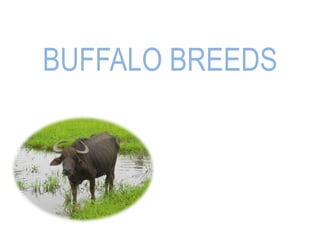
•The domestic buffalo, Bubalus bubalis, is 
descended from the wild water buffalo 
(Bubalus arnee) 
•Now designated an endangered species. 
• Buffalo have been bred, predominantly 
in Asia, for thousands of years for use by 
humans.
Introduction (cont….) 
•Water buffaloes Milk production. 
•Local buffaloes For power in rice cultivation 
•Introduced Indian breeds Milk production 
Cross breeding
Buffalo Breeds 
•Local buffalo 
•Nili Ravi 
•Murrah 
•Surti
LOCAL BUFFALO
• Origin – Sri Lanka 
• Classification 
• Morphology – Small in body size 
• Dark grey in color and posses 
light grey markings in front of 
the neck called chevrons
• Habitat – found in rural areas such as Jaffna 
and Mannar 
• Milk production – 350 – 390 Kg per lactation 
• They are kept for power in rice cultivation to 
plough and harrow the field.
Nilliravi
Scientific name 
Bubalus bubalis
Biological classification of 
Nilliravi buffalo
• Kingdom - Animalia 
• Phylum - Chordata 
• Class - Mammalia 
• Order - Artiodactyl 
• Family - Bovidae 
• Genus - Bubalus 
• Species - Bubalis
Distribution 
• Mainly Lahore, Sheikhupura, Faisalabad, 
Sahiwal, Multan and Bahawal Nagar districts 
in punjab province.
Morphological characters 
• Nilliravi buffalo is a milk type of buffalo 
breed. 
• Their colour is mainly Black & some are 
brown. 
• They have a wedge shape. 
• Massive frame. 
• Small curly horns and wall eyes.
• They often have white markings on the 
forehead, face, muzzle, and legs. 
• White switch of tail. 
• They have large, strong udder and are 
generally docile. 
• White markings extending above hock, knee 
and over the neck and body.
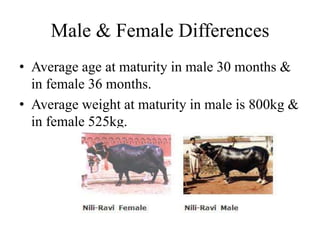
Male & Female Differences 
• Average age at maturity in male 30 months & 
in female 36 months. 
• Average weight at maturity in male is 800kg & 
in female 525kg.
Milk yield
• May be range from 90 to 18kg 
per day producing about 
1600kg in a lactation period of 
250 days
Surti 
• Other names 
• Gujarati 
• Deccani 
• Nadiadi 
• Surati 
Country of origin - India
The Surti is a breed of water buffalo found in the 
Charottar of Gujarat between the Mahi and 
Sabarmati rivers
Characteristics of Surti 
buffalo 
• The Surti buffaloes are of medium size 
and docile temperament. 
• Horns are sickle-shaped and flat which 
grow in a downward & backward 
direction and then upwards at the tip 
forming a hook.
• The breed has got a fairly broad and long 
head with a convex shape at the top in 
between horns. 
• The skin color is black or brown. 
• Surti breed has got an unique straight 
back. 
• Good specimen have two white collars. 
• Coat - rusty brown or silver-grey
Performance of Breed 
• Weight Male: average 499 kg 
• Female: average 408 kg 
• Height Male: ca. 130 cm 
• Female: ca. 125 cm 
• Average milk production:- 
• i)Ist Lactation:-1500-1600 Kg 
• ii) Other than Ist Lactation:- 1900- 
2000 Kg
• Age at 1st calving:- 45 to 47 months 
• Calving interval:- 400 to 425 days 
• Body weight at maturity:- 350 to 375 Kg 
• Breeding period:- Seasonal (Sept. to April) 
• Fat:- 7 to 7.5% 
• SNF:- 9 to 9.15%
MURRAH BUFFALO
ORIGIN 
• The origin places of Murrah buffalo are 
India. 
Pakistan.
MORPHOLOGICAL FEATURES 
• Body : Sound built, heavy and wedge shaped. 
• Head : Comparatively small. 
• Face : Comparatively long. 
• Neck : Comparatively long. 
• Body colour : Jet-black. 
• White markings on face and leg extremities may be there (2, 
3), but are not generally preferred. 
• Eyes : Should not be walled i.e. the cornea should not have 
whiteness. 
• Tail : Long reaching up to fetlock joint (2, 3, and 6) with black 
or white switch up to (maximum) 8.0 inches (4).
• Horns : Different from other breeds of buffaloes; short, tight, turning 
backward and upward and finally spirally curving inward. The horns should 
be somewhat flattened. As the age advances the horns get loosened 
slightly but spiral curves increases. 
• Limbs : Comparatively short but strong built. 
• Skin : Soft, smooth with scanty hairs as compared to other buffaloes. 
• Udder : Fully developed, drooping. 
• Teats : Equally distributed over the udder but hind teats are longer than 
fore teats. 
• Loin : Broader and sliding forward. 
• Body weight : The average body weight of males, 550 Kg and the females, 
450-Kg. 
• Height : The average height at withers; male: 1.42 meter; female: 1.32 
meter.
MILK PRODUCTION 
• The onset of lactation is with the birth of the calf. The 
initial yield is a reliable indicator of the animal’s genetic 
potential. The highest yield is reached after five to six 
weeks of lactation and maintained for some weeks. 
Thereafter the yield decreases until the end of 
lactation. The lactation ends as the dry period starts.
• Lactation and milk yield depend on both genetic 
and non-genetic factors. 
• The genetic influence is due to species, breed, 
and individual. Further, it is affected by ability to 
reproduce, e.g. fertility and thereby calving 
interval. Improvement on these may be the 
result of breeding and selection. 
• The non-genetic factors are management, 
amount and quality of feed and skill of the 
farmer to detect heat and illnesses. Factors 
which are outside the farmer’s control such as 
climate, temperature, humidity etc. also 
influence lactation and milk yield.
FEED FOR MURRAH BUFFALO 
Feed for buffaloes goes as below: 
• (1) Total feed should be 10 % of their body 
weight, assuming a buffalo is of 500 Kgs, 
they should get 50 kgs of feed. 
• (2) 35 kg Green fodder, 10 kg dry fodder 
and 5 kg concentrate feed, dry fodder is to 
fill their stomach, and min 40 - 50 lts of 
water.
• Concentrate feed should be calculated on the 
basis of how much a buffalo produces milk like 
500 grams of concentrate should be give for 
each lts of milk produced by a buffalo, and 
similarly 4-5 lts of water per lt of milk should 
be given.
DISTRIBUTION 
• The Murrah buffalo is originally 
from Rohtak, Jind and Hisar 
districts of Haryana; Nabha and 
Patiala districts of Punjab states of 
India; and in Pakistan, but has been 
used to improve the milk 
production of dairy buffalo in other 
countries, such as Italy, Bulgaria, 
Egypt and Pakistan.
The Murrah breed of Water buffalo (Bubalus 
bubalis) is the premier milking buffalo. In 
Haryana, Murrah buffalo keeping has a special 
role as its husbandry has been the way of life. 
Consequently, Haryana has the privilege of 
being known as the livestock mint of India. The 
buffalo of Murrah breed, which is described as 
the “Asian tractor”, is in fact triple purpose 
animal — for milk, meat and work.

Buffalo breeds

  • 1.
  • 2.
    Scientific classification Kingdom:Animalia Phylum: Chordata Class: Mammalia Order: Artiodactyla Family: Bovidae Subfamily: Bovinae Tribe: Bovini Genus: Bubalus Species: B. arnee Binomial name Bubalus arnee (Kerr, 1792)
  • 3.
    •The domestic buffalo,Bubalus bubalis, is descended from the wild water buffalo (Bubalus arnee) •Now designated an endangered species. • Buffalo have been bred, predominantly in Asia, for thousands of years for use by humans.
  • 4.
    Introduction (cont….) •Waterbuffaloes Milk production. •Local buffaloes For power in rice cultivation •Introduced Indian breeds Milk production Cross breeding
  • 5.
    Buffalo Breeds •Localbuffalo •Nili Ravi •Murrah •Surti
  • 6.
  • 7.
    • Origin –Sri Lanka • Classification • Morphology – Small in body size • Dark grey in color and posses light grey markings in front of the neck called chevrons
  • 8.
    • Habitat –found in rural areas such as Jaffna and Mannar • Milk production – 350 – 390 Kg per lactation • They are kept for power in rice cultivation to plough and harrow the field.
  • 10.
  • 11.
  • 12.
    Biological classification of Nilliravi buffalo
  • 13.
    • Kingdom -Animalia • Phylum - Chordata • Class - Mammalia • Order - Artiodactyl • Family - Bovidae • Genus - Bubalus • Species - Bubalis
  • 14.
    Distribution • MainlyLahore, Sheikhupura, Faisalabad, Sahiwal, Multan and Bahawal Nagar districts in punjab province.
  • 15.
    Morphological characters •Nilliravi buffalo is a milk type of buffalo breed. • Their colour is mainly Black & some are brown. • They have a wedge shape. • Massive frame. • Small curly horns and wall eyes.
  • 16.
    • They oftenhave white markings on the forehead, face, muzzle, and legs. • White switch of tail. • They have large, strong udder and are generally docile. • White markings extending above hock, knee and over the neck and body.
  • 17.
    Male & FemaleDifferences • Average age at maturity in male 30 months & in female 36 months. • Average weight at maturity in male is 800kg & in female 525kg.
  • 18.
  • 19.
    • May berange from 90 to 18kg per day producing about 1600kg in a lactation period of 250 days
  • 20.
    Surti • Othernames • Gujarati • Deccani • Nadiadi • Surati Country of origin - India
  • 21.
    The Surti isa breed of water buffalo found in the Charottar of Gujarat between the Mahi and Sabarmati rivers
  • 22.
    Characteristics of Surti buffalo • The Surti buffaloes are of medium size and docile temperament. • Horns are sickle-shaped and flat which grow in a downward & backward direction and then upwards at the tip forming a hook.
  • 23.
    • The breedhas got a fairly broad and long head with a convex shape at the top in between horns. • The skin color is black or brown. • Surti breed has got an unique straight back. • Good specimen have two white collars. • Coat - rusty brown or silver-grey
  • 24.
    Performance of Breed • Weight Male: average 499 kg • Female: average 408 kg • Height Male: ca. 130 cm • Female: ca. 125 cm • Average milk production:- • i)Ist Lactation:-1500-1600 Kg • ii) Other than Ist Lactation:- 1900- 2000 Kg
  • 25.
    • Age at1st calving:- 45 to 47 months • Calving interval:- 400 to 425 days • Body weight at maturity:- 350 to 375 Kg • Breeding period:- Seasonal (Sept. to April) • Fat:- 7 to 7.5% • SNF:- 9 to 9.15%
  • 26.
  • 27.
    ORIGIN • Theorigin places of Murrah buffalo are India. Pakistan.
  • 28.
    MORPHOLOGICAL FEATURES •Body : Sound built, heavy and wedge shaped. • Head : Comparatively small. • Face : Comparatively long. • Neck : Comparatively long. • Body colour : Jet-black. • White markings on face and leg extremities may be there (2, 3), but are not generally preferred. • Eyes : Should not be walled i.e. the cornea should not have whiteness. • Tail : Long reaching up to fetlock joint (2, 3, and 6) with black or white switch up to (maximum) 8.0 inches (4).
  • 29.
    • Horns :Different from other breeds of buffaloes; short, tight, turning backward and upward and finally spirally curving inward. The horns should be somewhat flattened. As the age advances the horns get loosened slightly but spiral curves increases. • Limbs : Comparatively short but strong built. • Skin : Soft, smooth with scanty hairs as compared to other buffaloes. • Udder : Fully developed, drooping. • Teats : Equally distributed over the udder but hind teats are longer than fore teats. • Loin : Broader and sliding forward. • Body weight : The average body weight of males, 550 Kg and the females, 450-Kg. • Height : The average height at withers; male: 1.42 meter; female: 1.32 meter.
  • 30.
    MILK PRODUCTION •The onset of lactation is with the birth of the calf. The initial yield is a reliable indicator of the animal’s genetic potential. The highest yield is reached after five to six weeks of lactation and maintained for some weeks. Thereafter the yield decreases until the end of lactation. The lactation ends as the dry period starts.
  • 31.
    • Lactation andmilk yield depend on both genetic and non-genetic factors. • The genetic influence is due to species, breed, and individual. Further, it is affected by ability to reproduce, e.g. fertility and thereby calving interval. Improvement on these may be the result of breeding and selection. • The non-genetic factors are management, amount and quality of feed and skill of the farmer to detect heat and illnesses. Factors which are outside the farmer’s control such as climate, temperature, humidity etc. also influence lactation and milk yield.
  • 32.
    FEED FOR MURRAHBUFFALO Feed for buffaloes goes as below: • (1) Total feed should be 10 % of their body weight, assuming a buffalo is of 500 Kgs, they should get 50 kgs of feed. • (2) 35 kg Green fodder, 10 kg dry fodder and 5 kg concentrate feed, dry fodder is to fill their stomach, and min 40 - 50 lts of water.
  • 33.
    • Concentrate feedshould be calculated on the basis of how much a buffalo produces milk like 500 grams of concentrate should be give for each lts of milk produced by a buffalo, and similarly 4-5 lts of water per lt of milk should be given.
  • 34.
    DISTRIBUTION • TheMurrah buffalo is originally from Rohtak, Jind and Hisar districts of Haryana; Nabha and Patiala districts of Punjab states of India; and in Pakistan, but has been used to improve the milk production of dairy buffalo in other countries, such as Italy, Bulgaria, Egypt and Pakistan.
  • 35.
    The Murrah breedof Water buffalo (Bubalus bubalis) is the premier milking buffalo. In Haryana, Murrah buffalo keeping has a special role as its husbandry has been the way of life. Consequently, Haryana has the privilege of being known as the livestock mint of India. The buffalo of Murrah breed, which is described as the “Asian tractor”, is in fact triple purpose animal — for milk, meat and work.