wheat and climate change
Graham Farquhar
Research School of Biology
Australian National University
Borlaug Summit on Wheat for Food Security
Borlaug100 @ CIMMYT
Ciudad Obregon, Mexico, 25-28 March 2014
How will the climate change?
• Many aspects of climate:
what should we look at first?
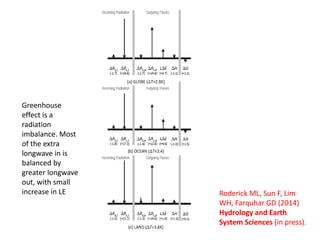
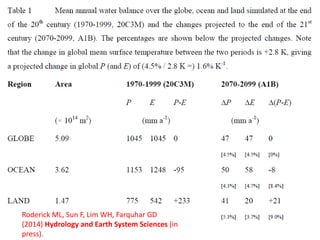
Roderick ML, Sun F, Lim
WH, Farquhar GD (2014)
Hydrology and Earth
System Sciences (in press).
Greenhouse
effect is a
radiation
imbalance. Most
of the extra
longwave in is
balanced by
greater longwave
out, with small
increase in LE
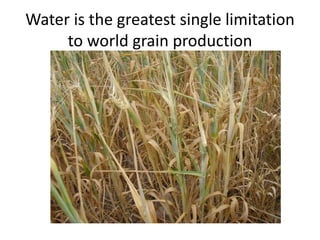
Water is the greatest single limitation
to world grain production
What will happen to precipitation?
What will happen to evaporation?
• P=precipitation,
• E=evaporation (productively through the plant as
transpiration, or unproductively as soil
evaporation),
• P-E = runoff
• We examine a multi-model ensemble mean
derived from CMIP3 models (Coupled Model
Intercomparison Project Phase 3)
• using 39 runs from 20 different climate models
Roderick ML, Sun F, Lim WH, Farquhar GD
(2014) Hydrology and Earth System Sciences (in
press).
What will happen to precipitation and
evaporation locally?
• We need granularity
• Previous research has demonstrated a “wet
get wetter and dry get drier” relation in
modelled output (Held & Soden, 2006)
• This has caught the scientific public’s attention
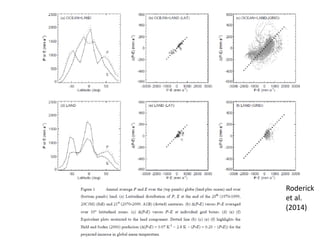
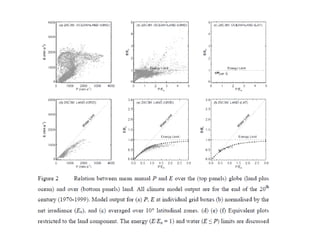
• More precisely, it was shown that (P-E)  P-E,
follows Clausius-Clapeyron scaling (7% increase in
vapour pressure/oC), when the projected changes
are averaged over latitudinal zones.
• Much of the subsequent research on impacts has
been based on an implicit assumption that this
CC relation also holds at local (grid box) scales
• Does it hold locally?
Roderick
et al.
(2014)
Conclusion re “local”
• The “Wet get wetter and the dry get drier”
notion, as assessed by P-E, is not supported at
the local (grid) scale by the ensemble of models
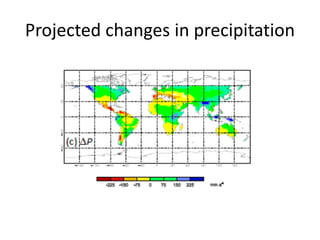
• Nevertheless the projections are for some areas
to become drier, and these include some areas
important to grain production, including Mexico
and Central America, Chile, southern Africa, the
Mediterranean & possibly southern Australia
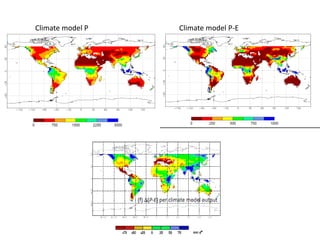
Projected changes in precipitation
How sure can we be about these
projections?
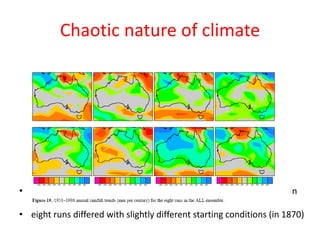
Chaotic nature of climate
• Rotstayn et al. (JGR, 2007) for the modeled annual rainfall trends in
Australia over the period 1951-1996
• eight runs differed with slightly different starting conditions (in 1870)
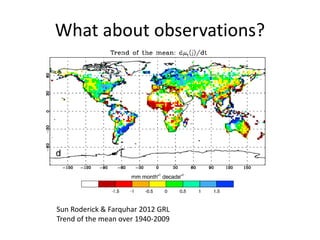
What about observations?
Sun Roderick & Farquhar 2012 GRL
Trend of the mean over 1940-2009
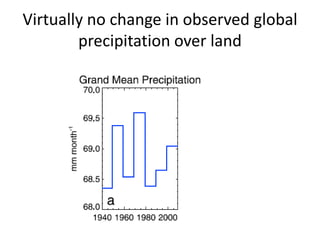
Virtually no change in observed global
precipitation over land
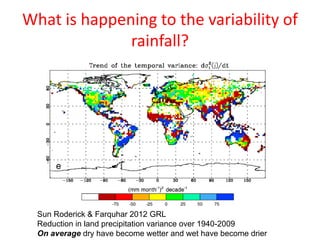
What is happening to the variability of
rainfall?
Sun Roderick & Farquhar 2012 GRL
Reduction in land precipitation variance over 1940-2009
On average dry have become wetter and wet have become drier
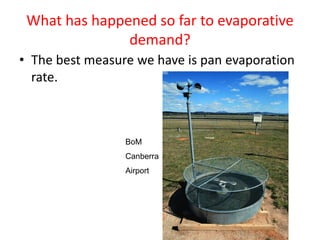
What has happened so far to evaporative
demand?
• The best measure we have is pan evaporation
rate.
BoM
Canberra
Airport
Will droughts get more severe with
warming? Is the evaporative demand
increasing?
• Around the world, pan evaporation rate has generally
been decreasing.
• Global warming is not like a hot day
• the oceans and lakes warm also, raising the humidity,
so that the vapour pressure deficit is little affected
on average
• The reasons for reduced evaporative demand include
aerosol loading and reduced windspeed (Roderick et
al., GRL 2007)
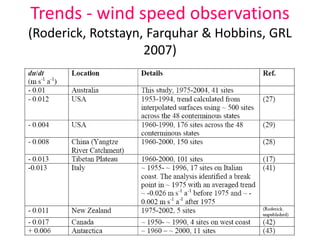
Trends - wind speed observations
(Roderick, Rotstayn, Farquhar & Hobbins, GRL
2007)
Effects of [CO2] and T on growth &
yield
• To what extent can we use responses to today’s
variations in temperature to learn about future
changes in T?
• Effects of T on assimilation rate are different at
different [CO2]
• In the short term there are interfering
correlations with less rainfall
• Effects on sterility or abortion-poorly understood
(see Poster 132)
• Photothermal quotient
How does CO2 concentration affect the
water requirements of plant growth?
• At the leaf level doubling the [CO2] is
effectively like almost doubling the rainfall. cf
Wong, Cowan & Farquhar Nature 1979
• So when the [CO2] was only half its present
value, say 20,000 years ago, the rainfall would
only have been about half as effective as that
rainfall would be today.
Impact of CO2 fertilization on maximum foliage
cover across the globe’s warm, arid environments
Randall J. Donohue, Michael L. Roderick, Tim R.
McVicar, and Graham D. Farquhar
GRL 2013
From 1982 to 2010 [CO2] increased 14% and the
responsiveness of foliage cover to precipitation increased
11% in the driest regions
Four Summary Messages
1. Many of the projected difficulties associated
with adjustment or adaptation to climate
change are ones that farmers have faced
before. But the projections add a layer of
uncertainty.
2. Increases in temperature place flowering at risk
in many crops. This may require some crop
production to move in a polewards direction, or
to remain in place but with earlier sowing, or….
Research needed on mechanisms of heat stress.
Four Summary Messages
3. Research on water-use efficiency (which should
increase in rain-fed environments under
increasing [CO2]) and drought tolerance, for
present-day problems, will be vital for future
climates, particularly in the context of increased
demand for water, just as will research on
improvement of yield potential.
4. There could be surprises and an understanding
of [CO2] effects on e.g. photosynthesis,
flowering and plant water relations in an
ecological context would be insurance.
Thank you CIMMYT
Conclusions
• We biologists need to take into account the statistical
nature of our environment
• Given the chaotic nature of climate and of good
climate models, we need to examine several runs of
each model as well as runs from different models
• We should be sceptical about predictions of climate
driven global changes in soil water content,
particularly those deriving from Thornthwaite
analyses that use T rather than full energy/mass
balance
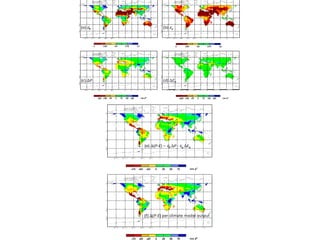
Climate model P Climate model P-E
Wheat and climate change

Wheat and climate change

  • 1.
    wheat and climatechange Graham Farquhar Research School of Biology Australian National University Borlaug Summit on Wheat for Food Security Borlaug100 @ CIMMYT Ciudad Obregon, Mexico, 25-28 March 2014
  • 2.
    How will theclimate change? • Many aspects of climate: what should we look at first?
  • 3.
    Roderick ML, SunF, Lim WH, Farquhar GD (2014) Hydrology and Earth System Sciences (in press). Greenhouse effect is a radiation imbalance. Most of the extra longwave in is balanced by greater longwave out, with small increase in LE
  • 4.
    Water is thegreatest single limitation to world grain production
  • 5.
    What will happento precipitation? What will happen to evaporation? • P=precipitation, • E=evaporation (productively through the plant as transpiration, or unproductively as soil evaporation), • P-E = runoff • We examine a multi-model ensemble mean derived from CMIP3 models (Coupled Model Intercomparison Project Phase 3) • using 39 runs from 20 different climate models
  • 6.
    Roderick ML, SunF, Lim WH, Farquhar GD (2014) Hydrology and Earth System Sciences (in press).
  • 7.
    What will happento precipitation and evaporation locally? • We need granularity • Previous research has demonstrated a “wet get wetter and dry get drier” relation in modelled output (Held & Soden, 2006) • This has caught the scientific public’s attention
  • 8.
    • More precisely,it was shown that (P-E)  P-E, follows Clausius-Clapeyron scaling (7% increase in vapour pressure/oC), when the projected changes are averaged over latitudinal zones. • Much of the subsequent research on impacts has been based on an implicit assumption that this CC relation also holds at local (grid box) scales • Does it hold locally?
  • 9.
  • 10.
    Conclusion re “local” •The “Wet get wetter and the dry get drier” notion, as assessed by P-E, is not supported at the local (grid) scale by the ensemble of models • Nevertheless the projections are for some areas to become drier, and these include some areas important to grain production, including Mexico and Central America, Chile, southern Africa, the Mediterranean & possibly southern Australia
  • 11.
    Projected changes inprecipitation
  • 12.
    How sure canwe be about these projections?
  • 13.
    Chaotic nature ofclimate • Rotstayn et al. (JGR, 2007) for the modeled annual rainfall trends in Australia over the period 1951-1996 • eight runs differed with slightly different starting conditions (in 1870)
  • 14.
    What about observations? SunRoderick & Farquhar 2012 GRL Trend of the mean over 1940-2009
  • 15.
    Virtually no changein observed global precipitation over land
  • 16.
    What is happeningto the variability of rainfall? Sun Roderick & Farquhar 2012 GRL Reduction in land precipitation variance over 1940-2009 On average dry have become wetter and wet have become drier
  • 17.
    What has happenedso far to evaporative demand? • The best measure we have is pan evaporation rate. BoM Canberra Airport
  • 18.
    Will droughts getmore severe with warming? Is the evaporative demand increasing? • Around the world, pan evaporation rate has generally been decreasing. • Global warming is not like a hot day • the oceans and lakes warm also, raising the humidity, so that the vapour pressure deficit is little affected on average • The reasons for reduced evaporative demand include aerosol loading and reduced windspeed (Roderick et al., GRL 2007)
  • 19.
    Trends - windspeed observations (Roderick, Rotstayn, Farquhar & Hobbins, GRL 2007)
  • 20.
    Effects of [CO2]and T on growth & yield • To what extent can we use responses to today’s variations in temperature to learn about future changes in T? • Effects of T on assimilation rate are different at different [CO2] • In the short term there are interfering correlations with less rainfall • Effects on sterility or abortion-poorly understood (see Poster 132) • Photothermal quotient
  • 21.
    How does CO2concentration affect the water requirements of plant growth? • At the leaf level doubling the [CO2] is effectively like almost doubling the rainfall. cf Wong, Cowan & Farquhar Nature 1979 • So when the [CO2] was only half its present value, say 20,000 years ago, the rainfall would only have been about half as effective as that rainfall would be today.
  • 23.
    Impact of CO2fertilization on maximum foliage cover across the globe’s warm, arid environments Randall J. Donohue, Michael L. Roderick, Tim R. McVicar, and Graham D. Farquhar GRL 2013 From 1982 to 2010 [CO2] increased 14% and the responsiveness of foliage cover to precipitation increased 11% in the driest regions
  • 24.
    Four Summary Messages 1.Many of the projected difficulties associated with adjustment or adaptation to climate change are ones that farmers have faced before. But the projections add a layer of uncertainty. 2. Increases in temperature place flowering at risk in many crops. This may require some crop production to move in a polewards direction, or to remain in place but with earlier sowing, or…. Research needed on mechanisms of heat stress.
  • 25.
    Four Summary Messages 3.Research on water-use efficiency (which should increase in rain-fed environments under increasing [CO2]) and drought tolerance, for present-day problems, will be vital for future climates, particularly in the context of increased demand for water, just as will research on improvement of yield potential. 4. There could be surprises and an understanding of [CO2] effects on e.g. photosynthesis, flowering and plant water relations in an ecological context would be insurance.
  • 26.
  • 27.
    Conclusions • We biologistsneed to take into account the statistical nature of our environment • Given the chaotic nature of climate and of good climate models, we need to examine several runs of each model as well as runs from different models • We should be sceptical about predictions of climate driven global changes in soil water content, particularly those deriving from Thornthwaite analyses that use T rather than full energy/mass balance
  • 30.
    Climate model PClimate model P-E