SINGLE-PHASE INDUCTION MOTOR
1
INTRODUCTION
 A single-phase induction motor is structurally similar to a three-phase induction
motor; the difference is only in the stator winding arrangements. The stator
windings of a single-phase induction motor are distributed, pitched and skewed to
produce a sinusoidal m.m.f. in space.
2
CONSTRUCTION
 The construction of a single-phase induction motor is similar to that of a three-
phase induction motor. The single-phase motor stator has a laminated iron core
with two windings arranged perpendicularly – one is the main and the other is the
auxiliary winding or starting winding. The motor uses a squirrel-cage rotor, which
has a laminated iron core with slots in it. Single-phase induction motor is not self-
starting and requires some mechanism to assist it in the starting process.
3
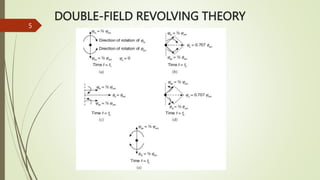
DOUBLE-FIELD REVOLVING THEORY
 According to this theory, a pulsating field of a single-phase motor can be
resolved into two rotating field of half its amplitude rotating in opposite
direction at synchronous speed.
4
DOUBLE-FIELD REVOLVING THEORY
5
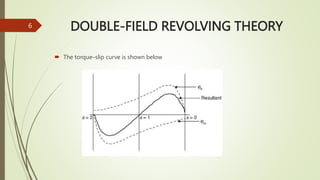
DOUBLE-FIELD REVOLVING THEORY
 The torque–slip curve is shown below
6
CROSS FIELD THEORY
 When a single-phase supply is given to the stator of a single-phase
induction motor, an alternating flux is produced in the stator.
 This alternating flux will produce an induced e.m.f. in the rotor windings,
which is initially at standstill.
 No torque will be produced in the rotor
7
CROSS FIELD THEORY
 If the rotor is rotated by giving some external force, an e.m.f. will be induced
in the rotor and thus a current will flow through the rotor. This current will be
displaced by 90 degree (electrical) from the stator axis.
8
Starting Methods of Single Phase Motor
 Split Phase or Resistance Start
 Capacitor Start
 Permanent Split Capacitor
 Capacitor Start Capacitor Run
 Electronic Starter for Single Phase Motor
9
Split Phase or Resistance Start
10
Continue…..
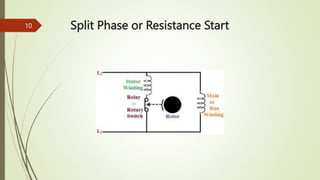
 These motors consist of two sets of windings, namely, start
winding and main or run winding. The start winding is made
from smaller wire with which it offers high resistance to
electrical flow compared to run winding. Due to this high
resistance, magnetic field is developed in start winding by the
current earlier than run winding magnetic field development.
Thus, two fields are 30 degrees apart, but this small angle
itself is enough to start the motor.
11
Capacitor Start
12
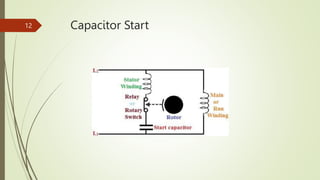
 The windings of the capacitor start motor are almost similar to the split-phase
motor. The poles of the stator are set apart by 90 degrees. To activate and
deactivate the start windings, a normally closed switch is used and capacitor is
placed in series with the start winding.
 Due to this capacitor, current leads voltage, thus this capacitor is used to start the
motor and it will be disconnected from the circuit after obtaining the 75% of the
rated speed of the motor.
13
Permanent Split Capacitor (PSC
14
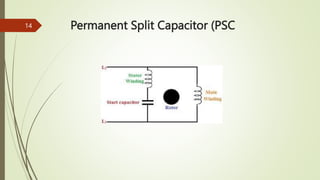
 In a capacitor start method, a capacitor has to be disconnected after the motor
reaches to a specific speed of motor. But in this method, a run-type capacitor is
placed in series with the start winding or auxiliary winding. This capacitor is used
continuously, and it doesn’t require any switch to disconnect it as it is not used to
start the motor only. The starting torque of the PSC is similar to the spilt-phase
motors, but with low starting current.
15
Capacitor Start Capacitor Run
16
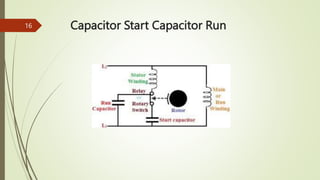
 The features of the capacitor start and PSC methods can be combined with this
method. Run capacitor is connected in series with the start winding or auxiliary
winding, and a start capacitor is connected in the circuit using a normally closed
switch while starting the motor. Start capacitor provides starting boost to motor
and PSC provides high running to the motor. It is more costly, but still facilitates
high starting and breakdown torque along with smooth running characteristics at
high horsepower ratings.
17

IM single.pptx

  • 1.
  • 2.
    INTRODUCTION  A single-phaseinduction motor is structurally similar to a three-phase induction motor; the difference is only in the stator winding arrangements. The stator windings of a single-phase induction motor are distributed, pitched and skewed to produce a sinusoidal m.m.f. in space. 2
  • 3.
    CONSTRUCTION  The constructionof a single-phase induction motor is similar to that of a three- phase induction motor. The single-phase motor stator has a laminated iron core with two windings arranged perpendicularly – one is the main and the other is the auxiliary winding or starting winding. The motor uses a squirrel-cage rotor, which has a laminated iron core with slots in it. Single-phase induction motor is not self- starting and requires some mechanism to assist it in the starting process. 3
  • 4.
    DOUBLE-FIELD REVOLVING THEORY According to this theory, a pulsating field of a single-phase motor can be resolved into two rotating field of half its amplitude rotating in opposite direction at synchronous speed. 4
  • 5.
  • 6.
    DOUBLE-FIELD REVOLVING THEORY The torque–slip curve is shown below 6
  • 7.
    CROSS FIELD THEORY When a single-phase supply is given to the stator of a single-phase induction motor, an alternating flux is produced in the stator.  This alternating flux will produce an induced e.m.f. in the rotor windings, which is initially at standstill.  No torque will be produced in the rotor 7
  • 8.
    CROSS FIELD THEORY If the rotor is rotated by giving some external force, an e.m.f. will be induced in the rotor and thus a current will flow through the rotor. This current will be displaced by 90 degree (electrical) from the stator axis. 8
  • 9.
    Starting Methods ofSingle Phase Motor  Split Phase or Resistance Start  Capacitor Start  Permanent Split Capacitor  Capacitor Start Capacitor Run  Electronic Starter for Single Phase Motor 9
  • 10.
    Split Phase orResistance Start 10
  • 11.
    Continue…..  These motorsconsist of two sets of windings, namely, start winding and main or run winding. The start winding is made from smaller wire with which it offers high resistance to electrical flow compared to run winding. Due to this high resistance, magnetic field is developed in start winding by the current earlier than run winding magnetic field development. Thus, two fields are 30 degrees apart, but this small angle itself is enough to start the motor. 11
  • 12.
  • 13.
     The windingsof the capacitor start motor are almost similar to the split-phase motor. The poles of the stator are set apart by 90 degrees. To activate and deactivate the start windings, a normally closed switch is used and capacitor is placed in series with the start winding.  Due to this capacitor, current leads voltage, thus this capacitor is used to start the motor and it will be disconnected from the circuit after obtaining the 75% of the rated speed of the motor. 13
  • 14.
  • 15.
     In acapacitor start method, a capacitor has to be disconnected after the motor reaches to a specific speed of motor. But in this method, a run-type capacitor is placed in series with the start winding or auxiliary winding. This capacitor is used continuously, and it doesn’t require any switch to disconnect it as it is not used to start the motor only. The starting torque of the PSC is similar to the spilt-phase motors, but with low starting current. 15
  • 16.
  • 17.
     The featuresof the capacitor start and PSC methods can be combined with this method. Run capacitor is connected in series with the start winding or auxiliary winding, and a start capacitor is connected in the circuit using a normally closed switch while starting the motor. Start capacitor provides starting boost to motor and PSC provides high running to the motor. It is more costly, but still facilitates high starting and breakdown torque along with smooth running characteristics at high horsepower ratings. 17