Page 1
at Vietnamese-German University
Lecturer: M.Sc. B.Eng. Müller Bastian
By Group 4:
Bùi Minh Đức (ID:1549)
Phạm Đăng Khoa (ID:1543)
Nguyễn Quang Thanh (ID:1558)
Tsang Ping Wang (ID:1553)
Trương Thị Xuân Đào(ID:1538)
DATE : 1 July 2014
SIMULATION OF FLEXIBLE ASSEMBLY
SYSTEM
Page 2
Agenda
 Preparation
 Realization
 Evaluation
 Bottleneck Analysis - Improvement
 References
Page 3
Agenda
 Preparation
 Basic decision
 Target system
 Structure of the simulation database
 Rough analytical estimation
 Modelling
 Validation
 Realization
 Simulation experiment
 Evaluation
 Bottle-neck Analysis - Improvement
 References
Page 4
Basic Decision-Complexity of the task
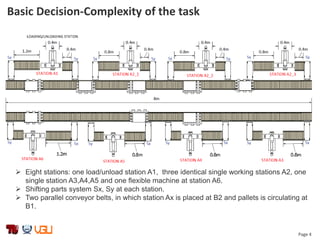
 Eight stations: one load/unload station A1, three identical single working stations A2, one
single station A3,A4,A5 and one flexible machine at station A6.
 Shifting parts system Sx, Sy at each station.
 Two parallel conveyor belts, in which station Ax is placed at B2 and pallets is circulating at
B1.
Page 5
Basic Decision- Expected benefit of the simulation
 Be able to run the experiment in a short period of time.
 Bottle-neck analysis.
 Development control strategy.
 Evaluation the optimal of pallets on system.
Page 6
Agenda
 Preparation
 Basic decision
 Target system
 Structure of the simulation database
 Rough analytical estimation
 Modelling
 Validation
 Realization
 Simulation experiment
 Evaluation
 Bottle-neck Analysis - Improvement
 References
Page 7
Target
 Understood how does the system work by building up a visualize
model
 Observe the modelling while 20,40 and 60 pallets working
 Determine the suitable optimal pallet.
 Figure out the bottleneck then improve system to increase the
throughput.
plus.maths.org
Page 8
Agenda
 Preparation
 Basic decision
 Target system
 Structure of the simulation database
 Rough analytical estimation
 Modelling
 Validation
 Realization
 Simulation experiment
 Evaluation
 Bottle-neck Analysis - Improvement
 References
Page 9
Structure of the simulation database
Some other rules are important
to keep in mind when building up the
simulation model:
 Ax is shifted back to B1 in Sy, having
priority over those coming from the
left on B1.
 Pallets from station A23 can be
shifted directly to A3 and from A6
directly to A1
 Pallets can queue up in front of
stations or Sx/Sy when the conveyor
is moving with its normal speed.
 Sx,Sy cannot function as buffers.
Main data of flexible assembly
system can be divided into 2 groups as
follows:
 Technical Data for describing the
system components.
 Data for describing the flow
operation of system.
Page 10
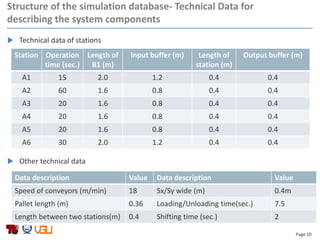
Structure of the simulation database- Technical Data for
describing the system components
 Technical data of stations
 Other technical data
Station Operation
time (sec.)
Length of
B1 (m)
Input buffer (m) Length of
station (m)
Output buffer (m)
A1 15 2.0 1.2 0.4 0.4
A2 60 1.6 0.8 0.4 0.4
A3 20 1.6 0.8 0.4 0.4
A4 20 1.6 0.8 0.4 0.4
A5 20 1.6 0.8 0.4 0.4
A6 30 2.0 1.2 0.4 0.4
Data description Value Data description Value
Speed of conveyors (m/min) 18 Sx/Sy wide (m) 0.4m
Pallet length (m) 0.36 Loading/Unloading time(sec.) 7.5
Length between two stations(m) 0.4 Shifting time (sec.) 2
Page 11
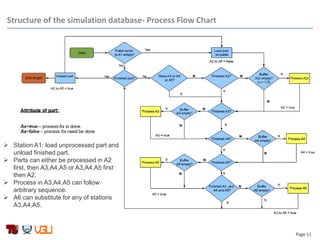
Structure of the simulation database- Process Flow Chart
 Station A1: load unprocessed part and
unload finished part.
 Parts can either be processed in A2
first, then A3,A4,A5 or A3,A4,A5 first
then A2.
 Process in A3,A4,A5 can follow
arbitrary sequence.
 A6 can substitute for any of stations
A3,A4,A5.
Page 12
Agenda
 Preparation
 Basic decision
 Target system
 Structure of the simulation database
 Rough analytical estimation
 Modelling
 Validation
 Realization
 Simulation experiment
 Evaluation
 Bottle-neck Analysis - Improvement
 References
Page 13
Rough analytical estimation
The flow time is calculated in scenario of only one circulating pallet in system in order to check
the validation of simulation model.
𝑓𝑙𝑜𝑤 𝑡𝑖𝑚𝑒 = 𝑝𝑟𝑜𝑐𝑒𝑠𝑠𝑖𝑛𝑔 𝑡𝑖𝑚𝑒 𝐴𝑥 + 𝑚𝑜𝑣𝑖𝑛𝑔 𝑡𝑖𝑚𝑒 + 𝑠ℎ𝑖𝑓𝑡𝑖𝑛𝑔 𝑡𝑖𝑚𝑒
Loading at A1 -> A2_1 -> A3 -> A4 -> A5 -> Unloading at A1
Therefore 𝑝𝑟𝑜𝑐𝑒𝑠𝑠𝑖𝑛𝑔 𝑡𝑖𝑚𝑒 𝐴𝑥 = 7.5 + 60 + 20 + 20 + 20 +7.5 =135s
The total length which parts has been traveled is
L= LA1 + LA2 + LA3 + LA4 + LA5 + LSx-Sy = (1.2+0.4)+4.(0.8+0.4)+7.6 = 14(m)
Conveyors move with the same speed 18m/min, so transportation time can be determined as
the equation below
𝑡 𝑇𝑟 =
𝐿
18
=
14
18
= 𝟒𝟔. 𝟔𝟖𝒔𝒆𝒄𝒐𝒏𝒅s
The number of shifting times when parts moving as the sequence above is 10 times,each time
take 2 seconds, so the shifting time is 20s
𝑭𝒍𝒐𝒘 𝒕𝒊𝒎𝒆 = 𝟏𝟑𝟓 + 𝟒𝟔. 𝟔𝟖 + 𝟐𝟎 = 𝟐𝟎𝟕. 𝟖 seconds
The number of pallets are limited by the capacity of buffer B1:
𝑵𝒖𝒎𝒃𝒆𝒓 𝒐𝒇 𝒑𝒂𝒍𝒍𝒆𝒕𝒔 =
𝑳𝒆𝒏𝒈𝒕𝒉 𝒐𝒇 𝒃𝒖𝒇𝒇𝒆𝒓 𝑩𝟏 (𝒎)
𝑳𝒆𝒏𝒈𝒕𝒉 𝒐𝒇 𝒑𝒂𝒍𝒍𝒆𝒕 (𝒎)
=
𝟏𝟔
𝟎. 𝟑𝟔
= 𝟒𝟒 𝒑𝒂𝒍𝒍𝒆𝒕𝒔
Page 14
Agenda
 Preparation
 Basic decision
 Target system
 Structure of the simulation database
 Rough analytical estimation
 Modelling
 Validation
 Realization
 Simulation experiment
 Evaluation
 Bottleneck Analysis - Improvement
 References
Page 15
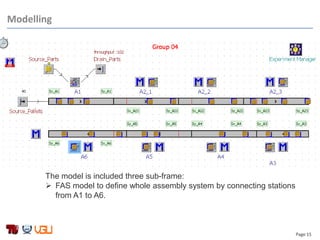
Modelling
The model is included three sub-frame:
 FAS model to define whole assembly system by connecting stations
from A1 to A6.
Page 16
Modelling
The model is included three sub-frame:
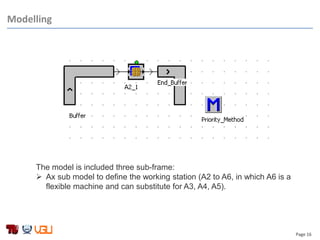
 Ax sub model to define the working station (A2 to A6, in which A6 is a
flexible machine and can substitute for A3, A4, A5).
Page 17
Modelling
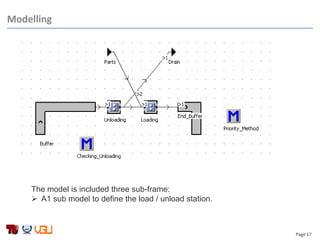
The model is included three sub-frame:
 A1 sub model to define the load / unload station.
Page 18
Agenda
 Preparation
 Basic decision
 Target system
 Structure of the simulation database
 Rough analytical estimation
 Modelling
 Validation
 Realization
 Simulation experiment
 Evaluation
 Bottle-neck Analysis - Improvement
 References
Page 19
Validation
 Validation 1: One pallet is circulated in the system and then determine its flowtime
- From rough estimate : Flowtime = 207.8 seconds
- From simulation : Flowtime = 207 seconds
 Difference = (207.8-207)/207.8 = 0.38 %
 Validation 2: Number of pallet causing the system to blocked
- From rough estimate : Number of pallets = 44 pallets
- - From simulation: Number of pallets = 44 pallets
 Validation 3: Length of conveyor belt B1
- From rough estimate : Length of conveyor = 16 m
- From simulation: Length of conveyor = 16 m
Conclusion: this simulation model is valid to simulate the flexible assembly system
Page 20
Agenda
 Preparation
 Basic decision
 Target system
 Structure of the simulation database
 Rough analytical estimation
 Modelling
 Validation
 Realization
 Simulation experiment
 Evaluation
 Bottleneck Analysis - Improvement
 References
Page 21
Realization: Simulation Experiment- Planning
 The number of pallets which are circulating in the system is the
variable can influence to the through put time when the structure
of system such as number of station, technical operation data
cannot be changed. On the other hand, the number of pallets are
limited by the capacity of buffer B1:
𝑁𝑢𝑚𝑏𝑒𝑟 𝑜𝑓 𝑝𝑎𝑙𝑙𝑒𝑡𝑠 =
𝐿𝑒𝑛𝑔𝑡ℎ 𝑜𝑓 𝑏𝑢𝑓𝑓𝑒𝑟 𝐵1 (𝑚)
𝐿𝑒𝑛𝑔𝑡ℎ 𝑜𝑓 𝑝𝑎𝑙𝑙𝑒𝑡 (𝑚)
=
16
0.36
= 44 𝑝𝑎𝑙𝑙𝑒𝑡𝑠
 The experiment step is started with 1 pallet is circulating in
system, then in each next experiment the number of pallets will
be increased by 1 up to over the limit number : 44 pallets for
validation. Due to this variable is deterministic; the observation in
each experiment is 1.
Page 22
Realization: Simulation Experiment - Execution
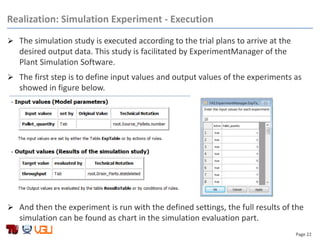
 The simulation study is executed according to the trial plans to arrive at the
desired output data. This study is facilitated by ExperimentManager of the
Plant Simulation Software.
 The first step is to define input values and output values of the experiments as
showed in figure below.
 And then the experiment is run with the defined settings, the full results of the
simulation can be found as chart in the simulation evaluation part.
Page 23
Agenda
 Preparation
 Basic decision
 Target system
 Structure of the simulation database
 Rough analytical estimation
 Modelling
 Validation
 Realization
 Simulation experiment
 Evaluation
 Bottle-neck Analysis - Improvement
 References
Page 24
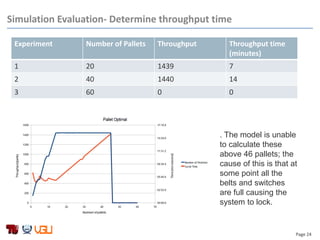
Simulation Evaluation- Determine throughput time
Experiment Number of Pallets Throughput Throughput time
(minutes)
1 20 1439 7
2 40 1440 14
3 60 0 0
. The model is unable
to calculate these
above 46 pallets; the
cause of this is that at
some point all the
belts and switches
are full causing the
system to lock.
Page 25
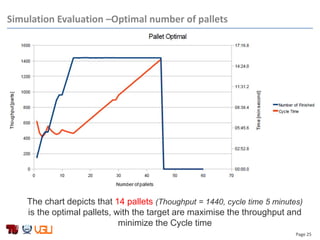
Simulation Evaluation –Optimal number of pallets
The chart depicts that 14 pallets (Thoughput = 1440, cycle time 5 minutes)
is the optimal pallets, with the target are maximise the throughput and
minimize the Cycle time
Page 26
Agenda
 Preparation
 Basic decision
 Target system
 Structure of the simulation database
 Rough analytical estimation
 Modelling
 Validation
 Realization
 Simulation experiment
 Evaluation
 Bottle-neck Analysis - Improvement
 References
Page 27
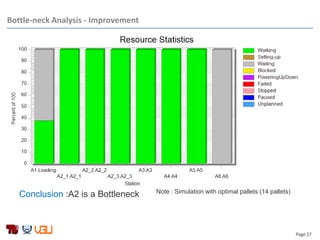
Note : Simulation with optimal pallets (14 pallets)
Bottle-neck Analysis - Improvement
Conclusion :A2 is a Bottleneck
Page 28
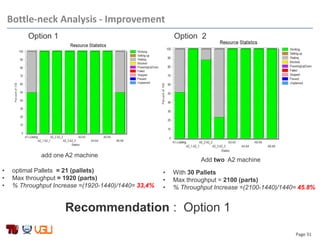
 Add one Station A2 :
Bottle-neck Analysis – Improvement : Option 1
* Capacity = 2
0
500
1000
1500
2000
2500
0 10 20 30 40 50 60
Thoughput[Parts]
Num of Pallets [Pallets]
4 Station A2
Optimal pallets = 21 pallets
increase 7 Pallets
Thoughput = 1920 parts
Increase 480 parts
Page 29
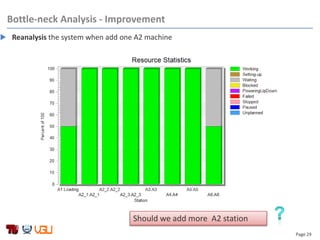
 Reanalysis the system when add one A2 machine
Bottle-neck Analysis - Improvement
Should we add more A2 station
Page 30
0
500
1000
1500
2000
2500
0 10 20 30 40 50 60 70
Thoughput[Parts]
5 Station A2
 Add two A2 machines:
Bottle-neck Analysis – Improvement – Option 2
* Capacity = 3
Optimal pallets = 30 pallets
increase 9 Pallets
Thoughput = 2100 parts
Increase 180 parts
Page 31
Bottle-neck Analysis - Improvement
add one A2 machine
Add two A2 machine
Recommendation : Option 1
Option 1 Option 2
• optimal Pallets = 21 (pallets)
• Max throughput = 1920 (parts)
• % Throughput Increase =(1920-1440)/1440= 33,4%
• With 30 Pallets
• Max throughput = 2100 (parts)
• % Throughput Increase =(2100-1440)/1440= 45.8%
Page 32
SUMMARY
 Success in modelling the Flexible Assembly System by Plant-
Simulation Software
 Throughput time with 20 pallets: 7minutes.
Throughput time with 40 pallets: 14minutes.
Throughput time with 60 pallets: system is blocked
 Optimal number of pallets: 14 (Throughput = 1440, cycle time 5
minutes)
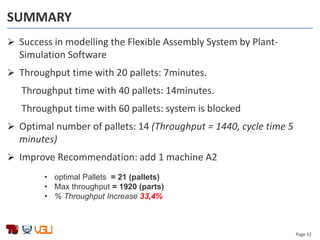
 Improve Recommendation: add 1 machine A2
• optimal Pallets = 21 (pallets)
• Max throughput = 1920 (parts)
• % Throughput Increase 33,4%
Page 33
Agenda
 Preparation
 Basic decision
 Target system
 Structure of the simulation database
 Rough analytical estimation
 Modelling
 Validation
 Realization
 Simulation experiment
 Evaluation
 Bottleneck Analysis - Improvement
 References
Page 34
References
[VDI-3633] Association of German Engineers. Simulation of systems in materials
handling, logistics and production: Fundamentals. 2010. Beuth Verlag,
Berlin.
[Book] Walter Terkaj, Tullio Tolio, Anna Valente.Design of Flexible Production
Systems.(2009).
[Book] Steffen Bangsow. Manufacturing Simulation with Plant Simulation
and SimTalk. (2009)
[Self-Guided
Script]
Azrul Azwan Abdul Rahman, Bastian Muller. Tecnomatix Plant
Simulation 11. Version 15.06.2014
Page 35
THANK YOU
FOR YOUR ATTENTION

Simulation of flexible assembly system using tecnomatix

  • 1.
    Page 1 at Vietnamese-GermanUniversity Lecturer: M.Sc. B.Eng. Müller Bastian By Group 4: Bùi Minh Đức (ID:1549) Phạm Đăng Khoa (ID:1543) Nguyễn Quang Thanh (ID:1558) Tsang Ping Wang (ID:1553) Trương Thị Xuân Đào(ID:1538) DATE : 1 July 2014 SIMULATION OF FLEXIBLE ASSEMBLY SYSTEM
  • 2.
    Page 2 Agenda  Preparation Realization  Evaluation  Bottleneck Analysis - Improvement  References
  • 3.
    Page 3 Agenda  Preparation Basic decision  Target system  Structure of the simulation database  Rough analytical estimation  Modelling  Validation  Realization  Simulation experiment  Evaluation  Bottle-neck Analysis - Improvement  References
  • 4.
    Page 4 Basic Decision-Complexityof the task  Eight stations: one load/unload station A1, three identical single working stations A2, one single station A3,A4,A5 and one flexible machine at station A6.  Shifting parts system Sx, Sy at each station.  Two parallel conveyor belts, in which station Ax is placed at B2 and pallets is circulating at B1.
  • 5.
    Page 5 Basic Decision-Expected benefit of the simulation  Be able to run the experiment in a short period of time.  Bottle-neck analysis.  Development control strategy.  Evaluation the optimal of pallets on system.
  • 6.
    Page 6 Agenda  Preparation Basic decision  Target system  Structure of the simulation database  Rough analytical estimation  Modelling  Validation  Realization  Simulation experiment  Evaluation  Bottle-neck Analysis - Improvement  References
  • 7.
    Page 7 Target  Understoodhow does the system work by building up a visualize model  Observe the modelling while 20,40 and 60 pallets working  Determine the suitable optimal pallet.  Figure out the bottleneck then improve system to increase the throughput. plus.maths.org
  • 8.
    Page 8 Agenda  Preparation Basic decision  Target system  Structure of the simulation database  Rough analytical estimation  Modelling  Validation  Realization  Simulation experiment  Evaluation  Bottle-neck Analysis - Improvement  References
  • 9.
    Page 9 Structure ofthe simulation database Some other rules are important to keep in mind when building up the simulation model:  Ax is shifted back to B1 in Sy, having priority over those coming from the left on B1.  Pallets from station A23 can be shifted directly to A3 and from A6 directly to A1  Pallets can queue up in front of stations or Sx/Sy when the conveyor is moving with its normal speed.  Sx,Sy cannot function as buffers. Main data of flexible assembly system can be divided into 2 groups as follows:  Technical Data for describing the system components.  Data for describing the flow operation of system.
  • 10.
    Page 10 Structure ofthe simulation database- Technical Data for describing the system components  Technical data of stations  Other technical data Station Operation time (sec.) Length of B1 (m) Input buffer (m) Length of station (m) Output buffer (m) A1 15 2.0 1.2 0.4 0.4 A2 60 1.6 0.8 0.4 0.4 A3 20 1.6 0.8 0.4 0.4 A4 20 1.6 0.8 0.4 0.4 A5 20 1.6 0.8 0.4 0.4 A6 30 2.0 1.2 0.4 0.4 Data description Value Data description Value Speed of conveyors (m/min) 18 Sx/Sy wide (m) 0.4m Pallet length (m) 0.36 Loading/Unloading time(sec.) 7.5 Length between two stations(m) 0.4 Shifting time (sec.) 2
  • 11.
    Page 11 Structure ofthe simulation database- Process Flow Chart  Station A1: load unprocessed part and unload finished part.  Parts can either be processed in A2 first, then A3,A4,A5 or A3,A4,A5 first then A2.  Process in A3,A4,A5 can follow arbitrary sequence.  A6 can substitute for any of stations A3,A4,A5.
  • 12.
    Page 12 Agenda  Preparation Basic decision  Target system  Structure of the simulation database  Rough analytical estimation  Modelling  Validation  Realization  Simulation experiment  Evaluation  Bottle-neck Analysis - Improvement  References
  • 13.
    Page 13 Rough analyticalestimation The flow time is calculated in scenario of only one circulating pallet in system in order to check the validation of simulation model. 𝑓𝑙𝑜𝑤 𝑡𝑖𝑚𝑒 = 𝑝𝑟𝑜𝑐𝑒𝑠𝑠𝑖𝑛𝑔 𝑡𝑖𝑚𝑒 𝐴𝑥 + 𝑚𝑜𝑣𝑖𝑛𝑔 𝑡𝑖𝑚𝑒 + 𝑠ℎ𝑖𝑓𝑡𝑖𝑛𝑔 𝑡𝑖𝑚𝑒 Loading at A1 -> A2_1 -> A3 -> A4 -> A5 -> Unloading at A1 Therefore 𝑝𝑟𝑜𝑐𝑒𝑠𝑠𝑖𝑛𝑔 𝑡𝑖𝑚𝑒 𝐴𝑥 = 7.5 + 60 + 20 + 20 + 20 +7.5 =135s The total length which parts has been traveled is L= LA1 + LA2 + LA3 + LA4 + LA5 + LSx-Sy = (1.2+0.4)+4.(0.8+0.4)+7.6 = 14(m) Conveyors move with the same speed 18m/min, so transportation time can be determined as the equation below 𝑡 𝑇𝑟 = 𝐿 18 = 14 18 = 𝟒𝟔. 𝟔𝟖𝒔𝒆𝒄𝒐𝒏𝒅s The number of shifting times when parts moving as the sequence above is 10 times,each time take 2 seconds, so the shifting time is 20s 𝑭𝒍𝒐𝒘 𝒕𝒊𝒎𝒆 = 𝟏𝟑𝟓 + 𝟒𝟔. 𝟔𝟖 + 𝟐𝟎 = 𝟐𝟎𝟕. 𝟖 seconds The number of pallets are limited by the capacity of buffer B1: 𝑵𝒖𝒎𝒃𝒆𝒓 𝒐𝒇 𝒑𝒂𝒍𝒍𝒆𝒕𝒔 = 𝑳𝒆𝒏𝒈𝒕𝒉 𝒐𝒇 𝒃𝒖𝒇𝒇𝒆𝒓 𝑩𝟏 (𝒎) 𝑳𝒆𝒏𝒈𝒕𝒉 𝒐𝒇 𝒑𝒂𝒍𝒍𝒆𝒕 (𝒎) = 𝟏𝟔 𝟎. 𝟑𝟔 = 𝟒𝟒 𝒑𝒂𝒍𝒍𝒆𝒕𝒔
  • 14.
    Page 14 Agenda  Preparation Basic decision  Target system  Structure of the simulation database  Rough analytical estimation  Modelling  Validation  Realization  Simulation experiment  Evaluation  Bottleneck Analysis - Improvement  References
  • 15.
    Page 15 Modelling The modelis included three sub-frame:  FAS model to define whole assembly system by connecting stations from A1 to A6.
  • 16.
    Page 16 Modelling The modelis included three sub-frame:  Ax sub model to define the working station (A2 to A6, in which A6 is a flexible machine and can substitute for A3, A4, A5).
  • 17.
    Page 17 Modelling The modelis included three sub-frame:  A1 sub model to define the load / unload station.
  • 18.
    Page 18 Agenda  Preparation Basic decision  Target system  Structure of the simulation database  Rough analytical estimation  Modelling  Validation  Realization  Simulation experiment  Evaluation  Bottle-neck Analysis - Improvement  References
  • 19.
    Page 19 Validation  Validation1: One pallet is circulated in the system and then determine its flowtime - From rough estimate : Flowtime = 207.8 seconds - From simulation : Flowtime = 207 seconds  Difference = (207.8-207)/207.8 = 0.38 %  Validation 2: Number of pallet causing the system to blocked - From rough estimate : Number of pallets = 44 pallets - - From simulation: Number of pallets = 44 pallets  Validation 3: Length of conveyor belt B1 - From rough estimate : Length of conveyor = 16 m - From simulation: Length of conveyor = 16 m Conclusion: this simulation model is valid to simulate the flexible assembly system
  • 20.
    Page 20 Agenda  Preparation Basic decision  Target system  Structure of the simulation database  Rough analytical estimation  Modelling  Validation  Realization  Simulation experiment  Evaluation  Bottleneck Analysis - Improvement  References
  • 21.
    Page 21 Realization: SimulationExperiment- Planning  The number of pallets which are circulating in the system is the variable can influence to the through put time when the structure of system such as number of station, technical operation data cannot be changed. On the other hand, the number of pallets are limited by the capacity of buffer B1: 𝑁𝑢𝑚𝑏𝑒𝑟 𝑜𝑓 𝑝𝑎𝑙𝑙𝑒𝑡𝑠 = 𝐿𝑒𝑛𝑔𝑡ℎ 𝑜𝑓 𝑏𝑢𝑓𝑓𝑒𝑟 𝐵1 (𝑚) 𝐿𝑒𝑛𝑔𝑡ℎ 𝑜𝑓 𝑝𝑎𝑙𝑙𝑒𝑡 (𝑚) = 16 0.36 = 44 𝑝𝑎𝑙𝑙𝑒𝑡𝑠  The experiment step is started with 1 pallet is circulating in system, then in each next experiment the number of pallets will be increased by 1 up to over the limit number : 44 pallets for validation. Due to this variable is deterministic; the observation in each experiment is 1.
  • 22.
    Page 22 Realization: SimulationExperiment - Execution  The simulation study is executed according to the trial plans to arrive at the desired output data. This study is facilitated by ExperimentManager of the Plant Simulation Software.  The first step is to define input values and output values of the experiments as showed in figure below.  And then the experiment is run with the defined settings, the full results of the simulation can be found as chart in the simulation evaluation part.
  • 23.
    Page 23 Agenda  Preparation Basic decision  Target system  Structure of the simulation database  Rough analytical estimation  Modelling  Validation  Realization  Simulation experiment  Evaluation  Bottle-neck Analysis - Improvement  References
  • 24.
    Page 24 Simulation Evaluation-Determine throughput time Experiment Number of Pallets Throughput Throughput time (minutes) 1 20 1439 7 2 40 1440 14 3 60 0 0 . The model is unable to calculate these above 46 pallets; the cause of this is that at some point all the belts and switches are full causing the system to lock.
  • 25.
    Page 25 Simulation Evaluation–Optimal number of pallets The chart depicts that 14 pallets (Thoughput = 1440, cycle time 5 minutes) is the optimal pallets, with the target are maximise the throughput and minimize the Cycle time
  • 26.
    Page 26 Agenda  Preparation Basic decision  Target system  Structure of the simulation database  Rough analytical estimation  Modelling  Validation  Realization  Simulation experiment  Evaluation  Bottle-neck Analysis - Improvement  References
  • 27.
    Page 27 Note :Simulation with optimal pallets (14 pallets) Bottle-neck Analysis - Improvement Conclusion :A2 is a Bottleneck
  • 28.
    Page 28  Addone Station A2 : Bottle-neck Analysis – Improvement : Option 1 * Capacity = 2 0 500 1000 1500 2000 2500 0 10 20 30 40 50 60 Thoughput[Parts] Num of Pallets [Pallets] 4 Station A2 Optimal pallets = 21 pallets increase 7 Pallets Thoughput = 1920 parts Increase 480 parts
  • 29.
    Page 29  Reanalysisthe system when add one A2 machine Bottle-neck Analysis - Improvement Should we add more A2 station
  • 30.
    Page 30 0 500 1000 1500 2000 2500 0 1020 30 40 50 60 70 Thoughput[Parts] 5 Station A2  Add two A2 machines: Bottle-neck Analysis – Improvement – Option 2 * Capacity = 3 Optimal pallets = 30 pallets increase 9 Pallets Thoughput = 2100 parts Increase 180 parts
  • 31.
    Page 31 Bottle-neck Analysis- Improvement add one A2 machine Add two A2 machine Recommendation : Option 1 Option 1 Option 2 • optimal Pallets = 21 (pallets) • Max throughput = 1920 (parts) • % Throughput Increase =(1920-1440)/1440= 33,4% • With 30 Pallets • Max throughput = 2100 (parts) • % Throughput Increase =(2100-1440)/1440= 45.8%
  • 32.
    Page 32 SUMMARY  Successin modelling the Flexible Assembly System by Plant- Simulation Software  Throughput time with 20 pallets: 7minutes. Throughput time with 40 pallets: 14minutes. Throughput time with 60 pallets: system is blocked  Optimal number of pallets: 14 (Throughput = 1440, cycle time 5 minutes)  Improve Recommendation: add 1 machine A2 • optimal Pallets = 21 (pallets) • Max throughput = 1920 (parts) • % Throughput Increase 33,4%
  • 33.
    Page 33 Agenda  Preparation Basic decision  Target system  Structure of the simulation database  Rough analytical estimation  Modelling  Validation  Realization  Simulation experiment  Evaluation  Bottleneck Analysis - Improvement  References
  • 34.
    Page 34 References [VDI-3633] Associationof German Engineers. Simulation of systems in materials handling, logistics and production: Fundamentals. 2010. Beuth Verlag, Berlin. [Book] Walter Terkaj, Tullio Tolio, Anna Valente.Design of Flexible Production Systems.(2009). [Book] Steffen Bangsow. Manufacturing Simulation with Plant Simulation and SimTalk. (2009) [Self-Guided Script] Azrul Azwan Abdul Rahman, Bastian Muller. Tecnomatix Plant Simulation 11. Version 15.06.2014
  • 35.
    Page 35 THANK YOU FORYOUR ATTENTION