Transfer Lines
The manufacturing systems considered in this unit are used for high
production of parts that require multiple processing operations. Each
processing operation is performed at a workstation and workstations are
physically integrated by means of a mechanized material handling system to
form an automated production line. Machining e.g. milling, drilling and similar
rotating cutter operations are common processing operations performed on
these production lines. These are called automated production lines or
transfer lines or transfer machines.
Transfer Lines are appropriate only under the following conditions:
• High production demand.
• Stable product design
• Long product life
• Multiple operations
Transfer Lines
When the application satisfies these conditions, automated production lines
provide the following benefits:
• Low direct labor content.
• Low product cost because cost of fixed equipment is spread over many units.
• High production rates.
• Production lead time (the time between beginning of production and
completion of a finished unit) and work in process are minimized.
• Factory floor space is minimized.
Fundamentals of Automated Production Lines
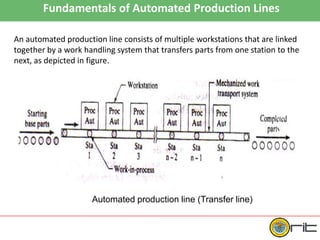
An automated production line consists of multiple workstations that are linked
together by a work handling system that transfers parts from one station to the
next, as depicted in figure.
Automated production line (Transfer line)
System Configurations
Although the first figure shows the flow of work to be in straight
line, the work flow can actually take several different forms. We
classify them as follows:
1. In-line
2. Segmented in-line, and
3. Rotary
System Configurations
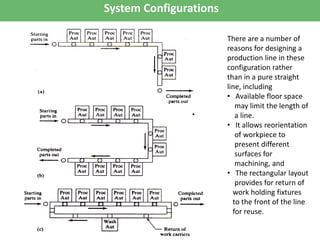
There are a number of
reasons for designing a
production line in these
configuration rather
than in a pure straight
line, including
• Available floor space
may limit the length of
a line.
• It allows reorientation
of workpiece to
present different
surfaces for
machining, and
• The rectangular layout
provides for return of
work holding fixtures
to the front of the line
for reuse.
System Configurations
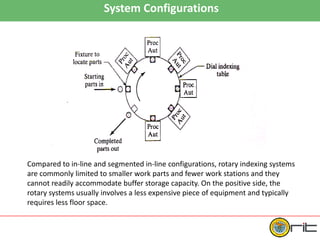
Compared to in-line and segmented in-line configurations, rotary indexing systems
are commonly limited to smaller work parts and fewer work stations and they
cannot readily accommodate buffer storage capacity. On the positive side, the
rotary systems usually involves a less expensive piece of equipment and typically
requires less floor space.
Workpart Transfer Mechanisms
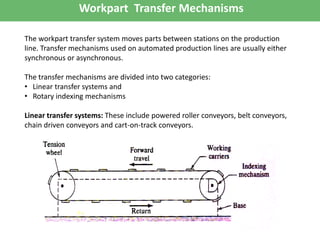
The workpart transfer system moves parts between stations on the production
line. Transfer mechanisms used on automated production lines are usually either
synchronous or asynchronous.
The transfer mechanisms are divided into two categories:
• Linear transfer systems and
• Rotary indexing mechanisms
Linear transfer systems: These include powered roller conveyors, belt conveyors,
chain driven conveyors and cart-on-track conveyors.
Workpart Transfer Mechanisms
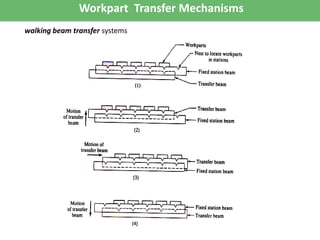
walking beam transfer systems
Workpart Transfer Mechanisms
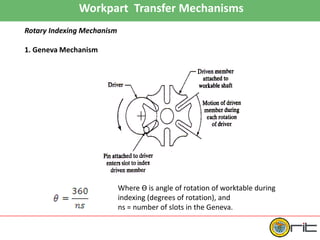
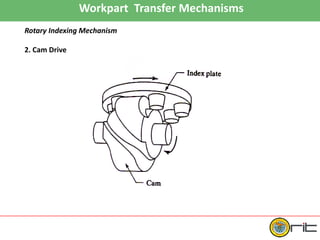
Rotary Indexing Mechanism
1. Geneva Mechanism
Where Ѳ is angle of rotation of worktable during
indexing (degrees of rotation), and
ns = number of slots in the Geneva.
Workpart Transfer Mechanisms
Rotary Indexing Mechanism
2. Cam Drive
Storage Buffers
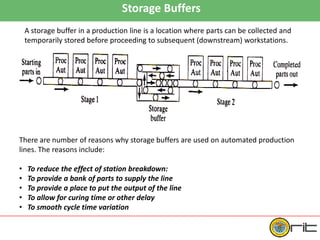
A storage buffer in a production line is a location where parts can be collected and
temporarily stored before proceeding to subsequent (downstream) workstations.
There are number of reasons why storage buffers are used on automated production
lines. The reasons include:
• To reduce the effect of station breakdown:
• To provide a bank of parts to supply the line
• To provide a place to put the output of the line
• To allow for curing time or other delay
• To smooth cycle time variation
Control of the Production Line
A storage buffer in a production line is a location where parts can be collected and
temporarily stored before proceeding to subsequent (downstream) workstations.
Basic control functions:
• Sequence control
• Safety monitoring
• Quality control
Line Controllers
For many years the traditional equipment used to control the sequence of steps on
automated production lines were electromechanical relays. Since the 1970s,
programmable logic controllers (PLCs) have been used as the controllers in new
installations. More recently, personal computers (PCs) are being used to
accomplish the control functions to operate automated production lines. In
addition to being more reliable, computer control offers the following benefits:
• Opportunity to improve and upgrade the control software, such as adding
specific functions not anticipated in the original system design.
• Recording of data on process performance, equipment reliability, and product
quality for subsequent analysis.
• Diagnostic routines to expedite maintenance and repair when the breakdowns
occur and to reduce the duration of downtime incidents.
• Automatic generation of preventive maintenance schedules indicating when
certain preventive maintenance actions should be performed. This helps to
reduce the frequency of downtime occurrences.
• Provides a more convenient human-machine interface between the operator and
the automated line.
Analysis of Transfer Lines
Analysis of Transfer Lines with no Internal Storage
Basic Terminology and Performance Measure
Assumptions
• The workstations perform processing operations such as machining, not
assembly.
• Processing times at each stations are constant, though not necessarily equal.
• Synchronous transfer of lines and
• No internal storage buffers.
Ideal cycle time Tc of the production line, which is the processing time for slowest
station on the line plus transfer time.
Tc = Max [Tsi] + Tr
where Tc = ideal cycle time in min.
Tsi = the processing time at station i in min, and
Tr = transfer time in min.
We use the Max [Tsi] because the longest processing time establishes the pace of
the production line. Remaining stations with lower processing times must wait for
the slowest station. Therefore, these other stations will experience idle time.
Analysis of Transfer Lines
In the operation of a transfer line, random breakdowns and planned stoppages cause
downtime on the line. Common reasons for downtime on an automated production
line are listed below:
• Tool failure at workstations
• Tool adjustments at workstations
• Scheduled tool changes.
• Limit switch or other electrical malfunctions
• Mechanical failure of a workstations
• Mechanical failure of the transfer system.
• Stock-outs of starting work units
• Insufficient space for completed workpiece
• Preventive maintenance on the line
• Worker breaks
Analysis of Transfer Lines
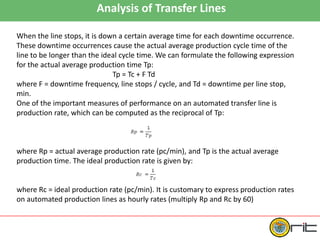
When the line stops, it is down a certain average time for each downtime occurrence.
These downtime occurrences cause the actual average production cycle time of the
line to be longer than the ideal cycle time. We can formulate the following expression
for the actual average production time Tp:
Tp = Tc + F Td
where F = downtime frequency, line stops / cycle, and Td = downtime per line stop,
min.
One of the important measures of performance on an automated transfer line is
production rate, which can be computed as the reciprocal of Tp:
where Rp = actual average production rate (pc/min), and Tp is the actual average
production time. The ideal production rate is given by:
where Rc = ideal production rate (pc/min). It is customary to express production rates
on automated production lines as hourly rates (multiply Rp and Rc by 60)
Analysis of Transfer Lines
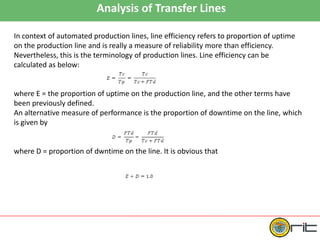
In context of automated production lines, line efficiency refers to proportion of uptime
on the production line and is really a measure of reliability more than efficiency.
Nevertheless, this is the terminology of production lines. Line efficiency can be
calculated as below:
where E = the proportion of uptime on the production line, and the other terms have
been previously defined.
An alternative measure of performance is the proportion of downtime on the line, which
is given by
where D = proportion of dwntime on the line. It is obvious that
Analysis of Transfer Lines
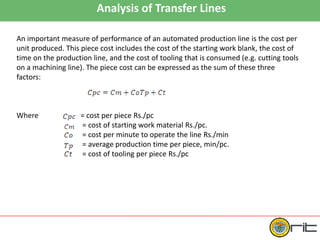
An important measure of performance of an automated production line is the cost per
unit produced. This piece cost includes the cost of the starting work blank, the cost of
time on the production line, and the cost of tooling that is consumed (e.g. cutting tools
on a machining line). The piece cost can be expressed as the sum of these three
factors:
Where = cost per piece Rs./pc
= cost of starting work material Rs./pc.
= cost per minute to operate the line Rs./min
= average production time per piece, min/pc.
= cost of tooling per piece Rs./pc
Analysis of Transfer Lines With Storage Buffers
s
In an automated production line with no internal parts
storage, the workstations are interdependent. When one
station breaks down, all other stations on the line are
affected, either immediately or by the end of a few cycles of
operation. The other stations will be forced to stop for one of
two reasons:
1. Starving of stations or
2. Blocking of stations.
Limits of Storage Buffer Effectiveness
Two extreme cases of storage buffer effectiveness can be identified:
1. no buffer storage capacity at all and
2. infinite capacity storage buffer.
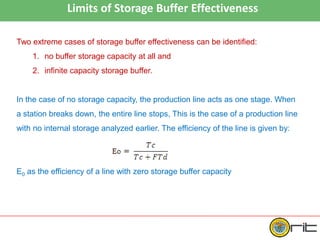
In the case of no storage capacity, the production line acts as one stage. When
a station breaks down, the entire line stops, This is the case of a production line
with no internal storage analyzed earlier. The efficiency of the line is given by:
E0 as the efficiency of a line with zero storage buffer capacity
Limits of Storage Buffer Effectiveness
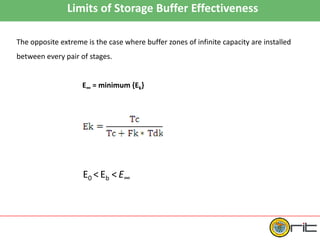
The opposite extreme is the case where buffer zones of infinite capacity are installed
between every pair of stages.
E∞ = minimum {Ek}
E0 < Eb < E∞
Analysis of a Two-Stage Transfer line
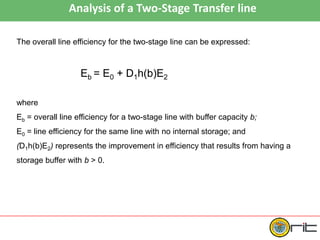
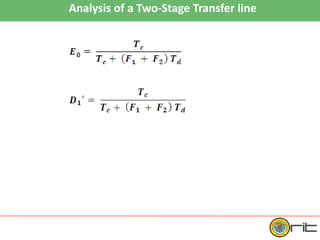
The overall line efficiency for the two-stage line can be expressed:
Eb = E0 + D1h(b)E2
where
Eb = overall line efficiency for a two-stage line with buffer capacity b;
E0 = line efficiency for the same line with no internal storage; and
(D1h(b)E2) represents the improvement in efficiency that results from having a
storage buffer with b > 0.
Analysis of a Two-Stage Transfer line
Determination of h(b)
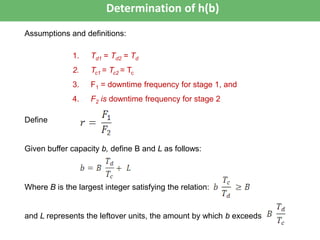
Assumptions and definitions:
1. Td1 = Td2 = Td
2. Tc1 = Tc2 = Tc
3. F1 = downtime frequency for stage 1, and
4. F2 is downtime frequency for stage 2
Define
Given buffer capacity b, define B and L as follows:
Where B is the largest integer satisfying the relation:
and L represents the leftover units, the amount by which b exceeds
Determination of h(b)
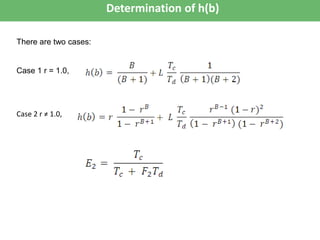
There are two cases:
Case 1 r = 1.0,
Case 2 r ≠ 1.0,

Aiar. unit ii. transfer lines

  • 1.
    Transfer Lines The manufacturingsystems considered in this unit are used for high production of parts that require multiple processing operations. Each processing operation is performed at a workstation and workstations are physically integrated by means of a mechanized material handling system to form an automated production line. Machining e.g. milling, drilling and similar rotating cutter operations are common processing operations performed on these production lines. These are called automated production lines or transfer lines or transfer machines. Transfer Lines are appropriate only under the following conditions: • High production demand. • Stable product design • Long product life • Multiple operations
  • 2.
    Transfer Lines When theapplication satisfies these conditions, automated production lines provide the following benefits: • Low direct labor content. • Low product cost because cost of fixed equipment is spread over many units. • High production rates. • Production lead time (the time between beginning of production and completion of a finished unit) and work in process are minimized. • Factory floor space is minimized.
  • 3.
    Fundamentals of AutomatedProduction Lines An automated production line consists of multiple workstations that are linked together by a work handling system that transfers parts from one station to the next, as depicted in figure. Automated production line (Transfer line)
  • 4.
    System Configurations Although thefirst figure shows the flow of work to be in straight line, the work flow can actually take several different forms. We classify them as follows: 1. In-line 2. Segmented in-line, and 3. Rotary
  • 5.
    System Configurations There area number of reasons for designing a production line in these configuration rather than in a pure straight line, including • Available floor space may limit the length of a line. • It allows reorientation of workpiece to present different surfaces for machining, and • The rectangular layout provides for return of work holding fixtures to the front of the line for reuse.
  • 6.
    System Configurations Compared toin-line and segmented in-line configurations, rotary indexing systems are commonly limited to smaller work parts and fewer work stations and they cannot readily accommodate buffer storage capacity. On the positive side, the rotary systems usually involves a less expensive piece of equipment and typically requires less floor space.
  • 7.
    Workpart Transfer Mechanisms Theworkpart transfer system moves parts between stations on the production line. Transfer mechanisms used on automated production lines are usually either synchronous or asynchronous. The transfer mechanisms are divided into two categories: • Linear transfer systems and • Rotary indexing mechanisms Linear transfer systems: These include powered roller conveyors, belt conveyors, chain driven conveyors and cart-on-track conveyors.
  • 8.
  • 9.
    Workpart Transfer Mechanisms RotaryIndexing Mechanism 1. Geneva Mechanism Where Ѳ is angle of rotation of worktable during indexing (degrees of rotation), and ns = number of slots in the Geneva.
  • 10.
    Workpart Transfer Mechanisms RotaryIndexing Mechanism 2. Cam Drive
  • 11.
    Storage Buffers A storagebuffer in a production line is a location where parts can be collected and temporarily stored before proceeding to subsequent (downstream) workstations. There are number of reasons why storage buffers are used on automated production lines. The reasons include: • To reduce the effect of station breakdown: • To provide a bank of parts to supply the line • To provide a place to put the output of the line • To allow for curing time or other delay • To smooth cycle time variation
  • 12.
    Control of theProduction Line A storage buffer in a production line is a location where parts can be collected and temporarily stored before proceeding to subsequent (downstream) workstations. Basic control functions: • Sequence control • Safety monitoring • Quality control
  • 13.
    Line Controllers For manyyears the traditional equipment used to control the sequence of steps on automated production lines were electromechanical relays. Since the 1970s, programmable logic controllers (PLCs) have been used as the controllers in new installations. More recently, personal computers (PCs) are being used to accomplish the control functions to operate automated production lines. In addition to being more reliable, computer control offers the following benefits: • Opportunity to improve and upgrade the control software, such as adding specific functions not anticipated in the original system design. • Recording of data on process performance, equipment reliability, and product quality for subsequent analysis. • Diagnostic routines to expedite maintenance and repair when the breakdowns occur and to reduce the duration of downtime incidents. • Automatic generation of preventive maintenance schedules indicating when certain preventive maintenance actions should be performed. This helps to reduce the frequency of downtime occurrences. • Provides a more convenient human-machine interface between the operator and the automated line.
  • 14.
    Analysis of TransferLines Analysis of Transfer Lines with no Internal Storage Basic Terminology and Performance Measure Assumptions • The workstations perform processing operations such as machining, not assembly. • Processing times at each stations are constant, though not necessarily equal. • Synchronous transfer of lines and • No internal storage buffers. Ideal cycle time Tc of the production line, which is the processing time for slowest station on the line plus transfer time. Tc = Max [Tsi] + Tr where Tc = ideal cycle time in min. Tsi = the processing time at station i in min, and Tr = transfer time in min. We use the Max [Tsi] because the longest processing time establishes the pace of the production line. Remaining stations with lower processing times must wait for the slowest station. Therefore, these other stations will experience idle time.
  • 15.
    Analysis of TransferLines In the operation of a transfer line, random breakdowns and planned stoppages cause downtime on the line. Common reasons for downtime on an automated production line are listed below: • Tool failure at workstations • Tool adjustments at workstations • Scheduled tool changes. • Limit switch or other electrical malfunctions • Mechanical failure of a workstations • Mechanical failure of the transfer system. • Stock-outs of starting work units • Insufficient space for completed workpiece • Preventive maintenance on the line • Worker breaks
  • 16.
    Analysis of TransferLines When the line stops, it is down a certain average time for each downtime occurrence. These downtime occurrences cause the actual average production cycle time of the line to be longer than the ideal cycle time. We can formulate the following expression for the actual average production time Tp: Tp = Tc + F Td where F = downtime frequency, line stops / cycle, and Td = downtime per line stop, min. One of the important measures of performance on an automated transfer line is production rate, which can be computed as the reciprocal of Tp: where Rp = actual average production rate (pc/min), and Tp is the actual average production time. The ideal production rate is given by: where Rc = ideal production rate (pc/min). It is customary to express production rates on automated production lines as hourly rates (multiply Rp and Rc by 60)
  • 17.
    Analysis of TransferLines In context of automated production lines, line efficiency refers to proportion of uptime on the production line and is really a measure of reliability more than efficiency. Nevertheless, this is the terminology of production lines. Line efficiency can be calculated as below: where E = the proportion of uptime on the production line, and the other terms have been previously defined. An alternative measure of performance is the proportion of downtime on the line, which is given by where D = proportion of dwntime on the line. It is obvious that
  • 18.
    Analysis of TransferLines An important measure of performance of an automated production line is the cost per unit produced. This piece cost includes the cost of the starting work blank, the cost of time on the production line, and the cost of tooling that is consumed (e.g. cutting tools on a machining line). The piece cost can be expressed as the sum of these three factors: Where = cost per piece Rs./pc = cost of starting work material Rs./pc. = cost per minute to operate the line Rs./min = average production time per piece, min/pc. = cost of tooling per piece Rs./pc
  • 19.
    Analysis of TransferLines With Storage Buffers s In an automated production line with no internal parts storage, the workstations are interdependent. When one station breaks down, all other stations on the line are affected, either immediately or by the end of a few cycles of operation. The other stations will be forced to stop for one of two reasons: 1. Starving of stations or 2. Blocking of stations.
  • 20.
    Limits of StorageBuffer Effectiveness Two extreme cases of storage buffer effectiveness can be identified: 1. no buffer storage capacity at all and 2. infinite capacity storage buffer. In the case of no storage capacity, the production line acts as one stage. When a station breaks down, the entire line stops, This is the case of a production line with no internal storage analyzed earlier. The efficiency of the line is given by: E0 as the efficiency of a line with zero storage buffer capacity
  • 21.
    Limits of StorageBuffer Effectiveness The opposite extreme is the case where buffer zones of infinite capacity are installed between every pair of stages. E∞ = minimum {Ek} E0 < Eb < E∞
  • 22.
    Analysis of aTwo-Stage Transfer line The overall line efficiency for the two-stage line can be expressed: Eb = E0 + D1h(b)E2 where Eb = overall line efficiency for a two-stage line with buffer capacity b; E0 = line efficiency for the same line with no internal storage; and (D1h(b)E2) represents the improvement in efficiency that results from having a storage buffer with b > 0.
  • 23.
    Analysis of aTwo-Stage Transfer line
  • 24.
    Determination of h(b) Assumptionsand definitions: 1. Td1 = Td2 = Td 2. Tc1 = Tc2 = Tc 3. F1 = downtime frequency for stage 1, and 4. F2 is downtime frequency for stage 2 Define Given buffer capacity b, define B and L as follows: Where B is the largest integer satisfying the relation: and L represents the leftover units, the amount by which b exceeds
  • 25.
    Determination of h(b) Thereare two cases: Case 1 r = 1.0, Case 2 r ≠ 1.0,