International Journal of Modern Engineering Research (IJMER)
                 www.ijmer.com         Vol.2, Issue.6, Nov-Dec. 2012 pp-4211-4214       ISSN: 2249-6645

      An Algorithm Based Simulation Modeling For Control of
                       Production Systems
                             Srinivas Viswanath V1, R Ramanujam2, VM Nistane3
                                           1,2
                                                 Mechanical Engineering, VIT University, India,
                                             3
                                                 Mechanical Engineering, VNIT Nagpur, India.

ABSTRAC: This paper describes an algorithm based                         Algorithm based paradigm, is a collection of data (attributes)
simulation approach for the design of a flexible production              together with all the operations (methods) which access or alter that
system Which allows the implementation of logic during the               data (Hill, 1996). Some or all of these operations could be used to
system design stage. The Algorithm design approach is built              provide a uniform external interface to other parts of the system.
around the basic concept of supervisory control based on limited         Other objects in the system can interact with this object only
Automation. We provide the optimal inventory control policy and          through requests for the object to execute its operations. The ability
characterize its structural properties for the single-period model.      of the Algorithm based paradigm to provide a direct representation
Through an extensive numerical study, we demonstrate that                for real world objects comes with four unique features associated
applied programmed methodology is sufficiently accurate and              with it, data abstraction, and dynamic binding.
close to optimal. The system resources are modeled to be
monitored for real-time control. Real-time control issues
including deadlock resolution, resource failures in various modes
of operation and recovery from failures while sustaining
desirable logical system properties are integrated into the logical
design for simulating the supervisory controller.

Keywords: Algorithm, Automated systems, Inventory
control, Production systems, simulation.
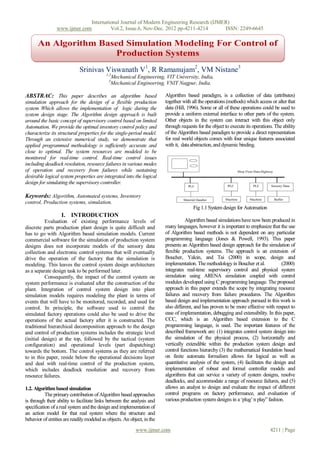
                                                                                        Fig 1.1 System design for Automation
                   I. INTRODUCTION
          Evaluation of existing performance levels of                              Algorithm based simulations have now been produced in
discrete parts production plant design is quite difficult and            many languages, however it is important to emphasize that the use
has to go with Algorithm based simulation models. Current                of Algorithm based methods is not dependent on any particular
commercial software for the simulation of production system              programming language (Jones & Powell, 1993). This paper
designs does not incorporate models of the sensory data                  presents an Algorithm based design approach for the simulation of
collection and electronic control systems that will eventually           flexible production systems. The approach is an extension of
drive the operation of the factory that the simulation is                Boucher, Yalcin, and Tai (2000) in scope, design and
modeling. This leaves the control system design architecture             implementation. The methodology in Boucher et al.            (2000)
as a separate design task to be performed later.                         integrates real-time supervisory control and physical system
          Consequently, the impact of the control system on              simulation using ARENA simulation coupled with control
system performance is evaluated after the construction of the            modules developed using C programming language. The proposed
plant. Integration of control system design into plant                   approach in this paper extends the scope by integrating resource
simulation models requires modeling the plant in terms of                failures and recovery from failure procedures. The Algorithm
events that will have to be monitored, recorded, and used for            based design and implementation approach pursued in this work is
control. In principle, the software used to control the                  also different, and has proven to be more effective with respect to
simulated factory operations could also be used to drive the             ease of implementation, debugging and extensibility. In this paper,
operations of the actual factory after it is constructed. The            CCC, which is an Algorithm based extension to the C
traditional hierarchical decomposition approach to the design            programming language, is used. The important features of the
and control of production systems includes the strategic level           described framework are: (1) integrates control system design into
(initial design) at the top, followed by the tactical (system            the simulation of the physical process, (2) horizontally and
configuration) and operational levels (part dispatching)                 vertically extendible within the production system design and
towards the bottom. The control systems as they are referred             control functions hierarchy (3) the mathematical foundation based
to in this paper, reside below the operational decisions layer           on finite automata formalism allows for logical as well as
and deal with real-time control of the production system,                quantitative analysis of the system, (4) facilitates the design and
which includes deadlock resolution and recovery from                     implementation of robust and formal controller models and
resource failures.                                                       algorithms that can service a variety of system designs, resolve
                                                                         deadlocks, and accommodate a range of resource failures, and (5)
1.2. Algorithm based simulation                                          allows an analyst to design and evaluate the impact of different
           The primary contribution of Algorithm based approaches        control programs on factory performance, and evaluation of
is through their ability to facilitate links between the analysis and    various production system designs in a ‘plug’ n play” fashion.
specification of a real system and the design and implementation of
an action model for that real system where the structure and
behavior of entities are readily modeled as objects. An object, in the
                                                            www.ijmer.com                                                        4211 | Page
International Journal of Modern Engineering Research (IJMER)
                 www.ijmer.com         Vol.2, Issue.6, Nov-Dec. 2012 pp-4211-4214       ISSN: 2249-6645
                       II. Physical system                                         4.2 Calculation of Buffer Stock / Inventory Levels
           The physical system considered is a fully automated                        The Proposed system supports level production. It helps
flexible production cell that has a number of single capacity              to maintain stable and efficient operations. The question of how
machines and a central material-handling device, such as a robot,          many proposed to use is a basic issue in tuning a proposed system.
that interconnects these machines. There is an input and an output         If your factory makes products using mostly standard, repeated
buffer where parts can be loaded and unloaded to and from the cell         operations, the number of proposed can be determined using the
via the material-handling device. Each machine and the material            formula The number of proposed you need dependent on the
handler are assumed to have their own internal controller as well as       number of pallets or containers and their capacity. Lead times,
a Programmable Logic Controller (PLC) that it is connected to              safety margins or buffer inventory , and transportation time for
which coordinates its interactions with the rest of the components         proposed retrieval are also important factors. Several questions
in the system. The cell controller monitors the machine PLCs for           must be answered when deciding the number of proposed to use.
machine failures, repair completions, event start and finish signals,      • How many products can be carried on a pallet?
etc.                                                                       • How many transport lots are needed, given the frequency of
           III. Algorithm based design framework                           transport?
           In order to simulate the real-time control activities, the      • Will a single product or mixed products be transported?
system model must consider several factors such as the status of
machines and material handlers, processing requirements of the             4.3. Inventory Level:
parts in the system, sequencing of the operations required by these        Inventory level is very important in between the process. That is
parts and contingencies such as equipment breakdowns. The                  also called as safety stock level which is calculated as below.
proposed Algorithm based design approach contains constructs to            Inventory level = [Daily Production Requirement * (1+α)]
model: (1) production cell, (2) the control structure to accomplish        Daily Production requirement for COMPONENT 1
desired system behavior, and (3) communication between the cell            Outer Ring = 4000 components
and its controller. The modeling of the cell includes the definition       According to monthly plan If safety factor α=1,
of machines, robots, input and output buffers, their interactions and      Inventory level for COMPONENT 1
associated contingencies such as resource failures.                         Outer Ring =DR * (1+ α) =4000 * (1+ 1) = 8000.

                        IV. Methodology                                    4.2. Simulation inputs
4.1. Mathematical Model:                                                               The input files to the simulation describe the processing
           As discussed earlier in the previous chapter the                times and the routing of the part types in the cell representing the
production process WIP inventory was increasing and there was              full set of alternative production sequences for the parts. There are
increase in the loss of utilization of resources as well. So there is a    two types of files. Thepartplantstate[i].txt specifies the machine
need of proper scheduling technique which takes care of this               which can perform the required operation on part typeiin a
problem. The Gantt charts can be one of the techniques to tackle           particular state. The partprocessplan[i].txt describes the state
this problem but the problem with the technique is that it is a slow       transitions for the part typei and the processing time for that part in
and time consuming process [5]. Each and every time we need to             each state. Together, they contain all the information to generate the
charts and also beyond a certain limit of time span it is difficult to     corresponding Finite Automata models of the parts. At the
read the charts. As the number of operations or number of batches          beginning of each simulation, the user also specifies the number of
in the scheduling increases in order to accommodate the larger time        machines in the cell model and the number of parts to be processed
span either the Gantt charts have to be huge or the resolution has to      in the plant during the simulation. The user may also simulate
be sacrificed. If there is a mathematical tool by which we can solve       resource failures in the plant by specifying failure-rates and repair
the above discussed problem then it will be much easier to get the         rates for the resources. These set of details are complete in
schedule. Inventory has problems. The proposed technique requires          themselves in describing the structure and behavior of the plant
the daily attainment of the track grinding that is the last operation of   comprehensively.
production process. Here the logic of process is reverse type of                       The constructor of the cell class is used as an
process i.e.., last process requests number of parts for before            initialization procedure to create the buffer, the machine, the
process. The same amount of parts are prepared and sent, no excess         material handler and the part objects that form the cell object, and
parts are send. So inventory levels are balanced and no excessive          to create certain information-arrays from the input files. These
stocks are maintained.                                                     arrays capture all the information on the cell behavior and are
                                                                           henceforth, used by the supervisor to formulate a control strategy.

                                                                           4.2. Simulation logic
                                                                                     The simulation logic is implemented in the object-
                                                                           oriented model through the updating of the attributes of the
                                                                           component objects and the interactions among these components
                                                                           are modeled through the message-passing facility in the object-
                                                                           oriented approach. The event handler object monitors the buffers
                                                                           and the machines in the cell and queues and relays appropriate
                                                                           event signals to the supervisor object. The supervisor object then
                                                                           evaluates the request based on the current state of the system and
                                                                           the control strategy and sends back the decision to allow/disallow
                                                                           the request back to the cell object, which executes the move if it is
                                                                           allowed. If the move is not allowed, it is sent to the end of the
                                                                           queue of events requested in the event handler object to be
                                                             www.ijmer.com                                                          4212 | Page
International Journal of Modern Engineering Research (IJMER)
                 www.ijmer.com         Vol.2, Issue.6, Nov-Dec. 2012 pp-4211-4214       ISSN: 2249-6645
evaluated again when the system state changes. The flow of               evaluated again when the system state changes.
information within the simulation is illustrated in flow chart.The
simulation starts with the arrival of a part to the input buffer. The
event handler sends the load new part signal to the supervisor based
on the change in the buffer object’s attributes. The supervisor
generates a new control pattern, evaluates the move requested
using       theevaluate_newpart_request(          )       and      the
evaluate_move_request( ) methods. The response is evaluated by
theevaluate_response( ) method of the cell, and if it is allowed,
theexecute_event( ) method of the material handler, load_machine(
) method of the cell andload_part( ) method of the machine are
sequentially invoked. The current states of the cell, the machine and
the part are updated using their respectiveupdate_state( ) methods.
Based on the processing time of the required operation,
themark_event( )method of the event handler object schedules the
part to be unloaded when the processing is complete.

                  V. Implementation Phase
5.1 Action Plan:
In this section action plan has been discussed.                                     Fig 5.1 Flow of materials and Application Logic

5.1.1 To Decide Proposed Methodology:                                              Simulation outputs the output produced by the simulation
After study of the existing process it was found that maximum            model is captured in data files and includes event trace information,
inventory and lack of utilization of available resources is with         system performance information, and supervisory controller
production process. In the                                               computation complexity information. The trace information
Process of production WIP inventory was increasing more so to            includes a trace of the events ordered by time for understanding the
avoid this it was decided to implement Toyota Production System          behavior of the system. The system performance information
PROPOSED Methodology.                                                    includes measures such as the throughput, resource utilization, etc.
                                                                         Also, included are the state space and response time of the
5.2 Monitoring Phase:                                                    supervisory controller to keep track of computational complexity.
 Having implemented Proposed Algorithm Methodology the next
most important step is to monitor the flow of materials. This step is                    VI. Summary and conclusions;
important so as to know whether an Just In Time, Toyota                            Integration of control requirements into plant simulation
implementation is successfully running or not.                           models requires modeling the plant in terms of events that have to
                                                                         be monitored, recorded, and used for control. In this paper we
5.2.1 Steps in Monitoring Phase:                                         describe an Algorithm based approach to the design of flexible
         Daily production fulfillments according to Monthly             production system simulation that allow the implementation of
          plan                                                           control logic during the system design phase. The Algorithm based
         Attend daily Production Meeting                                design approach is structured around formal supervisory control
         Update Current status of Notice Board                          theory. While Algorithm based design approaches have several
         Attend breakdown and know the root cause                       advantages for software development, especially in specifying
      Calculation of WIP inventory at starting of                       intra-object relationships, the interactions between objects in a
Take every problem for discussion with team and after answering it       complex system are difficult to capture.
design the solution on paper and gather necessary tools to
implement these solution. Getting proposal from top management                                        References:
is major thing it depend on understanding solution designed and          [1].   Buffer stocks controlled traditional by KANBAN methodology
how that can solve the problem associated with the existing                     .kumar and Rao.The journal of operations research 51, 195-294
process.                                                                 [2].   Inventory management with periodic ordering and minimum order
                                                                                quantities. The Journal of the Operational Research Society
5.2.2 Simulation logic:                                                          49, 1085–1094.
                                                                         [3].   Ross, S., 1992. Applied Probability Models with Optimization
          The simulation logic is implemented in the Algorithm
                                                                                Applications. Dover, New York.
based model through the updating of the attributes of the                [4].   Scarf, H., 1960. The optimality of (s,S) policies in the dynamic
component objects and the interactions among these components                   inventory problem.
are modeled through the message-passing facility in the Algorithm        [5].   Narayanan, S., Bodner, D. A., Sreekanth, U., Govindaraj, T.,
based approach. The event handler object monitors the buffers and               McGinnis, L. F., & Mitchell, C. M. (1998). Research in object-
the machines in the cell and queues and relays appropriate event                oriented manufacturing simulations: An assessment of the state of
signals to the supervisor object. The supervisor object then                    the art.IIE Transactions, 30, 795–810.
evaluates the request based on the current state of the system and       [6].   Smith, J. S., Hoberecht, W. C., & Joshi, S. B. (1996). A shop-floor
the control strategy and sends back the decision to allow/disallow              control architecture for computer-integrated manufacturing.
                                                                                IIE Transactions, 28, 783–794.
the request back to the cell object, which executes the move if it is
                                                                         [7].   Smith, J. S., & Joshi, S. B. (1993). Message-based part state graphs
allowed. If the move is not allowed, it is sent to the end of the               (MPSG) for shop floor control. Proceedings of the second
queue of events requested in the event handler object to be              [8].   IIE research conference, Los Angeles, CA.

                                                           www.ijmer.com                                                             4213 | Page
International Journal of Modern Engineering Research (IJMER)
                   www.ijmer.com         Vol.2, Issue.6, Nov-Dec. 2012 pp-4211-4214       ISSN: 2249-6645
        System Modeling Corporation (1999).Arena professional edition
        reference guide, Swickley, PA.
[9].    Tang, M. X., & Smothers, T. (1991). Towards object-oriented
        simulation. IEEE Colloquium on Object-Oriented Simulation and
        Control, 7/1–7/4.
[10].   Venkatesh, S., Smith, J. S., Deuermeyer, B., & Curry, G. (1998).
        Deadlock detection and resolution for discrete-event
        simulation: Multiple-unit seizes.IIE Transactions, 30, 201–216.
[11].   Yalcin, A. (2004). Re-configurable supervisory control of automated
        manufacturing cells with resource failures.Robotics and
        Computer Integrated Manufacturing, 20(2), 111–119.
[12].   Deuermeyer, B., Curry, G., Duchowski, A. T., & Venkatesh,
        S. (1997). An automatic approach to deadlock detection and
        resolution in discrete simulation systems. INFORMS Journal
        on Computing, 9(2), 195–205.
[13].   Hill, D. R. C. (1996).Object-oriented analysis and simulation.
        Reading, MA: Addison-Wesley.
[14].   Jones, J. A., & Powell, K. A. (1993). Building object-oriented
        simulations with CCC. Proceedings of the winter simulation
        conference, Los Angeles, 79–88.


                                                               www.ijmer.com                                4214 | Page

An Algorithm Based Simulation Modeling For Control of Production Systems

  • 1.
    International Journal ofModern Engineering Research (IJMER) www.ijmer.com Vol.2, Issue.6, Nov-Dec. 2012 pp-4211-4214 ISSN: 2249-6645 An Algorithm Based Simulation Modeling For Control of Production Systems Srinivas Viswanath V1, R Ramanujam2, VM Nistane3 1,2 Mechanical Engineering, VIT University, India, 3 Mechanical Engineering, VNIT Nagpur, India. ABSTRAC: This paper describes an algorithm based Algorithm based paradigm, is a collection of data (attributes) simulation approach for the design of a flexible production together with all the operations (methods) which access or alter that system Which allows the implementation of logic during the data (Hill, 1996). Some or all of these operations could be used to system design stage. The Algorithm design approach is built provide a uniform external interface to other parts of the system. around the basic concept of supervisory control based on limited Other objects in the system can interact with this object only Automation. We provide the optimal inventory control policy and through requests for the object to execute its operations. The ability characterize its structural properties for the single-period model. of the Algorithm based paradigm to provide a direct representation Through an extensive numerical study, we demonstrate that for real world objects comes with four unique features associated applied programmed methodology is sufficiently accurate and with it, data abstraction, and dynamic binding. close to optimal. The system resources are modeled to be monitored for real-time control. Real-time control issues including deadlock resolution, resource failures in various modes of operation and recovery from failures while sustaining desirable logical system properties are integrated into the logical design for simulating the supervisory controller. Keywords: Algorithm, Automated systems, Inventory control, Production systems, simulation. Fig 1.1 System design for Automation I. INTRODUCTION Evaluation of existing performance levels of Algorithm based simulations have now been produced in discrete parts production plant design is quite difficult and many languages, however it is important to emphasize that the use has to go with Algorithm based simulation models. Current of Algorithm based methods is not dependent on any particular commercial software for the simulation of production system programming language (Jones & Powell, 1993). This paper designs does not incorporate models of the sensory data presents an Algorithm based design approach for the simulation of collection and electronic control systems that will eventually flexible production systems. The approach is an extension of drive the operation of the factory that the simulation is Boucher, Yalcin, and Tai (2000) in scope, design and modeling. This leaves the control system design architecture implementation. The methodology in Boucher et al. (2000) as a separate design task to be performed later. integrates real-time supervisory control and physical system Consequently, the impact of the control system on simulation using ARENA simulation coupled with control system performance is evaluated after the construction of the modules developed using C programming language. The proposed plant. Integration of control system design into plant approach in this paper extends the scope by integrating resource simulation models requires modeling the plant in terms of failures and recovery from failure procedures. The Algorithm events that will have to be monitored, recorded, and used for based design and implementation approach pursued in this work is control. In principle, the software used to control the also different, and has proven to be more effective with respect to simulated factory operations could also be used to drive the ease of implementation, debugging and extensibility. In this paper, operations of the actual factory after it is constructed. The CCC, which is an Algorithm based extension to the C traditional hierarchical decomposition approach to the design programming language, is used. The important features of the and control of production systems includes the strategic level described framework are: (1) integrates control system design into (initial design) at the top, followed by the tactical (system the simulation of the physical process, (2) horizontally and configuration) and operational levels (part dispatching) vertically extendible within the production system design and towards the bottom. The control systems as they are referred control functions hierarchy (3) the mathematical foundation based to in this paper, reside below the operational decisions layer on finite automata formalism allows for logical as well as and deal with real-time control of the production system, quantitative analysis of the system, (4) facilitates the design and which includes deadlock resolution and recovery from implementation of robust and formal controller models and resource failures. algorithms that can service a variety of system designs, resolve deadlocks, and accommodate a range of resource failures, and (5) 1.2. Algorithm based simulation allows an analyst to design and evaluate the impact of different The primary contribution of Algorithm based approaches control programs on factory performance, and evaluation of is through their ability to facilitate links between the analysis and various production system designs in a ‘plug’ n play” fashion. specification of a real system and the design and implementation of an action model for that real system where the structure and behavior of entities are readily modeled as objects. An object, in the www.ijmer.com 4211 | Page
  • 2.
    International Journal ofModern Engineering Research (IJMER) www.ijmer.com Vol.2, Issue.6, Nov-Dec. 2012 pp-4211-4214 ISSN: 2249-6645 II. Physical system 4.2 Calculation of Buffer Stock / Inventory Levels The physical system considered is a fully automated The Proposed system supports level production. It helps flexible production cell that has a number of single capacity to maintain stable and efficient operations. The question of how machines and a central material-handling device, such as a robot, many proposed to use is a basic issue in tuning a proposed system. that interconnects these machines. There is an input and an output If your factory makes products using mostly standard, repeated buffer where parts can be loaded and unloaded to and from the cell operations, the number of proposed can be determined using the via the material-handling device. Each machine and the material formula The number of proposed you need dependent on the handler are assumed to have their own internal controller as well as number of pallets or containers and their capacity. Lead times, a Programmable Logic Controller (PLC) that it is connected to safety margins or buffer inventory , and transportation time for which coordinates its interactions with the rest of the components proposed retrieval are also important factors. Several questions in the system. The cell controller monitors the machine PLCs for must be answered when deciding the number of proposed to use. machine failures, repair completions, event start and finish signals, • How many products can be carried on a pallet? etc. • How many transport lots are needed, given the frequency of III. Algorithm based design framework transport? In order to simulate the real-time control activities, the • Will a single product or mixed products be transported? system model must consider several factors such as the status of machines and material handlers, processing requirements of the 4.3. Inventory Level: parts in the system, sequencing of the operations required by these Inventory level is very important in between the process. That is parts and contingencies such as equipment breakdowns. The also called as safety stock level which is calculated as below. proposed Algorithm based design approach contains constructs to Inventory level = [Daily Production Requirement * (1+α)] model: (1) production cell, (2) the control structure to accomplish Daily Production requirement for COMPONENT 1 desired system behavior, and (3) communication between the cell Outer Ring = 4000 components and its controller. The modeling of the cell includes the definition According to monthly plan If safety factor α=1, of machines, robots, input and output buffers, their interactions and Inventory level for COMPONENT 1 associated contingencies such as resource failures. Outer Ring =DR * (1+ α) =4000 * (1+ 1) = 8000. IV. Methodology 4.2. Simulation inputs 4.1. Mathematical Model: The input files to the simulation describe the processing As discussed earlier in the previous chapter the times and the routing of the part types in the cell representing the production process WIP inventory was increasing and there was full set of alternative production sequences for the parts. There are increase in the loss of utilization of resources as well. So there is a two types of files. Thepartplantstate[i].txt specifies the machine need of proper scheduling technique which takes care of this which can perform the required operation on part typeiin a problem. The Gantt charts can be one of the techniques to tackle particular state. The partprocessplan[i].txt describes the state this problem but the problem with the technique is that it is a slow transitions for the part typei and the processing time for that part in and time consuming process [5]. Each and every time we need to each state. Together, they contain all the information to generate the charts and also beyond a certain limit of time span it is difficult to corresponding Finite Automata models of the parts. At the read the charts. As the number of operations or number of batches beginning of each simulation, the user also specifies the number of in the scheduling increases in order to accommodate the larger time machines in the cell model and the number of parts to be processed span either the Gantt charts have to be huge or the resolution has to in the plant during the simulation. The user may also simulate be sacrificed. If there is a mathematical tool by which we can solve resource failures in the plant by specifying failure-rates and repair the above discussed problem then it will be much easier to get the rates for the resources. These set of details are complete in schedule. Inventory has problems. The proposed technique requires themselves in describing the structure and behavior of the plant the daily attainment of the track grinding that is the last operation of comprehensively. production process. Here the logic of process is reverse type of The constructor of the cell class is used as an process i.e.., last process requests number of parts for before initialization procedure to create the buffer, the machine, the process. The same amount of parts are prepared and sent, no excess material handler and the part objects that form the cell object, and parts are send. So inventory levels are balanced and no excessive to create certain information-arrays from the input files. These stocks are maintained. arrays capture all the information on the cell behavior and are henceforth, used by the supervisor to formulate a control strategy. 4.2. Simulation logic The simulation logic is implemented in the object- oriented model through the updating of the attributes of the component objects and the interactions among these components are modeled through the message-passing facility in the object- oriented approach. The event handler object monitors the buffers and the machines in the cell and queues and relays appropriate event signals to the supervisor object. The supervisor object then evaluates the request based on the current state of the system and the control strategy and sends back the decision to allow/disallow the request back to the cell object, which executes the move if it is allowed. If the move is not allowed, it is sent to the end of the queue of events requested in the event handler object to be www.ijmer.com 4212 | Page
  • 3.
    International Journal ofModern Engineering Research (IJMER) www.ijmer.com Vol.2, Issue.6, Nov-Dec. 2012 pp-4211-4214 ISSN: 2249-6645 evaluated again when the system state changes. The flow of evaluated again when the system state changes. information within the simulation is illustrated in flow chart.The simulation starts with the arrival of a part to the input buffer. The event handler sends the load new part signal to the supervisor based on the change in the buffer object’s attributes. The supervisor generates a new control pattern, evaluates the move requested using theevaluate_newpart_request( ) and the evaluate_move_request( ) methods. The response is evaluated by theevaluate_response( ) method of the cell, and if it is allowed, theexecute_event( ) method of the material handler, load_machine( ) method of the cell andload_part( ) method of the machine are sequentially invoked. The current states of the cell, the machine and the part are updated using their respectiveupdate_state( ) methods. Based on the processing time of the required operation, themark_event( )method of the event handler object schedules the part to be unloaded when the processing is complete. V. Implementation Phase 5.1 Action Plan: In this section action plan has been discussed. Fig 5.1 Flow of materials and Application Logic 5.1.1 To Decide Proposed Methodology: Simulation outputs the output produced by the simulation After study of the existing process it was found that maximum model is captured in data files and includes event trace information, inventory and lack of utilization of available resources is with system performance information, and supervisory controller production process. In the computation complexity information. The trace information Process of production WIP inventory was increasing more so to includes a trace of the events ordered by time for understanding the avoid this it was decided to implement Toyota Production System behavior of the system. The system performance information PROPOSED Methodology. includes measures such as the throughput, resource utilization, etc. Also, included are the state space and response time of the 5.2 Monitoring Phase: supervisory controller to keep track of computational complexity. Having implemented Proposed Algorithm Methodology the next most important step is to monitor the flow of materials. This step is VI. Summary and conclusions; important so as to know whether an Just In Time, Toyota Integration of control requirements into plant simulation implementation is successfully running or not. models requires modeling the plant in terms of events that have to be monitored, recorded, and used for control. In this paper we 5.2.1 Steps in Monitoring Phase: describe an Algorithm based approach to the design of flexible  Daily production fulfillments according to Monthly production system simulation that allow the implementation of plan control logic during the system design phase. The Algorithm based  Attend daily Production Meeting design approach is structured around formal supervisory control  Update Current status of Notice Board theory. While Algorithm based design approaches have several  Attend breakdown and know the root cause advantages for software development, especially in specifying  Calculation of WIP inventory at starting of intra-object relationships, the interactions between objects in a Take every problem for discussion with team and after answering it complex system are difficult to capture. design the solution on paper and gather necessary tools to implement these solution. Getting proposal from top management References: is major thing it depend on understanding solution designed and [1]. Buffer stocks controlled traditional by KANBAN methodology how that can solve the problem associated with the existing .kumar and Rao.The journal of operations research 51, 195-294 process. [2]. Inventory management with periodic ordering and minimum order quantities. The Journal of the Operational Research Society 5.2.2 Simulation logic: 49, 1085–1094. [3]. Ross, S., 1992. Applied Probability Models with Optimization The simulation logic is implemented in the Algorithm Applications. Dover, New York. based model through the updating of the attributes of the [4]. Scarf, H., 1960. The optimality of (s,S) policies in the dynamic component objects and the interactions among these components inventory problem. are modeled through the message-passing facility in the Algorithm [5]. Narayanan, S., Bodner, D. A., Sreekanth, U., Govindaraj, T., based approach. The event handler object monitors the buffers and McGinnis, L. F., & Mitchell, C. M. (1998). Research in object- the machines in the cell and queues and relays appropriate event oriented manufacturing simulations: An assessment of the state of signals to the supervisor object. The supervisor object then the art.IIE Transactions, 30, 795–810. evaluates the request based on the current state of the system and [6]. Smith, J. S., Hoberecht, W. C., & Joshi, S. B. (1996). A shop-floor the control strategy and sends back the decision to allow/disallow control architecture for computer-integrated manufacturing. IIE Transactions, 28, 783–794. the request back to the cell object, which executes the move if it is [7]. Smith, J. S., & Joshi, S. B. (1993). Message-based part state graphs allowed. If the move is not allowed, it is sent to the end of the (MPSG) for shop floor control. Proceedings of the second queue of events requested in the event handler object to be [8]. IIE research conference, Los Angeles, CA. www.ijmer.com 4213 | Page
  • 4.
    International Journal ofModern Engineering Research (IJMER) www.ijmer.com Vol.2, Issue.6, Nov-Dec. 2012 pp-4211-4214 ISSN: 2249-6645 System Modeling Corporation (1999).Arena professional edition reference guide, Swickley, PA. [9]. Tang, M. X., & Smothers, T. (1991). Towards object-oriented simulation. IEEE Colloquium on Object-Oriented Simulation and Control, 7/1–7/4. [10]. Venkatesh, S., Smith, J. S., Deuermeyer, B., & Curry, G. (1998). Deadlock detection and resolution for discrete-event simulation: Multiple-unit seizes.IIE Transactions, 30, 201–216. [11]. Yalcin, A. (2004). Re-configurable supervisory control of automated manufacturing cells with resource failures.Robotics and Computer Integrated Manufacturing, 20(2), 111–119. [12]. Deuermeyer, B., Curry, G., Duchowski, A. T., & Venkatesh, S. (1997). An automatic approach to deadlock detection and resolution in discrete simulation systems. INFORMS Journal on Computing, 9(2), 195–205. [13]. Hill, D. R. C. (1996).Object-oriented analysis and simulation. Reading, MA: Addison-Wesley. [14]. Jones, J. A., & Powell, K. A. (1993). Building object-oriented simulations with CCC. Proceedings of the winter simulation conference, Los Angeles, 79–88. www.ijmer.com 4214 | Page