Welcome
To Our Presentation
Group name:
Shopnochari
Group Member:
Name ID
Debashish Kumer Shingho 123-15-
2054
Md. Saddam Hossain 123-15-2010
MST.Eshita Katun 123-15-2081
Antim 123-15-2162
Importance of simulation & Systemwith model
Originof simulation word ---
Middle English
simulacion
&
Latin simulātiōn-
(stem of simulātiō)
Simulation ---?
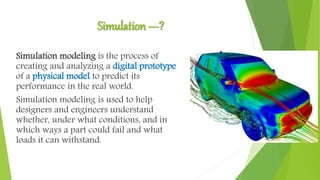
Simulation modeling is the process of
creating and analyzing a digital prototype
of a physical model to predict its
performance in the real world.
Simulation modeling is used to help
designers and engineers understand
whether, under what conditions, and in
which ways a part could fail and what
loads it can withstand.
Simulation in Computer science---
simulation has some specialized
meanings –
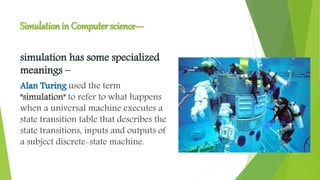
Alan Turing used the term
"simulation" to refer to what happens
when a universal machine executes a
state transition table that describes the
state transitions, inputs and outputs of
a subject discrete-state machine.
SimulationModeling Workflow---
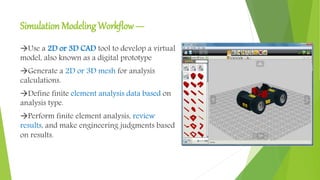
Use a 2D or 3D CAD tool to develop a virtual
model, also known as a digital prototype
Generate a 2D or 3D mesh for analysis
calculations.
Define finite element analysis data based on
analysis type.
Perform finite element analysis, review
results, and make engineering judgments based
on results.
Simulationis Needed
 experiment with new designs
or policies prior to
implementation
 can be used to verify analytic
solutions
 different capabilities for a
machine, requirements can be
determined.
 designed for training allow
learning without the cost and
disruption of on-the-job
learning.
Simulation is not Needed
 problem can be solved using
common sense
 simulation costs exceed the
savings
 Resources or time are not
available
 system behavior is too complex
or can’t be defined.
 isn’t the ability to verify and
validate the model.
Why is Modeling and Simulation Important in Engineering?
 Unavailable input and output.
 Experiment may be too dangerous.
 Cost of experimentation might be too high.
 Time constants of the system may not be compatible with human
dimensions.
 Experimental behavior might be obscured by disturbances.
Advantage:
 New polices, operating procedures, decision rules,
information flows, organizational procedures.
 New hardware designs, physical layouts, transportation
systems.
 Hypotheses about how or why certain phenomena occur can
be tested for feasibility.
 Insight can be obtained about the interaction of variables.
 Insight can be obtained about the importance of variables to
the performance of the system.
Advantage:
Disadvantages:
There are disadvantages in using a simulation model:-
 We have a poor understanding of how some physical systems work so that we do
not have sufficient data to produce a mathematical model. For this reason it has not
been possible to create simulations that can accurately predict the occurrence and
effects of earthquakes and tsunami.
 The formula and functions that are used may not provide an accurate description of
the system resulting in inaccurate output from the simulation.
 Complex simulations can require the use of a computer system with a fast processor
and large amounts of memory.
 Simulation results may be difficult to interpret.
 Simulation modeling and analysis can be time consuming and expensive.
Areas of Application:
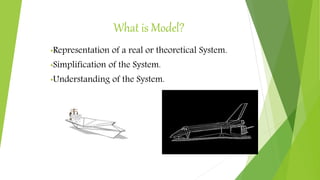
What is Model?
•Representation of a real or theoretical System.
•Simplification of the System.
•Understanding of the System.
Why we need modeling ?
 Cost effective way to represent a real-world system.
 Key aspects of the system, components.
 And how those components communicate with one
another.
 To test designs before implementation.
Model Types
• Visual Models : Graphical sketches, Computer solid
models
 Physical Models: Prototypes, mock-ups, structural
models.
• Logical Models : Algebraic and different equation
used for computer simulation.
 Empirical Models: Relationship between variables.
Deterministic Simulation Models
• A model that does not contain probability.
• Every run will result the same.
• Single run is enough to evaluate the result.
Stochastic Simulation Models
• A model that contains probability.
using random numbers.
 Every run will result differently.
• Multiple runs are required to evaluate the
results.
Define An Achievable Goal
To model the…” is NOT a goal!
“To model the…in order to select/determine feasibility/…is a
goal.
Goal selection is not cast in concrete
Goals change with increasing insight
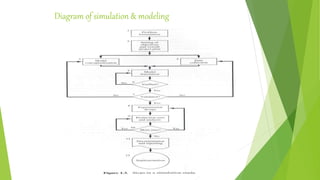
Example for process Model
Diagram of simulation & modeling
Modeling ---
 Disadvantages:
 Higher software cost .
 Additional training required.
 Limited portability.
 Advantages:
 Standard features often needed .
 Shorter development cycle .
 Very readable code.
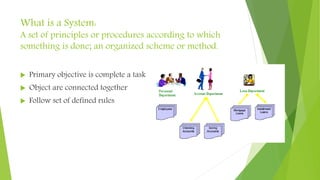
What is a System:
A set of principles or procedures according to which
something is done; an organized scheme or method.
 Primary objective is complete a task
 Object are connected together
 Follow set of defined rules
System Environment ---
where all the system objects are grouped together to accomplish
the task.
System Boundary:
System boundary are something to detect
whether the changes occurs inside the system
or outside the system
Types of System:
There are two types of system.
 Discrete System
 Continuous System
What system made of:
Some important key concept of a system is given below
 Entity
 Attribute
 Activity
 State
 Event
 Endogenous
 Exogenous
Entity:
Entityis a real world object in the system
Attribute:
A property of an entity
Activity:
A time period or task which is done of specified length.
State:
The collection of variables necessary to describe the system at any time
Event:
An sudden occurrence that may change the state of the system.
Endogenous:
Endogenous describe activities and events occurring within a system.
Exogenous
Exogenous describe activities and events in
an environment that affect the system

Introduction to simulation and modeling

  • 1.
  • 2.
  • 3.
    Group Member: Name ID DebashishKumer Shingho 123-15- 2054 Md. Saddam Hossain 123-15-2010 MST.Eshita Katun 123-15-2081 Antim 123-15-2162
  • 4.
    Importance of simulation& Systemwith model
  • 5.
    Originof simulation word--- Middle English simulacion & Latin simulātiōn- (stem of simulātiō)
  • 6.
    Simulation ---? Simulation modelingis the process of creating and analyzing a digital prototype of a physical model to predict its performance in the real world. Simulation modeling is used to help designers and engineers understand whether, under what conditions, and in which ways a part could fail and what loads it can withstand.
  • 7.
    Simulation in Computerscience--- simulation has some specialized meanings – Alan Turing used the term "simulation" to refer to what happens when a universal machine executes a state transition table that describes the state transitions, inputs and outputs of a subject discrete-state machine.
  • 8.
    SimulationModeling Workflow--- Use a2D or 3D CAD tool to develop a virtual model, also known as a digital prototype Generate a 2D or 3D mesh for analysis calculations. Define finite element analysis data based on analysis type. Perform finite element analysis, review results, and make engineering judgments based on results.
  • 9.
    Simulationis Needed  experimentwith new designs or policies prior to implementation  can be used to verify analytic solutions  different capabilities for a machine, requirements can be determined.  designed for training allow learning without the cost and disruption of on-the-job learning. Simulation is not Needed  problem can be solved using common sense  simulation costs exceed the savings  Resources or time are not available  system behavior is too complex or can’t be defined.  isn’t the ability to verify and validate the model.
  • 10.
    Why is Modelingand Simulation Important in Engineering?  Unavailable input and output.  Experiment may be too dangerous.  Cost of experimentation might be too high.  Time constants of the system may not be compatible with human dimensions.  Experimental behavior might be obscured by disturbances.
  • 11.
    Advantage:  New polices,operating procedures, decision rules, information flows, organizational procedures.  New hardware designs, physical layouts, transportation systems.  Hypotheses about how or why certain phenomena occur can be tested for feasibility.  Insight can be obtained about the interaction of variables.  Insight can be obtained about the importance of variables to the performance of the system.
  • 12.
  • 13.
    Disadvantages: There are disadvantagesin using a simulation model:-  We have a poor understanding of how some physical systems work so that we do not have sufficient data to produce a mathematical model. For this reason it has not been possible to create simulations that can accurately predict the occurrence and effects of earthquakes and tsunami.  The formula and functions that are used may not provide an accurate description of the system resulting in inaccurate output from the simulation.  Complex simulations can require the use of a computer system with a fast processor and large amounts of memory.  Simulation results may be difficult to interpret.  Simulation modeling and analysis can be time consuming and expensive.
  • 14.
  • 15.
    What is Model? •Representationof a real or theoretical System. •Simplification of the System. •Understanding of the System.
  • 16.
    Why we needmodeling ?  Cost effective way to represent a real-world system.  Key aspects of the system, components.  And how those components communicate with one another.  To test designs before implementation.
  • 17.
    Model Types • VisualModels : Graphical sketches, Computer solid models  Physical Models: Prototypes, mock-ups, structural models. • Logical Models : Algebraic and different equation used for computer simulation.  Empirical Models: Relationship between variables.

  • 18.
    Deterministic Simulation Models •A model that does not contain probability. • Every run will result the same. • Single run is enough to evaluate the result.
  • 19.
    Stochastic Simulation Models •A model that contains probability. using random numbers.  Every run will result differently. • Multiple runs are required to evaluate the results.
  • 20.
    Define An AchievableGoal To model the…” is NOT a goal! “To model the…in order to select/determine feasibility/…is a goal. Goal selection is not cast in concrete Goals change with increasing insight
  • 21.
  • 22.
  • 23.
    Modeling ---  Disadvantages: Higher software cost .  Additional training required.  Limited portability.  Advantages:  Standard features often needed .  Shorter development cycle .  Very readable code.
  • 24.
    What is aSystem: A set of principles or procedures according to which something is done; an organized scheme or method.  Primary objective is complete a task  Object are connected together  Follow set of defined rules
  • 25.
    System Environment --- whereall the system objects are grouped together to accomplish the task. System Boundary: System boundary are something to detect whether the changes occurs inside the system or outside the system
  • 26.
    Types of System: Thereare two types of system.  Discrete System  Continuous System
  • 27.
    What system madeof: Some important key concept of a system is given below  Entity  Attribute  Activity  State  Event  Endogenous  Exogenous
  • 28.
    Entity: Entityis a realworld object in the system
  • 29.
  • 30.
    Activity: A time periodor task which is done of specified length.
  • 31.
    State: The collection ofvariables necessary to describe the system at any time
  • 32.
    Event: An sudden occurrencethat may change the state of the system.
  • 33.
    Endogenous: Endogenous describe activitiesand events occurring within a system. Exogenous Exogenous describe activities and events in an environment that affect the system