Simulation
Navjeevan institute of management,Nashik
Name- Aadeshkumar Vijay Bhosale
Subject- Decision Sciences[302]
Class –MBA II
Guided by- Ms. Prajakta Shirode
SIMULATION
A simulation imitates the operation of real world processes or systems with the use of models.
The model represents the key behaviours and characteristics of the selected process or system
while the simulation represents how the model evolves under different conditions over time.
Simulations are usually computer-based, using a software-generated model to provide support
for the decisions of managers and engineers as well as for training purposes. Simulation
techniques aid understanding and experimentation, as the models are both visual and
interactive.
Simulation systems include discrete event simulation, process simulation and dynamic
simulation. Businesses may use all of these systems across different levels of the organisation.
Simulation Introduction
A simulation is a model that mimics the operation of an existing or proposed system, providing
evidence for decision-making by being able to test different scenarios or process changes. This
can be coupled with virtual reality technologies for a more immersive experience.
Simulations can be used to tune up performance, optimise a process, improve safety, testing
theories, training staff and even for entertainment in video games! Scientifically modelling
systems allows a user to gain an insight into the effects of different conditions and courses of
action.
Simulation can also be used when the real system is inaccessible or too dangerous to assess or
when a system is still in the design or theory stages.
Key to any simulation is the information that is used to build the simulation model and protocols
for the verification and validation of models are still being researched and refined, particularly
with regard to computer simulation.
Simulation Works
Simulation works through the use of intuitive simulation software to create a visual mock-up of
a process. This visual simulation should include details of timings, rules, resources and
constraints, to accurately reflect the real-world process.
This can be applied to a range of scenarios, for example, you can model a supermarket and the
likely behaviours of customers as they move around the shop as it becomes busier. This can
inform decisions including staffing requirements, shop floor layout, and supply chain needs.
Another example would be a manufacturing environment where different parts of the line can
be simulated to assess how their processes interact with those of others. This can provide an
overview of how the entire system will perform in order to devise innovative methods to
improve performance.
Advantages
 Less Financial Risk
 Exact Repeated Testing
 Examine Long-Term Impacts
 Gain Insights for Process Improvement
 Assess Random Events
 Test Non-Standard Distributions
 Encourages In-Depth Thinking
 Improve Stakeholder Buy-In
Limitations
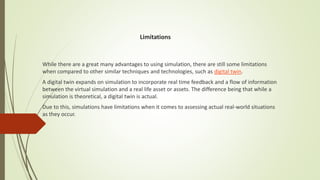
While there are a great many advantages to using simulation, there are still some limitations
when compared to other similar techniques and technologies, such as digital twin.
A digital twin expands on simulation to incorporate real time feedback and a flow of information
between the virtual simulation and a real life asset or assets. The difference being that while a
simulation is theoretical, a digital twin is actual.
Due to this, simulations have limitations when it comes to assessing actual real-world situations
as they occur.
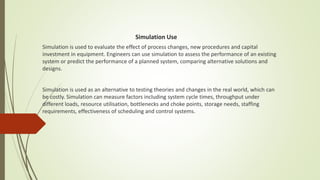
Simulation Use
Simulation is used to evaluate the effect of process changes, new procedures and capital
investment in equipment. Engineers can use simulation to assess the performance of an existing
system or predict the performance of a planned system, comparing alternative solutions and
designs.
Simulation is used as an alternative to testing theories and changes in the real world, which can
be costly. Simulation can measure factors including system cycle times, throughput under
different loads, resource utilisation, bottlenecks and choke points, storage needs, staffing
requirements, effectiveness of scheduling and control systems.
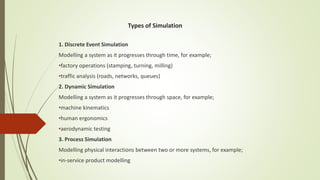
Types of Simulation
1. Discrete Event Simulation
Modelling a system as it progresses through time, for example;
•factory operations (stamping, turning, milling)
•traffic analysis (roads, networks, queues)
2. Dynamic Simulation
Modelling a system as it progresses through space, for example;
•machine kinematics
•human ergonomics
•aerodynamic testing
3. Process Simulation
Modelling physical interactions between two or more systems, for example;
•in-service product modelling
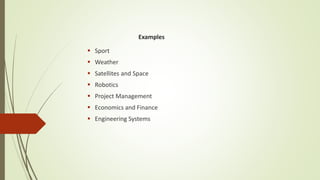
Examples
 Sport
 Weather
 Satellites and Space
 Robotics
 Project Management
 Economics and Finance
 Engineering Systems
Thank You

Simulation.pptx

  • 1.
    Simulation Navjeevan institute ofmanagement,Nashik Name- Aadeshkumar Vijay Bhosale Subject- Decision Sciences[302] Class –MBA II Guided by- Ms. Prajakta Shirode
  • 2.
    SIMULATION A simulation imitatesthe operation of real world processes or systems with the use of models. The model represents the key behaviours and characteristics of the selected process or system while the simulation represents how the model evolves under different conditions over time. Simulations are usually computer-based, using a software-generated model to provide support for the decisions of managers and engineers as well as for training purposes. Simulation techniques aid understanding and experimentation, as the models are both visual and interactive. Simulation systems include discrete event simulation, process simulation and dynamic simulation. Businesses may use all of these systems across different levels of the organisation.
  • 3.
    Simulation Introduction A simulationis a model that mimics the operation of an existing or proposed system, providing evidence for decision-making by being able to test different scenarios or process changes. This can be coupled with virtual reality technologies for a more immersive experience. Simulations can be used to tune up performance, optimise a process, improve safety, testing theories, training staff and even for entertainment in video games! Scientifically modelling systems allows a user to gain an insight into the effects of different conditions and courses of action. Simulation can also be used when the real system is inaccessible or too dangerous to assess or when a system is still in the design or theory stages. Key to any simulation is the information that is used to build the simulation model and protocols for the verification and validation of models are still being researched and refined, particularly with regard to computer simulation.
  • 4.
    Simulation Works Simulation worksthrough the use of intuitive simulation software to create a visual mock-up of a process. This visual simulation should include details of timings, rules, resources and constraints, to accurately reflect the real-world process. This can be applied to a range of scenarios, for example, you can model a supermarket and the likely behaviours of customers as they move around the shop as it becomes busier. This can inform decisions including staffing requirements, shop floor layout, and supply chain needs. Another example would be a manufacturing environment where different parts of the line can be simulated to assess how their processes interact with those of others. This can provide an overview of how the entire system will perform in order to devise innovative methods to improve performance.
  • 5.
    Advantages  Less FinancialRisk  Exact Repeated Testing  Examine Long-Term Impacts  Gain Insights for Process Improvement  Assess Random Events  Test Non-Standard Distributions  Encourages In-Depth Thinking  Improve Stakeholder Buy-In
  • 6.
    Limitations While there area great many advantages to using simulation, there are still some limitations when compared to other similar techniques and technologies, such as digital twin. A digital twin expands on simulation to incorporate real time feedback and a flow of information between the virtual simulation and a real life asset or assets. The difference being that while a simulation is theoretical, a digital twin is actual. Due to this, simulations have limitations when it comes to assessing actual real-world situations as they occur.
  • 7.
    Simulation Use Simulation isused to evaluate the effect of process changes, new procedures and capital investment in equipment. Engineers can use simulation to assess the performance of an existing system or predict the performance of a planned system, comparing alternative solutions and designs. Simulation is used as an alternative to testing theories and changes in the real world, which can be costly. Simulation can measure factors including system cycle times, throughput under different loads, resource utilisation, bottlenecks and choke points, storage needs, staffing requirements, effectiveness of scheduling and control systems.
  • 8.
    Types of Simulation 1.Discrete Event Simulation Modelling a system as it progresses through time, for example; •factory operations (stamping, turning, milling) •traffic analysis (roads, networks, queues) 2. Dynamic Simulation Modelling a system as it progresses through space, for example; •machine kinematics •human ergonomics •aerodynamic testing 3. Process Simulation Modelling physical interactions between two or more systems, for example; •in-service product modelling
  • 9.
    Examples  Sport  Weather Satellites and Space  Robotics  Project Management  Economics and Finance  Engineering Systems
  • 10.