Modelling and Simulation3.5 Science and the Environment
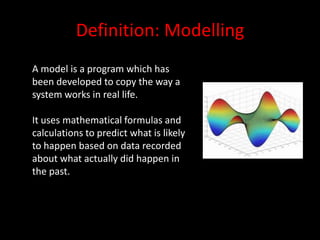
Definition: ModellingA model is a program which has been developed to copy the way a system works in real life.It uses mathematical formulas and calculations to predict what is likely to happen based on data recorded about what actually did happen in the past.
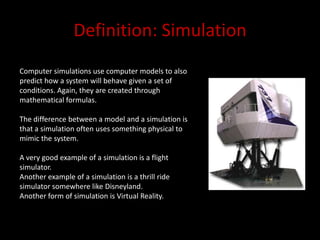
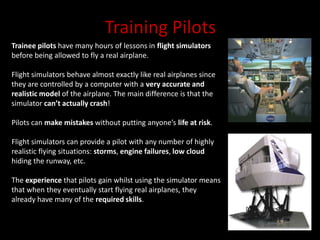
Definition: SimulationComputer simulations use computer models to also predict how a system will behave given a set of conditions. Again, they are created through mathematical formulas.The difference between a model and a simulation is that a simulation often uses something physical to mimic the system.A very good example of a simulation is a flight simulator.Another example of a simulation is a thrill ride simulator somewhere like Disneyland.Another form of simulation is Virtual Reality.
Why are models used?To test a system without having to create the system for real (Building real-life systems can be expensive, and take a long time)To predict what might happen to a system in the future (An accurate model allows us to go forward in virtual time to see what the system will be doing in the future)To train people to use a system without putting them at risk (Learning to fly an airplane is very difficult and mistake will be made. In a real plane mistakes could be fatal!)To investigate a system in great detail (A model of a system can be zoomed in/out or rotated. Time can be stopped, rewound, etc.)
DisadvantagesThe results depend on how good the model is and how much data was used to create it in the first place.
Models and simulations can't ever completely re-create real-life situations.
Not every possible situation may have been included in the model.
The equipment and software are expensive to purchase.
Staff need to be trained how to use the software and equipment. Examples of Computer Modelling
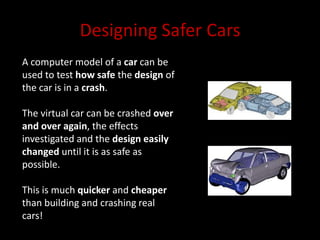
Designing Safer CarsA computer model of a car can be used to test how safe the design of the car is in a crash.The virtual car can be crashed over and over again, the effects investigated and the design easily changed until it is as safe as possible. This is much quicker and cheaper than building and crashing real cars!
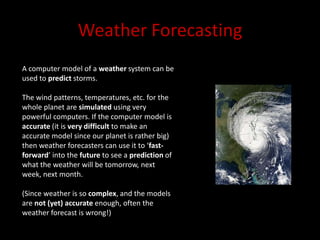
Weather ForecastingA computer model of a weather system can be used to predict storms.The wind patterns, temperatures, etc. for the whole planet are simulated using very powerful computers. If the computer model is accurate (it is very difficult to make an accurate model since our planet is rather big) then weather forecasters can use it to ‘fast-forward’ into the future to see a prediction of what the weather will be tomorrow, next week, next month. (Since weather is so complex, and the models are not (yet) accurate enough, often the weather forecast is wrong!)

Modelling and simulation

  • 1.
    Modelling and Simulation3.5Science and the Environment
  • 2.
    Definition: ModellingA modelis a program which has been developed to copy the way a system works in real life.It uses mathematical formulas and calculations to predict what is likely to happen based on data recorded about what actually did happen in the past.
  • 3.
    Definition: SimulationComputer simulationsuse computer models to also predict how a system will behave given a set of conditions. Again, they are created through mathematical formulas.The difference between a model and a simulation is that a simulation often uses something physical to mimic the system.A very good example of a simulation is a flight simulator.Another example of a simulation is a thrill ride simulator somewhere like Disneyland.Another form of simulation is Virtual Reality.
  • 4.
    Why are modelsused?To test a system without having to create the system for real (Building real-life systems can be expensive, and take a long time)To predict what might happen to a system in the future (An accurate model allows us to go forward in virtual time to see what the system will be doing in the future)To train people to use a system without putting them at risk (Learning to fly an airplane is very difficult and mistake will be made. In a real plane mistakes could be fatal!)To investigate a system in great detail (A model of a system can be zoomed in/out or rotated. Time can be stopped, rewound, etc.)
  • 5.
    DisadvantagesThe results dependon how good the model is and how much data was used to create it in the first place.
  • 6.
    Models and simulationscan't ever completely re-create real-life situations.
  • 7.
    Not every possiblesituation may have been included in the model.
  • 8.
    The equipment andsoftware are expensive to purchase.
  • 9.
    Staff need tobe trained how to use the software and equipment. Examples of Computer Modelling
  • 10.
    Designing Safer CarsAcomputer model of a car can be used to test how safe the design of the car is in a crash.The virtual car can be crashed over and over again, the effects investigated and the design easily changed until it is as safe as possible. This is much quicker and cheaper than building and crashing real cars!
  • 11.
    Weather ForecastingA computermodel of a weather system can be used to predict storms.The wind patterns, temperatures, etc. for the whole planet are simulated using very powerful computers. If the computer model is accurate (it is very difficult to make an accurate model since our planet is rather big) then weather forecasters can use it to ‘fast-forward’ into the future to see a prediction of what the weather will be tomorrow, next week, next month. (Since weather is so complex, and the models are not (yet) accurate enough, often the weather forecast is wrong!)