Guidelines
3
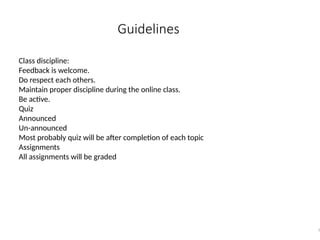
Class discipline:
Feedback iswelcome.
Do respect each others.
Maintain proper discipline during the online class.
Be active.
Quiz
Announced
Un-announced
Most probably quiz will be after completion of each topic
Assignments
All assignments will be graded
4.
Course Learning Outcome(CLO)
4
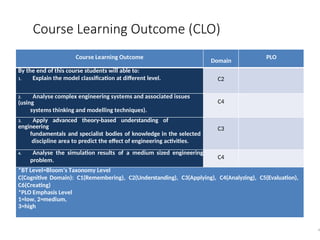
Course Learning Outcome
Domain
PLO
By the end of this course students will able to:
1. Explain the model classification at different level. C2
2. Analyse complex engineering systems and associated issues
(using
systems thinking and modelling techniques).
C4
3. Apply advanced theory-based understanding of
engineering
fundamentals and specialist bodies of knowledge in the selected
discipline area to predict the effect of engineering activities.
C3
4. Analyse the simulation results of a medium sized engineering
problem. C4
*BT Level=Bloom’s Taxonomy Level
C(Cognitive Domain): C1(Remembering), C2(Understanding), C3(Applying), C4(Analyzing), C5(Evaluation),
C6(Creating)
*PLO Emphasis Level
1=low, 2=medium,
3=high
5.
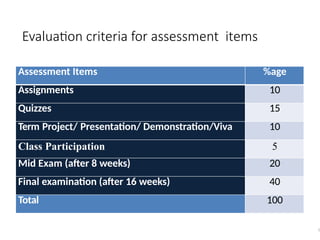
Evaluation criteria forassessment items
5
Assessment Items %age
Assignments 10
Quizzes 15
Term Project/ Presentation/ Demonstration/Viva 10
Class Participation 5
Mid Exam (after 8 weeks) 20
Final examination (after 16 weeks) 40
Total 100
6.
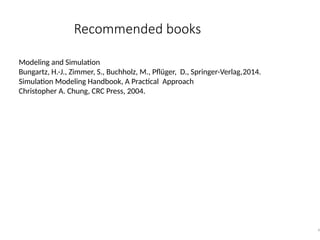
Recommended books
6
Modeling andSimulation
Bungartz, H.-J., Zimmer, S., Buchholz, M., Pflüger, D., Springer-Verlag,2014.
Simulation Modeling Handbook, A Practical Approach
Christopher A. Chung, CRC Press, 2004.
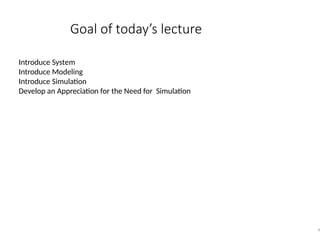
Goal of today’slecture
8
Introduce System
Introduce Modeling
Introduce Simulation
Develop an Appreciation for the Need for Simulation
9.
What is System
9
System
Theterm system is derive from the Greek word systema, which means an organized
relationship among functioning units or components.
System exists because it is designed to reach one or more
goals
We come into daily contact with the transportation system, the telephone system,
the accounting system, the production system, and for two decades the computer
system
There are more than a hundred definitions of the word system, but most seem to
have a common thread that suggests that a system is an orderly grouping of
interdependent components linked together according to a plan to reach a specific
goal
e.g. computer system, banking system, bus ticking system, etc.
10.
What is System(cont.)
10
The study of the systems concepts, then, has three basic implications:
A system must be designed to reach a predetermined goal
Interrelationships and interdependence must exist among the components
The goals of the organization as a whole have a higher priority than the goals of its
subsystems
11.
What is System(cont.)
11
Entity
An object of interest in the system
e.g. different software
Attribute
a property of an entity
E.g. version of the software
Activity
Represents a time period of specified length.
Collection of operations that transform the state of an entity
e.g. executing the software
12.
What is System(cont.)
12
Event
change in the system state
E.g., shutting down the computer
State Variables
Define the state of the system
Can restart simulation from state variables
E.g., computer is in sleep mode
13.
What is Modeling
13
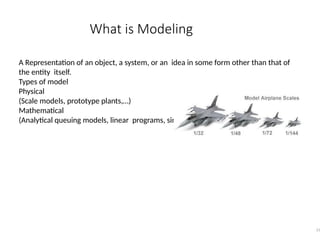
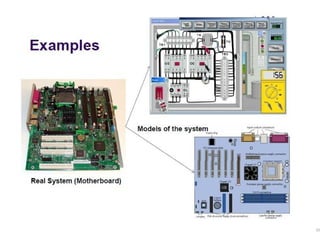
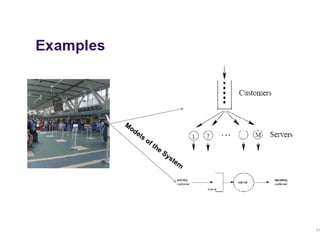
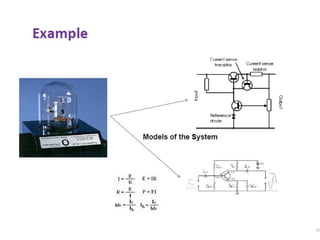
ARepresentation of an object, a system, or an idea in some form other than that of
the entity itself.
Types of model
Physical
(Scale models, prototype plants,…)
Mathematical
(Analytical queuing models, linear programs, simulation)
14.
What is Simulation
14
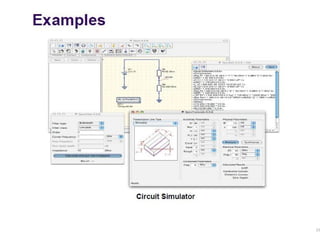
ASimulation of a system is the operation of a model, which is a representation of
that system
In another word simulation is an imitation of the reality
Simulation has long been used by the researchers, analysts, designers and other
professionals in the physical and non-physical experimentations and investigations
15.
Why Simulation?
15
It maybe too hard, hazardous, or expensive to observe a real, operational system
The operation of the model can be studied, and, from this, properties concerning
the behavior of the actual system can be inferred
Uses of simulations
Analyze systems before they are built
Reduce number of design mistakes
Optimize design
Analyze operational systems
Create virtual surroundingss for training, entertainment
16.
When to useSimulation?
16
Over the years tremendous developments have taken place in computing capabilities
and in special purpose simulation languages, and in simulation methodologies.
The use of simulation techniques has also become widespread.
Following are some of the purposes for which simulation may be used.
Simulation is very useful for experiments with the internal interactions of a complex
system, or of a subsystem within a complex system.
Simulation can be employed to experiment with new designs and policies, before
implementing
Simulation can be used to verify the results obtained by analytical methods and
reinforce the analytical techniques.
Simulation is very useful in determining the influence of changes in variables on the
input output of the system.
Simulation helps in suggesting modifications in the system under investigation for its
optimal performance.
Types of SimulationModels (cont.)
18
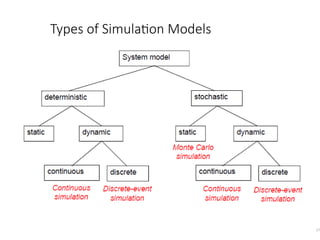
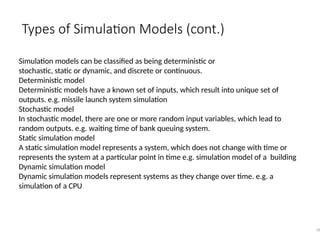
Simulation models can be classified as being deterministic or
stochastic, static or dynamic, and discrete or continuous.
Deterministic model
Deterministic models have a known set of inputs, which result into unique set of
outputs. e.g. missile launch system simulation
Stochastic model
In stochastic model, there are one or more random input variables, which lead to
random outputs. e.g. waiting time of bank queuing system.
Static simulation model
A static simulation model represents a system, which does not change with time or
represents the system at a particular point in time e.g. simulation model of a building
Dynamic simulation model
Dynamic simulation models represent systems as they change over time. e.g. a
simulation of a CPU
19.
Types of SimulationModels (cont.)
19
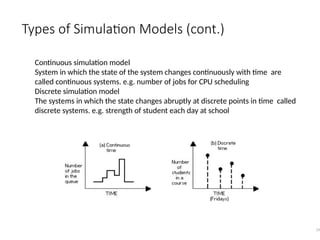
Continuous simulation model
System in which the state of the system changes continuously with time are
called continuous systems. e.g. number of jobs for CPU scheduling
Discrete simulation model
The systems in which the state changes abruptly at discrete points in time called
discrete systems. e.g. strength of student each day at school
Steps In Simulationand Model Building
24
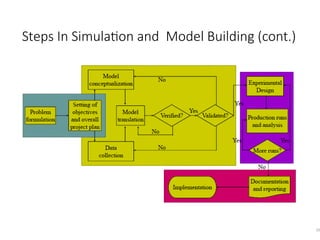
Define an achievable goal
Put together a complete mix of skills on the team
Involve the end-user
Choose the suitable simulation tools
Model the suitable level(s) of detail
Start early to collect the necessary input data
25.
Steps In Simulationand Model Building (cont.)
25
Provide adequate and on-going documentation
Develop a plan for adequate model checking
(Did we get the “right answers ?”)
Develop a plan for model making sure (Did we ask the “right questions ?”)
Develop a plan for statistical output study
Define An AchievableGoal
27
“To model the…” is NOT a goal!
“To model the…in order to select/determine feasibility/…is a goal.
Goal selection is not cast in concrete
Goals change with increasing insight
28.
Put together acomplete mix
of skills on the team
28
We Need:
Knowledge of the system under investigation
System analyst skills (model formulation)
Model building skills (model Programming)
Data collection skills
Statistical skills (input data representation)
29.
Put together acomplete mix of skills
on the team (cont.)
29
We Need:
More statistical skills (output data study)
Even more statistical skills (design of experiments)
Management skills (to get everyone pulling in the same direction)
30.
Involve end user
30
Modelingis a selling job!
Does anyone believe the results?
Will anyone put the results into action?
The End-user (your customer) can (and must) do all of the above BUT, first he
must be convinced!
He must believe it is HIS Model!
31.
Choose The SuitableSimulation Tools
31
Assuming Simulation is the suitable means, three alternatives exist:
Build Model in a General Purpose Language
Build Model in a General Simulation Language
Use a Special Purpose Simulation Package
32.
Modeling with generalpurpose languages
32
1. C, C++, Java
– Object-oriented programming language
Benefits
Little or no additional software cost
Universally available (portable)
No additional training (Everybody knows…(language X) ! )
Disbenefits
Every model starts from scratch
Very little reusable code
Long development cycle for each model
Hard checking phase
33.
Modeling with generalsimulation languages
33
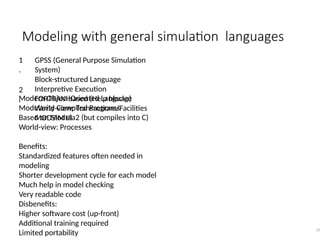
1
.
2
.
GPSS (General Purpose Simulation
System)
Block-structured Language
Interpretive Execution
FORTRAN-based (Help blocks)
World-view: Transactions/Facilities
MODSIM III
Modern Object-Oriented Language
Modularity Compiled Programs
Based on Modula2 (but compiles into C)
World-view: Processes
Benefits:
Standardized features often needed in
modeling
Shorter development cycle for each model
Much help in model checking
Very readable code
Disbenefits:
Higher software cost (up-front)
Additional training required
Limited portability
34.
Modeling with specialpurpose simulation
languages
34
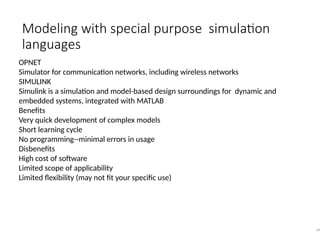
OPNET
Simulator for communication networks, including wireless networks
SIMULINK
Simulink is a simulation and model-based design surroundings for dynamic and
embedded systems, integrated with MATLAB
Benefits
Very quick development of complex models
Short learning cycle
No programming--minimal errors in usage
Disbenefits
High cost of software
Limited scope of applicability
Limited flexibility (may not fit your specific use)
35.
Model the suitablelevel(s) of detail
35
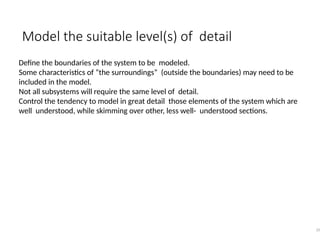
Define the boundaries of the system to be modeled.
Some characteristics of “the surroundings” (outside the boundaries) may need to be
included in the model.
Not all subsystems will require the same level of detail.
Control the tendency to model in great detail those elements of the system which are
well understood, while skimming over other, less well- understood sections.
36.
Start early tocollect the necessary input data
36
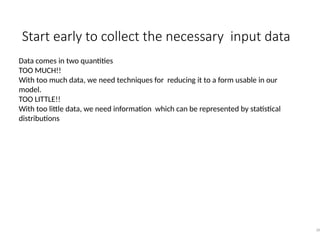
Data comes in two quantities
TOO MUCH!!
With too much data, we need techniques for reducing it to a form usable in our
model.
TOO LITTLE!!
With too little data, we need information which can be represented by statistical
distributions
37.
Provide adequate andon-going
documentation
37
In general, programmers hate to document. (They love to program!)
What can we do?
Insist on built-in user instructions(help screens)
Set (or insist on) standards for coding style
38.
Develop plan foradequate model checking
38
Did we get the “right answers?”
Simulation provides something that no other technique does
Step by step tracing of the model execution.
This provides a very natural way of checking the internal consistency of the model
39.
Develop a planfor model making sure
39
VALIDATION
“Doing the right thing” Or “Asking the right questions”
How do we know our model represents the system under investigation?
Compare to existing system?
Deterministic Case?
40.
Benefits of Simulation
40
Simulationhelps to learn about real system, without having the system at all. For
example the wind tunnel testing of the model of an aero plane does not require a
full sized plane
Many managerial decision making problems are too complex to be solved by
mathematical programming
In many situations experimenting with actual system may not be possible at all. For
example, it is not possible to conduct experiment, to study the behavior of a man on
the surface of moon.
In some other situations, even if experimentation is possible, it may be too costly
and risky.
41.
Benefits of Simulation(cont.)
41
In the real system, the changes we want to study may take place too slowly or too fast
to be observed conveniently.
Computer simulation can compress the performance of a system over years into a few
minutes of computer running time
Conversely, in systems like nuclear reactors where millions of events take place per
second, simulation can expand the time to required level
42.
Benefits of Simulation(cont.)
42
Through simulation, management can foresee the hardies and bottlenecks, which
may come up due to the introduction of new machines, equipment's and processes.
It thus eliminates the need of costly trial and error method of trying out the
new concepts
Simulation being relatively free from mathematics can easily be understood by the
operating personnel and non-technical managers. This helps in getting the proposed
plans accepted and implemented.
Simulation Models are comparatively flexible and can be modified to accommodate
the changing surroundings to the real situation.
43.
Benefits of Simulation(cont.)
43
Extensive computer software packages are available, making it very convenient to
use fairly sophisticated simulation models.
Simulation is a very good tool of training and has benefitously been used for
training the operating and managerial staff in the operation of complex system.
Space engineers simulate space flights in laboratories to train the future astronauts
for working in weightless surroundings.
Airline pilots are given extensive training on flight
simulators, before they are allowed to handle real planes.
44.
Disbenefits of Simulation
44
Modelbuilding requires special training. It is an art that is learned over time and
through experience. Furthermore, if two models are constructed by two competent
individuals, they may have similarities, but it is highly unlike that they will be the
same.
Simulation results may be hard to interpret. Since most simulation outputs are
essentially random variables, it may be hard to determine whether an observation is
a result of system interrelations or randomness.
Simulation is used in some cases when an analytical solution is possible, or even
preferable.
Simulation modeling and study can be time consuming and expensive.
45.
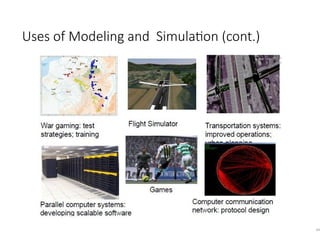
Uses of Modelingand Simulation
45
Manufacturing
Design study and optimization of production system, materials management, capacity
planning, layout planning, and performance evaluation, evaluation of process
quality.
Business
Market study, prediction of consumer behavior, and optimization of marketing
strategy and logistics, comparative evaluation of marketing campaigns.
46.
Uses of Modelingand Simulation (cont.)
46
Military
Testing of alternative combat strategies, air operations, sea operations, simulated
war exercises, practicing ordinance effectiveness, inventory management.
Healthcare uses
Planning of health services, expected patient density, facilities need, hospital
staffing , estimating the effectiveness of a health care program.
47.
Uses of Modelingand Simulation (cont.)
• Communication Uses
• Such as network design, and optimization, evaluating network
reliability, manpower planning, sizing of message buffers.
• Computer Uses
• Such as designing hardware configurations and operating system
protocols, sharing networking. Client/Server system architecture
• Economic uses
• Such as portfolio management, forecasting impact of Govt. Policies
and market on the international fluctuations economy. Budgeting and
forecasting market fluctuations.
47
48.
Uses of Modelingand Simulation (cont.)
48
Transportation uses
Design and testing of alternative transportation policies, transportation networks-
roads, railways, airways etc. Evaluation of timetables, traffic planning.
Environnent use
Solid waste management, performance evaluation of surroundingsal programs,
evaluation of pollution control systems.
Biological uses
Such as population genetics and spread of epidemics.
Business process Re-engineering
Integrating business process re-engineering with image –based work flow, using
process modeling and study tool.
Summary
50
Modeling and simulationis an important, widely used technique with a wide range
of uses
Computation power increases (Moore’s law) have made it more pervasive
In some cases, it has become essential (e.g., to be economically competitive)
Rich variety of types of models, uses, uses
Suitable methodologies required to protect against major mistakes.