Baselios Marthoma Mathews ii training college, 
Kottarakara 
ASSIGNMENT IN MATHEMATICS 
1 
2013-2014
2 
ASSIGNMENT 
Simulation in mathematics
Submitted by Submitted to 
Renjith S. Mrs. Prinsamma K. George 
13350007 Lect. In Mathematics Education 
Mathematics B. M. M II Training College, Kottarakara 
3 
Introduction 
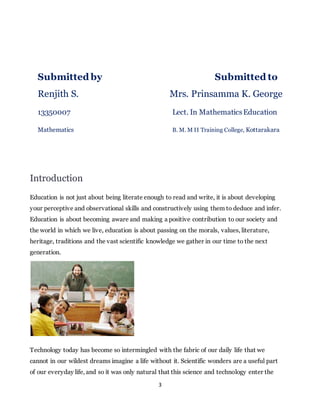
Education is not just about being literate enough to read and write, it is about developing 
your perceptive and observational skills and constructively using them to deduce and infer. 
Education is about becoming aware and making a positive contribution to our society and 
the world in which we live, education is about passing on the morals, values, literature, 
heritage, traditions and the vast scientific knowledge we gather in our time to the next 
generation. 
Technology today has become so intermingled with the fabric of our daily life that we 
cannot in our wildest dreams imagine a life without it. Scientific wonders are a useful part 
of our everyday life, and so it was only natural that this science and technology enter the
portals of the education realm too. Today, all modern schools have incorporated the use of 
Information and Communication Technology products as a complementary aid 
to effectively teaching the curriculum content and enhancing classroom practices all over 
the globe. 
Simulation 
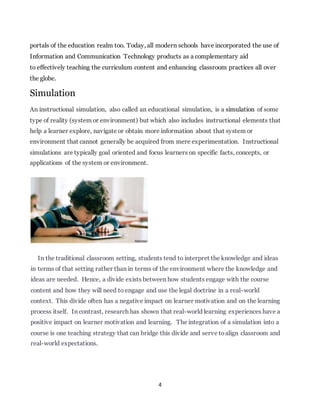
An instructional simulation, also called an educational simulation, is a simulation of some 
type of reality (system or environment) but which also includes instructional elements that 
help a learner explore, navigate or obtain more information about that system or 
environment that cannot generally be acquired from mere experimentation. Instructional 
simulations are typically goal oriented and focus learners on specific facts, concepts, or 
applications of the system or environment. 
In the traditional classroom setting, students tend to interpret the knowledge and ideas 
in terms of that setting rather than in terms of the environment where the knowledge and 
ideas are needed. Hence, a divide exists between how students engage with the course 
content and how they will need to engage and use the legal doctrine in a real-world 
context. This divide often has a negative impact on learner motivation and on the learning 
process itself. In contrast, research has shown that real-world learning experiences have a 
positive impact on learner motivation and learning. The integration of a simulation into a 
course is one teaching strategy that can bridge this divide and serve to align classroom and 
real-world expectations. 
4
5 
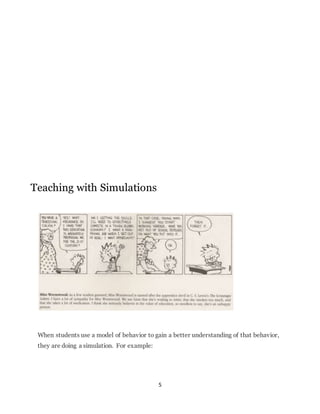
Teaching with Simulations 
When students use a model of behavior to gain a better understanding of that behavior, 
they are doing a simulation. For example:
 When students are assigned roles as buyers and sellers of some good and asked to 
strike deals to exchange the good, they are learning about market behavior by 
simulating a market. 
 When students take on the roles of party delegates to a political convention and run 
the model convention, they are learning about the election process by simulating a 
political convention. 
 When students create an electric circuit with an online program, they are learning 
about physics theory by simulating an actual physical set-up. 
 The Geometer’s Sketchpad is the world’s leading software for teaching 
mathematics. Sketchpad gives students at all levels—from third grade through 
college—a concrete, visual way to learn mathematics that increases their engagement, 
understanding, and achievement. It make math more meaningful and memorable 
using Sketchpad. 
Why Teach with Simulations? 
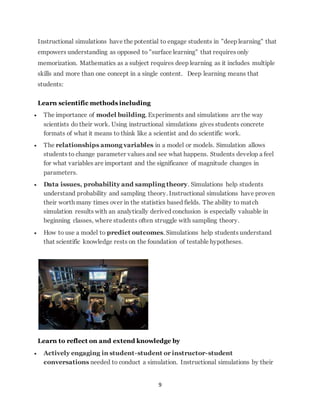
Instructional simulations have the potential to engage students in "deep learning" that 
empowers understanding as opposed to "surface learning" that requires only 
memorization. It helps in effective transaction of any subject, especially Mathematics. At 
secondary school level the most challenging subject need to be taught is Mathematics as 
it demands multiple skills and intelligence from the learning. It is every Mathematics 
teacher’s challenge that, how to keep the students engaged throughout the classroom 
6
interactions ensuring deep learning. Deep learning means that students: Learn 
scientific methods including, the importance of model building, the relationships 
among variables in a model or models, data issues, probability and sampling theory, 
how to use a model to predict outcomes. Learn to reflect on and extend 
knowledge by, actively engaging in student-student or instructor-student 
conversations needed to conduct a simulation, transferring knowledge to new problems 
and situations, understanding and refining their own though processes. seeing social 
processes and social interactions in action. 
What are Instructional Simulations? 
What Differentiates this Teaching Method? 
The key element that differentiates instructional simulation from other pedagogies is 
the formal specification of a conceptual structure with which students interact to learn 
about relationships between concepts. As Mathematics demands the ability of students 
to relate or connect more than one concept to reach the finding, Simulation can prove 
effective in teaching and learning Mathematics at any levels of learning. 
7
Different Disciplines have Different Simulations 
Every discipline treats the conceptual structure of the simulation differently. To 
economics and Mathematics, the conceptual structure is typically mathematical. In 
other words, simulation involves the specification of a mathematical model that is 
solved several times with different parameters to reveal relationships and illustrate 
concepts. To sociologists, the conceptual structure is typically sets of social interactions. 
To political scientists, the conceptual structure is often institutional. 
Simulations Vary in Style and Complexity 
Simulations may use computer programs that require only a portion of a single class 
period. More commonly, computer models require that students complete several 
assignments taking significant time or indeed even a large part of a course. Simulations 
range from attempts to duplicate complex social processes, such as a legislature, to very 
simple social interactions, such as making eye contact. These simulations may be 
conducted with computers, pencil-and-paper, or physical models of some natural 
phenomenon. Some work only with small classes. Some work with all class sizes. 
Why Teach with Simulations? 
Tell me, I forget. Show me, I remember. Involve me, I understand. _ 
Chinese Proverb 
This explains why simulations are important in teaching learning process. 
8 
Deep Learning
Instructional simulations have the potential to engage students in "deep learning" that 
empowers understanding as opposed to "surface learning" that requires only 
memorization. Mathematics as a subject requires deep learning as it includes multiple 
skills and more than one concept in a single content. Deep learning means that 
students: 
9 
Learn scientific methods including 
 The importance of model building. Experiments and simulations are the way 
scientists do their work. Using instructional simulations gives students concrete 
formats of what it means to think like a scientist and do scientific work. 
 The relationships among variables in a model or models. Simulation allows 
students to change parameter values and see what happens. Students develop a feel 
for what variables are important and the significance of magnitude changes in 
parameters. 
 Data issues, probability and sampling theory. Simulations help students 
understand probability and sampling theory. Instructional simulations have proven 
their worth many times over in the statistics based fields. The ability to match 
simulation results with an analytically derived conclusion is especially valuable in 
beginning classes, where students often struggle with sampling theory. 
 How to use a model to predict outcomes. Simulations help students understand 
that scientific knowledge rests on the foundation of testable hypotheses. 
Learn to reflect on and extend knowledge by 
 Actively engaging in student-student or instructor-student 
conversations needed to conduct a simulation. Instructional simulations by their
very nature cannot be passive learning. Students are active participants in selecting 
parameter values, anticipating outcomes, and formulating new questions to ask. 
 Transferring knowledge to new problems and situations. A well done 
simulation is constructed to include an extension to a new problem or new set of 
parameters that requires students to extend what they have learned in an earlier 
context. 
 Understanding and refining their own thought processes. A well done 
simulation includes a strong reflection summary that requires students to think 
about how and why they behaved as they did during the simulation. 
 Seeing social processes and social interactions in action. This is one of the 
most significant outcomes of simulation in social science disciplines such as 
sociology and political science. 
Examples of Simulations in Mathematics. 
As technology has swept in to different areas of education, role of technological aspects 
has great importance in Mathematics education too. There are several examples for 
simple simulations that are possible in Mathematics classrooms. This ranges from 
activities for Kindergarten till Secondary Education. A few of it is embedded here for 
reference. Teachers can create their own simulations in accordance to their classroom 
environment, if equipped with simple technological knowhow. 
http://www.nctm.org/eexamples/ 
http://mathforum.org/pcmi/hstp/resources/cerealbox/ 
10 
http://mathforum.org/escotpow/ 
http://www.horton.com/portfolio/MathSim/MathSim.html 
http://www.mathapprentice.com/ 
How to Teach with Simulations
11 
Instructor Preparation is Crucial 
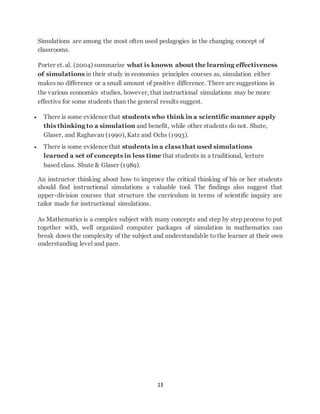
Lesson preparation varies with the type and complexity of the simulation. However, 
most expert users argue that instructional simulation work best when: 
 Instructors have a clear written statement in the course syllabus about the goals of 
the simulation and an explanation of how the simulation is tied to the course goals. 
 Instructors read ALL the supporting material for the simulation. 
 Instructors do a trial run of the simulation before assigning the simulation to 
students, when possible. 
 Instructors make sure that university laboratory facilities support the simulation 
when laboratory facilities are needed. 
 Instructors integrate instructional simulations with other pedagogies such 
as Cooperative Learning or Interactive Lecture Demonstration. 
Active Student Participation Is important
Students learn through instructional simulations when they are actively engaged. 
 Students should predict and explain the outcome they expect the simulation to 
12 
generate. 
 Every effort should be made to make it difficult for students to become passive 
during the simulation. Students must submit timely input and not rely on 
classmates to play for them. 
 Instructors should anticipate ways the simulation can go wrong and include this in 
their pre-simulation discussion with the class. 
Post –Simulation Discussion is Crucial 
Post-simulation discussion with students leads to deeper learning. The instructor 
should: 
 Provide sufficient time for students to reflect on and discuss what they learned from 
the simulation. 
 Integrate the course goals into the post-simulation discussion. 
 Ask students explicitly asked how the simulation helped them understand the 
course goals or how it may have made the goals more confusing. 
Conclusion
Simulations are among the most often used pedagogies in the changing concept of 
classrooms. 
Porter et. al. (2004) summarize what is known about the learning effectiveness 
of simulations in their study in economics principles courses as, simulation either 
makes no difference or a small amount of positive difference. There are suggestions in 
the various economics studies, however, that instructional simulations may be more 
effective for some students than the general results suggest. 
 There is some evidence that students who think in a scientific manner apply 
this thinking to a simulation and benefit, while other students do not. Shute, 
Glaser, and Raghavan (1990), Katz and Ochs (1993). 
 There is some evidence that students in a class that used simulations 
learned a set of concepts in less time that students in a traditional, lecture 
based class. Shute & Glaser (1989). 
An instructor thinking about how to improve the critical thinking of his or her students 
should find instructional simulations a valuable tool. The findings also suggest that 
upper-division courses that structure the curriculum in terms of scientific inquiry are 
tailor made for instructional simulations. 
As Mathematics is a complex subject with many concepts and step by step process to put 
together with, well organized computer packages of simulation in mathematics can 
break down the complexity of the subject and understandable to the learner at their own 
understanding level and pace. 
13
14 
Reference 
http://en.wikipedia.org/wiki/Simulation 
http://net.educause.edu/ir/library/pdf/erb1003.pdf 
http://www.creativeteachingsite.com/edusims.html 
http://web.stanford.edu/class/symbsys205/commentaryonsimulationineducation.htm 
http://www.journals.elsevier.com/mathematics-and-computers-in-simulation/ 
http://news.stanford.edu/news/2010/february15/devlin-aaas-mathematics- 
021910.html

online assignment

  • 1.
    Baselios Marthoma Mathewsii training college, Kottarakara ASSIGNMENT IN MATHEMATICS 1 2013-2014
  • 2.
  • 3.
    Submitted by Submittedto Renjith S. Mrs. Prinsamma K. George 13350007 Lect. In Mathematics Education Mathematics B. M. M II Training College, Kottarakara 3 Introduction Education is not just about being literate enough to read and write, it is about developing your perceptive and observational skills and constructively using them to deduce and infer. Education is about becoming aware and making a positive contribution to our society and the world in which we live, education is about passing on the morals, values, literature, heritage, traditions and the vast scientific knowledge we gather in our time to the next generation. Technology today has become so intermingled with the fabric of our daily life that we cannot in our wildest dreams imagine a life without it. Scientific wonders are a useful part of our everyday life, and so it was only natural that this science and technology enter the
  • 4.
    portals of theeducation realm too. Today, all modern schools have incorporated the use of Information and Communication Technology products as a complementary aid to effectively teaching the curriculum content and enhancing classroom practices all over the globe. Simulation An instructional simulation, also called an educational simulation, is a simulation of some type of reality (system or environment) but which also includes instructional elements that help a learner explore, navigate or obtain more information about that system or environment that cannot generally be acquired from mere experimentation. Instructional simulations are typically goal oriented and focus learners on specific facts, concepts, or applications of the system or environment. In the traditional classroom setting, students tend to interpret the knowledge and ideas in terms of that setting rather than in terms of the environment where the knowledge and ideas are needed. Hence, a divide exists between how students engage with the course content and how they will need to engage and use the legal doctrine in a real-world context. This divide often has a negative impact on learner motivation and on the learning process itself. In contrast, research has shown that real-world learning experiences have a positive impact on learner motivation and learning. The integration of a simulation into a course is one teaching strategy that can bridge this divide and serve to align classroom and real-world expectations. 4
  • 5.
    5 Teaching withSimulations When students use a model of behavior to gain a better understanding of that behavior, they are doing a simulation. For example:
  • 6.
     When studentsare assigned roles as buyers and sellers of some good and asked to strike deals to exchange the good, they are learning about market behavior by simulating a market.  When students take on the roles of party delegates to a political convention and run the model convention, they are learning about the election process by simulating a political convention.  When students create an electric circuit with an online program, they are learning about physics theory by simulating an actual physical set-up.  The Geometer’s Sketchpad is the world’s leading software for teaching mathematics. Sketchpad gives students at all levels—from third grade through college—a concrete, visual way to learn mathematics that increases their engagement, understanding, and achievement. It make math more meaningful and memorable using Sketchpad. Why Teach with Simulations? Instructional simulations have the potential to engage students in "deep learning" that empowers understanding as opposed to "surface learning" that requires only memorization. It helps in effective transaction of any subject, especially Mathematics. At secondary school level the most challenging subject need to be taught is Mathematics as it demands multiple skills and intelligence from the learning. It is every Mathematics teacher’s challenge that, how to keep the students engaged throughout the classroom 6
  • 7.
    interactions ensuring deeplearning. Deep learning means that students: Learn scientific methods including, the importance of model building, the relationships among variables in a model or models, data issues, probability and sampling theory, how to use a model to predict outcomes. Learn to reflect on and extend knowledge by, actively engaging in student-student or instructor-student conversations needed to conduct a simulation, transferring knowledge to new problems and situations, understanding and refining their own though processes. seeing social processes and social interactions in action. What are Instructional Simulations? What Differentiates this Teaching Method? The key element that differentiates instructional simulation from other pedagogies is the formal specification of a conceptual structure with which students interact to learn about relationships between concepts. As Mathematics demands the ability of students to relate or connect more than one concept to reach the finding, Simulation can prove effective in teaching and learning Mathematics at any levels of learning. 7
  • 8.
    Different Disciplines haveDifferent Simulations Every discipline treats the conceptual structure of the simulation differently. To economics and Mathematics, the conceptual structure is typically mathematical. In other words, simulation involves the specification of a mathematical model that is solved several times with different parameters to reveal relationships and illustrate concepts. To sociologists, the conceptual structure is typically sets of social interactions. To political scientists, the conceptual structure is often institutional. Simulations Vary in Style and Complexity Simulations may use computer programs that require only a portion of a single class period. More commonly, computer models require that students complete several assignments taking significant time or indeed even a large part of a course. Simulations range from attempts to duplicate complex social processes, such as a legislature, to very simple social interactions, such as making eye contact. These simulations may be conducted with computers, pencil-and-paper, or physical models of some natural phenomenon. Some work only with small classes. Some work with all class sizes. Why Teach with Simulations? Tell me, I forget. Show me, I remember. Involve me, I understand. _ Chinese Proverb This explains why simulations are important in teaching learning process. 8 Deep Learning
  • 9.
    Instructional simulations havethe potential to engage students in "deep learning" that empowers understanding as opposed to "surface learning" that requires only memorization. Mathematics as a subject requires deep learning as it includes multiple skills and more than one concept in a single content. Deep learning means that students: 9 Learn scientific methods including  The importance of model building. Experiments and simulations are the way scientists do their work. Using instructional simulations gives students concrete formats of what it means to think like a scientist and do scientific work.  The relationships among variables in a model or models. Simulation allows students to change parameter values and see what happens. Students develop a feel for what variables are important and the significance of magnitude changes in parameters.  Data issues, probability and sampling theory. Simulations help students understand probability and sampling theory. Instructional simulations have proven their worth many times over in the statistics based fields. The ability to match simulation results with an analytically derived conclusion is especially valuable in beginning classes, where students often struggle with sampling theory.  How to use a model to predict outcomes. Simulations help students understand that scientific knowledge rests on the foundation of testable hypotheses. Learn to reflect on and extend knowledge by  Actively engaging in student-student or instructor-student conversations needed to conduct a simulation. Instructional simulations by their
  • 10.
    very nature cannotbe passive learning. Students are active participants in selecting parameter values, anticipating outcomes, and formulating new questions to ask.  Transferring knowledge to new problems and situations. A well done simulation is constructed to include an extension to a new problem or new set of parameters that requires students to extend what they have learned in an earlier context.  Understanding and refining their own thought processes. A well done simulation includes a strong reflection summary that requires students to think about how and why they behaved as they did during the simulation.  Seeing social processes and social interactions in action. This is one of the most significant outcomes of simulation in social science disciplines such as sociology and political science. Examples of Simulations in Mathematics. As technology has swept in to different areas of education, role of technological aspects has great importance in Mathematics education too. There are several examples for simple simulations that are possible in Mathematics classrooms. This ranges from activities for Kindergarten till Secondary Education. A few of it is embedded here for reference. Teachers can create their own simulations in accordance to their classroom environment, if equipped with simple technological knowhow. http://www.nctm.org/eexamples/ http://mathforum.org/pcmi/hstp/resources/cerealbox/ 10 http://mathforum.org/escotpow/ http://www.horton.com/portfolio/MathSim/MathSim.html http://www.mathapprentice.com/ How to Teach with Simulations
  • 11.
    11 Instructor Preparationis Crucial Lesson preparation varies with the type and complexity of the simulation. However, most expert users argue that instructional simulation work best when:  Instructors have a clear written statement in the course syllabus about the goals of the simulation and an explanation of how the simulation is tied to the course goals.  Instructors read ALL the supporting material for the simulation.  Instructors do a trial run of the simulation before assigning the simulation to students, when possible.  Instructors make sure that university laboratory facilities support the simulation when laboratory facilities are needed.  Instructors integrate instructional simulations with other pedagogies such as Cooperative Learning or Interactive Lecture Demonstration. Active Student Participation Is important
  • 12.
    Students learn throughinstructional simulations when they are actively engaged.  Students should predict and explain the outcome they expect the simulation to 12 generate.  Every effort should be made to make it difficult for students to become passive during the simulation. Students must submit timely input and not rely on classmates to play for them.  Instructors should anticipate ways the simulation can go wrong and include this in their pre-simulation discussion with the class. Post –Simulation Discussion is Crucial Post-simulation discussion with students leads to deeper learning. The instructor should:  Provide sufficient time for students to reflect on and discuss what they learned from the simulation.  Integrate the course goals into the post-simulation discussion.  Ask students explicitly asked how the simulation helped them understand the course goals or how it may have made the goals more confusing. Conclusion
  • 13.
    Simulations are amongthe most often used pedagogies in the changing concept of classrooms. Porter et. al. (2004) summarize what is known about the learning effectiveness of simulations in their study in economics principles courses as, simulation either makes no difference or a small amount of positive difference. There are suggestions in the various economics studies, however, that instructional simulations may be more effective for some students than the general results suggest.  There is some evidence that students who think in a scientific manner apply this thinking to a simulation and benefit, while other students do not. Shute, Glaser, and Raghavan (1990), Katz and Ochs (1993).  There is some evidence that students in a class that used simulations learned a set of concepts in less time that students in a traditional, lecture based class. Shute & Glaser (1989). An instructor thinking about how to improve the critical thinking of his or her students should find instructional simulations a valuable tool. The findings also suggest that upper-division courses that structure the curriculum in terms of scientific inquiry are tailor made for instructional simulations. As Mathematics is a complex subject with many concepts and step by step process to put together with, well organized computer packages of simulation in mathematics can break down the complexity of the subject and understandable to the learner at their own understanding level and pace. 13
  • 14.
    14 Reference http://en.wikipedia.org/wiki/Simulation http://net.educause.edu/ir/library/pdf/erb1003.pdf http://www.creativeteachingsite.com/edusims.html http://web.stanford.edu/class/symbsys205/commentaryonsimulationineducation.htm http://www.journals.elsevier.com/mathematics-and-computers-in-simulation/ http://news.stanford.edu/news/2010/february15/devlin-aaas-mathematics- 021910.html