Master of Arts in
                     Teaching (MAT)
                     An Al-Quads University/Bard
                         College partnership


   “ Teaching as reflective practice ”
                      ‘presentation’
New Pedagogies on teaching science with computer simulation

                                   by
 Reyad Ibrahim @ Ghadeer Marmash
                           INSTRUCTOR:
Introduction
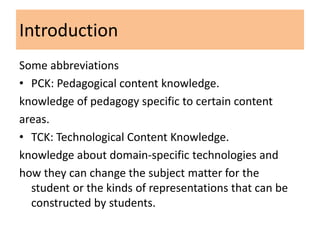
Some abbreviations
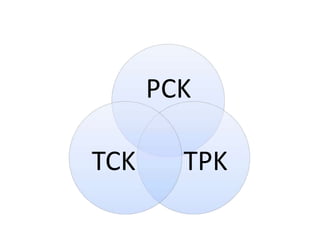
• PCK: Pedagogical content knowledge.
knowledge of pedagogy specific to certain content
areas.
• TCK: Technological Content Knowledge.
knowledge about domain-specific technologies and
how they can change the subject matter for the
  student or the kinds of representations that can be
  constructed by students.
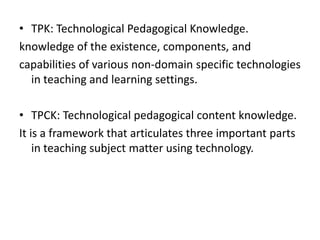
• TPK: Technological Pedagogical Knowledge.
knowledge of the existence, components, and
capabilities of various non-domain specific technologies
  in teaching and learning settings.

• TPCK: Technological pedagogical content knowledge.
It is a framework that articulates three important parts
    in teaching subject matter using technology.
PCK

TCK     TPK
• Computer Simulation:
Computer program that attempts to simulate a model
  of a particular system.
Aims of using computer simulation;
1. Manipulating a model and view how it will behave
   under certain conditions.
2. Visualize aspects of science that are too big or
   small.
3. Provide extreme situations to support thought
   experiment.
4. Testing of ideas
5. Provide extreme situations to support what If
   scenarios.
6. visualization of scientific phenomena have been
   associated with gains in conceptual understanding.
• Reports on teaching techniques using
  computer simulation are not enough.
• Pedagogical approach practiced by teachers
  strongly affect students learning outcomes.
• Most of computer simulations lack the
  capability to independently tutor the student
  on concepts, direct investigation or guide
  student inquiry.
Aims of the study
• To explicate pedagogy of teaching science with
  computer simulations.
Questions of the study
1. How does the teacher use computer simulations to
teach science?
2. What are the teaching heuristics that are central to the
teacher’s pedagogy with computer simulations?
a. What is the role of the teacher in a technology enhanced
environment?
b. What are the affordances of the computer simulation
technology for teaching science and when
should this technology be employed?
c. What are the perceived limitations of using
computer simulation technology to teach science?
3. What is the impact of teaching science with computer
simulations on the learners?
Methodology
Two parts of the case study
1. Experienced teacher’s general pedagogical
   approach was examined.
2. Teacher-student- computer simulation
   interaction was focused.
• A cyclic pattern in which student generated
   evaluated and modified hypothesis is
   revealed in this study.
• Why case study?
• It can fulfill the detailed requirements to fulfill
  the aims of the study.
• Because of its detailed analysis
• It permits more direct and frequently interplay
  between theory and data and closer matching of
  conceptual intent and empirical evidence.
• the ability to reveal the properties of the class to
  which the instance being studied belongs,
  produce new typologies, provide the basis for
  subsequent theory-development and test and
  generate and generate hypotheses.
• It’s suitable for research in complex settings where
  there is little control over behavior and organization
  or events.
• Research context
• Introductory chemistry course for university students
  in north American public university.
• The course has syllabus and electronic homework
  system.
• The teacher was an experienced science teacher,
  leader in chemistry and educational technology.
• Electronic classrooms with computer terminals each
  equipped with suites of multiple, compact,
  interactive modules.
•   Data gathering
•   Interview with teacher and students.
•   Intensive classroom observation for one year.
•   Student survey.

• Data analysis
• data were analyzed using mean statistics
with Excel.
• The qualitative data were analyzed using a
  constant comparative method which is an
  analytical approach that supports evaluation and
  reevaluation of hypotheses.
New Pedagogies on Teaching Science with Computer Simulations
Results and Discussion:

The first section of the results responds to research question :


1: what is the teacher’s approach to teaching science with computer simulations? This is
accomplished through an analysis of classroom observations, student survey, and
teacher interviews.


2: what are the heuristics central to the teacher’s pedagogy with computer simulations
and how does the teacher utilize the affordances of the simulation technology?


3: Finally, the results section concludes with data on the impact of teaching science with
computer simulations from the students’ points of view.
Teacher’s Use of Computer Simulations to Support GEM Cycles:

Computer simulations is not intended to replace the laboratories, but rather
represented the results of simulated lab experiments or the behavior of atoms of
molecules under conditions not observable with the eye.


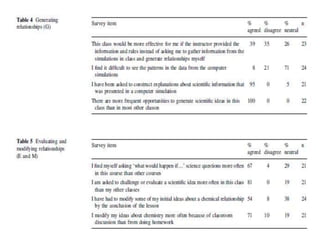
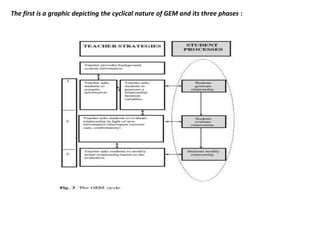
The general instructional approach was identified as generating (G), evaluating (E),
and modifying (M) (GEM) students’ models in chemistry.


G, E, and M occurred in three distinguishable phases or instructional segments
with the evaluation (E) and modification (M) instructional segments repeating
themselves in a cyclical fashion.
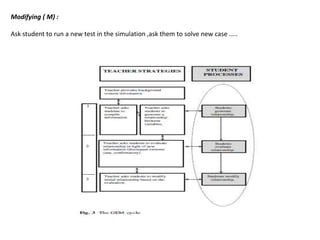
The first is a graphic depicting the cyclical nature of GEM and its three phases :
In one period of class, the teacher engaged in this pedagogical approach two times , for total of 52
time across 11 different topics in chemistry.

-Generating ( g ) : let’s go and just look at what the boiling points are for these things
 { ethanol and methanol }

Then students gather information from the simulation :
[ S ] :so ethanol between 78 and 79 degree- its boiling point,..so methanol is between 64 and 65
degrees. Using the computer simulation to locate the boiling points.

[ S ] as molecular weight increases, the boiling point increases --- this come by simulation by the
computer that generate a graph of molecular weight by boiling point.
Simulations during the Evaluation (E) and Modification (M) Phases :
Three major teacher activities:1- providing disconfirming information,2- providing extreme
cases,3- and providing confirming information.

 These teacher activities can be done by:

making comparisons, asking why questions, asking what’s wrong questions, making
predictions, considering new data points, designing a new test, see if it holds true, finding
more information and adding content information.

For an example of evaluation (E), the teacher stated in a lesson on intermolecular forces,

‘‘We want to use this *simulation+ to see if your trend there *referring to a hypothetical
relationship students had constructed: ‘As molecular weight increases the boiling point
increases’+ actually works for more than say two compounds.
’’ Students were encouraged by the teacher to examine a new computer simulation set
on organic boiling points in order to compare previous data with new data and to gauge
the scope of their hypothetical relationships. Students viewed a graph on the simulation
of selected alkanes and functional groups, by molecular weight and boiling point.

The simulation also showed a spherical model of the selected compound.

Based on the earlier relationship they had generated, students generally stated that they
expected that boiling points would increase as molecular weight increased.

This trend was evident in most cases, but compounds with functional groups that had the
capacity to hydrogen bond, such as hydroxyl and amine groups, had anomalously high
boiling points for their molecular weights, as displayed by the computer simulation.

Let student see graphs , colors, animations, why? What’s wrong?
Modifying ( M) :

Ask student to run a new test in the simulation ,ask them to solve new case …..
The Teacher’s TPCK: Affordances of Computer Simulations for Teaching Science:

The teacher was interviewed and asked about the affordances of computer simulations for
his approach to teaching science. His response to this set of questions were compiled, as
following;

A lot of the kinds of things we do with computer simulation could be done with pieces of
paper.

The thing that’s better about the computer part of it is, you can do a lot more exploring, so
*the computer simulation+ gives *students+ more control over what they’re going to look at,
as opposed to if I give them a sheet of paper with numbers on it. It’s like I’m going to look
at this information, I’m going to come to some conclusion, I’m going to look at some
more information, and I’m going to test those conclusions…. So when I throw up an
overhead, I’m doing the exploring and they *the students+ are explaining it. And that’s
okay, but when it’s a simulation and they are choosing things, then they are
doing the exploring much more. So it’s a control issue.
Teacher’s TPCK: When to Use Computer Simulations:
To further articulate the heuristics by which the teacher made decisions about
computer simulations in science, the teacher was asked about when computer
simulations should be used to teach science: [T]he time to be able to do it [begin to
use computer simulations+ is *when students+ know what it is they’re looking at.

  They need to know what the information is telling them in each data point by data
point instance, but the thing that they should not know before they start looking at it
is what the overall relationship and guiding principles are.

, but you would not use the simulation to get them to know what ionization energy is.

 they know a rough range of where it’s coming from,
 Then you give them the simulation, so they can look at trends in that thing …. They
can grasp that relationship because they know what they’re looking at.

The teacher did not encourage the students to read ahead on the topic, rather, he
utilized simulation technology and conceptual exercises to learn about relationships
first-hand within the classroom environment.
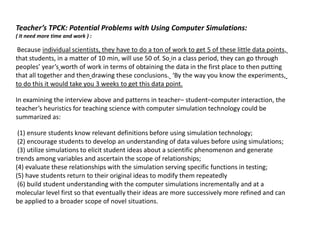
Teacher’s TPCK: Potential Problems with Using Computer Simulations:
( it need more time and work ) :

 Because individual scientists, they have to do a ton of work to get 5 of these little data points,
that students, in a matter of 10 min, will use 50 of. So in a class period, they can go through
peoples’ year’s worth of work in terms of obtaining the data in the first place to then putting
that all together and then drawing these conclusions. ‘By the way you know the experiments,
to do this it would take you 3 weeks to get this data point.

In examining the interview above and patterns in teacher– student–computer interaction, the
teacher’s heuristics for teaching science with computer simulation technology could be
summarized as:

 (1) ensure students know relevant definitions before using simulation technology;
 (2) encourage students to develop an understanding of data values before using simulations;
 (3) utilize simulations to elicit student ideas about a scientific phenomenon and generate
trends among variables and ascertain the scope of relationships;
(4) evaluate these relationships with the simulation serving specific functions in testing;
(5) have students return to their original ideas to modify them repeatedly
 (6) build student understanding with the computer simulations incrementally and at a
molecular level first so that eventually their ideas are more successively more refined and can
be applied to a broader scope of novel situations.
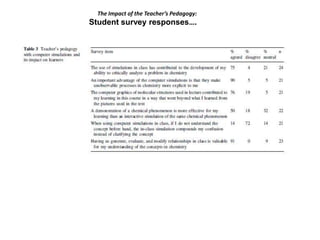
The Impact of the Teacher’s Pedagogy:
Student survey responses….
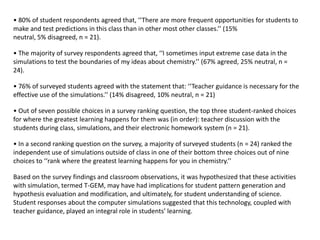
• 80% of student respondents agreed that, ‘‘There are more frequent opportunities for students to
make and test predictions in this class than in other most other classes.’’ (15%
neutral, 5% disagreed, n = 21).

• The majority of survey respondents agreed that, ‘‘I sometimes input extreme case data in the
simulations to test the boundaries of my ideas about chemistry.’’ (67% agreed, 25% neutral, n =
24).

• 76% of surveyed students agreed with the statement that: ‘‘Teacher guidance is necessary for the
effective use of the simulations.’’ (14% disagreed, 10% neutral, n = 21)

• Out of seven possible choices in a survey ranking question, the top three student-ranked choices
for where the greatest learning happens for them was (in order): teacher discussion with the
students during class, simulations, and their electronic homework system (n = 21).

• In a second ranking question on the survey, a majority of surveyed students (n = 24) ranked the
independent use of simulations outside of class in one of their bottom three choices out of nine
choices to ‘‘rank where the greatest learning happens for you in chemistry.’’

Based on the survey findings and classroom observations, it was hypothesized that these activities
with simulation, termed T-GEM, may have had implications for student pattern generation and
hypothesis evaluation and modification, and ultimately, for student understanding of science.
Student responses about the computer simulations suggested that this technology, coupled with
teacher guidance, played an integral role in students’ learning.
Conclusions :
Experienced science teachers with well developed TPACK may help us to gain a better
understanding’’ for how to teach with this technology,Three main findings of the
research were:

The T-GEM pedagogical approach. T-GEM is a 3 step, coordinated pedagogical .1
approach with computer simulations that involves generating, evaluating, and
modifying student ideas with the full integration of computer simulation technology
in each of these three phases.

2. Simulation technology has specific affordances for teaching science. Simulation
technology appears to afford T-GEM teachers and students with the capacity to:
compile information between variables in order to generate initial relationships, push
values to extremes or in increments to assess the scope of the relationship, and provide
an environment to make comparisons between data and visually draw attention to
patterns and contrasts using graphs and animations.

3. The teacher’s TPCK framed his approach to teaching with computer simulations. The
teacher had knowledge of: specific teaching roles to help students examine subject area
relationships using computer simulations; how conceptual classroom activities were
(dis)similar to/from the nature of science, and heuristics about when and where to use
simulation technology.

computer simulation- BARD

  • 1.
    Master of Artsin Teaching (MAT) An Al-Quads University/Bard College partnership “ Teaching as reflective practice ” ‘presentation’ New Pedagogies on teaching science with computer simulation by Reyad Ibrahim @ Ghadeer Marmash INSTRUCTOR:
  • 2.
    Introduction Some abbreviations • PCK:Pedagogical content knowledge. knowledge of pedagogy specific to certain content areas. • TCK: Technological Content Knowledge. knowledge about domain-specific technologies and how they can change the subject matter for the student or the kinds of representations that can be constructed by students.
  • 3.
    • TPK: TechnologicalPedagogical Knowledge. knowledge of the existence, components, and capabilities of various non-domain specific technologies in teaching and learning settings. • TPCK: Technological pedagogical content knowledge. It is a framework that articulates three important parts in teaching subject matter using technology.
  • 4.
  • 5.
    • Computer Simulation: Computerprogram that attempts to simulate a model of a particular system. Aims of using computer simulation; 1. Manipulating a model and view how it will behave under certain conditions. 2. Visualize aspects of science that are too big or small. 3. Provide extreme situations to support thought experiment. 4. Testing of ideas
  • 6.
    5. Provide extremesituations to support what If scenarios. 6. visualization of scientific phenomena have been associated with gains in conceptual understanding.
  • 7.
    • Reports onteaching techniques using computer simulation are not enough. • Pedagogical approach practiced by teachers strongly affect students learning outcomes. • Most of computer simulations lack the capability to independently tutor the student on concepts, direct investigation or guide student inquiry.
  • 8.
    Aims of thestudy • To explicate pedagogy of teaching science with computer simulations.
  • 9.
    Questions of thestudy 1. How does the teacher use computer simulations to teach science? 2. What are the teaching heuristics that are central to the teacher’s pedagogy with computer simulations? a. What is the role of the teacher in a technology enhanced environment? b. What are the affordances of the computer simulation technology for teaching science and when should this technology be employed? c. What are the perceived limitations of using computer simulation technology to teach science? 3. What is the impact of teaching science with computer simulations on the learners?
  • 10.
    Methodology Two parts ofthe case study 1. Experienced teacher’s general pedagogical approach was examined. 2. Teacher-student- computer simulation interaction was focused. • A cyclic pattern in which student generated evaluated and modified hypothesis is revealed in this study.
  • 11.
    • Why casestudy? • It can fulfill the detailed requirements to fulfill the aims of the study. • Because of its detailed analysis • It permits more direct and frequently interplay between theory and data and closer matching of conceptual intent and empirical evidence. • the ability to reveal the properties of the class to which the instance being studied belongs, produce new typologies, provide the basis for subsequent theory-development and test and generate and generate hypotheses.
  • 12.
    • It’s suitablefor research in complex settings where there is little control over behavior and organization or events. • Research context • Introductory chemistry course for university students in north American public university. • The course has syllabus and electronic homework system. • The teacher was an experienced science teacher, leader in chemistry and educational technology. • Electronic classrooms with computer terminals each equipped with suites of multiple, compact, interactive modules.
  • 13.
    Data gathering • Interview with teacher and students. • Intensive classroom observation for one year. • Student survey. • Data analysis • data were analyzed using mean statistics with Excel. • The qualitative data were analyzed using a constant comparative method which is an analytical approach that supports evaluation and reevaluation of hypotheses.
  • 14.
    New Pedagogies onTeaching Science with Computer Simulations Results and Discussion: The first section of the results responds to research question : 1: what is the teacher’s approach to teaching science with computer simulations? This is accomplished through an analysis of classroom observations, student survey, and teacher interviews. 2: what are the heuristics central to the teacher’s pedagogy with computer simulations and how does the teacher utilize the affordances of the simulation technology? 3: Finally, the results section concludes with data on the impact of teaching science with computer simulations from the students’ points of view.
  • 15.
    Teacher’s Use ofComputer Simulations to Support GEM Cycles: Computer simulations is not intended to replace the laboratories, but rather represented the results of simulated lab experiments or the behavior of atoms of molecules under conditions not observable with the eye. The general instructional approach was identified as generating (G), evaluating (E), and modifying (M) (GEM) students’ models in chemistry. G, E, and M occurred in three distinguishable phases or instructional segments with the evaluation (E) and modification (M) instructional segments repeating themselves in a cyclical fashion.
  • 16.
    The first isa graphic depicting the cyclical nature of GEM and its three phases :
  • 17.
    In one periodof class, the teacher engaged in this pedagogical approach two times , for total of 52 time across 11 different topics in chemistry. -Generating ( g ) : let’s go and just look at what the boiling points are for these things { ethanol and methanol } Then students gather information from the simulation : [ S ] :so ethanol between 78 and 79 degree- its boiling point,..so methanol is between 64 and 65 degrees. Using the computer simulation to locate the boiling points. [ S ] as molecular weight increases, the boiling point increases --- this come by simulation by the computer that generate a graph of molecular weight by boiling point.
  • 18.
    Simulations during theEvaluation (E) and Modification (M) Phases : Three major teacher activities:1- providing disconfirming information,2- providing extreme cases,3- and providing confirming information. These teacher activities can be done by: making comparisons, asking why questions, asking what’s wrong questions, making predictions, considering new data points, designing a new test, see if it holds true, finding more information and adding content information. For an example of evaluation (E), the teacher stated in a lesson on intermolecular forces, ‘‘We want to use this *simulation+ to see if your trend there *referring to a hypothetical relationship students had constructed: ‘As molecular weight increases the boiling point increases’+ actually works for more than say two compounds.
  • 19.
    ’’ Students wereencouraged by the teacher to examine a new computer simulation set on organic boiling points in order to compare previous data with new data and to gauge the scope of their hypothetical relationships. Students viewed a graph on the simulation of selected alkanes and functional groups, by molecular weight and boiling point. The simulation also showed a spherical model of the selected compound. Based on the earlier relationship they had generated, students generally stated that they expected that boiling points would increase as molecular weight increased. This trend was evident in most cases, but compounds with functional groups that had the capacity to hydrogen bond, such as hydroxyl and amine groups, had anomalously high boiling points for their molecular weights, as displayed by the computer simulation. Let student see graphs , colors, animations, why? What’s wrong?
  • 20.
    Modifying ( M): Ask student to run a new test in the simulation ,ask them to solve new case …..
  • 21.
    The Teacher’s TPCK:Affordances of Computer Simulations for Teaching Science: The teacher was interviewed and asked about the affordances of computer simulations for his approach to teaching science. His response to this set of questions were compiled, as following; A lot of the kinds of things we do with computer simulation could be done with pieces of paper. The thing that’s better about the computer part of it is, you can do a lot more exploring, so *the computer simulation+ gives *students+ more control over what they’re going to look at, as opposed to if I give them a sheet of paper with numbers on it. It’s like I’m going to look at this information, I’m going to come to some conclusion, I’m going to look at some more information, and I’m going to test those conclusions…. So when I throw up an overhead, I’m doing the exploring and they *the students+ are explaining it. And that’s okay, but when it’s a simulation and they are choosing things, then they are doing the exploring much more. So it’s a control issue.
  • 22.
    Teacher’s TPCK: Whento Use Computer Simulations: To further articulate the heuristics by which the teacher made decisions about computer simulations in science, the teacher was asked about when computer simulations should be used to teach science: [T]he time to be able to do it [begin to use computer simulations+ is *when students+ know what it is they’re looking at. They need to know what the information is telling them in each data point by data point instance, but the thing that they should not know before they start looking at it is what the overall relationship and guiding principles are. , but you would not use the simulation to get them to know what ionization energy is. they know a rough range of where it’s coming from, Then you give them the simulation, so they can look at trends in that thing …. They can grasp that relationship because they know what they’re looking at. The teacher did not encourage the students to read ahead on the topic, rather, he utilized simulation technology and conceptual exercises to learn about relationships first-hand within the classroom environment.
  • 23.
    Teacher’s TPCK: PotentialProblems with Using Computer Simulations: ( it need more time and work ) : Because individual scientists, they have to do a ton of work to get 5 of these little data points, that students, in a matter of 10 min, will use 50 of. So in a class period, they can go through peoples’ year’s worth of work in terms of obtaining the data in the first place to then putting that all together and then drawing these conclusions. ‘By the way you know the experiments, to do this it would take you 3 weeks to get this data point. In examining the interview above and patterns in teacher– student–computer interaction, the teacher’s heuristics for teaching science with computer simulation technology could be summarized as: (1) ensure students know relevant definitions before using simulation technology; (2) encourage students to develop an understanding of data values before using simulations; (3) utilize simulations to elicit student ideas about a scientific phenomenon and generate trends among variables and ascertain the scope of relationships; (4) evaluate these relationships with the simulation serving specific functions in testing; (5) have students return to their original ideas to modify them repeatedly (6) build student understanding with the computer simulations incrementally and at a molecular level first so that eventually their ideas are more successively more refined and can be applied to a broader scope of novel situations.
  • 24.
    The Impact ofthe Teacher’s Pedagogy: Student survey responses….
  • 26.
    • 80% ofstudent respondents agreed that, ‘‘There are more frequent opportunities for students to make and test predictions in this class than in other most other classes.’’ (15% neutral, 5% disagreed, n = 21). • The majority of survey respondents agreed that, ‘‘I sometimes input extreme case data in the simulations to test the boundaries of my ideas about chemistry.’’ (67% agreed, 25% neutral, n = 24). • 76% of surveyed students agreed with the statement that: ‘‘Teacher guidance is necessary for the effective use of the simulations.’’ (14% disagreed, 10% neutral, n = 21) • Out of seven possible choices in a survey ranking question, the top three student-ranked choices for where the greatest learning happens for them was (in order): teacher discussion with the students during class, simulations, and their electronic homework system (n = 21). • In a second ranking question on the survey, a majority of surveyed students (n = 24) ranked the independent use of simulations outside of class in one of their bottom three choices out of nine choices to ‘‘rank where the greatest learning happens for you in chemistry.’’ Based on the survey findings and classroom observations, it was hypothesized that these activities with simulation, termed T-GEM, may have had implications for student pattern generation and hypothesis evaluation and modification, and ultimately, for student understanding of science. Student responses about the computer simulations suggested that this technology, coupled with teacher guidance, played an integral role in students’ learning.
  • 27.
    Conclusions : Experienced scienceteachers with well developed TPACK may help us to gain a better understanding’’ for how to teach with this technology,Three main findings of the research were: The T-GEM pedagogical approach. T-GEM is a 3 step, coordinated pedagogical .1 approach with computer simulations that involves generating, evaluating, and modifying student ideas with the full integration of computer simulation technology in each of these three phases. 2. Simulation technology has specific affordances for teaching science. Simulation technology appears to afford T-GEM teachers and students with the capacity to: compile information between variables in order to generate initial relationships, push values to extremes or in increments to assess the scope of the relationship, and provide an environment to make comparisons between data and visually draw attention to patterns and contrasts using graphs and animations. 3. The teacher’s TPCK framed his approach to teaching with computer simulations. The teacher had knowledge of: specific teaching roles to help students examine subject area relationships using computer simulations; how conceptual classroom activities were (dis)similar to/from the nature of science, and heuristics about when and where to use simulation technology.