Simple Future:
     Will
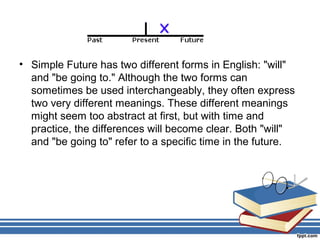
• Simple Future has two different forms in English: "will"
  and "be going to." Although the two forms can
  sometimes be used interchangeably, they often express
  two very different meanings. These different meanings
  might seem too abstract at first, but with time and
  practice, the differences will become clear. Both "will"
  and "be going to" refer to a specific time in the future.
• FORM Will

• [will + verb]

• Examples:

• You will help him later.
• FORM Be Going To

• [am/is/are + going to + verb]

• Examples:

• You are going to meet Jane tonight.
USE 1 "Will" to Express a Voluntary
               Action
• "Will" often suggests that a speaker will do something
   voluntarily. A voluntary action is one the speaker offers
   to do for someone else. Often, we use "will" to respond
   to someone else's complaint or request for help. We also
   use "will" when we request that someone help us or
   volunteer to do something for us. Similarly, we use "will
   not" or "won't" when we refuse to voluntarily do
   something.
• Examples:
I will send you the information when I get it.
USE 2 "Will" to Express a
            Promise.
• "Will" is usually used in promises.

• Examples:

• I will call you when I arrive.
USE 3 "Be going to" to Express
           a Plan
"Be going to" expresses that something is a
plan. It expresses the idea that a person
intends to do something in the future. It does
not matter whether the plan is realistic or
not.
Examples:
•He is going to spend his vacation in Hawaii.
USE 4 "Will" or "Be Going to" to
    Express a Prediction.
Both "will" and "be going to" can express the idea
of a general prediction about the future.
Predictions are guesses about what might happen
in the future. In "prediction" sentences, the subject
usually has little control over the future and
therefore USES 1-3 do not apply. In the following
examples, there is no difference in meaning.
Examples:
•The year 2222 will be a very interesting year.
ADVERB PLACEMENT
The examples below show the placement
for grammar adverbs such as: always, only,
never, ever, still, just, etc.

Examples:

•You will never help him.
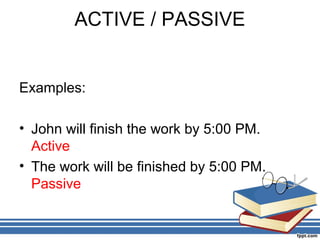
ACTIVE / PASSIVE


Examples:

• John will finish the work by 5:00 PM.
  Active
• The work will be finished by 5:00 PM.
  Passive

Simple future will

  • 1.
  • 2.
    • Simple Futurehas two different forms in English: "will" and "be going to." Although the two forms can sometimes be used interchangeably, they often express two very different meanings. These different meanings might seem too abstract at first, but with time and practice, the differences will become clear. Both "will" and "be going to" refer to a specific time in the future.
  • 3.
    • FORM Will •[will + verb] • Examples: • You will help him later.
  • 4.
    • FORM BeGoing To • [am/is/are + going to + verb] • Examples: • You are going to meet Jane tonight.
  • 5.
    USE 1 "Will"to Express a Voluntary Action • "Will" often suggests that a speaker will do something voluntarily. A voluntary action is one the speaker offers to do for someone else. Often, we use "will" to respond to someone else's complaint or request for help. We also use "will" when we request that someone help us or volunteer to do something for us. Similarly, we use "will not" or "won't" when we refuse to voluntarily do something. • Examples: I will send you the information when I get it.
  • 6.
    USE 2 "Will"to Express a Promise. • "Will" is usually used in promises. • Examples: • I will call you when I arrive.
  • 7.
    USE 3 "Begoing to" to Express a Plan "Be going to" expresses that something is a plan. It expresses the idea that a person intends to do something in the future. It does not matter whether the plan is realistic or not. Examples: •He is going to spend his vacation in Hawaii.
  • 8.
    USE 4 "Will"or "Be Going to" to Express a Prediction. Both "will" and "be going to" can express the idea of a general prediction about the future. Predictions are guesses about what might happen in the future. In "prediction" sentences, the subject usually has little control over the future and therefore USES 1-3 do not apply. In the following examples, there is no difference in meaning. Examples: •The year 2222 will be a very interesting year.
  • 9.
    ADVERB PLACEMENT The examplesbelow show the placement for grammar adverbs such as: always, only, never, ever, still, just, etc. Examples: •You will never help him.
  • 10.
    ACTIVE / PASSIVE Examples: •John will finish the work by 5:00 PM. Active • The work will be finished by 5:00 PM. Passive