



Simple Present
Simple Present verb to be
Uses:

• To introduce yourself and other
• To express nationality
• To express age
• To express occupations
• To talk about physical characteristics
Example:
• I am Carol
• She is French
• He is a policeman
• I am tall
Simple Present Tense
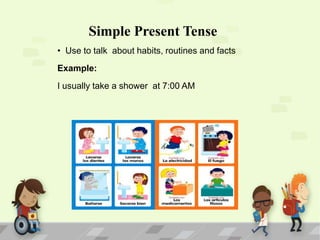
• Use to talk about habits, routines and facts
Example:
I usually take a shower at 7:00 AM
Affirmative
Example:
I

eat

bread

He

eats

Bread

It

begins

at 8:15 a.m.
Negative

Example:

I

don’t

eat

bread

she

doesn`t

eat

bread
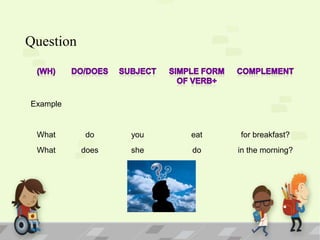
Question

Example

What

do

you

eat

for breakfast?

What

does

she

do

in the morning?
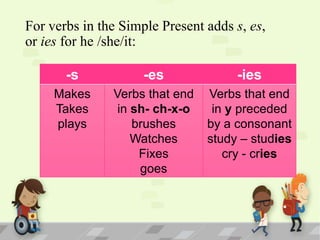
For verbs in the Simple Present adds s, es,
or ies for he /she/it:
-s

-es

-ies

Makes
Takes
plays

Verbs that end
in sh- ch-x-o
brushes
Watches
Fixes
goes

Verbs that end
in y preceded
by a consonant
study – studies
cry - cries
Simple Past
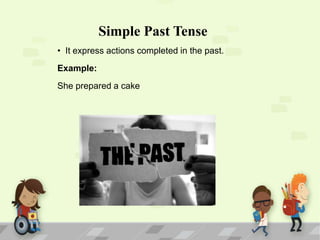
Simple Past Tense
• It express actions completed in the past.
Example:
She prepared a cake
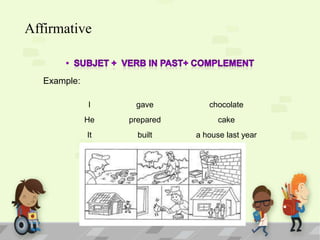
Affirmative

Example:
I

gave

chocolate

He

prepared

cake

It

built

a house last year
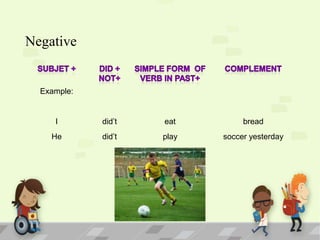
Negative

Example:

I

did’t

eat

bread

He

did’t

play

soccer yesterday
Question

Example

What

did

you

buy

in the mall?

What

did

she

do

in the morning?
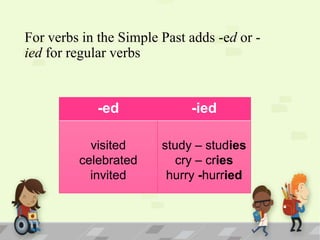
For verbs in the Simple Past adds -ed or ied for regular verbs

-ed

-ied

visited
celebrated
invited

study – studies
cry – cries
hurry -hurried
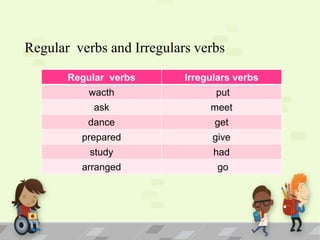
Regular verbs and Irregulars verbs
Regular verbs

Irregulars verbs

wacth

put

ask

meet

dance

get

prepared

give

study

had

arranged

go
Future
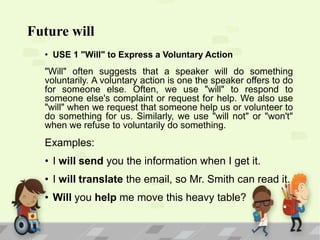
Future will
• USE 1 "Will" to Express a Voluntary Action

"Will" often suggests that a speaker will do something
voluntarily. A voluntary action is one the speaker offers to do
for someone else. Often, we use "will" to respond to
someone else's complaint or request for help. We also use
"will" when we request that someone help us or volunteer to
do something for us. Similarly, we use "will not" or "won't"
when we refuse to voluntarily do something.

Examples:
• I will send you the information when I get it.
• I will translate the email, so Mr. Smith can read it.
• Will you help me move this heavy table?
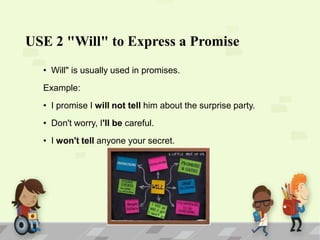
USE 2 "Will" to Express a Promise
• Will" is usually used in promises.

Example:
• I promise I will not tell him about the surprise party.
• Don't worry, I'll be careful.

• I won't tell anyone your secret.
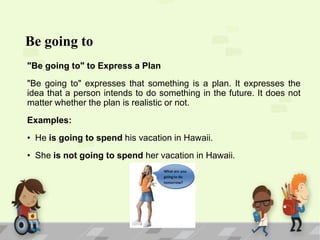
Be going to
"Be going to" to Express a Plan

"Be going to" expresses that something is a plan. It expresses the
idea that a person intends to do something in the future. It does not
matter whether the plan is realistic or not.
Examples:

• He is going to spend his vacation in Hawaii.
• She is not going to spend her vacation in Hawaii.
"Will" or "Be Going to" to Express a
Prediction
• Both "will" and "be going to" can express the idea of a general
prediction about the future. Predictions are guesses about what
might happen in the future. In "prediction" sentences, the subject
usually has little control over the future and therefore USES 1-3
do not apply. In the following examples, there is no difference in
meaning.
Examples:
• The year 2222 will be a very interesting year.
• The year 2222 is going to be a very interesting year.
lIMPORTANT
In the Simple Future, it is not always
clear which USE the speaker has in
mind. Often, there is more than one
way to interpret a sentence's
meaning.
No Future in Time Clauses
• Like all future forms, the Simple Future cannot be used in
clauses beginning with time expressions such as: when, while,
before, after, by the time, as soon as, if, unless, etc. Instead of
Simple Future, Simple Present is used.
Examples:

• When you will arrive tonight, we will go out for dinner. Not
Correct
• When you arrive tonight, we will go out for dinner. Correct
The simple present, simple past and future

The simple present, simple past and future

  • 2.
  • 3.
    Simple Present verbto be Uses: • To introduce yourself and other • To express nationality • To express age • To express occupations • To talk about physical characteristics Example: • I am Carol • She is French • He is a policeman • I am tall
  • 4.
    Simple Present Tense •Use to talk about habits, routines and facts Example: I usually take a shower at 7:00 AM
  • 5.
  • 6.
  • 7.
  • 8.
    For verbs inthe Simple Present adds s, es, or ies for he /she/it: -s -es -ies Makes Takes plays Verbs that end in sh- ch-x-o brushes Watches Fixes goes Verbs that end in y preceded by a consonant study – studies cry - cries
  • 9.
  • 10.
    Simple Past Tense •It express actions completed in the past. Example: She prepared a cake
  • 11.
  • 12.
  • 13.
  • 14.
    For verbs inthe Simple Past adds -ed or ied for regular verbs -ed -ied visited celebrated invited study – studies cry – cries hurry -hurried
  • 15.
    Regular verbs andIrregulars verbs Regular verbs Irregulars verbs wacth put ask meet dance get prepared give study had arranged go
  • 16.
  • 17.
    Future will • USE1 "Will" to Express a Voluntary Action "Will" often suggests that a speaker will do something voluntarily. A voluntary action is one the speaker offers to do for someone else. Often, we use "will" to respond to someone else's complaint or request for help. We also use "will" when we request that someone help us or volunteer to do something for us. Similarly, we use "will not" or "won't" when we refuse to voluntarily do something. Examples: • I will send you the information when I get it. • I will translate the email, so Mr. Smith can read it. • Will you help me move this heavy table?
  • 18.
    USE 2 "Will"to Express a Promise • Will" is usually used in promises. Example: • I promise I will not tell him about the surprise party. • Don't worry, I'll be careful. • I won't tell anyone your secret.
  • 19.
    Be going to "Begoing to" to Express a Plan "Be going to" expresses that something is a plan. It expresses the idea that a person intends to do something in the future. It does not matter whether the plan is realistic or not. Examples: • He is going to spend his vacation in Hawaii. • She is not going to spend her vacation in Hawaii.
  • 20.
    "Will" or "BeGoing to" to Express a Prediction • Both "will" and "be going to" can express the idea of a general prediction about the future. Predictions are guesses about what might happen in the future. In "prediction" sentences, the subject usually has little control over the future and therefore USES 1-3 do not apply. In the following examples, there is no difference in meaning. Examples: • The year 2222 will be a very interesting year. • The year 2222 is going to be a very interesting year.
  • 21.
    lIMPORTANT In the SimpleFuture, it is not always clear which USE the speaker has in mind. Often, there is more than one way to interpret a sentence's meaning.
  • 22.
    No Future inTime Clauses • Like all future forms, the Simple Future cannot be used in clauses beginning with time expressions such as: when, while, before, after, by the time, as soon as, if, unless, etc. Instead of Simple Future, Simple Present is used. Examples: • When you will arrive tonight, we will go out for dinner. Not Correct • When you arrive tonight, we will go out for dinner. Correct