FUTURE TENSES
REVIEW
Future! What is it?
In English we don’t have ONE
 future tense. We use several
 forms to talk about different
 ideas about the future.
• Future Simple “Will”
• “Be going to”


• Present Continuous
• Present Simple
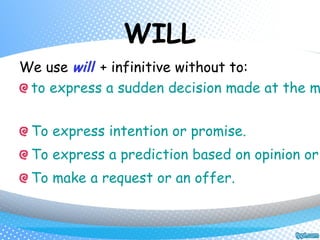
WILL
We use will + infinitive without to:
 to express a sudden decision made at the m


 To express intention or promise.
 To express a prediction based on opinion or
 To make a request or an offer.
I have a nice dress! I
  will go to the party
        tonight!
I promise, I
   will bring
   the book
  tomorrow!
We think he
 will win the
 competition!
   He is a
 Spiderman!
I want to eat. Will
   you take a cat
       away?
Be going to
We use be going to + infinitive without to:

 To express n intention.


 To express a prediction based on something
Hmmm... I am
going to sleep !
It is going to
      rain!
Present Continuous
We use Present Continuous to talk
about future events we have arranged.
I am going to
  the cinema
  tonight!
Present Simple

We use Present Simple to talk about
future events that we cannot change.
Hurry up! The
 train leaves in
   two hours.
Let’s practice
                       Will or be going to

1. Look! I’ve just won 100$. I will / am going to buy myself a new
      jacket at last.
2. He doesn’t look healthy and smokes like a chimney. He will /
      is going to have a heart attack one day.
3. Sarah is going on holiday tomorrow. I’m sure she will / is going to
      enjoy it.
4. I’ve decided to stay at home tonight. I will / am gong to study for
      my history test.
5. Al is coming to our party. I hope he will / isn’t going to /
      is going not to bring anyone with him.
6. Just look at Susan. Everybody can see that she will / is going to
      have a baby.
7. Don’t pick up the phone, I will / am gong to answer it.
8. I’ve heard that Peter and Jane will / are going to spend their
      honeymoon in Europe.
Let’s practice again
         Present Continuous or Present Simple

1. I play / am playing tennis with David tomorrow.
2. Our plane take off / takes off / is taking off at six in the morning.
3. What time does last train leave / is last train leaving?
4. We are not going to / don’t go to Jessica’s this evening, she is ill.
5. School starts / start / is starting at 8.45.
6. The exam don’t finish / doesn’t finish / is not finishing until 3.30.
7. When do we go / does we go / is we going / are we going to the
      cinema?
8. The match finish / finishes / is finishing at 4.45.
Will, be going to or Present Continuous
                                   Choose the right answer.

1.    Jane has passed all her exams and
a.    She’ll study in Prague next year.
b.    She’s going to study in Prague next year.
2.   He rides that motorbike much too fast.
a.    He’s going to have an accident soon.
b.    He’s having an accident soon.
3.   We’ve got some bad news.
a.    We aren’t coming tomorrow.
b.    We aren’t going to come tomorrow.
4.   Next year Mum
a.    is going to be forty.
b.    will be forty.
5.   What
a.    Will you do this evening?
b.    Are you doing this evening?
6.   Don’t worry!
a.    She’ll be here soon.
b.    She’s going to be here soon.
My
congratulation
     you
are finished !

Future tense

  • 1.
  • 2.
    Future! What isit? In English we don’t have ONE future tense. We use several forms to talk about different ideas about the future.
  • 3.
    • Future Simple“Will” • “Be going to” • Present Continuous • Present Simple
  • 4.
    WILL We use will+ infinitive without to: to express a sudden decision made at the m To express intention or promise. To express a prediction based on opinion or To make a request or an offer.
  • 5.
    I have anice dress! I will go to the party tonight!
  • 6.
    I promise, I will bring the book tomorrow!
  • 7.
    We think he will win the competition! He is a Spiderman!
  • 8.
    I want toeat. Will you take a cat away?
  • 9.
    Be going to Weuse be going to + infinitive without to: To express n intention. To express a prediction based on something
  • 10.
  • 11.
    It is goingto rain!
  • 12.
    Present Continuous We usePresent Continuous to talk about future events we have arranged.
  • 13.
    I am goingto the cinema tonight!
  • 14.
    Present Simple We usePresent Simple to talk about future events that we cannot change.
  • 15.
    Hurry up! The train leaves in two hours.
  • 16.
    Let’s practice Will or be going to 1. Look! I’ve just won 100$. I will / am going to buy myself a new jacket at last. 2. He doesn’t look healthy and smokes like a chimney. He will / is going to have a heart attack one day. 3. Sarah is going on holiday tomorrow. I’m sure she will / is going to enjoy it. 4. I’ve decided to stay at home tonight. I will / am gong to study for my history test. 5. Al is coming to our party. I hope he will / isn’t going to / is going not to bring anyone with him. 6. Just look at Susan. Everybody can see that she will / is going to have a baby. 7. Don’t pick up the phone, I will / am gong to answer it. 8. I’ve heard that Peter and Jane will / are going to spend their honeymoon in Europe.
  • 17.
    Let’s practice again Present Continuous or Present Simple 1. I play / am playing tennis with David tomorrow. 2. Our plane take off / takes off / is taking off at six in the morning. 3. What time does last train leave / is last train leaving? 4. We are not going to / don’t go to Jessica’s this evening, she is ill. 5. School starts / start / is starting at 8.45. 6. The exam don’t finish / doesn’t finish / is not finishing until 3.30. 7. When do we go / does we go / is we going / are we going to the cinema? 8. The match finish / finishes / is finishing at 4.45.
  • 18.
    Will, be goingto or Present Continuous Choose the right answer. 1. Jane has passed all her exams and a. She’ll study in Prague next year. b. She’s going to study in Prague next year. 2. He rides that motorbike much too fast. a. He’s going to have an accident soon. b. He’s having an accident soon. 3. We’ve got some bad news. a. We aren’t coming tomorrow. b. We aren’t going to come tomorrow. 4. Next year Mum a. is going to be forty. b. will be forty. 5. What a. Will you do this evening? b. Are you doing this evening? 6. Don’t worry! a. She’ll be here soon. b. She’s going to be here soon.
  • 19.
    My congratulation you are finished !