Airstream Mechanism
Organ of Speech
Letters vs Sounds











The major ‘initiator’ is the lungs and the
most common direction is to the air flow
out from the lungs through the trachea
(windpipe), larynx (in the Adam’s apple)
and vocal tract (mouth and nose).
As the air is pushed out from the lungs, it
moves up the trachea into the larynx.
All human languages, including English,
involve this type of airstream mechanism,
known as ‘pulmonic eggresive’ (from the
lungs outwards).
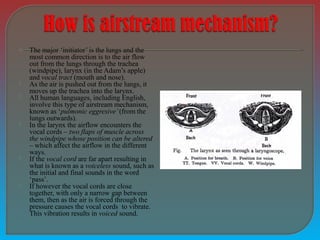
In the larynx the airflow encounters the
vocal cords – two flaps of muscle across
the windpipe whose position can be altered
– which affect the airflow in the different
ways.
If the vocal cord are far apart resulting in
what is known as a voiceless sound, such as
the initial and final sounds in the word
‘pass’.
If however the vocal cords are close
together, with only a narrow gap between
them, then as the air is forced through the
pressure causes the vocal cords to vibrate.
This vibration results in voiced sound.





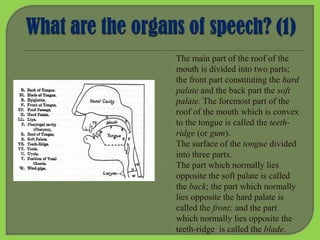
The main part of the roof of the
mouth is divided into two parts;
the front part constituting the hard
palate and the back part the soft
palate. The foremost part of the
roof of the mouth which is convex
to the tongue is called the teethridge (or gum).
The surface of the tongue divided
into three parts.
The part which normally lies
opposite the soft palate is called
the back; the part which normally
lies opposite the hard palate is
called the front; and the part
which normally lies opposite the
teeth-ridge is called the blade.






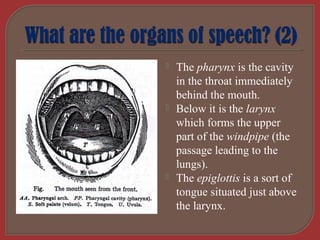
The pharynx is the cavity
in the throat immediately
behind the mouth.
Below it is the larynx
which forms the upper
part of the windpipe (the
passage leading to the
lungs).
The epiglottis is a sort of
tongue situated just above
the larynx.


In writing, words are made of letters. In speech,
words are made of sounds. Letters are not always
the same as sounds. For example, the words key
and car begin with the same sound, but the letters
are different. We can see this clearly if we read the
two words in phonemic symbols: /ki:/, /kA:/. In
the examples below, word pairs have the same
pronunciation but different spelling:
• Buy
• Weak
• Too

bye
week
two

sun
weigh
write

son
way
right


There are two kinds of sounds: consonants
sounds (C) and vowel sounds (V). For
example, in duck, there are three sounds,
consonant-vowel-consonant (CVC). The
number of sounds in a word is not usually the
same as the number of letters. We can see this
if we write the word using phonemic symbols.
For example, duck is /dök/.


There are two kinds of sounds: consonants
sounds (C) and vowel sounds (V). For
example, in duck, there are three sounds,
consonant-vowel-consonant (CVC). The
number of sounds in a word is not usually the
same as the number of letters. We can see this
if we write the word using phonemic symbols.
For example, duck is /dök/.

pronunciation 1

  • 1.
    Airstream Mechanism Organ ofSpeech Letters vs Sounds
  • 2.
          The major ‘initiator’is the lungs and the most common direction is to the air flow out from the lungs through the trachea (windpipe), larynx (in the Adam’s apple) and vocal tract (mouth and nose). As the air is pushed out from the lungs, it moves up the trachea into the larynx. All human languages, including English, involve this type of airstream mechanism, known as ‘pulmonic eggresive’ (from the lungs outwards). In the larynx the airflow encounters the vocal cords – two flaps of muscle across the windpipe whose position can be altered – which affect the airflow in the different ways. If the vocal cord are far apart resulting in what is known as a voiceless sound, such as the initial and final sounds in the word ‘pass’. If however the vocal cords are close together, with only a narrow gap between them, then as the air is forced through the pressure causes the vocal cords to vibrate. This vibration results in voiced sound.
  • 3.
       The main partof the roof of the mouth is divided into two parts; the front part constituting the hard palate and the back part the soft palate. The foremost part of the roof of the mouth which is convex to the tongue is called the teethridge (or gum). The surface of the tongue divided into three parts. The part which normally lies opposite the soft palate is called the back; the part which normally lies opposite the hard palate is called the front; and the part which normally lies opposite the teeth-ridge is called the blade.
  • 4.
       The pharynx isthe cavity in the throat immediately behind the mouth. Below it is the larynx which forms the upper part of the windpipe (the passage leading to the lungs). The epiglottis is a sort of tongue situated just above the larynx.
  • 5.
     In writing, wordsare made of letters. In speech, words are made of sounds. Letters are not always the same as sounds. For example, the words key and car begin with the same sound, but the letters are different. We can see this clearly if we read the two words in phonemic symbols: /ki:/, /kA:/. In the examples below, word pairs have the same pronunciation but different spelling: • Buy • Weak • Too bye week two sun weigh write son way right
  • 6.
     There are twokinds of sounds: consonants sounds (C) and vowel sounds (V). For example, in duck, there are three sounds, consonant-vowel-consonant (CVC). The number of sounds in a word is not usually the same as the number of letters. We can see this if we write the word using phonemic symbols. For example, duck is /dök/.
  • 7.
     There are twokinds of sounds: consonants sounds (C) and vowel sounds (V). For example, in duck, there are three sounds, consonant-vowel-consonant (CVC). The number of sounds in a word is not usually the same as the number of letters. We can see this if we write the word using phonemic symbols. For example, duck is /dök/.