What is Indefinite Pronoun?
Prepared by Ms Jovis
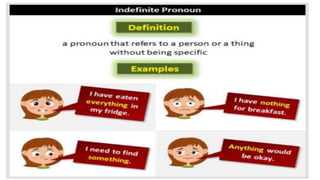
What is Indefinite Pronoun?
An indefinite pronoun does not refer to any specific person,
thing or amount.
 It is vague and “not definite”.
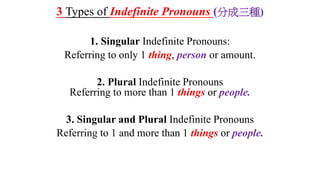
3 Types of Indefinite Pronouns (分成三種)
1. Singular Indefinite Pronouns:
Referring to only 1 thing, person or amount.
2. Plural Indefinite Pronouns
Referring to more than 1 things or people.
3. Singular and Plural Indefinite Pronouns
Referring to 1 and more than 1 things or people.
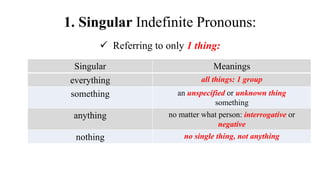
1. Singular Indefinite Pronouns:
 Referring to only 1 thing:
Singular Meanings
everything all things: 1 group
something an unspecified or unknown thing
something
anything no matter what person: interrogative or
negative
nothing no single thing, not anything
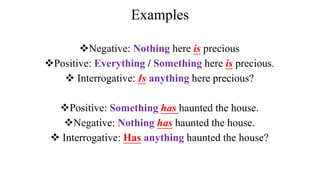
Examples
Negative: Nothing here is precious
Positive: Everything / Something here is precious.
 Interrogative: Is anything here precious?
Positive: Something has haunted the house.
Negative: Nothing has haunted the house.
 Interrogative: Has anything haunted the house?
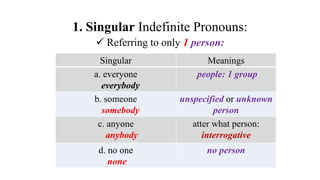
1. Singular Indefinite Pronouns:
 Referring to only 1 person:
Singular Meanings
a. everyone
everybody
people: 1 group
b. someone
somebody
unspecified or unknown
person
c. anyone
anybody
atter what person:
interrogative
d. no one
none
no person
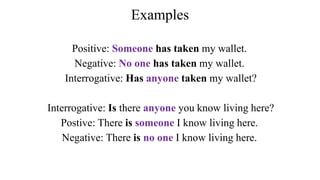
Examples
Positive: Someone has taken my wallet.
Negative: No one has taken my wallet.
Interrogative: Has anyone taken my wallet?
Interrogative: Is there anyone you know living here?
Postive: There is someone I know living here.
Negative: There is no one I know living here.
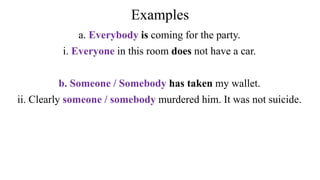
Examples
a. Everybody is coming for the party.
i. Everyone in this room does not have a car.
b. Someone / Somebody has taken my wallet.
ii. Clearly someone / somebody murdered him. It was not suicide.
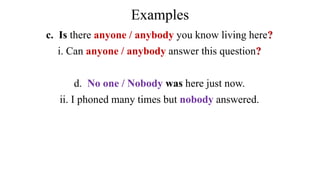
Examples
c. Is there anyone / anybody you know living here?
i. Can anyone / anybody answer this question?
d. No one / Nobody was here just now.
ii. I phoned many times but nobody answered.
2. Plural Indefinite Pronouns
 Referring to more than 1 things, people or amounts.
Plural Meanings
a. both (兩個)
two people or things, seen together
b. a few (一些[可數n.])
some: countable
c. few (一些, 但幾乎沒有[可數n.])
a small number o
d. many (很多[可數n.])a large number of people or things
e. several (一些[可數n.])
more than 2 but not many
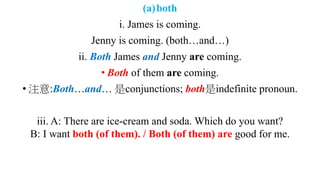
(a)both
i. James is coming.
Jenny is coming. (both…and…)
ii. Both James and Jenny are coming.
• Both of them are coming.
• 注意:Both…and… 是conjunctions; both是indefinite pronoun.
iii. A: There are ice-cream and soda. Which do you want?
B: I want both (of them). / Both (of them) are good for me.
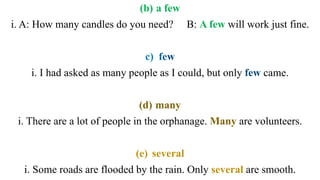
(b) a few
i. A: How many candles do you need? B: A few will work just fine.
i. I had asked as many people as I could, but only came.
(d) many
i. There are a lot of people in the orphanage. Many are volunteers.
(e) several
i. Some roads are flooded by the rain. Only several are smooth.
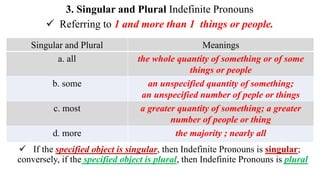
3. Singular and Plural Indefinite Pronouns
 Referring to 1 and more than 1 things or people.
 If the specified object is singular, then Indefinite Pronouns is singular;
conversely, if the specified object is plural, then Indefinite Pronouns is plural
Singular and Plural Meanings
a. all the whole quantity of something or of some
things or people
b. some an unspecified quantity of something;
an unspecified number of peple or things
c. most a greater quantity of something; a greater
number of people or thing
d. more the majority ; nearly all
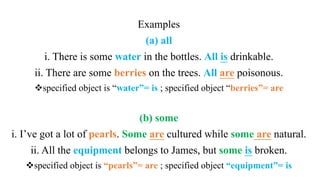
Examples
(a) all
i. There is some water in the bottles. All is drinkable.
ii. There are some berries on the trees. All are poisonous.
specified object is “water”= is ; specified object “berries”= are
(b) some
i. I’ve got a lot of pearls. Some are cultured while some are natural.
ii. All the equipment belongs to James, but some is broken.
specified object is “pearls”= are ; specified object “equipment”= is
Examples
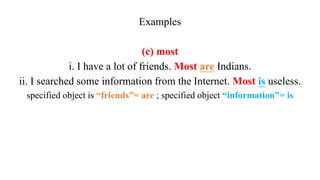
(c) most
i. I have a lot of friends. Most are Indians.
ii. I searched some information from the Internet. Most is useless.
specified object is “friends”= are ; specified object “information”= is
Examples
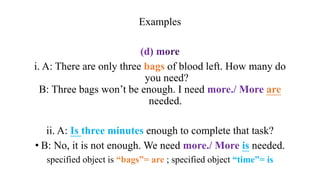
i. A: There are only three bags of blood left. How many do
you need?
B: Three bags won’t be enough. I need more./ More are
needed.
ii. A: Is three minutes enough to complete that task?
• B: No, it is not enough. We need more./ More is needed.
specified object is “bags”= are ; specified object “time”= is
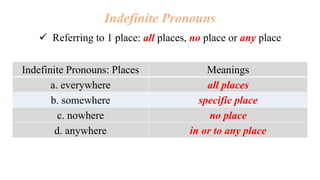
Indefinite Pronouns
 Referring to 1 place: all places, no place or any place
Indefinite Pronouns: Places Meanings
a. everywhere all places
b. somewhere specific place
c. nowhere no place
d. anywhere in or to any place
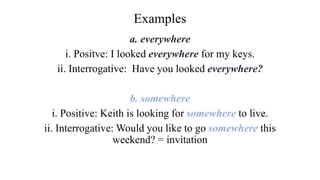
Examples
a. everywhere
i. Positve: I looked everywhere for my keys.
ii. Interrogative: Have you looked everywhere?
b. somewhere
i. Positive: Keith is looking for somewhere to live.
ii. Interrogative: Would you like to go somewhere this
weekend? = invitation
Examples
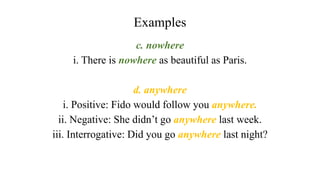
c. nowhere
i. There is nowhere as beautiful as Paris.
d. anywhere
i. Positive: Fido would follow you anywhere.
ii. Negative: She didn’t go anywhere last week.
iii. Interrogative: Did you go anywhere last night?
More Indefinite Pronouns
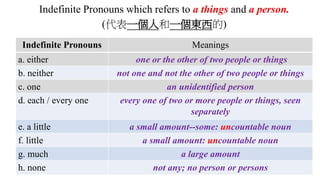
Indefinite Pronouns which refers to a things and a person.
(代表一個人和一個東西的)
Indefinite Pronouns Meanings
a. either one or the other of two people or things
b. neither not one and not the other of two people or things
c. one an unidentified person
d. each / every one every one of two or more people or things, seen
separately
e. a little a small amount--some: uncountable noun
f. little a small amount: uncountable noun
g. much a large amount
h. none not any; no person or persons
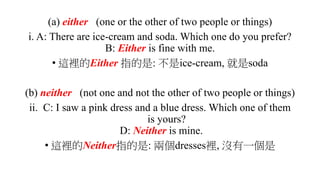
(a) either (one or the other of two people or things)
i. A: There are ice-cream and soda. Which one do you prefer?
B: Either is fine with me.
• 這裡的Either 指的是: 不是ice-cream, 就是soda
(b) neither (not one and not the other of two people or things)
ii. C: I saw a pink dress and a blue dress. Which one of them
is yours?
D: Neither is mine.
• 這裡的Neither指的是: 兩個dresses裡, 沒有一個是
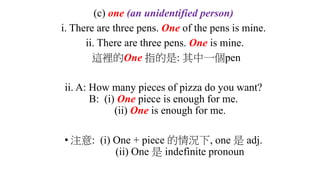
(c) one (an unidentified person)
i. There are three pens. One of the pens is mine.
ii. There are three pens. One is mine.
這裡的One 指的是: 其中一個pen
ii. A: How many pieces of pizza do you want?
B: (i) One piece is enough for me.
(ii) One is enough for me.
• 注意: (i) One + piece 的情況下, one 是 adj.
(ii) One 是 indefinite pronoun
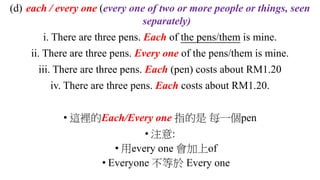
(d) each / every one (every one of two or more people or things, seen
separately)
i. There are three pens. Each of the pens/them is mine.
ii. There are three pens. Every one of the pens/them is mine.
iii. There are three pens. Each (pen) costs about RM1.20
iv. There are three pens. Each costs about RM1.20.
• 這裡的Each/Every one 指的是 每一個pen
• 注意:
• 用every one 會加上of
• Everyone 不等於 Every one
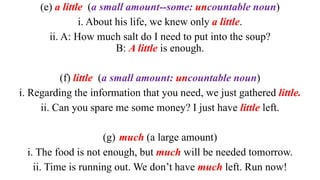
(e) a little (a small amount--some: uncountable noun)
i. About his life, we knew only a little.
ii. A: How much salt do I need to put into the soup?
B: A little is enough.
(f) little (a small amount: uncountable noun)
i. Regarding the information that you need, we just gathered little.
ii. Can you spare me some money? I just have little left.
(g) much (a large amount)
i. The food is not enough, but much will be needed tomorrow.
ii. Time is running out. We don’t have much left. Run now!
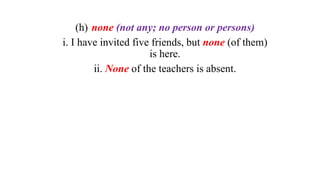
(h) none (not any; no person or persons)
i. I have invited five friends, but none (of them)
is here.
ii. None of the teachers is absent.
Singular and Plural Meaning
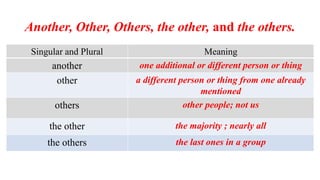
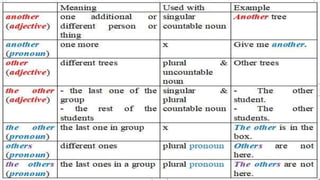
another one additional or different person or thing
other a different person or thing from one already
mentioned
others other people; not us
the other the majority ; nearly all
the others the last ones in a group
Another, Other, Others, the other, and the others.
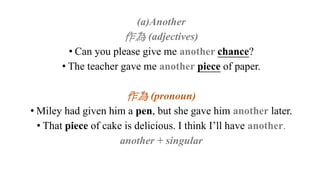
(a)Another
作為 (adjectives)
• Can you please give me another chance?
• The teacher gave me another piece of paper.
作為 (pronoun)
• Miley had given him a pen, but she gave him another later.
• That piece of cake is delicious. I think I’ll have another.
another + singular
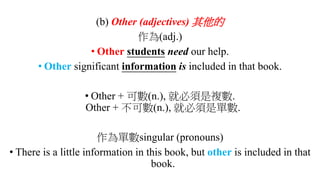
(b) Other (adjectives) 其他的
作為(adj.)
• Other students need our help.
• Other significant information is included in that book.
• Other + 可數(n.), 就必須是複數.
Other + 不可數(n.), 就必須是單數.
作為單數singular (pronouns)
• There is a little information in this book, but other is included in that
book.
(c) Others (pronouns) 其他的
• The students here are fine, but others need our help.
• I have carried some books with me. Others are with James.
• I don’t like these post cards. Let’s ask for others .
(d)The other 其餘的
作為(adjective)
• I have four pens. One is red while the other pens are blue.
• I have four pens. Three are red while the other pen is blue.
作為(pron.) [必須是單數singular]
• I have four pens. Three are red while the other is blue.
(e) The others (pron.) 其餘的[必須是複數 Plural]
• I have four pens. One is red while the others are blue.
• I am carrying some of the books. The others are still in my car.
Eg.
• I have five fingers on my right hand. One is thumb. Another is index finger.
Another is middle finger. Another is ring finger. Finally, the other is little finger.
• I have five pens. One is blue, others are black, the others are red.
• I have five pens. One is blue, others are black, the other is red.
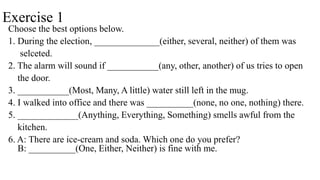
Exercise 1
Choose the best options below.
1. During the election, ______________(either, several, neither) of them was
selceted.
2. The alarm will sound if ___________(any, other, another) of us tries to open
the door.
3. ___________(Most, Many, A little) water still left in the mug.
4. I walked into office and there was __________(none, no one, nothing) there.
5. _____________(Anything, Everything, Something) smells awful from the
kitchen.
6. A: There are ice-cream and soda. Which one do you prefer?
B: __________(One, Either, Neither) is fine with me.
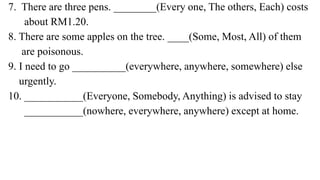
7. There are three pens. ________(Every one, The others, Each) costs
about RM1.20.
8. There are some apples on the tree. ____(Some, Most, All) of them
are poisonous.
9. I need to go __________(everywhere, anywhere, somewhere) else
urgently.
10. ___________(Everyone, Somebody, Anything) is advised to stay
___________(nowhere, everywhere, anywhere) except at home.
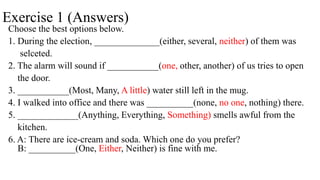
Exercise 1 (Answers)
Choose the best options below.
1. During the election, ______________(either, several, neither) of them was
selceted.
2. The alarm will sound if ___________(one, other, another) of us tries to open
the door.
3. ___________(Most, Many, A little) water still left in the mug.
4. I walked into office and there was __________(none, no one, nothing) there.
5. _____________(Anything, Everything, Something) smells awful from the
kitchen.
6. A: There are ice-cream and soda. Which one do you prefer?
B: __________(One, Either, Neither) is fine with me.
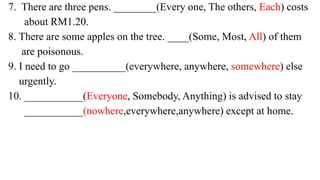
7. There are three pens. ________(Every one, The others, Each) costs
about RM1.20.
8. There are some apples on the tree. ____(Some, Most, All) of them
are poisonous.
9. I need to go __________(everywhere, anywhere, somewhere) else
urgently.
10. ___________(Everyone, Somebody, Anything) is advised to stay
___________(nowhere,everywhere,anywhere) except at home.
References
1) https://www.grammar-
monster.com/glossary/indefinite_pronoun.htm
2) https://www.englishclub.com/grammar/pronouns-
indefinite.htm#:~:text=An%20indefinite%20pronoun%20does
%20not,several%2C%20some%2C%20somebody%2Fsomeon
e
3) https://www.ef.com/wwen/english-resources/english-
grammar/indefinite-pronouns/
Indefinite pronouns ppt slides

Indefinite pronouns ppt slides

  • 1.
    What is IndefinitePronoun? Prepared by Ms Jovis
  • 2.
    What is IndefinitePronoun? An indefinite pronoun does not refer to any specific person, thing or amount.  It is vague and “not definite”.
  • 4.
    3 Types ofIndefinite Pronouns (分成三種) 1. Singular Indefinite Pronouns: Referring to only 1 thing, person or amount. 2. Plural Indefinite Pronouns Referring to more than 1 things or people. 3. Singular and Plural Indefinite Pronouns Referring to 1 and more than 1 things or people.
  • 5.
    1. Singular IndefinitePronouns:  Referring to only 1 thing: Singular Meanings everything all things: 1 group something an unspecified or unknown thing something anything no matter what person: interrogative or negative nothing no single thing, not anything
  • 6.
    Examples Negative: Nothing hereis precious Positive: Everything / Something here is precious.  Interrogative: Is anything here precious? Positive: Something has haunted the house. Negative: Nothing has haunted the house.  Interrogative: Has anything haunted the house?
  • 7.
    1. Singular IndefinitePronouns:  Referring to only 1 person: Singular Meanings a. everyone everybody people: 1 group b. someone somebody unspecified or unknown person c. anyone anybody atter what person: interrogative d. no one none no person
  • 8.
    Examples Positive: Someone hastaken my wallet. Negative: No one has taken my wallet. Interrogative: Has anyone taken my wallet? Interrogative: Is there anyone you know living here? Postive: There is someone I know living here. Negative: There is no one I know living here.
  • 9.
    Examples a. Everybody iscoming for the party. i. Everyone in this room does not have a car. b. Someone / Somebody has taken my wallet. ii. Clearly someone / somebody murdered him. It was not suicide.
  • 10.
    Examples c. Is thereanyone / anybody you know living here? i. Can anyone / anybody answer this question? d. No one / Nobody was here just now. ii. I phoned many times but nobody answered.
  • 11.
    2. Plural IndefinitePronouns  Referring to more than 1 things, people or amounts. Plural Meanings a. both (兩個) two people or things, seen together b. a few (一些[可數n.]) some: countable c. few (一些, 但幾乎沒有[可數n.]) a small number o d. many (很多[可數n.])a large number of people or things e. several (一些[可數n.]) more than 2 but not many
  • 12.
    (a)both i. James iscoming. Jenny is coming. (both…and…) ii. Both James and Jenny are coming. • Both of them are coming. • 注意:Both…and… 是conjunctions; both是indefinite pronoun. iii. A: There are ice-cream and soda. Which do you want? B: I want both (of them). / Both (of them) are good for me.
  • 13.
    (b) a few i.A: How many candles do you need? B: A few will work just fine. i. I had asked as many people as I could, but only came. (d) many i. There are a lot of people in the orphanage. Many are volunteers. (e) several i. Some roads are flooded by the rain. Only several are smooth.
  • 14.
    3. Singular andPlural Indefinite Pronouns  Referring to 1 and more than 1 things or people.  If the specified object is singular, then Indefinite Pronouns is singular; conversely, if the specified object is plural, then Indefinite Pronouns is plural Singular and Plural Meanings a. all the whole quantity of something or of some things or people b. some an unspecified quantity of something; an unspecified number of peple or things c. most a greater quantity of something; a greater number of people or thing d. more the majority ; nearly all
  • 15.
    Examples (a) all i. Thereis some water in the bottles. All is drinkable. ii. There are some berries on the trees. All are poisonous. specified object is “water”= is ; specified object “berries”= are (b) some i. I’ve got a lot of pearls. Some are cultured while some are natural. ii. All the equipment belongs to James, but some is broken. specified object is “pearls”= are ; specified object “equipment”= is
  • 16.
    Examples (c) most i. Ihave a lot of friends. Most are Indians. ii. I searched some information from the Internet. Most is useless. specified object is “friends”= are ; specified object “information”= is
  • 17.
    Examples i. A: Thereare only three bags of blood left. How many do you need? B: Three bags won’t be enough. I need more./ More are needed. ii. A: Is three minutes enough to complete that task? • B: No, it is not enough. We need more./ More is needed. specified object is “bags”= are ; specified object “time”= is
  • 18.
    Indefinite Pronouns  Referringto 1 place: all places, no place or any place Indefinite Pronouns: Places Meanings a. everywhere all places b. somewhere specific place c. nowhere no place d. anywhere in or to any place
  • 19.
    Examples a. everywhere i. Positve:I looked everywhere for my keys. ii. Interrogative: Have you looked everywhere? b. somewhere i. Positive: Keith is looking for somewhere to live. ii. Interrogative: Would you like to go somewhere this weekend? = invitation
  • 20.
    Examples c. nowhere i. Thereis nowhere as beautiful as Paris. d. anywhere i. Positive: Fido would follow you anywhere. ii. Negative: She didn’t go anywhere last week. iii. Interrogative: Did you go anywhere last night?
  • 21.
  • 22.
    Indefinite Pronouns whichrefers to a things and a person. (代表一個人和一個東西的) Indefinite Pronouns Meanings a. either one or the other of two people or things b. neither not one and not the other of two people or things c. one an unidentified person d. each / every one every one of two or more people or things, seen separately e. a little a small amount--some: uncountable noun f. little a small amount: uncountable noun g. much a large amount h. none not any; no person or persons
  • 23.
    (a) either (oneor the other of two people or things) i. A: There are ice-cream and soda. Which one do you prefer? B: Either is fine with me. • 這裡的Either 指的是: 不是ice-cream, 就是soda (b) neither (not one and not the other of two people or things) ii. C: I saw a pink dress and a blue dress. Which one of them is yours? D: Neither is mine. • 這裡的Neither指的是: 兩個dresses裡, 沒有一個是
  • 24.
    (c) one (anunidentified person) i. There are three pens. One of the pens is mine. ii. There are three pens. One is mine. 這裡的One 指的是: 其中一個pen ii. A: How many pieces of pizza do you want? B: (i) One piece is enough for me. (ii) One is enough for me. • 注意: (i) One + piece 的情況下, one 是 adj. (ii) One 是 indefinite pronoun
  • 25.
    (d) each /every one (every one of two or more people or things, seen separately) i. There are three pens. Each of the pens/them is mine. ii. There are three pens. Every one of the pens/them is mine. iii. There are three pens. Each (pen) costs about RM1.20 iv. There are three pens. Each costs about RM1.20. • 這裡的Each/Every one 指的是 每一個pen • 注意: • 用every one 會加上of • Everyone 不等於 Every one
  • 26.
    (e) a little(a small amount--some: uncountable noun) i. About his life, we knew only a little. ii. A: How much salt do I need to put into the soup? B: A little is enough. (f) little (a small amount: uncountable noun) i. Regarding the information that you need, we just gathered little. ii. Can you spare me some money? I just have little left. (g) much (a large amount) i. The food is not enough, but much will be needed tomorrow. ii. Time is running out. We don’t have much left. Run now!
  • 27.
    (h) none (notany; no person or persons) i. I have invited five friends, but none (of them) is here. ii. None of the teachers is absent.
  • 28.
    Singular and PluralMeaning another one additional or different person or thing other a different person or thing from one already mentioned others other people; not us the other the majority ; nearly all the others the last ones in a group Another, Other, Others, the other, and the others.
  • 30.
    (a)Another 作為 (adjectives) • Canyou please give me another chance? • The teacher gave me another piece of paper. 作為 (pronoun) • Miley had given him a pen, but she gave him another later. • That piece of cake is delicious. I think I’ll have another. another + singular
  • 31.
    (b) Other (adjectives)其他的 作為(adj.) • Other students need our help. • Other significant information is included in that book. • Other + 可數(n.), 就必須是複數. Other + 不可數(n.), 就必須是單數. 作為單數singular (pronouns) • There is a little information in this book, but other is included in that book.
  • 32.
    (c) Others (pronouns)其他的 • The students here are fine, but others need our help. • I have carried some books with me. Others are with James. • I don’t like these post cards. Let’s ask for others . (d)The other 其餘的 作為(adjective) • I have four pens. One is red while the other pens are blue. • I have four pens. Three are red while the other pen is blue. 作為(pron.) [必須是單數singular] • I have four pens. Three are red while the other is blue.
  • 33.
    (e) The others(pron.) 其餘的[必須是複數 Plural] • I have four pens. One is red while the others are blue. • I am carrying some of the books. The others are still in my car. Eg. • I have five fingers on my right hand. One is thumb. Another is index finger. Another is middle finger. Another is ring finger. Finally, the other is little finger. • I have five pens. One is blue, others are black, the others are red. • I have five pens. One is blue, others are black, the other is red.
  • 34.
    Exercise 1 Choose thebest options below. 1. During the election, ______________(either, several, neither) of them was selceted. 2. The alarm will sound if ___________(any, other, another) of us tries to open the door. 3. ___________(Most, Many, A little) water still left in the mug. 4. I walked into office and there was __________(none, no one, nothing) there. 5. _____________(Anything, Everything, Something) smells awful from the kitchen. 6. A: There are ice-cream and soda. Which one do you prefer? B: __________(One, Either, Neither) is fine with me.
  • 35.
    7. There arethree pens. ________(Every one, The others, Each) costs about RM1.20. 8. There are some apples on the tree. ____(Some, Most, All) of them are poisonous. 9. I need to go __________(everywhere, anywhere, somewhere) else urgently. 10. ___________(Everyone, Somebody, Anything) is advised to stay ___________(nowhere, everywhere, anywhere) except at home.
  • 36.
    Exercise 1 (Answers) Choosethe best options below. 1. During the election, ______________(either, several, neither) of them was selceted. 2. The alarm will sound if ___________(one, other, another) of us tries to open the door. 3. ___________(Most, Many, A little) water still left in the mug. 4. I walked into office and there was __________(none, no one, nothing) there. 5. _____________(Anything, Everything, Something) smells awful from the kitchen. 6. A: There are ice-cream and soda. Which one do you prefer? B: __________(One, Either, Neither) is fine with me.
  • 37.
    7. There arethree pens. ________(Every one, The others, Each) costs about RM1.20. 8. There are some apples on the tree. ____(Some, Most, All) of them are poisonous. 9. I need to go __________(everywhere, anywhere, somewhere) else urgently. 10. ___________(Everyone, Somebody, Anything) is advised to stay ___________(nowhere,everywhere,anywhere) except at home.
  • 38.