



In phonetics, a diphthong
literally "with two sounds," or
"with two tones") is a vowel
combination in a single syllable
involving a quick but smooth
movement from one vowel to
another, often interpreted by
listeners as a single vowel sound
or phoneme.
Diphthongs are represented by
two symbols, for example English
"same" as /seim/, where the two
vowel symbols are intended to
represent approximately the
beginning and ending tongue
positions.




The first letter shows
the starting point and
the second indicates the
direction of movement.
The terms, closing and
centering, refer to the
tongue position when it
produces those sounds.
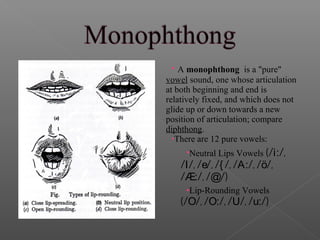
• A monophthong is a "pure"
vowel sound, one whose articulation
at both beginning and end is
relatively fixed, and which does not
glide up or down towards a new
position of articulation; compare
diphthong.
•There are 12 pure vowels:
•Neutral Lips Vowels (/i:/,

/I/, /e/, /{ /, /A:/, /ö/,
/Æ:/, /@/)
•Lip-Rounding Vowels

(/O/, /O:/, /U/, /u:/)
/ei / is the so-called ‘long’ sound of the
letter a as in came /keim/.
The diphthong /ei / starts at about the
English /e/ or Vowel No. 3 and moves in
the direction of /i/ or Vowel No. 2.
Example: a – late /leit/, waste /weist/
ai, ay – rain /rein/, day /dei /
ei, ey – eight /eit/, they /Dei /
ea – great /greit/, break /breik/
exceptional: gauge /geiD/
•

•

Features:
• height of tongue: between halfopen and open
• part of the tongue which is
highest: the ‘front’
• position of lips: spread or
neutral
• opening between the jaws:
medium to wide
Examples:
› a – glad /gl{ d/, cat /k{ t/
› ai – plait /pl{ t/, plaid /pl{ d/
•

•

Features:
• height of tongue: between halfopen and open
• part of the tongue which is
highest: the ‘front’
• position of lips: spread or
neutral
• opening between the jaws:
medium to wide
Examples:
› a – glad /gl{ d/, cat /k{ t/
› ai – plait /pl{ t/, plaid /pl{ d/

Pronunciation 2

  • 2.
      In phonetics, adiphthong literally "with two sounds," or "with two tones") is a vowel combination in a single syllable involving a quick but smooth movement from one vowel to another, often interpreted by listeners as a single vowel sound or phoneme. Diphthongs are represented by two symbols, for example English "same" as /seim/, where the two vowel symbols are intended to represent approximately the beginning and ending tongue positions.
  • 3.
      The first lettershows the starting point and the second indicates the direction of movement. The terms, closing and centering, refer to the tongue position when it produces those sounds.
  • 4.
    • A monophthongis a "pure" vowel sound, one whose articulation at both beginning and end is relatively fixed, and which does not glide up or down towards a new position of articulation; compare diphthong. •There are 12 pure vowels: •Neutral Lips Vowels (/i:/, /I/, /e/, /{ /, /A:/, /ö/, /Æ:/, /@/) •Lip-Rounding Vowels (/O/, /O:/, /U/, /u:/)
  • 5.
    /ei / isthe so-called ‘long’ sound of the letter a as in came /keim/. The diphthong /ei / starts at about the English /e/ or Vowel No. 3 and moves in the direction of /i/ or Vowel No. 2. Example: a – late /leit/, waste /weist/ ai, ay – rain /rein/, day /dei / ei, ey – eight /eit/, they /Dei / ea – great /greit/, break /breik/ exceptional: gauge /geiD/
  • 6.
    • • Features: • height oftongue: between halfopen and open • part of the tongue which is highest: the ‘front’ • position of lips: spread or neutral • opening between the jaws: medium to wide Examples: › a – glad /gl{ d/, cat /k{ t/ › ai – plait /pl{ t/, plaid /pl{ d/
  • 7.
    • • Features: • height oftongue: between halfopen and open • part of the tongue which is highest: the ‘front’ • position of lips: spread or neutral • opening between the jaws: medium to wide Examples: › a – glad /gl{ d/, cat /k{ t/ › ai – plait /pl{ t/, plaid /pl{ d/