Present Future Tense
Simple Future has two different forms in
English: "will" and "be going to." Although
the two forms can sometimes be used
interchangeably, they often express two
very different meanings. These different
meanings might seem too abstract at first,
but with time and practice, the differences
will become clear. Both "will" and "be
going to" refer to a specific time in the
future.
Discussing the future using going to
We say something is going to happen
when it has already been planned.
FORM Be Going To
S + am/is/are + going to + verb1 + O + TS
Examples:
• You are going to meet Jane tonight.
• Are you going to meet Jane tonight?
• You are not going to meet Jane tonight
"Be going to" to Express a Plan
Be going to" expresses that something is a
plan. It expresses the idea that a person
intends to do something in the future. It
does not matter whether the plan is
realistic or not.
Examples:
• He is going to spend his vacation in
Hawaii.
• She is not going to spend her vacation in
Hawaii.
• A: When are we going to meet each
other tonight?
B: We are going to meet at 6 PM.
• I'm going to be an actor when I grow up.
• Michelle is going to begin medical school
next year.
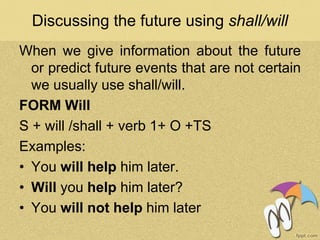
Discussing the future using shall/will
When we give information about the future
or predict future events that are not certain
we usually use shall/will.
FORM Will
S + will /shall + verb 1+ O +TS
Examples:
• You will help him later.
• Will you help him later?
• You will not help him later
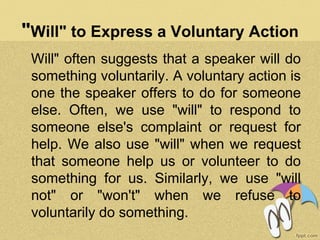
"Will" to Express a Voluntary Action
Will" often suggests that a speaker will do
something voluntarily. A voluntary action is
one the speaker offers to do for someone
else. Often, we use "will" to respond to
someone else's complaint or request for
help. We also use "will" when we request
that someone help us or volunteer to do
something for us. Similarly, we use "will
not" or "won't" when we refuse to
voluntarily do something.
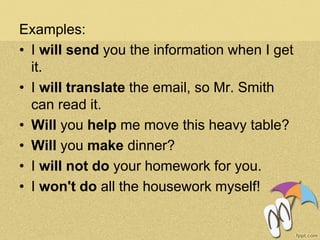
Examples:
• I will send you the information when I get
it.
• I will translate the email, so Mr. Smith
can read it.
• Will you help me move this heavy table?
• Will you make dinner?
• I will not do your homework for you.
• I won't do all the housework myself!
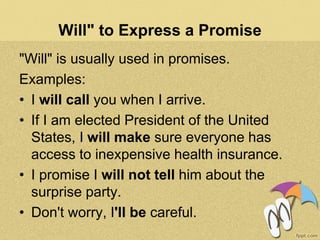
Will" to Express a Promise
"Will" is usually used in promises.
Examples:
• I will call you when I arrive.
• If I am elected President of the United
States, I will make sure everyone has
access to inexpensive health insurance.
• I promise I will not tell him about the
surprise party.
• Don't worry, I'll be careful.

5.present future tense

  • 1.
    Present Future Tense SimpleFuture has two different forms in English: "will" and "be going to." Although the two forms can sometimes be used interchangeably, they often express two very different meanings. These different meanings might seem too abstract at first, but with time and practice, the differences will become clear. Both "will" and "be going to" refer to a specific time in the future.
  • 2.
    Discussing the futureusing going to We say something is going to happen when it has already been planned. FORM Be Going To S + am/is/are + going to + verb1 + O + TS Examples: • You are going to meet Jane tonight. • Are you going to meet Jane tonight? • You are not going to meet Jane tonight
  • 3.
    "Be going to"to Express a Plan Be going to" expresses that something is a plan. It expresses the idea that a person intends to do something in the future. It does not matter whether the plan is realistic or not.
  • 4.
    Examples: • He isgoing to spend his vacation in Hawaii. • She is not going to spend her vacation in Hawaii. • A: When are we going to meet each other tonight? B: We are going to meet at 6 PM. • I'm going to be an actor when I grow up. • Michelle is going to begin medical school next year.
  • 5.
    Discussing the futureusing shall/will When we give information about the future or predict future events that are not certain we usually use shall/will. FORM Will S + will /shall + verb 1+ O +TS Examples: • You will help him later. • Will you help him later? • You will not help him later
  • 6.
    "Will" to Expressa Voluntary Action Will" often suggests that a speaker will do something voluntarily. A voluntary action is one the speaker offers to do for someone else. Often, we use "will" to respond to someone else's complaint or request for help. We also use "will" when we request that someone help us or volunteer to do something for us. Similarly, we use "will not" or "won't" when we refuse to voluntarily do something.
  • 7.
    Examples: • I willsend you the information when I get it. • I will translate the email, so Mr. Smith can read it. • Will you help me move this heavy table? • Will you make dinner? • I will not do your homework for you. • I won't do all the housework myself!
  • 8.
    Will" to Expressa Promise "Will" is usually used in promises. Examples: • I will call you when I arrive. • If I am elected President of the United States, I will make sure everyone has access to inexpensive health insurance. • I promise I will not tell him about the surprise party. • Don't worry, I'll be careful.