SPELLING RULES -ING
Gerunds Verb
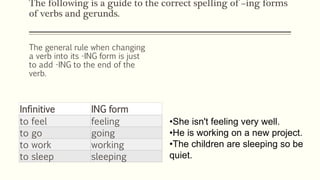
The following is a guide to the correct spelling of –ing forms
of verbs and gerunds.
Infinitive ING form
to feel feeling
to go going
to work working
to sleep sleeping
The general rule when changing
a verb into its -ING form is just
to add -ING to the end of the
verb.
•She isn't feeling very well.
•He is working on a new project.
•The children are sleeping so be
quiet.
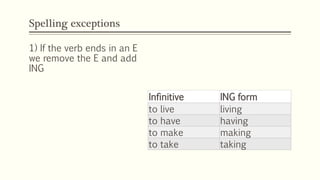
Spelling exceptions
Infinitive ING form
to live living
to have having
to make making
to take taking
1) If the verb ends in an E
we remove the E and add
ING
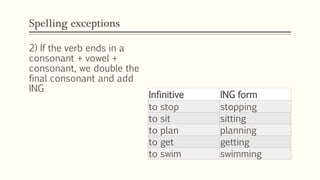
Spelling exceptions
Infinitive ING form
to stop stopping
to sit sitting
to plan planning
to get getting
to swim swimming
2) If the verb ends in a
consonant + vowel +
consonant, we double the
final consonant and add
ING
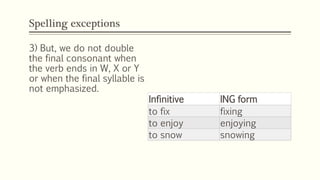
Spelling exceptions
Infinitive ING form
to fix fixing
to enjoy enjoying
to snow snowing
3) But, we do not double
the final consonant when
the verb ends in W, X or Y
or when the final syllable is
not emphasized.
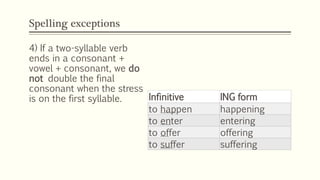
Spelling exceptions
Infinitive ING form
to happen happening
to enter entering
to offer offering
to suffer suffering
4) If a two-syllable verb
ends in a consonant +
vowel + consonant, we do
not double the final
consonant when the stress
is on the first syllable.
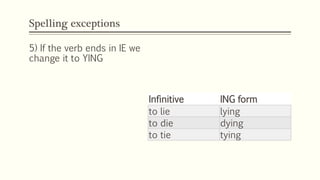
Spelling exceptions
Infinitive ING form
to lie lying
to die dying
to tie tying
5) If the verb ends in IE we
change it to YING
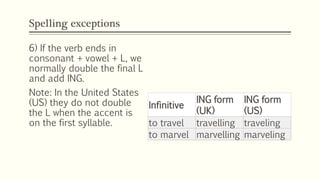
Spelling exceptions
Infinitive
ING form
(UK)
ING form
(US)
to travel travelling traveling
to marvel marvelling marveling
6) If the verb ends in
consonant + vowel + L, we
normally double the final L
and add ING.
Note: In the United States
(US) they do not double
the L when the accent is
on the first syllable.
Spelling exceptions
Infinitive ING form
refer referring
defer deferring
7) If the verb ends in a
stressed vowel + R, we
double the final R and add
ING.
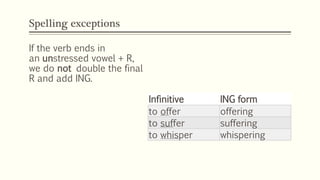
Spelling exceptions
Infinitive ING form
to offer offering
to suffer suffering
to whisper whispering
If the verb ends in
an unstressed vowel + R,
we do not double the final
R and add ING.
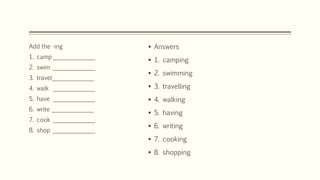
 Answers
 1. camping
 2. swimming
 3. travelling
 4. walking
 5. having
 6. writing
 7. cooking
 8. shopping
Add the -ing
1. camp ______________
2. swim ______________
3. travel______________
4. walk ______________
5. have ______________
6. write ______________
7. cook ______________
8. shop ______________
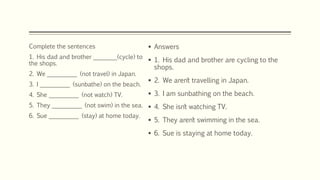
 Answers
 1. His dad and brother are cycling to the
shops.
 2. We aren´t travelling in Japan.
 3. I am sunbathing on the beach.
 4. She isn´t watching TV.
 5. They aren´t swimming in the sea.
 6. Sue is staying at home today.
Complete the sentences
1. His dad and brother ________(cycle) to
the shops.
2. We __________ (not travel) in Japan.
3. I __________ (sunbathe) on the beach.
4. She __________ (not watch) TV.
5. They __________ (not swim) in the sea.
6. Sue __________ (stay) at home today.
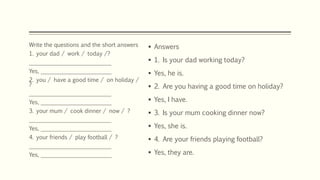
 Answers
 1. Is your dad working today?
 Yes, he is.
 2. Are you having a good time on holiday?
 Yes, I have.
 3. Is your mum cooking dinner now?
 Yes, she is.
 4. Are your friends playing football?
 Yes, they are.
Write the questions and the short answers
1. your dad / work / today /?
_____________________________
Yes, _________________________
2. you / have a good time / on holiday /
?
_____________________________
Yes, _________________________
3. your mum / cook dinner / now / ?
_____________________________
Yes, _________________________
4. your friends / play football / ?
_____________________________
Yes, _________________________
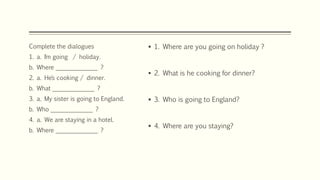
 1. Where are you going on holiday ?
 2. What is he cooking for dinner?
 3. Who is going to England?
 4. Where are you staying?
Complete the dialogues
1. a. I´m going / holiday.
b. Where ______________ ?
2. a. He´s cooking / dinner.
b. What ______________ ?
3. a. My sister is going to England.
b. Who ______________ ?
4. a. We are staying in a hotel.
b. Where ______________ ?
Spelling rules  ing

Spelling rules ing

  • 1.
  • 2.
    The following isa guide to the correct spelling of –ing forms of verbs and gerunds. Infinitive ING form to feel feeling to go going to work working to sleep sleeping The general rule when changing a verb into its -ING form is just to add -ING to the end of the verb. •She isn't feeling very well. •He is working on a new project. •The children are sleeping so be quiet.
  • 3.
    Spelling exceptions Infinitive INGform to live living to have having to make making to take taking 1) If the verb ends in an E we remove the E and add ING
  • 4.
    Spelling exceptions Infinitive INGform to stop stopping to sit sitting to plan planning to get getting to swim swimming 2) If the verb ends in a consonant + vowel + consonant, we double the final consonant and add ING
  • 5.
    Spelling exceptions Infinitive INGform to fix fixing to enjoy enjoying to snow snowing 3) But, we do not double the final consonant when the verb ends in W, X or Y or when the final syllable is not emphasized.
  • 6.
    Spelling exceptions Infinitive INGform to happen happening to enter entering to offer offering to suffer suffering 4) If a two-syllable verb ends in a consonant + vowel + consonant, we do not double the final consonant when the stress is on the first syllable.
  • 7.
    Spelling exceptions Infinitive INGform to lie lying to die dying to tie tying 5) If the verb ends in IE we change it to YING
  • 8.
    Spelling exceptions Infinitive ING form (UK) INGform (US) to travel travelling traveling to marvel marvelling marveling 6) If the verb ends in consonant + vowel + L, we normally double the final L and add ING. Note: In the United States (US) they do not double the L when the accent is on the first syllable.
  • 9.
    Spelling exceptions Infinitive INGform refer referring defer deferring 7) If the verb ends in a stressed vowel + R, we double the final R and add ING.
  • 10.
    Spelling exceptions Infinitive INGform to offer offering to suffer suffering to whisper whispering If the verb ends in an unstressed vowel + R, we do not double the final R and add ING.
  • 11.
     Answers  1.camping  2. swimming  3. travelling  4. walking  5. having  6. writing  7. cooking  8. shopping Add the -ing 1. camp ______________ 2. swim ______________ 3. travel______________ 4. walk ______________ 5. have ______________ 6. write ______________ 7. cook ______________ 8. shop ______________
  • 12.
     Answers  1.His dad and brother are cycling to the shops.  2. We aren´t travelling in Japan.  3. I am sunbathing on the beach.  4. She isn´t watching TV.  5. They aren´t swimming in the sea.  6. Sue is staying at home today. Complete the sentences 1. His dad and brother ________(cycle) to the shops. 2. We __________ (not travel) in Japan. 3. I __________ (sunbathe) on the beach. 4. She __________ (not watch) TV. 5. They __________ (not swim) in the sea. 6. Sue __________ (stay) at home today.
  • 13.
     Answers  1.Is your dad working today?  Yes, he is.  2. Are you having a good time on holiday?  Yes, I have.  3. Is your mum cooking dinner now?  Yes, she is.  4. Are your friends playing football?  Yes, they are. Write the questions and the short answers 1. your dad / work / today /? _____________________________ Yes, _________________________ 2. you / have a good time / on holiday / ? _____________________________ Yes, _________________________ 3. your mum / cook dinner / now / ? _____________________________ Yes, _________________________ 4. your friends / play football / ? _____________________________ Yes, _________________________
  • 14.
     1. Whereare you going on holiday ?  2. What is he cooking for dinner?  3. Who is going to England?  4. Where are you staying? Complete the dialogues 1. a. I´m going / holiday. b. Where ______________ ? 2. a. He´s cooking / dinner. b. What ______________ ? 3. a. My sister is going to England. b. Who ______________ ? 4. a. We are staying in a hotel. b. Where ______________ ?