Simple and
Compound
Interest
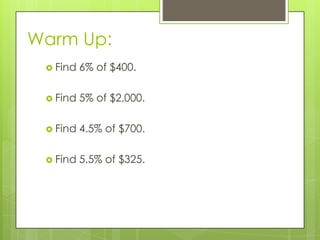
Warm Up:
 Find

6% of $400.

 Find

5% of $2,000.

 Find

4.5% of $700.

 Find

5.5% of $325.
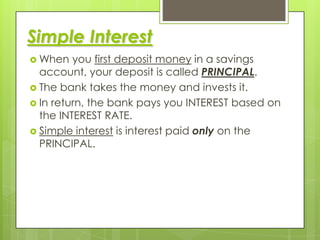
Simple Interest
 When

you first deposit money in a savings
account, your deposit is called PRINCIPAL.
 The bank takes the money and invests it.
 In return, the bank pays you INTEREST based on
the INTEREST RATE.
 Simple interest is interest paid only on the
PRINCIPAL.
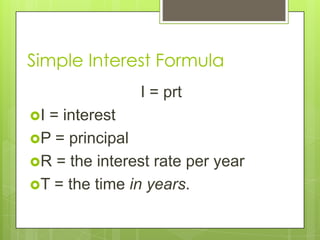
Simple Interest Formula
I = prt
I

= interest
P = principal
R = the interest rate per year
T = the time in years.
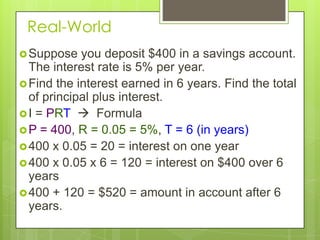
Real-World
 Suppose

you deposit $400 in a savings account.
The interest rate is 5% per year.
 Find the interest earned in 6 years. Find the total
of principal plus interest.
 I = PRT  Formula
 P = 400, R = 0.05 = 5%, T = 6 (in years)
 400 x 0.05 = 20 = interest on one year
 400 x 0.05 x 6 = 120 = interest on $400 over 6
years
 400 + 120 = $520 = amount in account after 6
years.
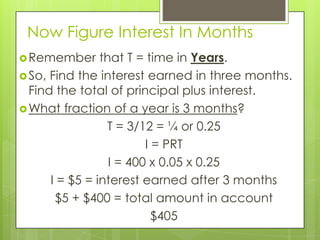
Now Figure Interest In Months
 Remember

that T = time in Years.
 So, Find the interest earned in three months.
Find the total of principal plus interest.
 What fraction of a year is 3 months?
T = 3/12 = ¼ or 0.25
I = PRT
I = 400 x 0.05 x 0.25
I = $5 = interest earned after 3 months
$5 + $400 = total amount in account
$405
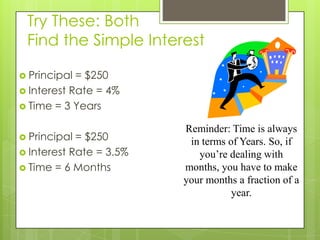
Try These: Both
Find the Simple Interest
 Principal

= $250
 Interest Rate = 4%
 Time = 3 Years
 Principal

= $250
 Interest Rate = 3.5%
 Time = 6 Months

Reminder: Time is always
in terms of Years. So, if
you’re dealing with
months, you have to make
your months a fraction of a
year.
Compound Interest
 Compound

Interest is when the bank pays
interest on the Principal AND the Interest already
earned.
 The Balance is the Principal PLUS the Interest.
 The Balance becomes the Principal on which the
bank figures the next interest payment when
doing Compound Interest.
Compound Interest Example
 You

deposit $400 in an account that earns 5%
interest compounded annually (once per year).
What is the balance in your account after 4
years? In your last calculation, round to the
nearest cent.
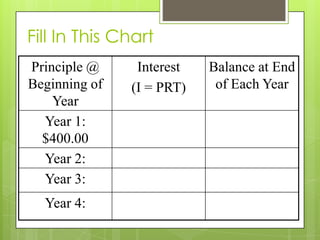
Fill In This Chart
Principle @
Beginning of
Year
Year 1:
$400.00
Year 2:
Year 3:
Year 4:

Interest
(I = PRT)

Balance at End
of Each Year
Compound Interest Formula
 You

can find a balance using compound
interest in one step with the compound
interest formula.
 An INTEREST PERIOD is the length of time
over which interest is calculated.
 The Interest Period can be a year or less
than a year.
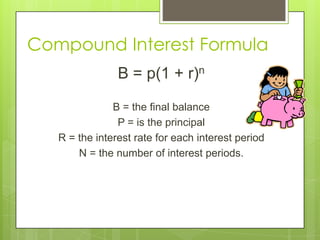
Compound Interest Formula
B = p(1 + r)n
B = the final balance
P = is the principal
R = the interest rate for each interest period
N = the number of interest periods.
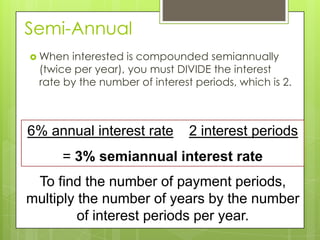
Semi-Annual
 When

interested is compounded semiannually
(twice per year), you must DIVIDE the interest
rate by the number of interest periods, which is 2.

6% annual interest rate

2 interest periods

= 3% semiannual interest rate
To find the number of payment periods,
multiply the number of years by the number
of interest periods per year.
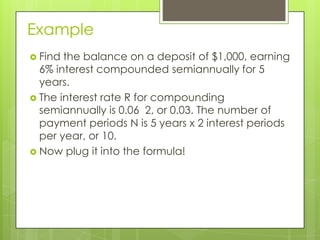
Example
 Find

the balance on a deposit of $1,000, earning
6% interest compounded semiannually for 5
years.
 The interest rate R for compounding
semiannually is 0.06 2, or 0.03. The number of
payment periods N is 5 years x 2 interest periods
per year, or 10.
 Now plug it into the formula!
The Formula!
B = p (1 + R)n
B = $1,000 (1 + 0.03)10
B = $1,000 (1.03)10
B = $1,000 (1.34391638)
B = $1,343.92
Happy? You’ll actually get to use a
calculator for these =]
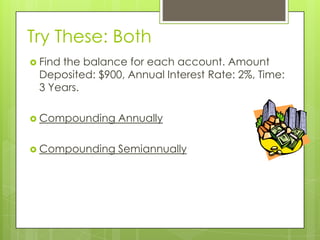
Try These: Both
 Find

the balance for each account. Amount
Deposited: $900, Annual Interest Rate: 2%, Time:
3 Years.

 Compounding

Annually

 Compounding

Semiannually

Simple and compound interest student

  • 1.
  • 2.
    Warm Up:  Find 6%of $400.  Find 5% of $2,000.  Find 4.5% of $700.  Find 5.5% of $325.
  • 3.
    Simple Interest  When youfirst deposit money in a savings account, your deposit is called PRINCIPAL.  The bank takes the money and invests it.  In return, the bank pays you INTEREST based on the INTEREST RATE.  Simple interest is interest paid only on the PRINCIPAL.
  • 4.
    Simple Interest Formula I= prt I = interest P = principal R = the interest rate per year T = the time in years.
  • 5.
    Real-World  Suppose you deposit$400 in a savings account. The interest rate is 5% per year.  Find the interest earned in 6 years. Find the total of principal plus interest.  I = PRT  Formula  P = 400, R = 0.05 = 5%, T = 6 (in years)  400 x 0.05 = 20 = interest on one year  400 x 0.05 x 6 = 120 = interest on $400 over 6 years  400 + 120 = $520 = amount in account after 6 years.
  • 6.
    Now Figure InterestIn Months  Remember that T = time in Years.  So, Find the interest earned in three months. Find the total of principal plus interest.  What fraction of a year is 3 months? T = 3/12 = ¼ or 0.25 I = PRT I = 400 x 0.05 x 0.25 I = $5 = interest earned after 3 months $5 + $400 = total amount in account $405
  • 7.
    Try These: Both Findthe Simple Interest  Principal = $250  Interest Rate = 4%  Time = 3 Years  Principal = $250  Interest Rate = 3.5%  Time = 6 Months Reminder: Time is always in terms of Years. So, if you’re dealing with months, you have to make your months a fraction of a year.
  • 8.
    Compound Interest  Compound Interestis when the bank pays interest on the Principal AND the Interest already earned.  The Balance is the Principal PLUS the Interest.  The Balance becomes the Principal on which the bank figures the next interest payment when doing Compound Interest.
  • 9.
    Compound Interest Example You deposit $400 in an account that earns 5% interest compounded annually (once per year). What is the balance in your account after 4 years? In your last calculation, round to the nearest cent.
  • 10.
    Fill In ThisChart Principle @ Beginning of Year Year 1: $400.00 Year 2: Year 3: Year 4: Interest (I = PRT) Balance at End of Each Year
  • 11.
    Compound Interest Formula You can find a balance using compound interest in one step with the compound interest formula.  An INTEREST PERIOD is the length of time over which interest is calculated.  The Interest Period can be a year or less than a year.
  • 12.
    Compound Interest Formula B= p(1 + r)n B = the final balance P = is the principal R = the interest rate for each interest period N = the number of interest periods.
  • 13.
    Semi-Annual  When interested iscompounded semiannually (twice per year), you must DIVIDE the interest rate by the number of interest periods, which is 2. 6% annual interest rate 2 interest periods = 3% semiannual interest rate To find the number of payment periods, multiply the number of years by the number of interest periods per year.
  • 14.
    Example  Find the balanceon a deposit of $1,000, earning 6% interest compounded semiannually for 5 years.  The interest rate R for compounding semiannually is 0.06 2, or 0.03. The number of payment periods N is 5 years x 2 interest periods per year, or 10.  Now plug it into the formula!
  • 15.
    The Formula! B =p (1 + R)n B = $1,000 (1 + 0.03)10 B = $1,000 (1.03)10 B = $1,000 (1.34391638) B = $1,343.92 Happy? You’ll actually get to use a calculator for these =]
  • 16.
    Try These: Both Find the balance for each account. Amount Deposited: $900, Annual Interest Rate: 2%, Time: 3 Years.  Compounding Annually  Compounding Semiannually