Section 5.1:
Section 5.1:
Simple and Compound Interest
Simple Interest
Simple Interest
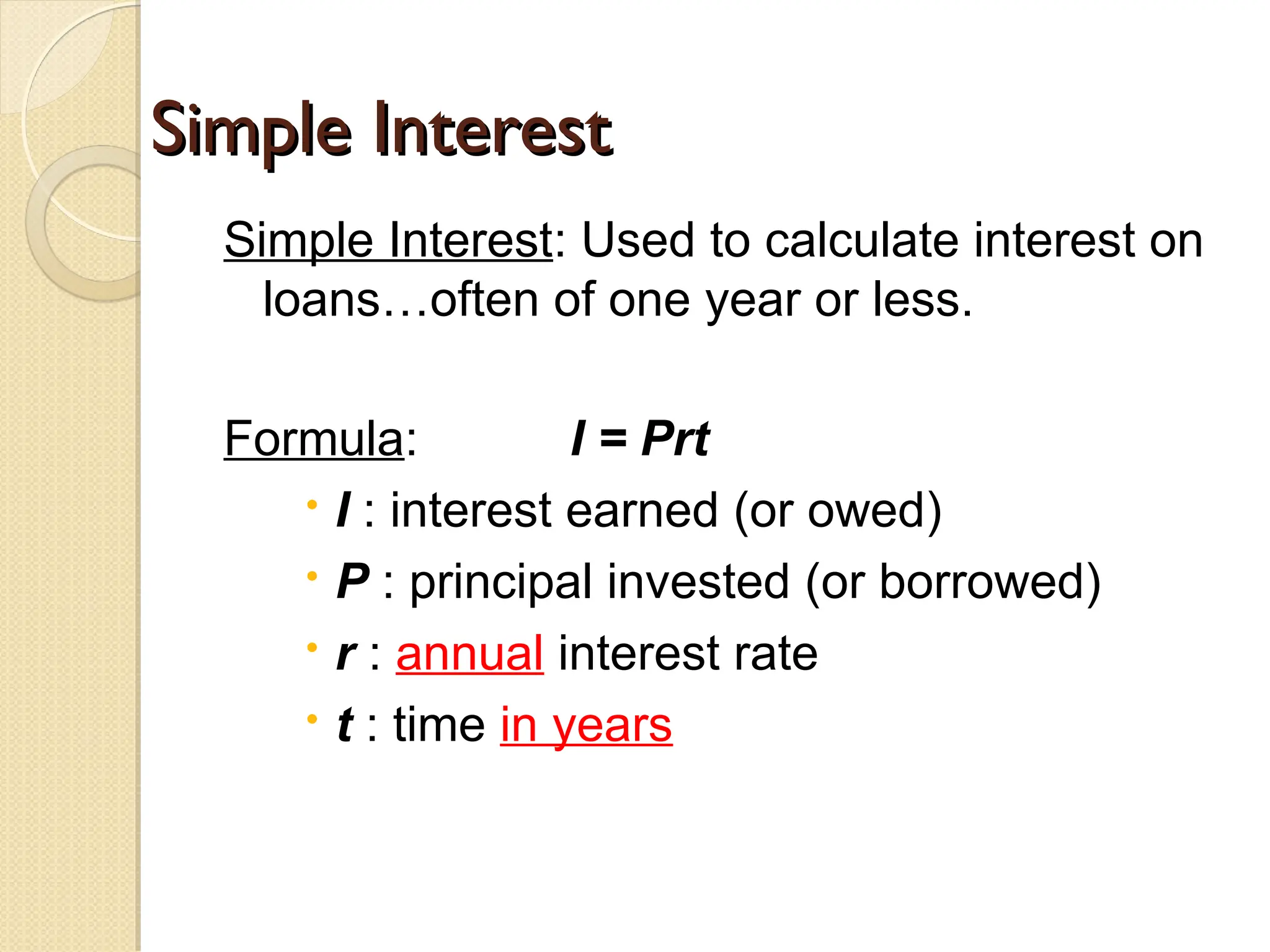
Simple Interest: Used to calculate interest on
loans…often of one year or less.
Formula: I = Prt
 I : interest earned (or owed)
 P : principal invested (or borrowed)
 r : annual interest rate
 t : time in years
Example 1
Example 1
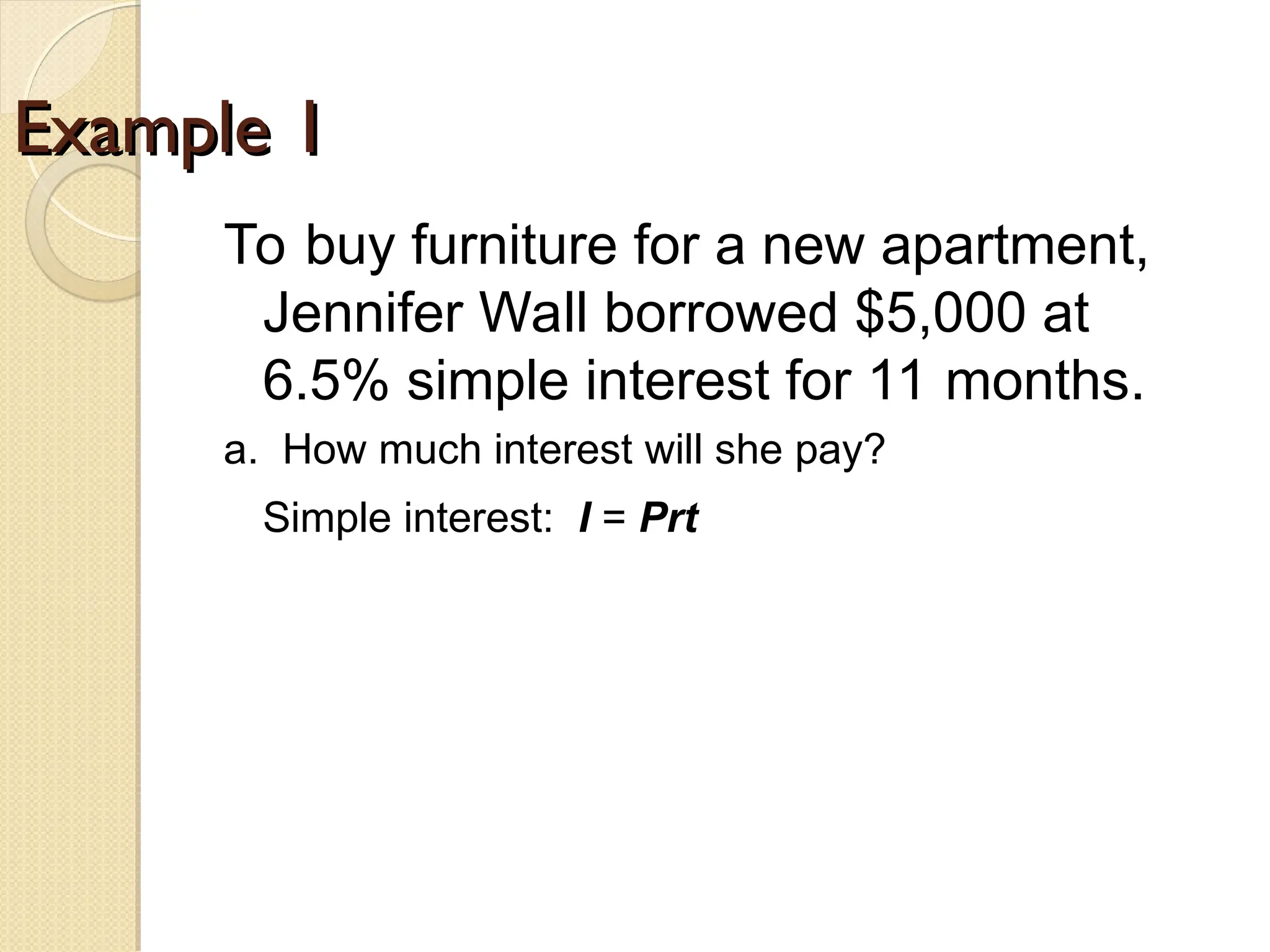
To buy furniture for a new apartment,
Jennifer Wall borrowed $5,000 at
6.5% simple interest for 11 months.
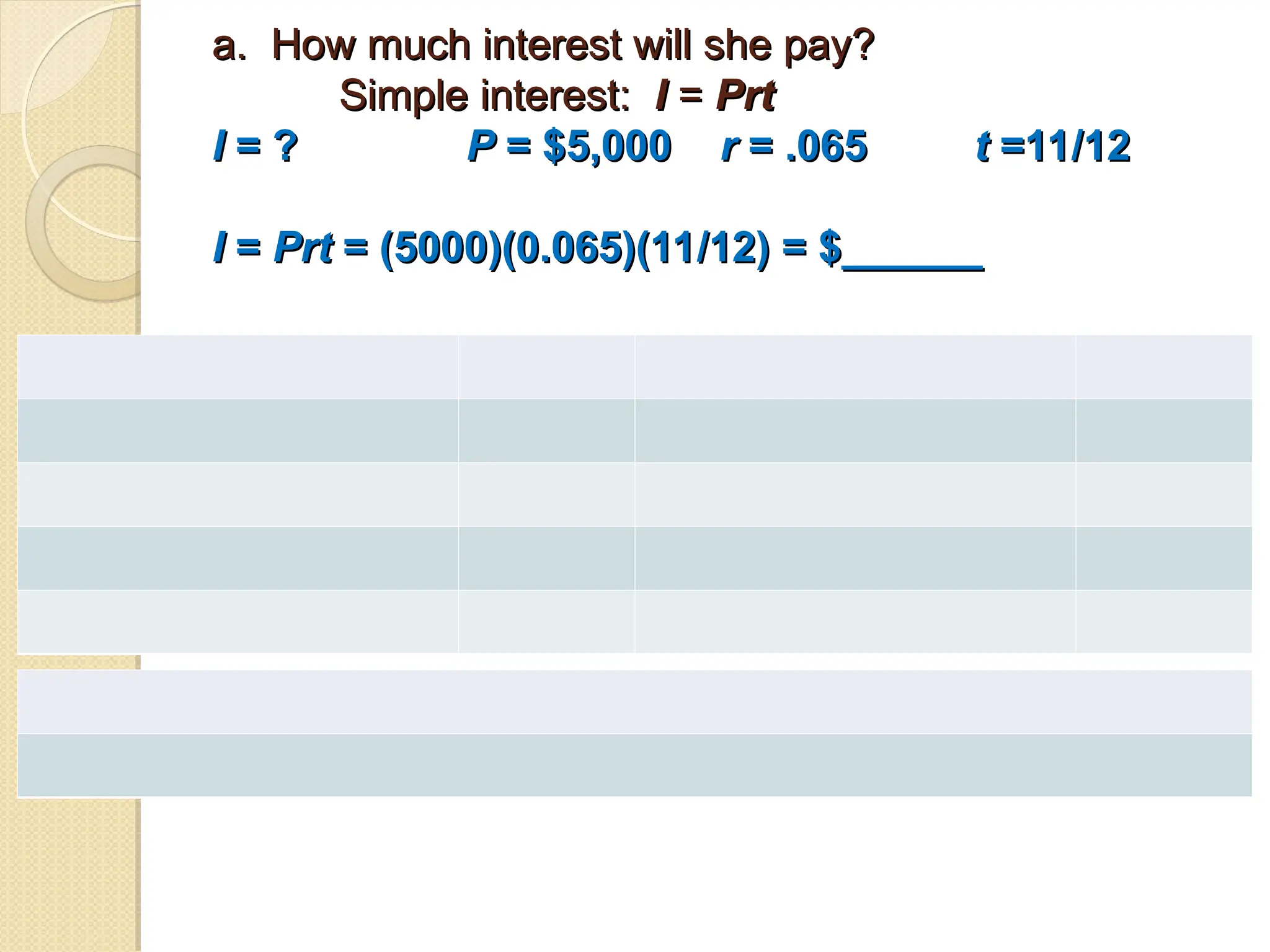
a. How much interest will she pay?
Simple interest: I = Prt
I = ?
Example 1
Example 1
To buy furniture for a new apartment,
Jennifer Wall borrowed $5,000 at
6.5% simple interest for 11 months.
a. How much interest will she pay?
Simple interest: I = Prt
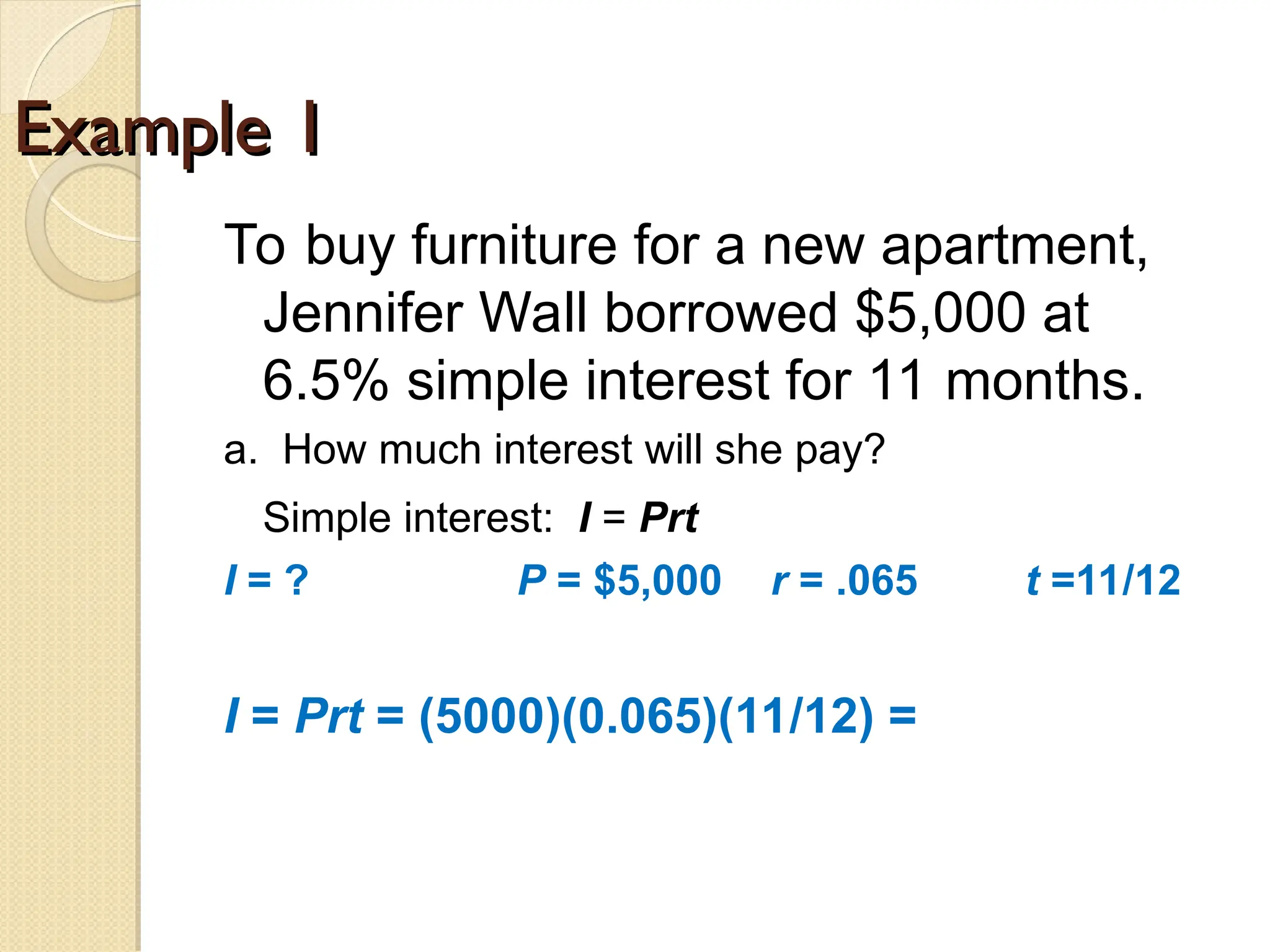
I = ? P = $5,000 r = .065 t =11/12
Example 1
Example 1
To buy furniture for a new apartment,
Jennifer Wall borrowed $5,000 at
6.5% simple interest for 11 months.
a. How much interest will she pay?
Simple interest: I = Prt
I = ? P = $5,000 r = .065 t =11/12
I = Prt = (5000)(0.065)(11/12) =
a. How much interest will she pay?
Simple interest:
Simple interest: I
I =
= Prt
Prt
I
I = ?
= ? P
P = $5,000
= $5,000 r
r = .065
= .065 t
t =11/12
=11/12
I
I =
= Prt
Prt = (5000)(0.065)(11/12) = $______
= (5000)(0.065)(11/12) = $______
Example 1
Example 1
To buy furniture for a new apartment,
Jennifer Wall borrowed $5,000 at
6.5% simple interest for 11 months.
a. How much interest will she pay?
Simple interest: I = Prt
I = ? P = $5,000 r = .065 t =11/12
I = Prt = (5000)(0.065)(11/12) = $297.92
Example 1
Example 1
To buy furniture for a new apartment,
Jennifer Wall borrowed $5,000 at
6.5% simple interest for 11 months.
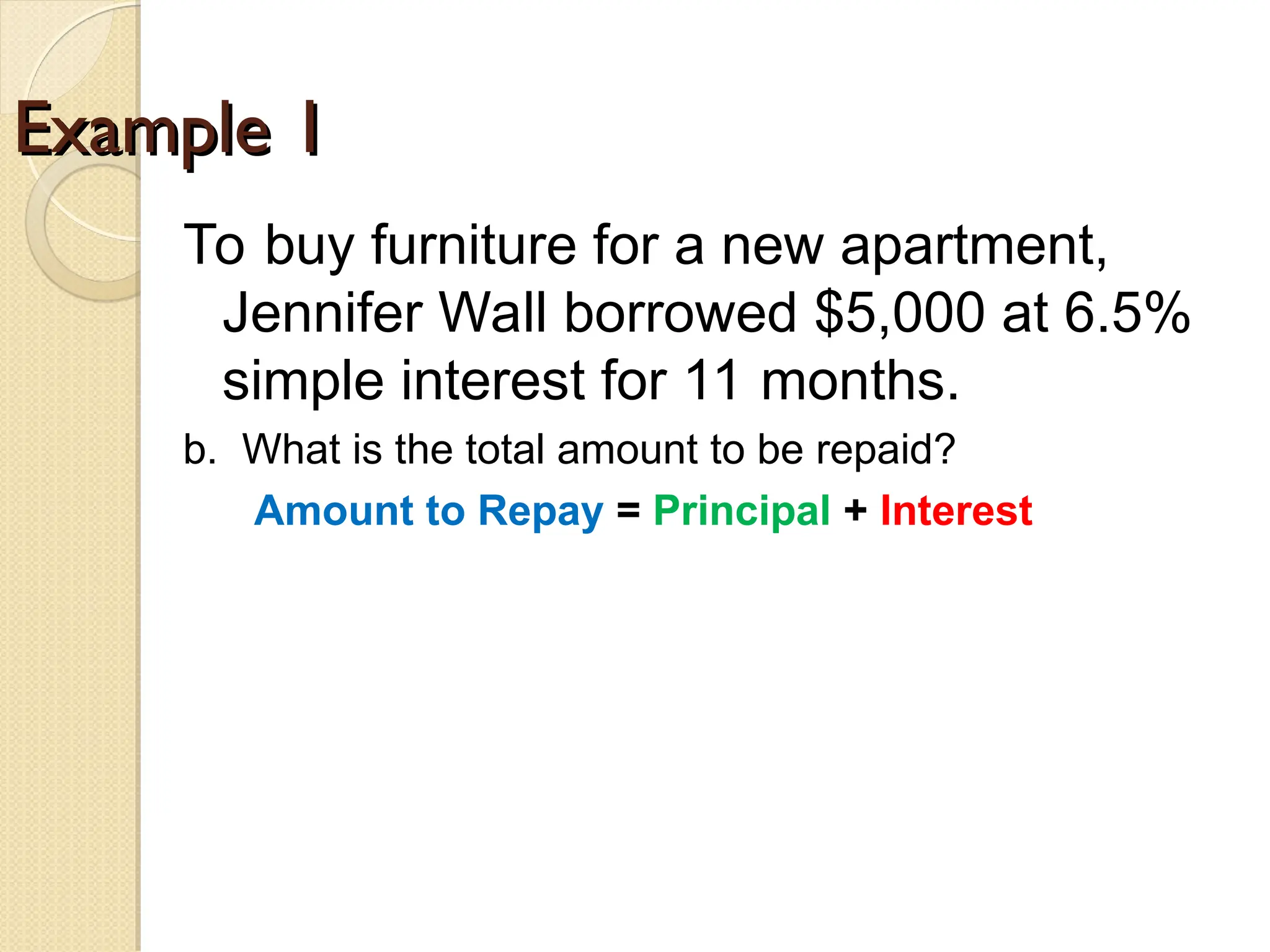
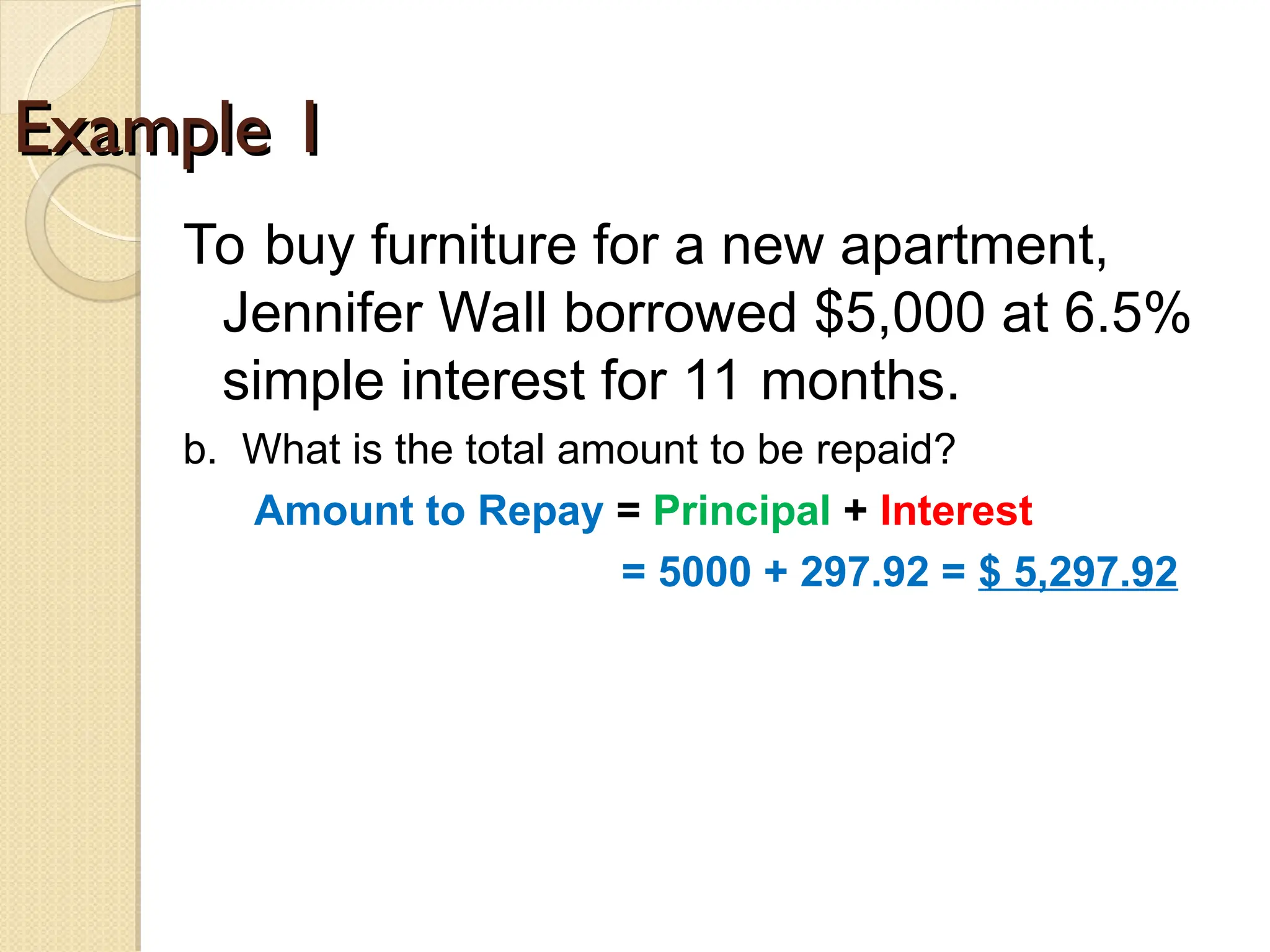
b. What is the total amount to be repaid?
Example 1
Example 1
To buy furniture for a new apartment,
Jennifer Wall borrowed $5,000 at 6.5%
simple interest for 11 months.
b. What is the total amount to be repaid?
Amount to Repay = Principal + Interest
Example 1
Example 1
To buy furniture for a new apartment,
Jennifer Wall borrowed $5,000 at 6.5%
simple interest for 11 months.
b. What is the total amount to be repaid?
Amount to Repay = Principal + Interest
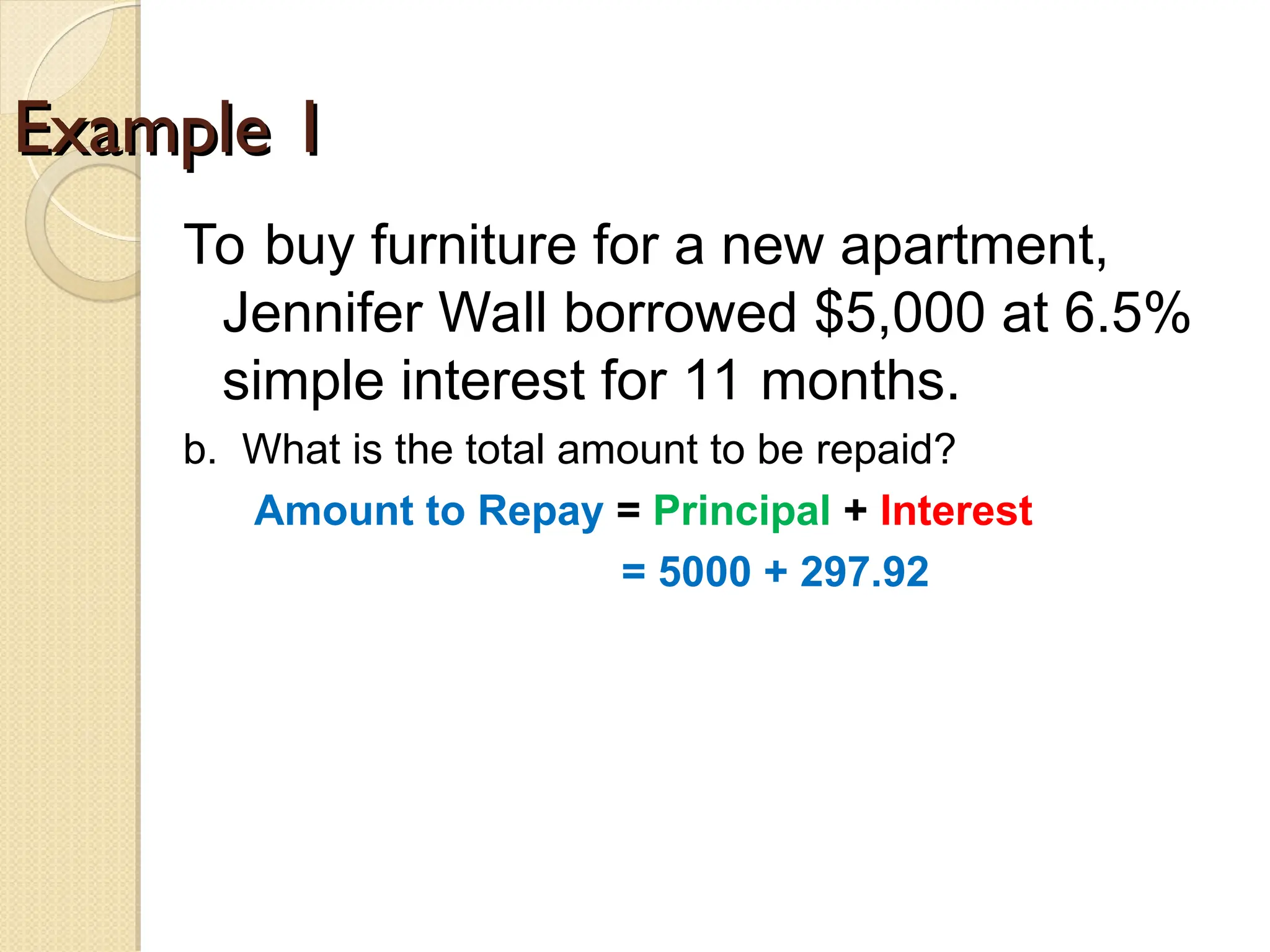
= 5000 + 297.92
Example 1
Example 1
To buy furniture for a new apartment,
Jennifer Wall borrowed $5,000 at 6.5%
simple interest for 11 months.
b. What is the total amount to be repaid?
Amount to Repay = Principal + Interest
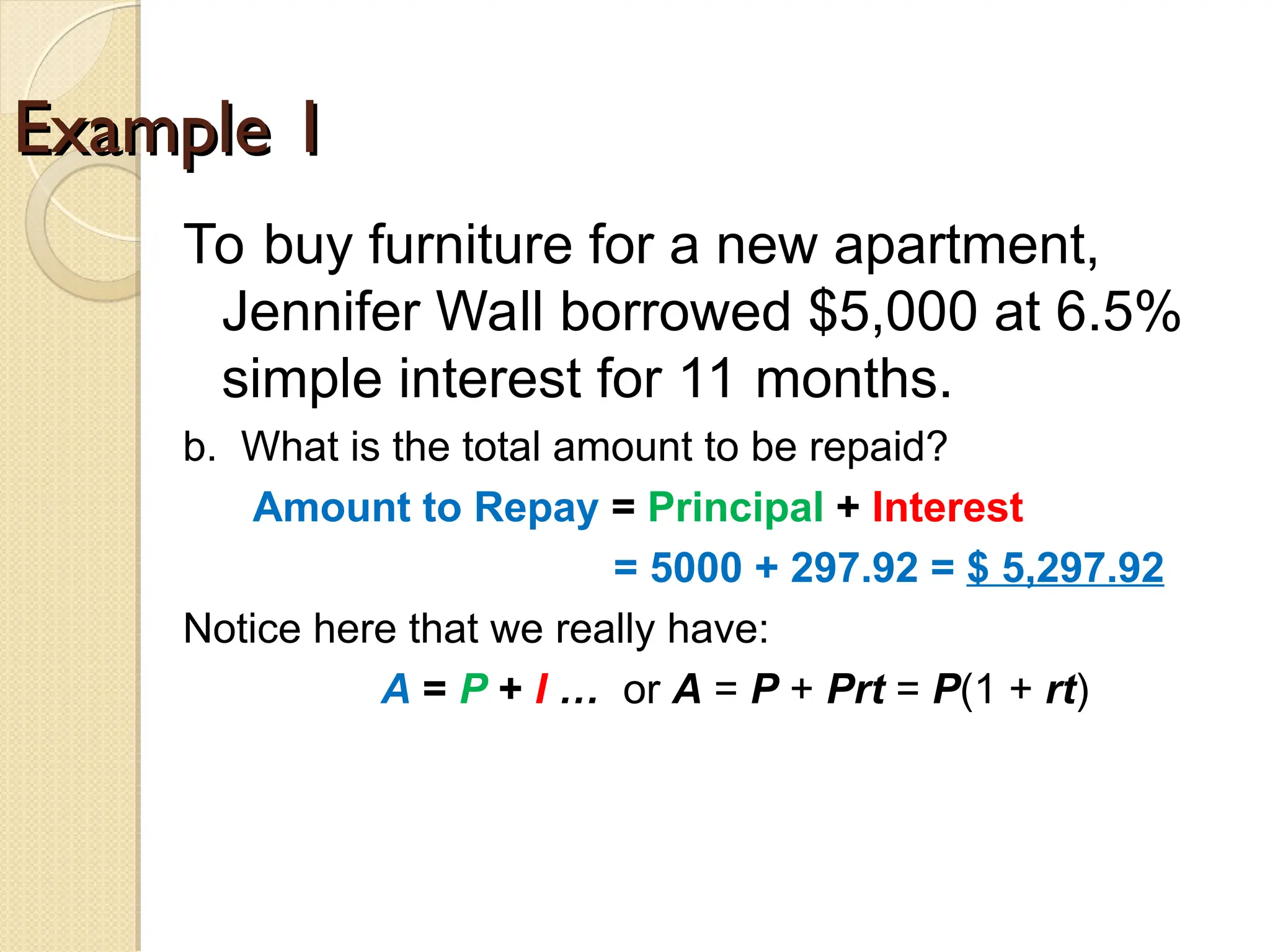
= 5000 + 297.92 = $ 5,297.92
Example 1
Example 1
To buy furniture for a new apartment,
Jennifer Wall borrowed $5,000 at 6.5%
simple interest for 11 months.
b. What is the total amount to be repaid?
Amount to Repay = Principal + Interest
= 5000 + 297.92 = $ 5,297.92
Notice here that we really have:
A = P + I … or A = P + Prt = P(1 + rt)
Example 1
Example 1
To buy furniture for a new apartment,
Jennifer Wall borrowed $5,000 at 6.5%
simple interest for 11 months.
b. What is the total amount to be repaid?
Amount to Repay = Principal + Interest
= 5000 + 297.92 = $ 5,297.92
Notice here that we really have:
A = P + I … or A = P + Prt = P(1 + rt)
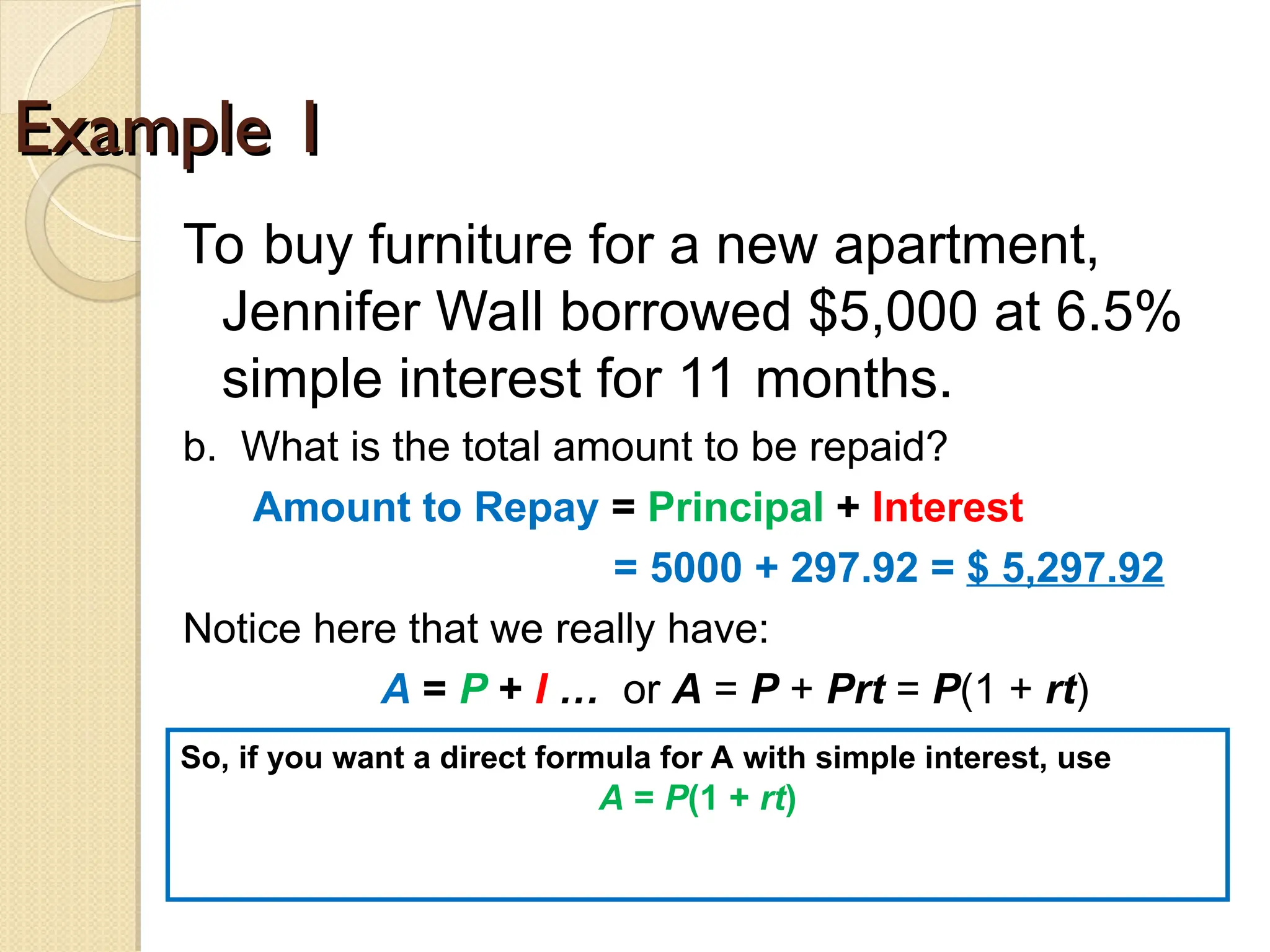
So, if you want a direct formula for A with simple interest, use
A = P(1 + rt)
Example 1
Example 1
To buy furniture for a new apartment,
Jennifer Wall borrowed $5,000 at 6.5%
simple interest for 11 months.
b. What is the total amount to be repaid?
Amount to Repay = Principal + Interest
= 5000 + 297.92 = $ 5,297.92
Notice here that we really have:
A = P + I … or A = P + Prt = P(1 + rt)
So, if you want a direct formula for A with simple interest, use
A = P(1 + rt)
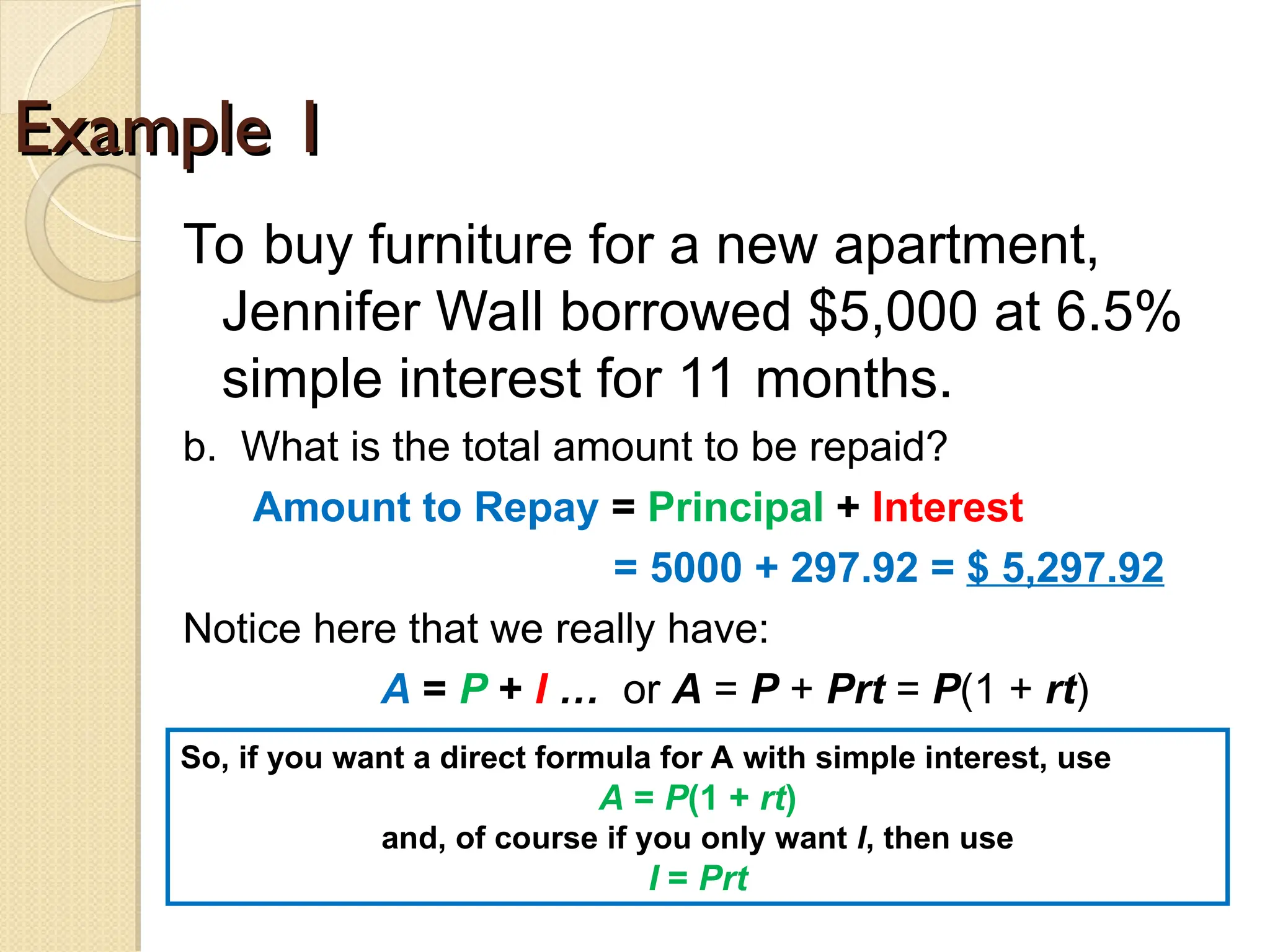
and, of course if you only want I, then use
I = Prt
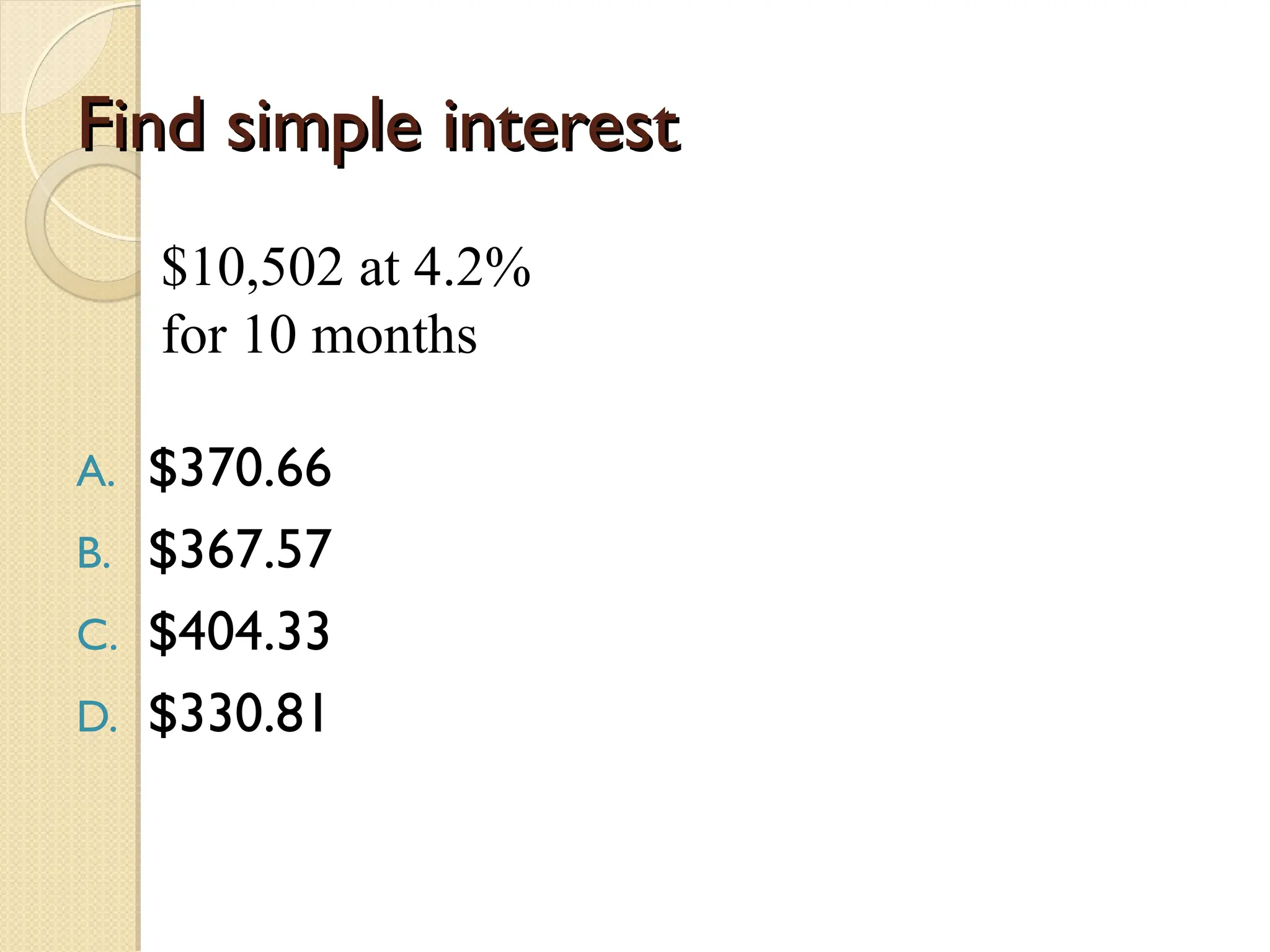
Find simple interest
$10,502 at 4.2%
for 10 months
A. $370.66
B. $367.57
C. $404.33
D. $330.81
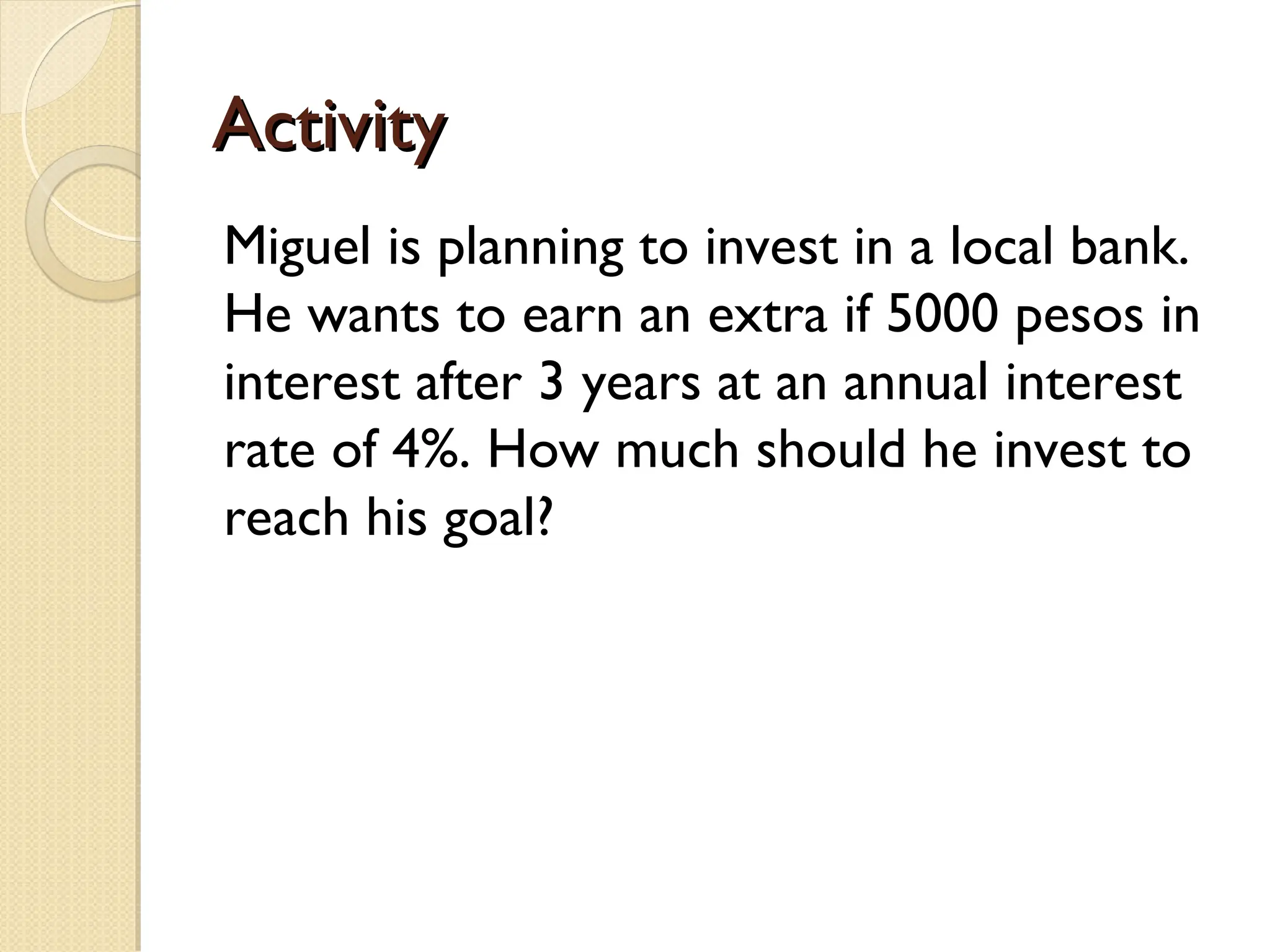
Activity
Activity
Miguel is planning to invest in a local bank.
He wants to earn an extra if 5000 pesos in
interest after 3 years at an annual interest
rate of 4%. How much should he invest to
reach his goal?
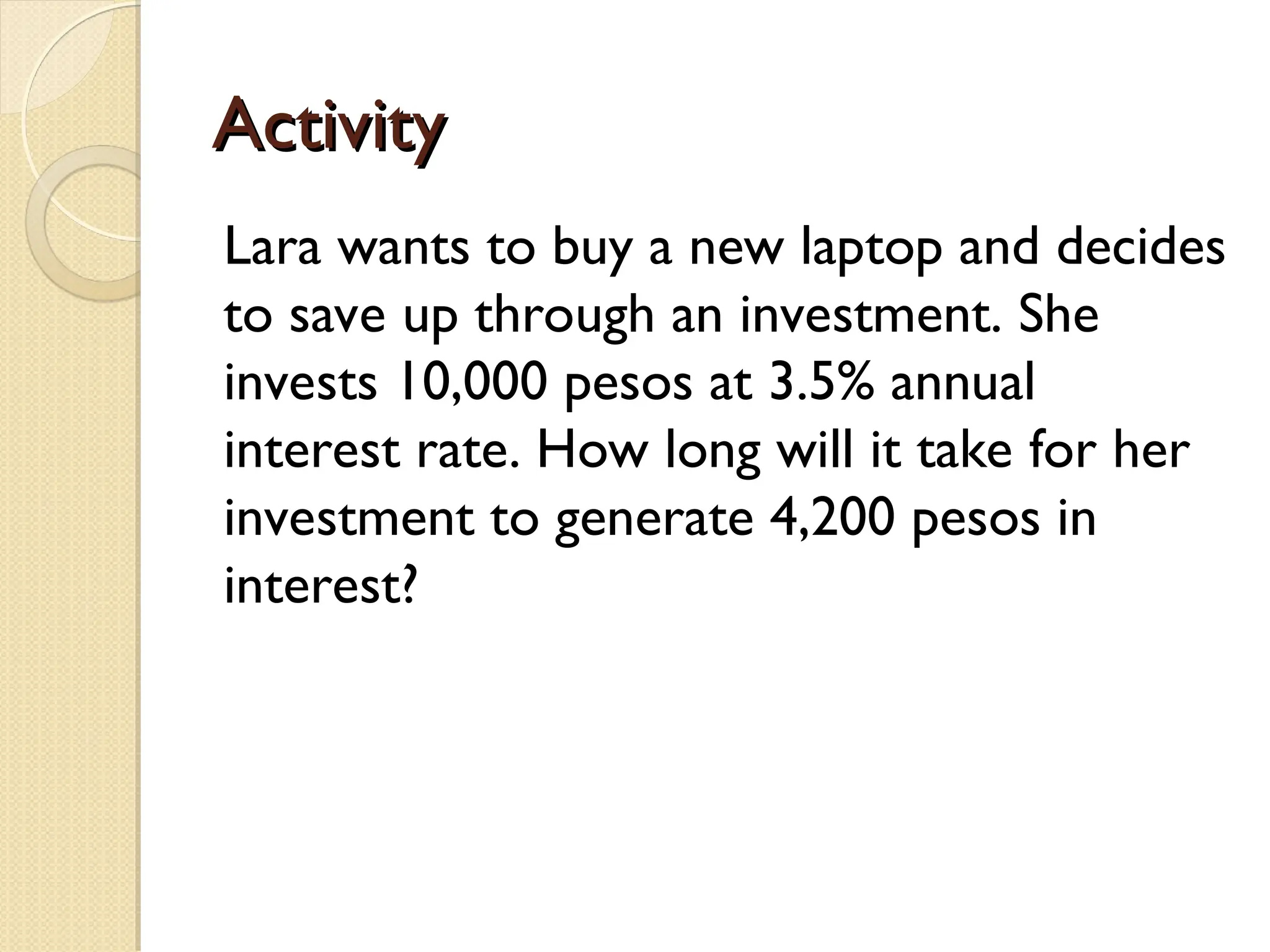
Activity
Activity
Lara wants to buy a new laptop and decides
to save up through an investment. She
invests 10,000 pesos at 3.5% annual
interest rate. How long will it take for her
investment to generate 4,200 pesos in
interest?
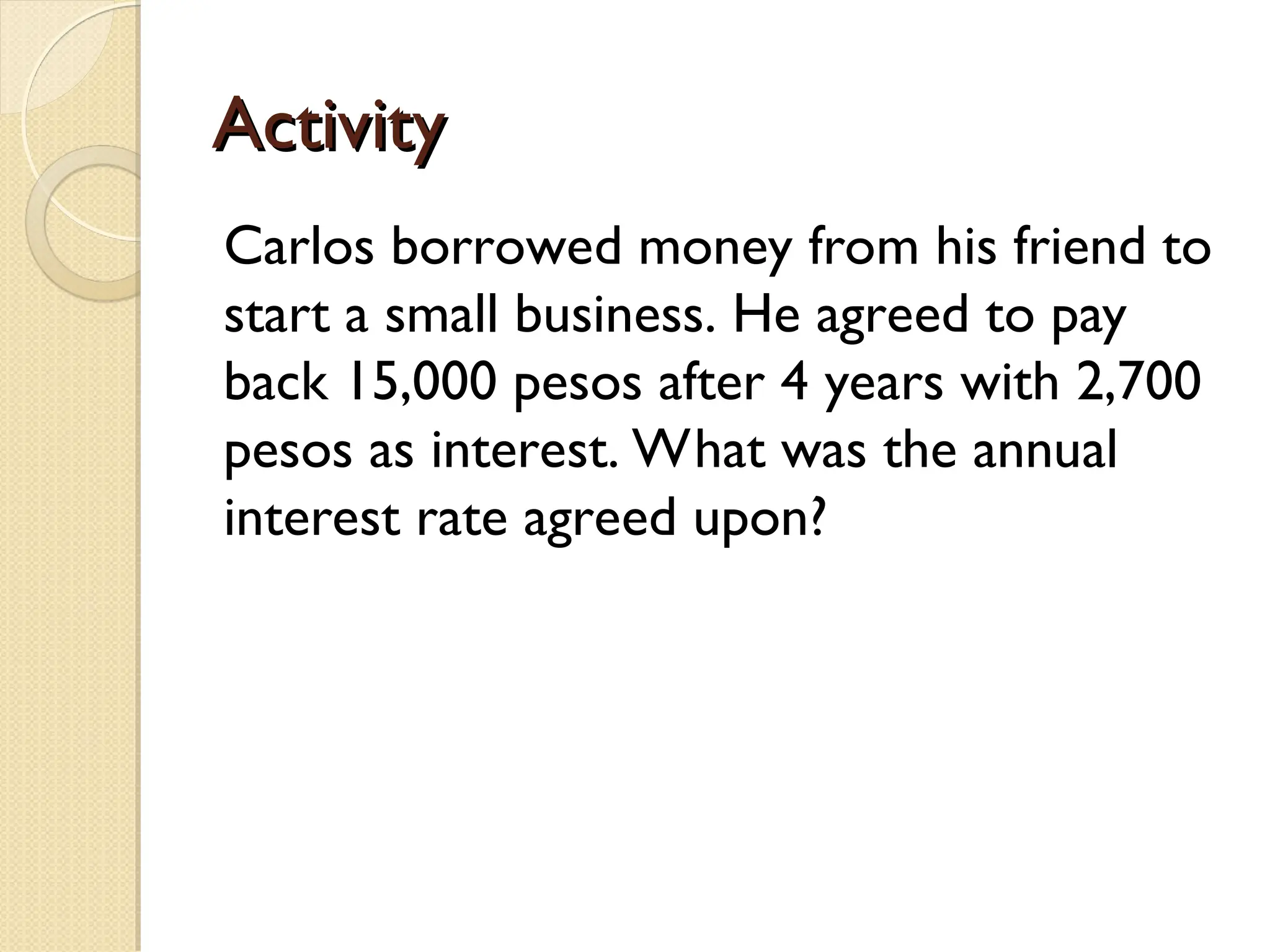
Activity
Activity
Carlos borrowed money from his friend to
start a small business. He agreed to pay
back 15,000 pesos after 4 years with 2,700
pesos as interest. What was the annual
interest rate agreed upon?
Activity
Activity
Anna invested in a short-term project that
promised 6% annual return. She invested
8,000 pesos for a period of 120 days. How
much will be the exact interest will Anna
earn by the end of the project?
Compound Interest
Compound Interest
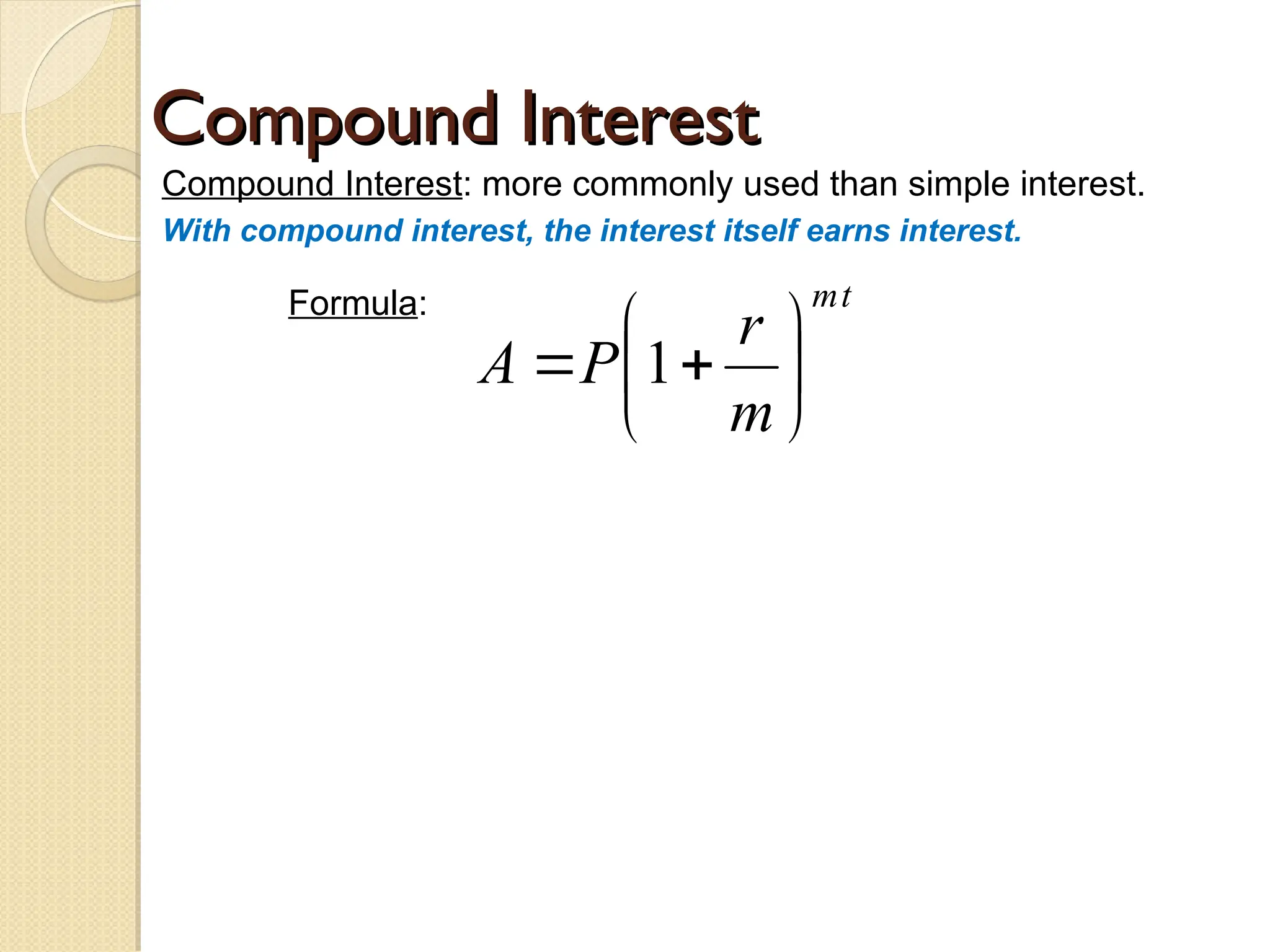
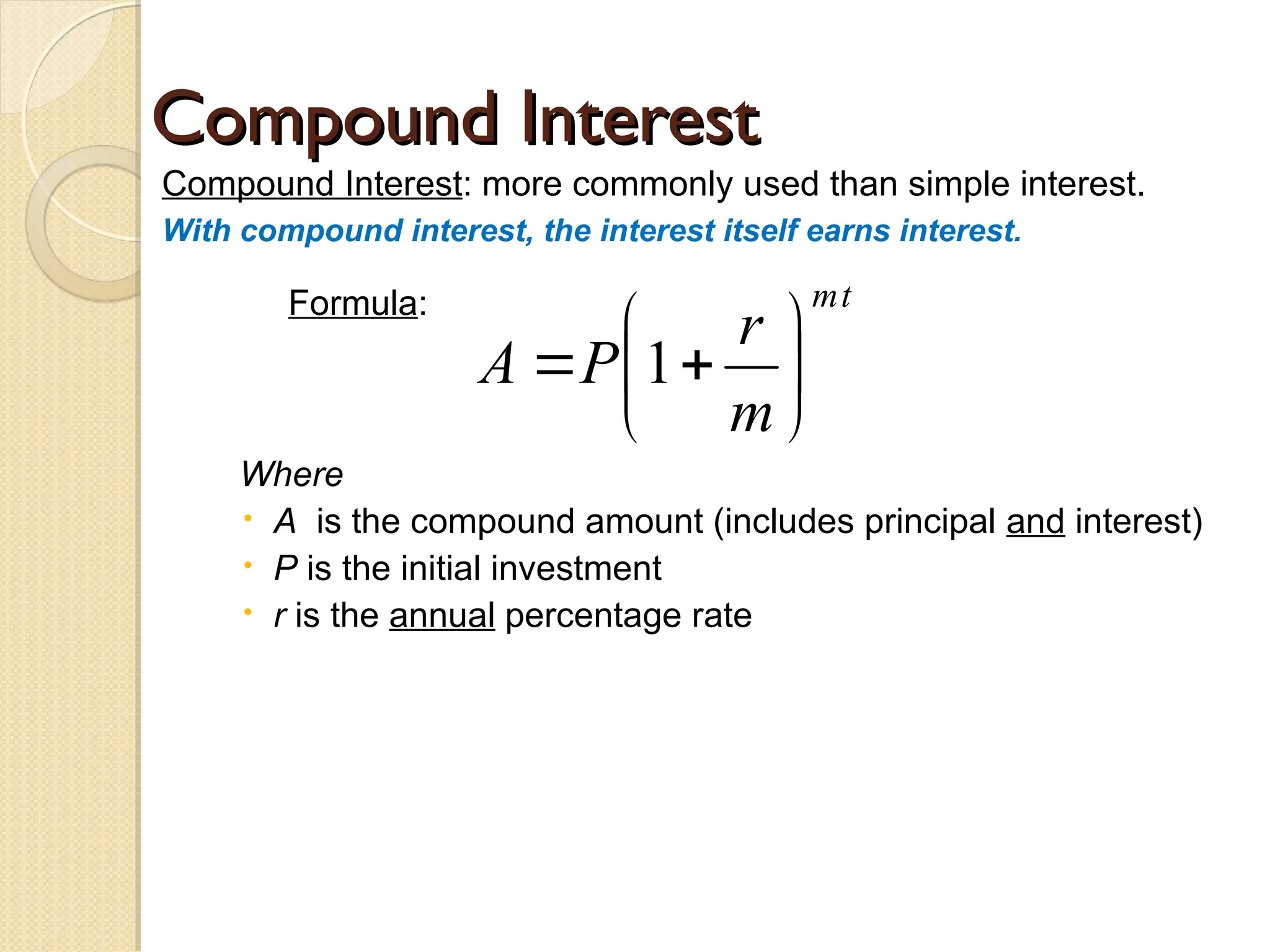
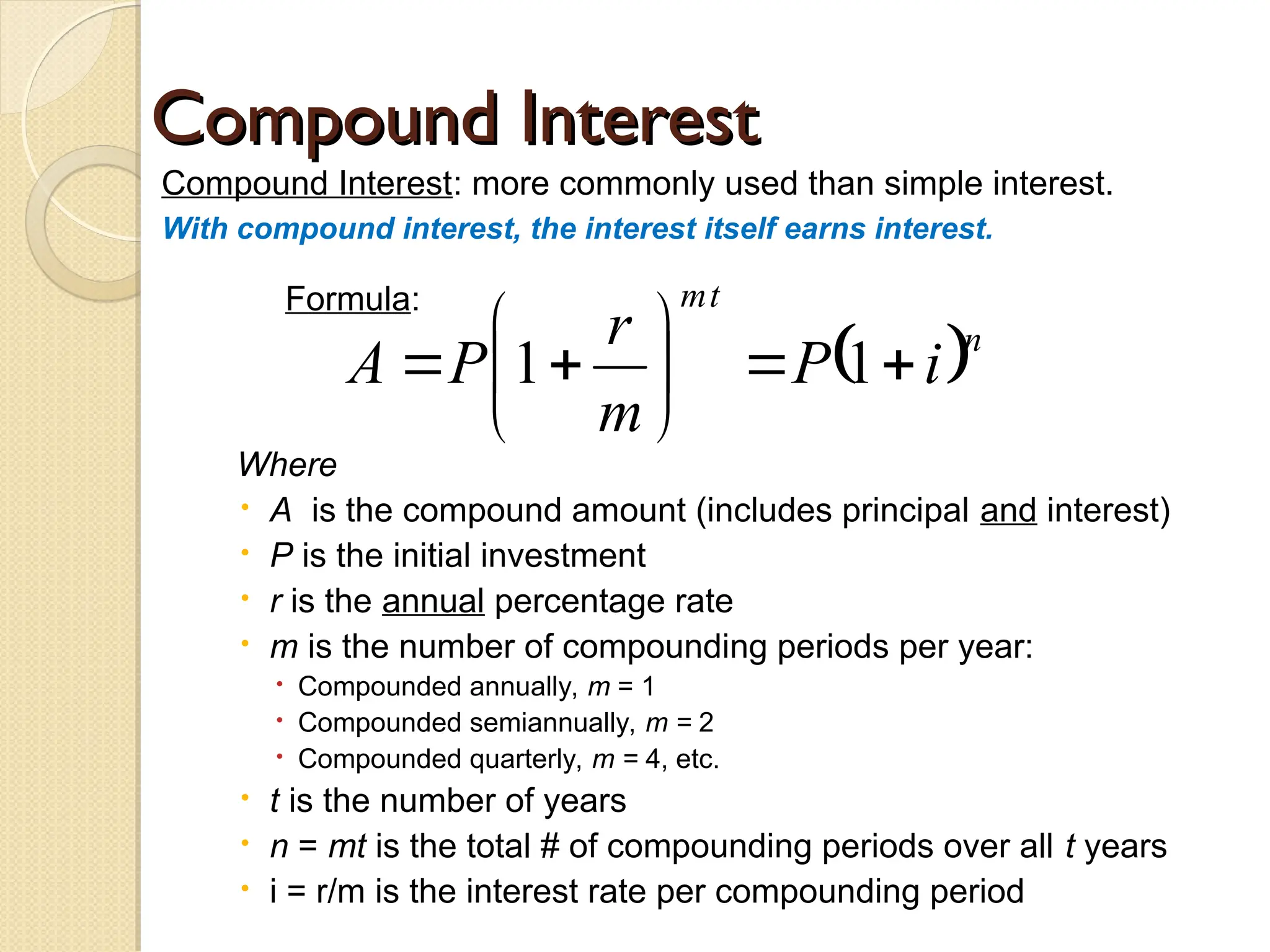
Compound Interest: more commonly used than simple interest.
With compound interest, the interest itself earns interest.
Formula: t
m
m
r
P
A 






 1
Compound Interest
Compound Interest
Compound Interest: more commonly used than simple interest.
With compound interest, the interest itself earns interest.
Formula:
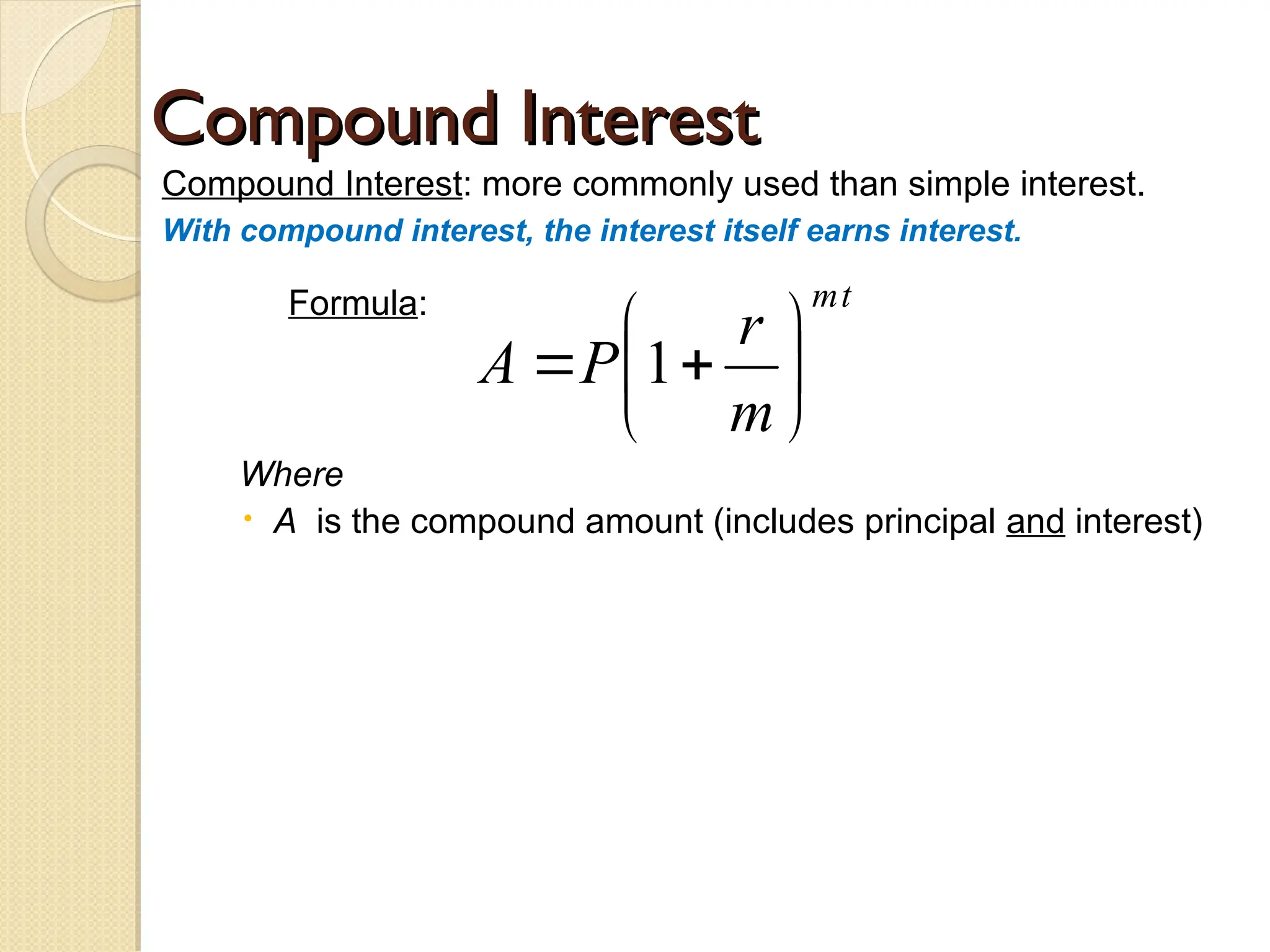
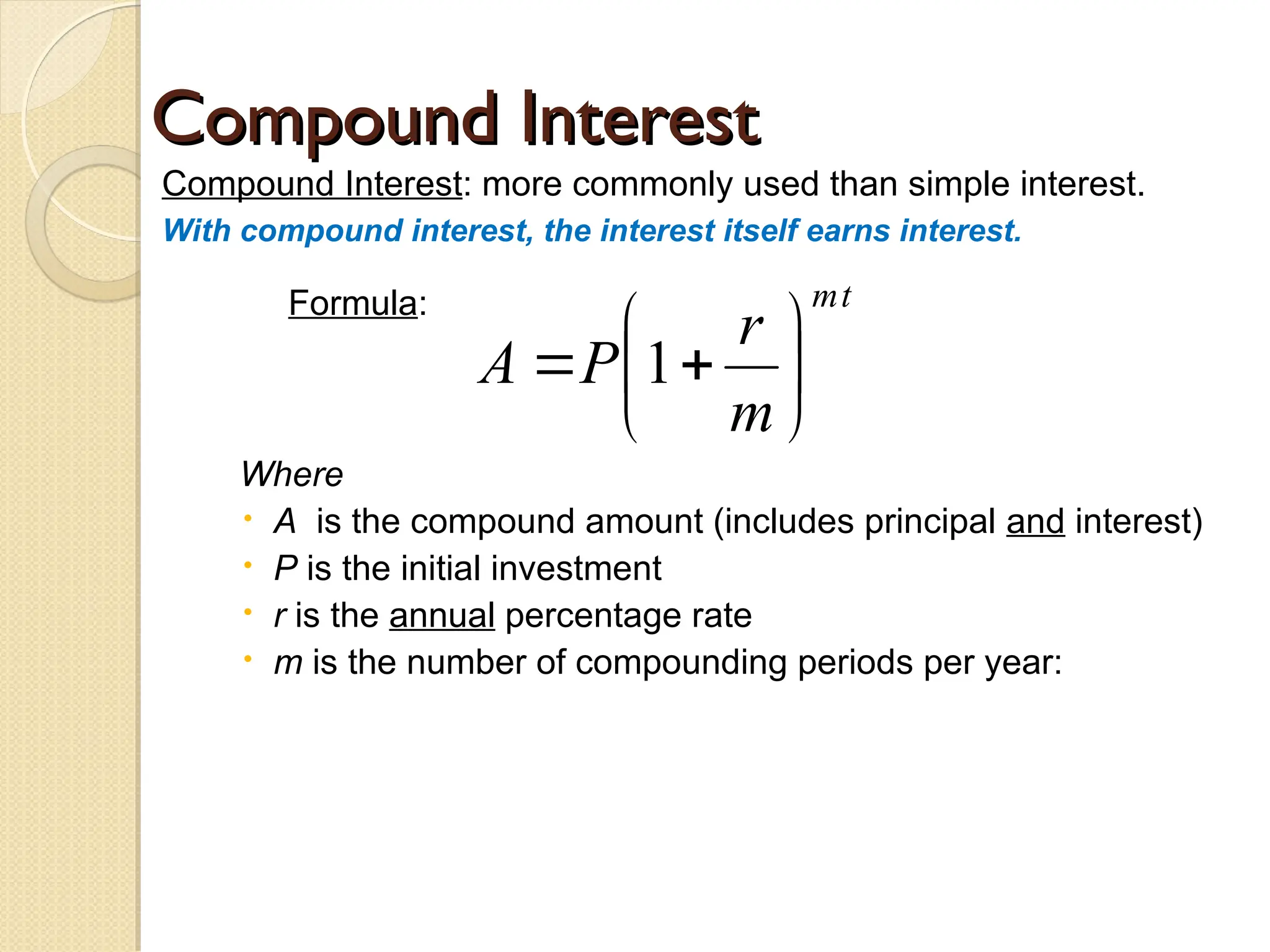
Where
 A is the compound amount (includes principal and interest)
t
m
m
r
P
A 






 1
Compound Interest
Compound Interest
Compound Interest: more commonly used than simple interest.
With compound interest, the interest itself earns interest.
Formula:
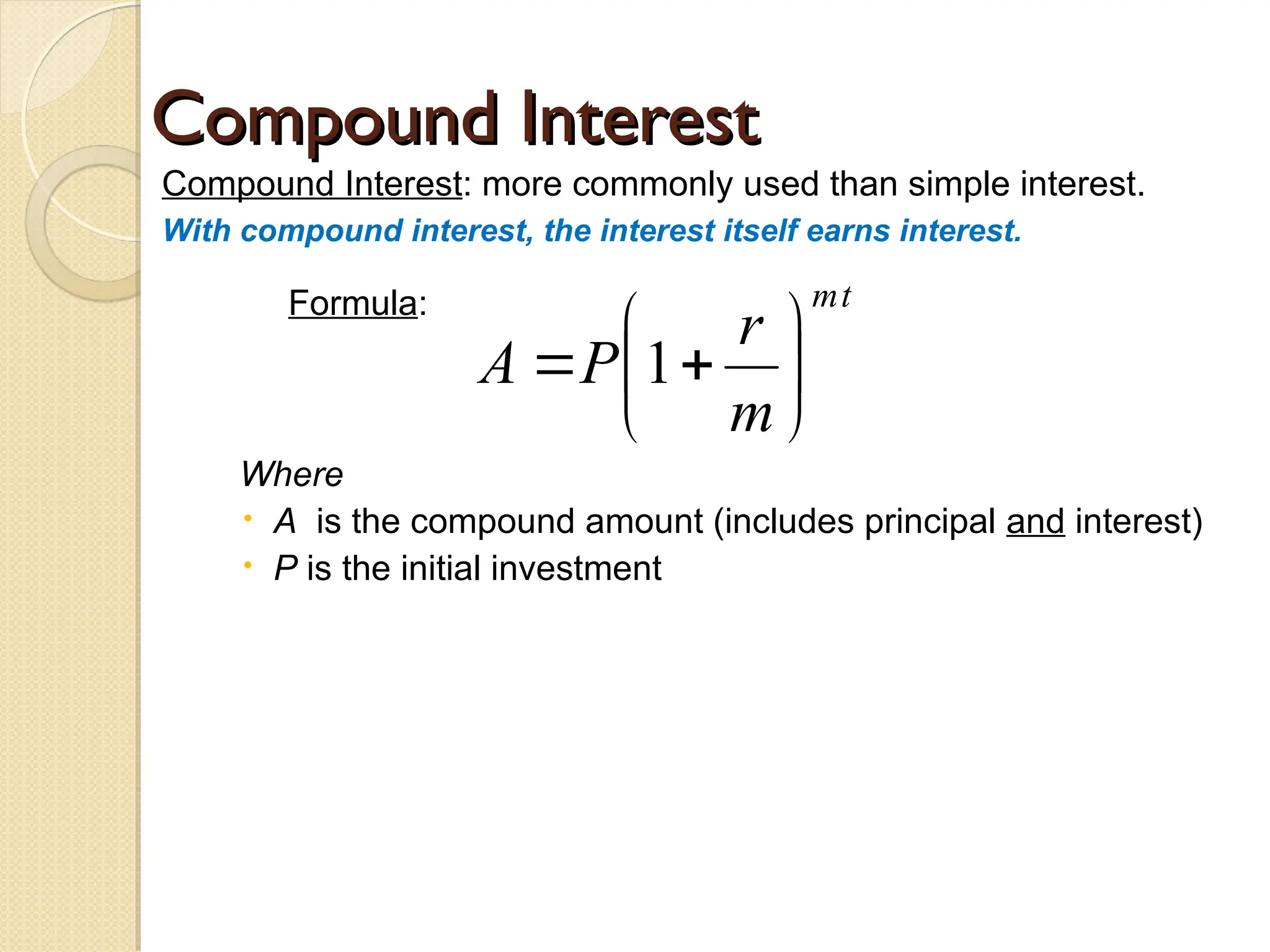
Where
 A is the compound amount (includes principal and interest)
 P is the initial investment
t
m
m
r
P
A 






 1
Compound Interest
Compound Interest
Compound Interest: more commonly used than simple interest.
With compound interest, the interest itself earns interest.
Formula:
Where
 A is the compound amount (includes principal and interest)
 P is the initial investment
 r is the annual percentage rate
t
m
m
r
P
A 






 1
Compound Interest
Compound Interest
Compound Interest: more commonly used than simple interest.
With compound interest, the interest itself earns interest.
Formula:
Where
 A is the compound amount (includes principal and interest)
 P is the initial investment
 r is the annual percentage rate
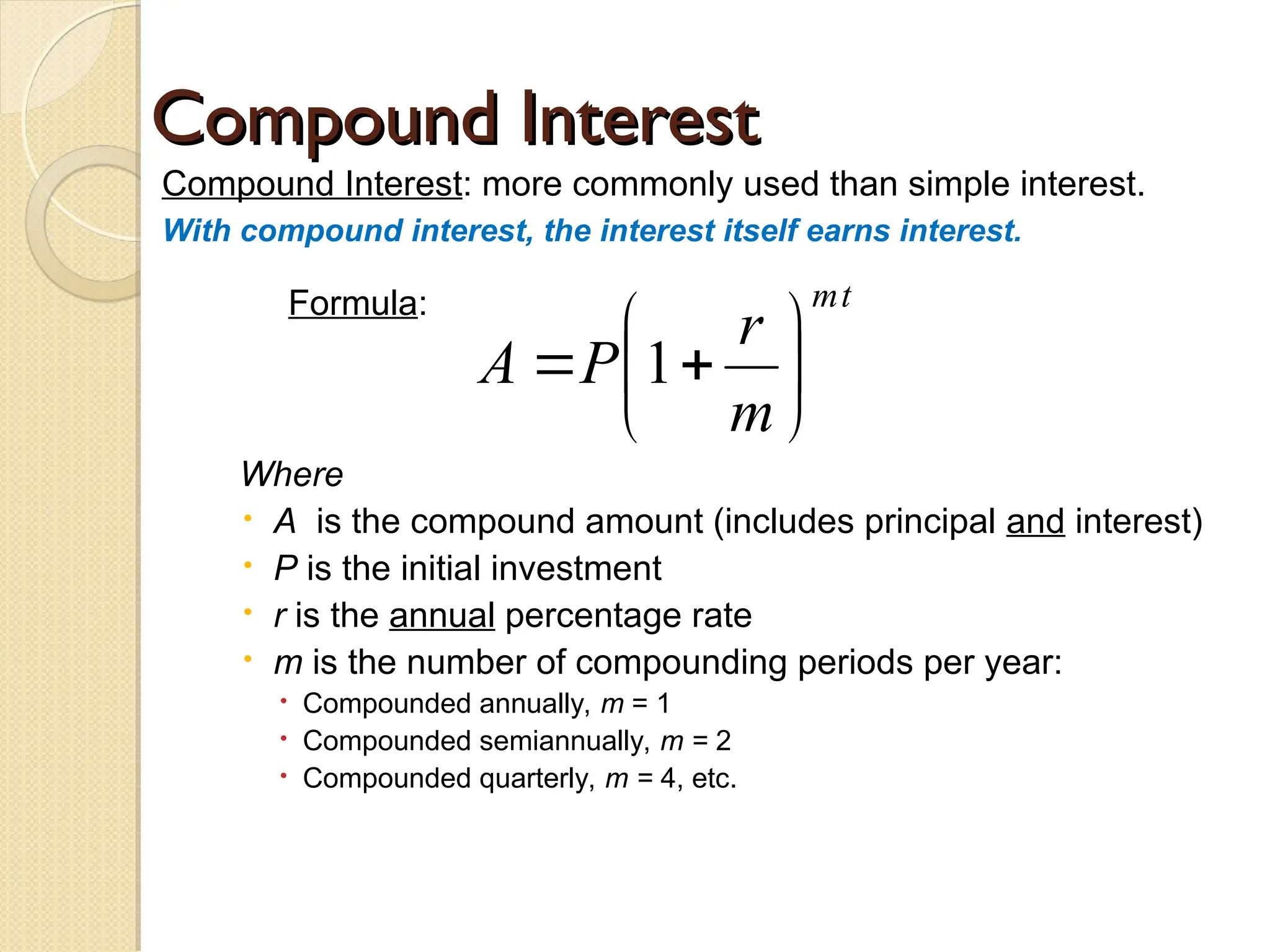
 m is the number of compounding periods per year:
t
m
m
r
P
A 






 1
Compound Interest
Compound Interest
Compound Interest: more commonly used than simple interest.
With compound interest, the interest itself earns interest.
Formula:
Where
 A is the compound amount (includes principal and interest)
 P is the initial investment
 r is the annual percentage rate
 m is the number of compounding periods per year:
 Compounded annually, m = 1
 Compounded semiannually, m = 2
 Compounded quarterly, m = 4, etc.
t
m
m
r
P
A 






 1
Compound Interest
Compound Interest
Compound Interest: more commonly used than simple interest.
With compound interest, the interest itself earns interest.
Formula:
Where
 A is the compound amount (includes principal and interest)
 P is the initial investment
 r is the annual percentage rate
 m is the number of compounding periods per year:
 Compounded annually, m = 1
 Compounded semiannually, m = 2
 Compounded quarterly, m = 4, etc.
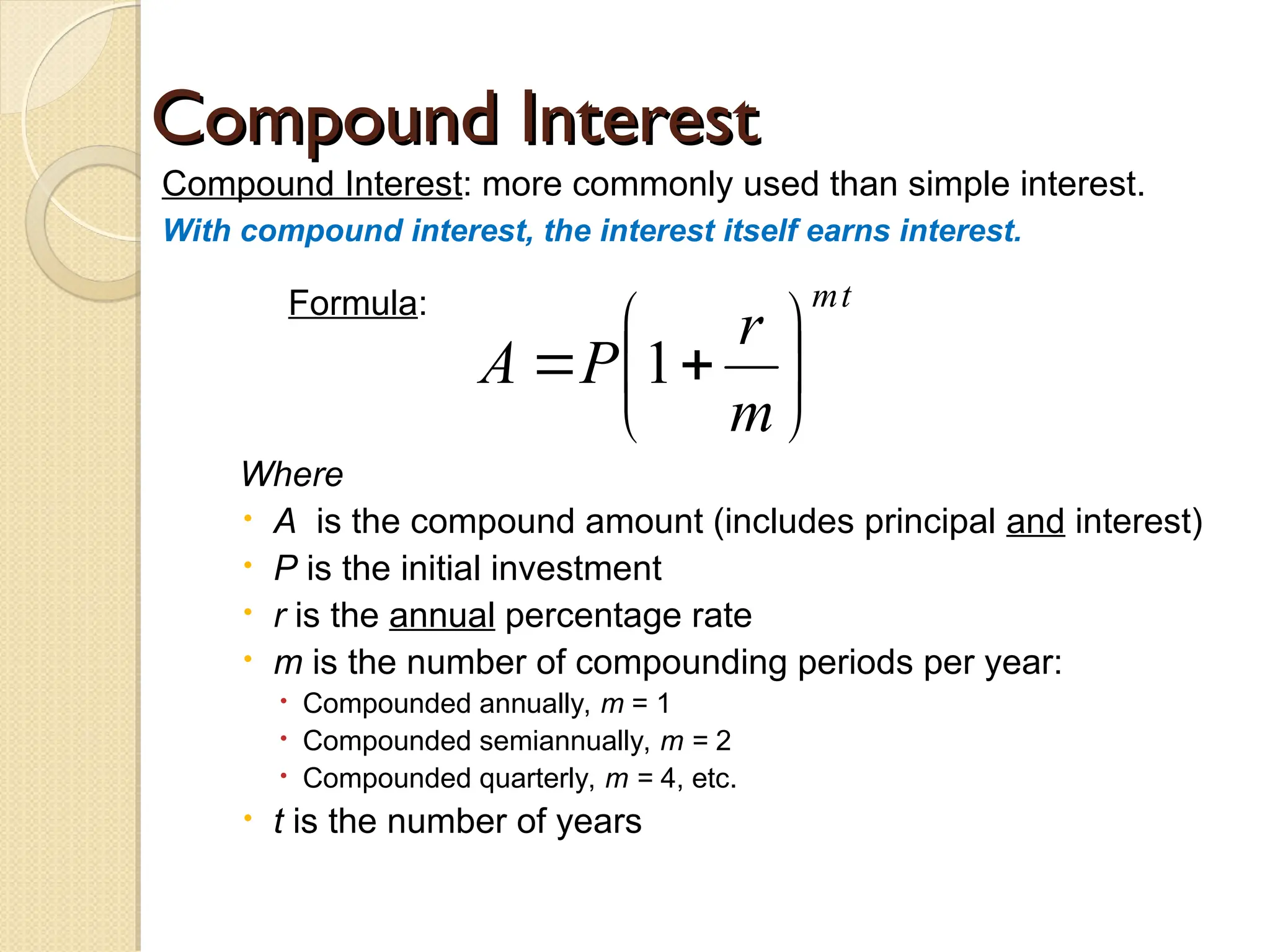
 t is the number of years
t
m
m
r
P
A 






 1
Compound Interest
Compound Interest
Compound Interest: more commonly used than simple interest.
With compound interest, the interest itself earns interest.
Formula:
Where
 A is the compound amount (includes principal and interest)
 P is the initial investment
 r is the annual percentage rate
 m is the number of compounding periods per year:
 Compounded annually, m = 1
 Compounded semiannually, m = 2
 Compounded quarterly, m = 4, etc.
 t is the number of years
 n = mt is the total # of compounding periods over all t years
 i = r/m is the interest rate per compounding period
 n
t
m
i
P
m
r
P
A 








 1
1
Example 2
Example 2
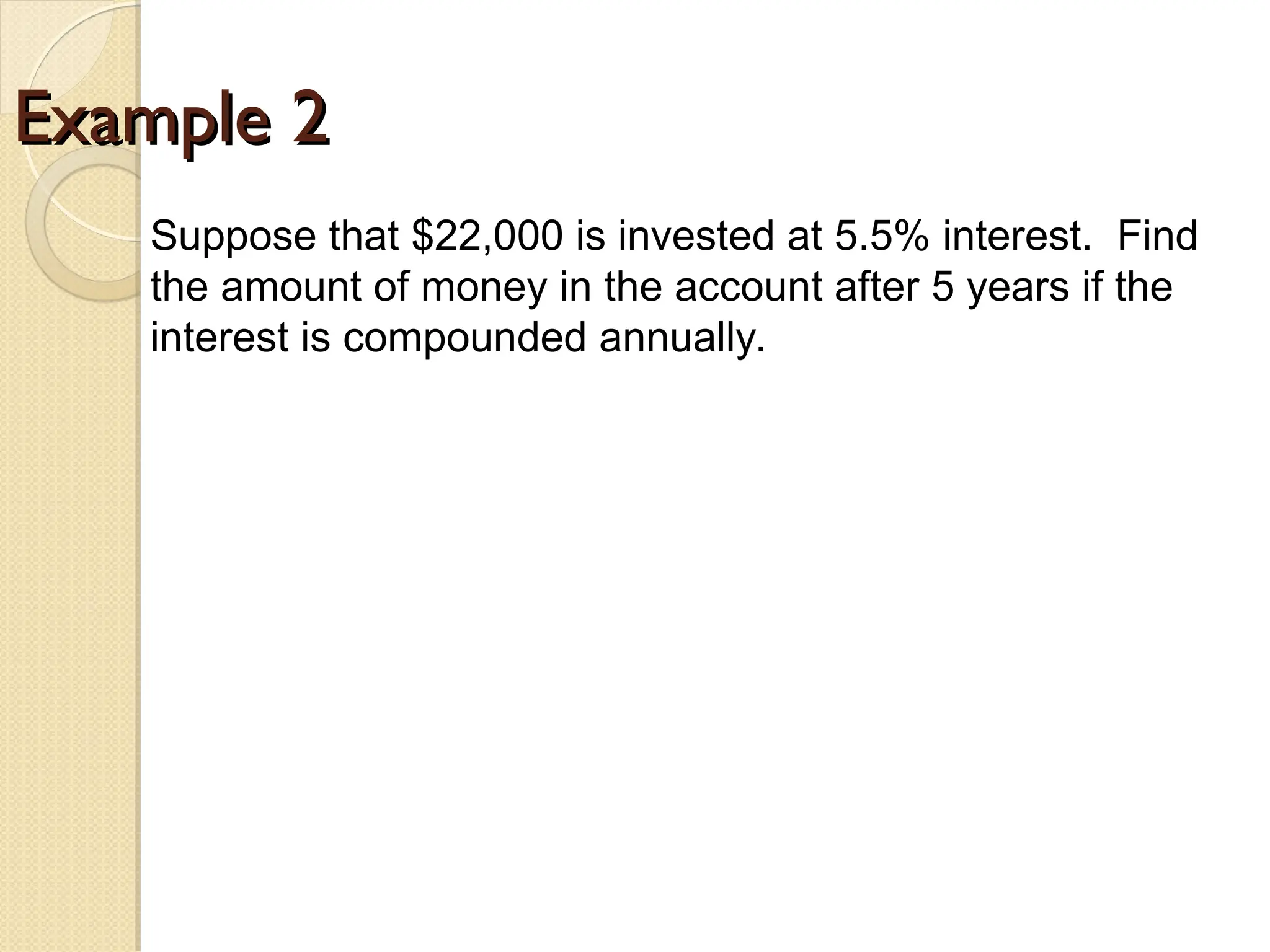
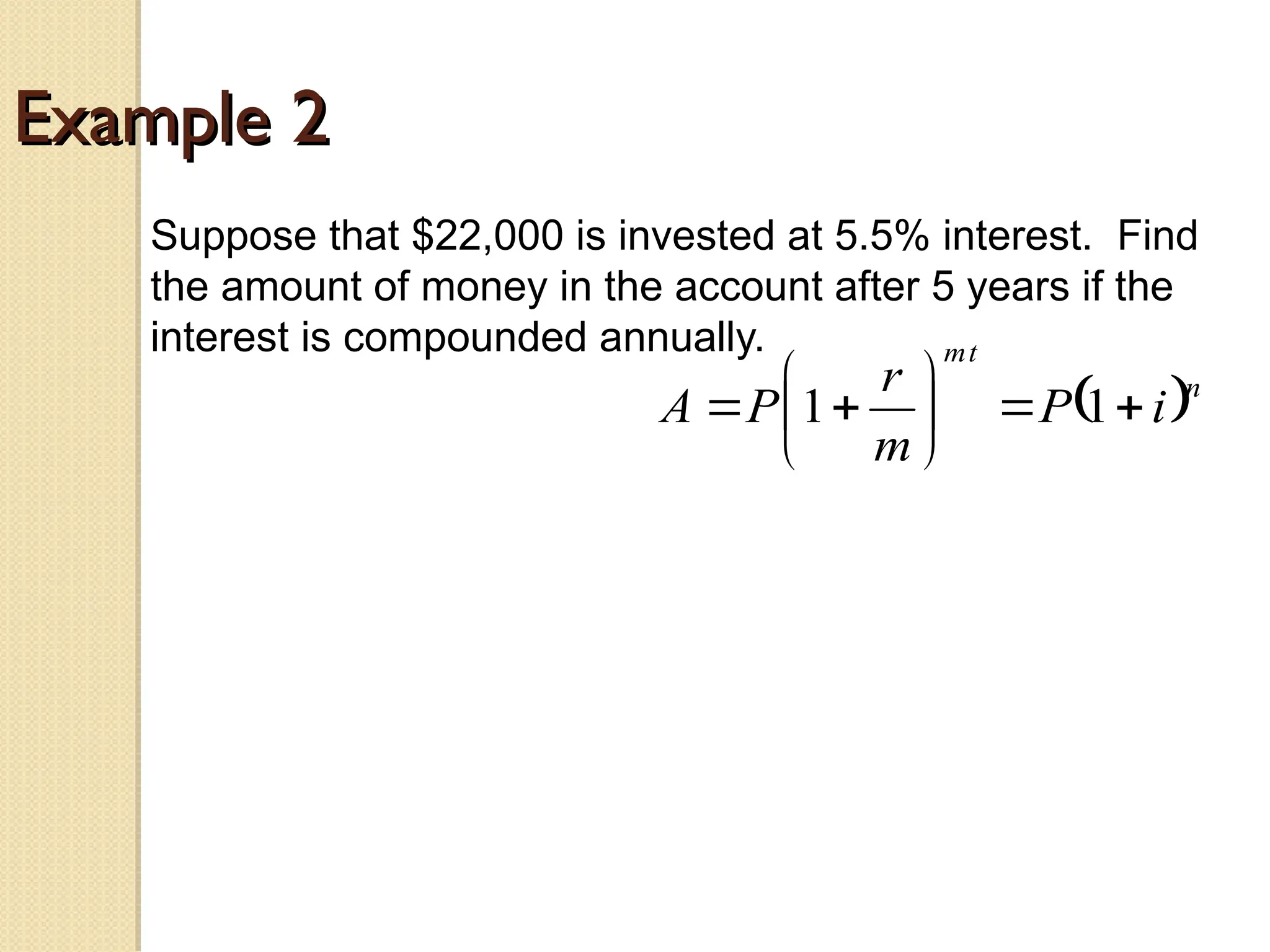
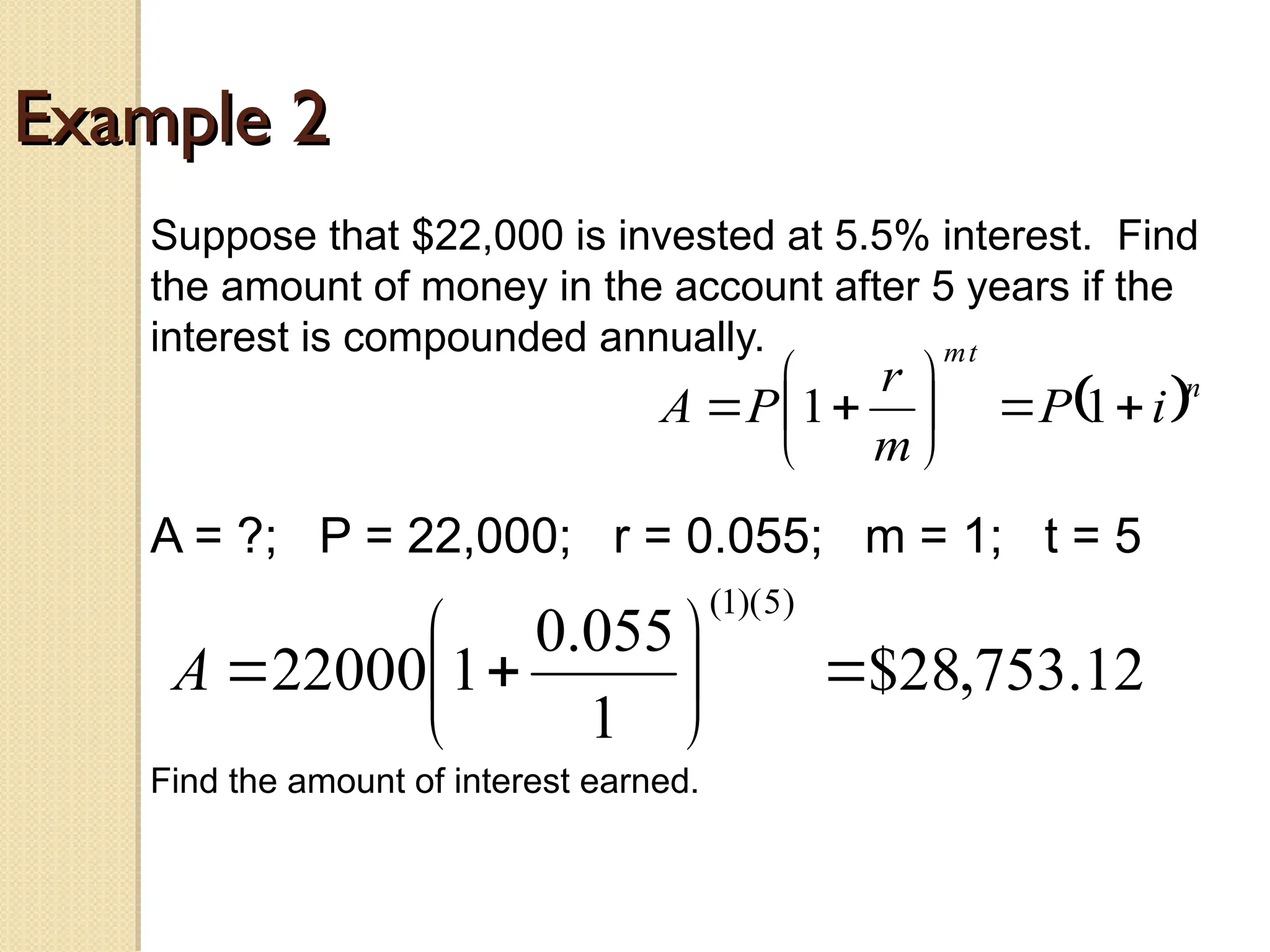
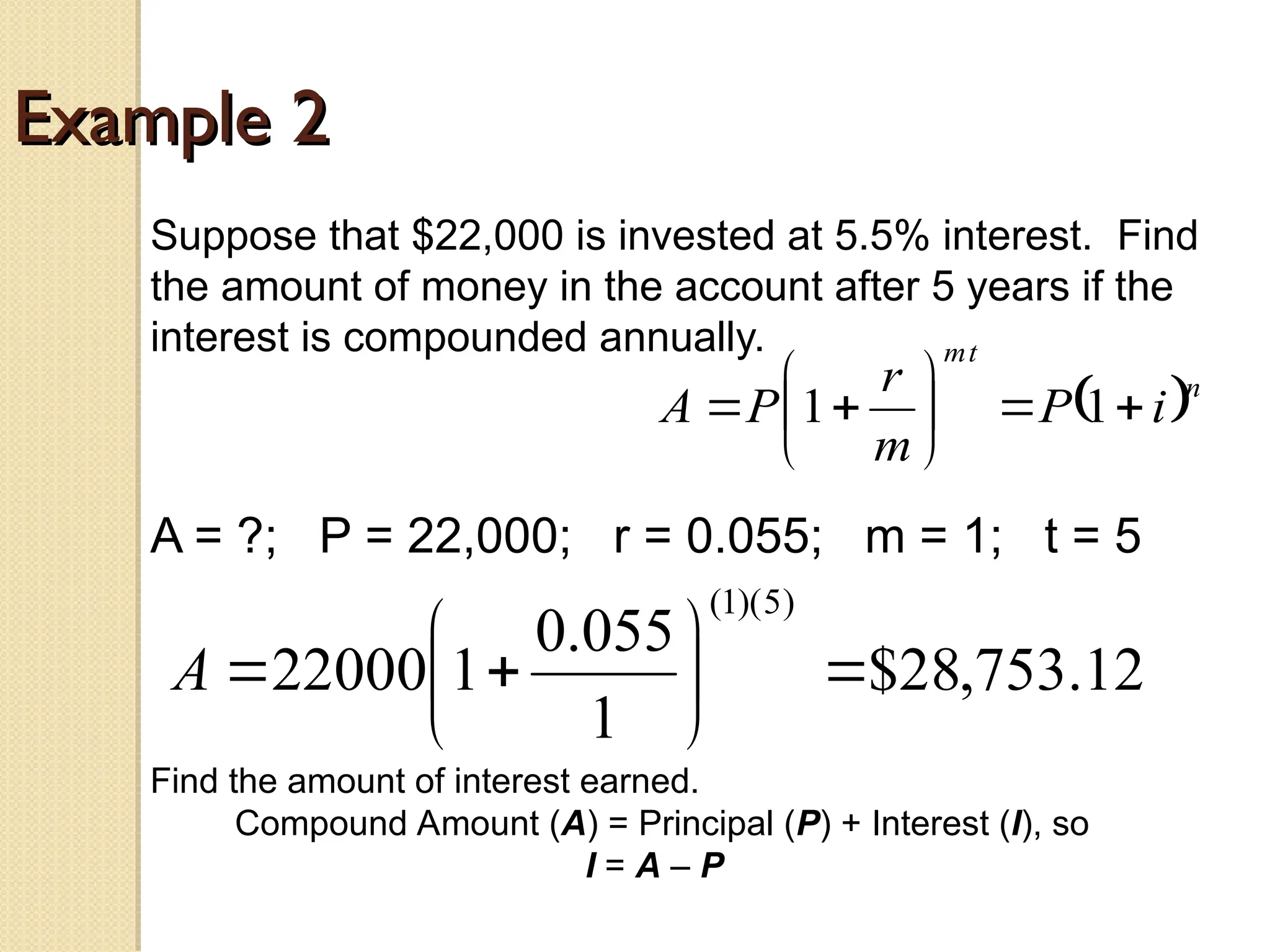
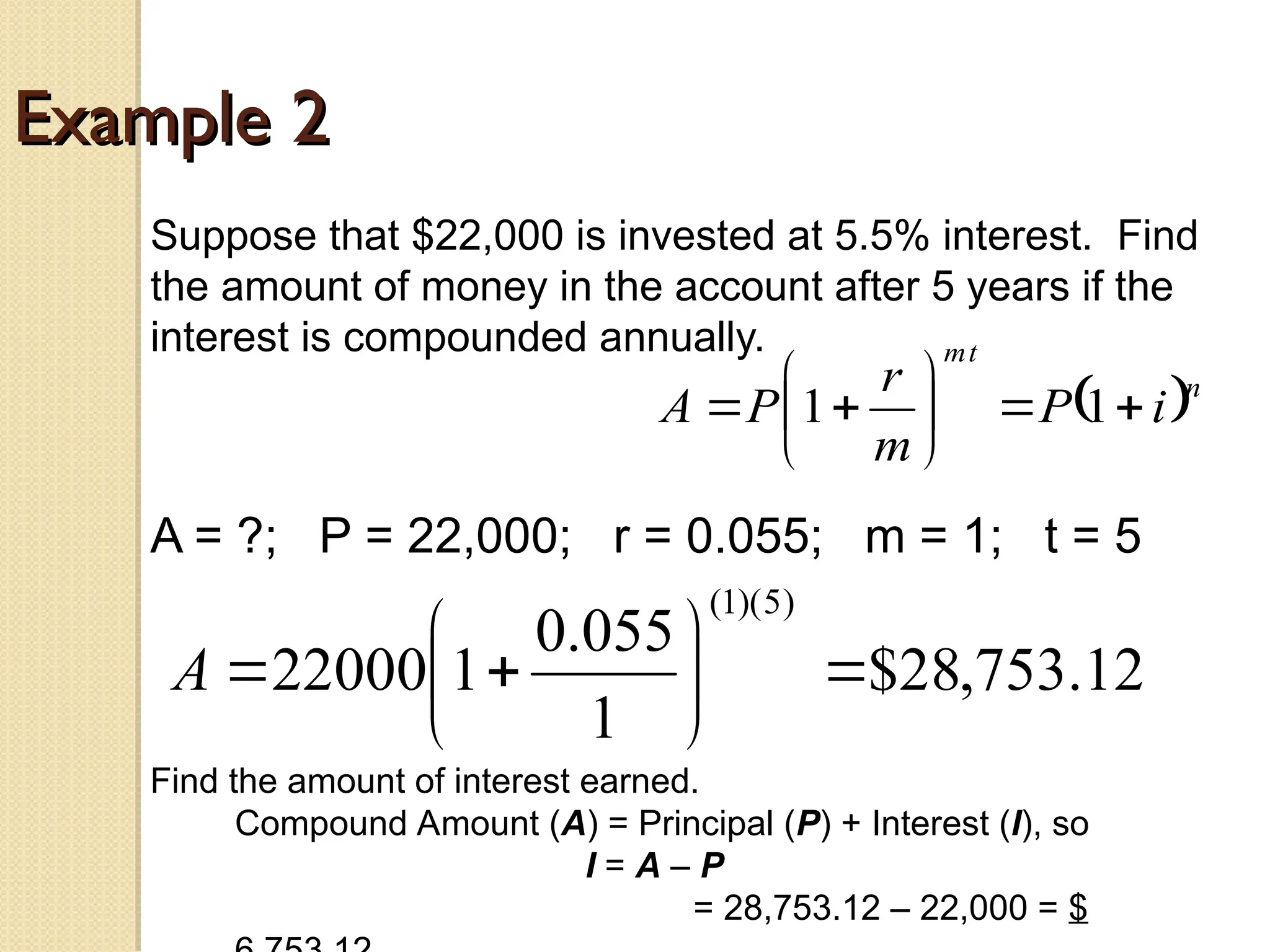
Suppose that $22,000 is invested at 5.5% interest. Find
the amount of money in the account after 5 years if the
interest is compounded annually.
Example 2
Example 2
Suppose that $22,000 is invested at 5.5% interest. Find
the amount of money in the account after 5 years if the
interest is compounded annually.
 n
t
m
i
P
m
r
P
A 








 1
1
Example 2
Example 2
Suppose that $22,000 is invested at 5.5% interest. Find
the amount of money in the account after 5 years if the
interest is compounded annually.
A = ?; P = 22,000; r = 0.055; m = 1; t = 5
 n
t
m
i
P
m
r
P
A 








 1
1
Example 2
Example 2
Suppose that $22,000 is invested at 5.5% interest. Find
the amount of money in the account after 5 years if the
interest is compounded annually.
A = ?; P = 22,000; r = 0.055; m = 1; t = 5
 n
t
m
i
P
m
r
P
A 








 1
1
)
5
)(
1
(
1
055
.
0
1
22000 







A
Example 2
Example 2
Suppose that $22,000 is invested at 5.5% interest. Find
the amount of money in the account after 5 years if the
interest is compounded annually.
A = ?; P = 22,000; r = 0.055; m = 1; t = 5
 n
t
m
i
P
m
r
P
A 








 1
1
12
.
753
,
28
$
1
055
.
0
1
22000
)
5
)(
1
(









A
Example 2
Example 2
Suppose that $22,000 is invested at 5.5% interest. Find
the amount of money in the account after 5 years if the
interest is compounded annually.
A = ?; P = 22,000; r = 0.055; m = 1; t = 5
 n
t
m
i
P
m
r
P
A 








 1
1
12
.
753
,
28
$
1
055
.
0
1
22000
)
5
)(
1
(









A
Find the amount of interest earned.
Example 2
Example 2
Suppose that $22,000 is invested at 5.5% interest. Find
the amount of money in the account after 5 years if the
interest is compounded annually.
A = ?; P = 22,000; r = 0.055; m = 1; t = 5
 n
t
m
i
P
m
r
P
A 








 1
1
12
.
753
,
28
$
1
055
.
0
1
22000
)
5
)(
1
(









A
Find the amount of interest earned.
Compound Amount (A) = Principal (P) + Interest (I), so
I = A – P
Example 2
Example 2
Suppose that $22,000 is invested at 5.5% interest. Find
the amount of money in the account after 5 years if the
interest is compounded annually.
A = ?; P = 22,000; r = 0.055; m = 1; t = 5
 n
t
m
i
P
m
r
P
A 








 1
1
12
.
753
,
28
$
1
055
.
0
1
22000
)
5
)(
1
(









A
Find the amount of interest earned.
Compound Amount (A) = Principal (P) + Interest (I), so
I = A – P
= 28,753.12 – 22,000 = $
Example 3
Example 3
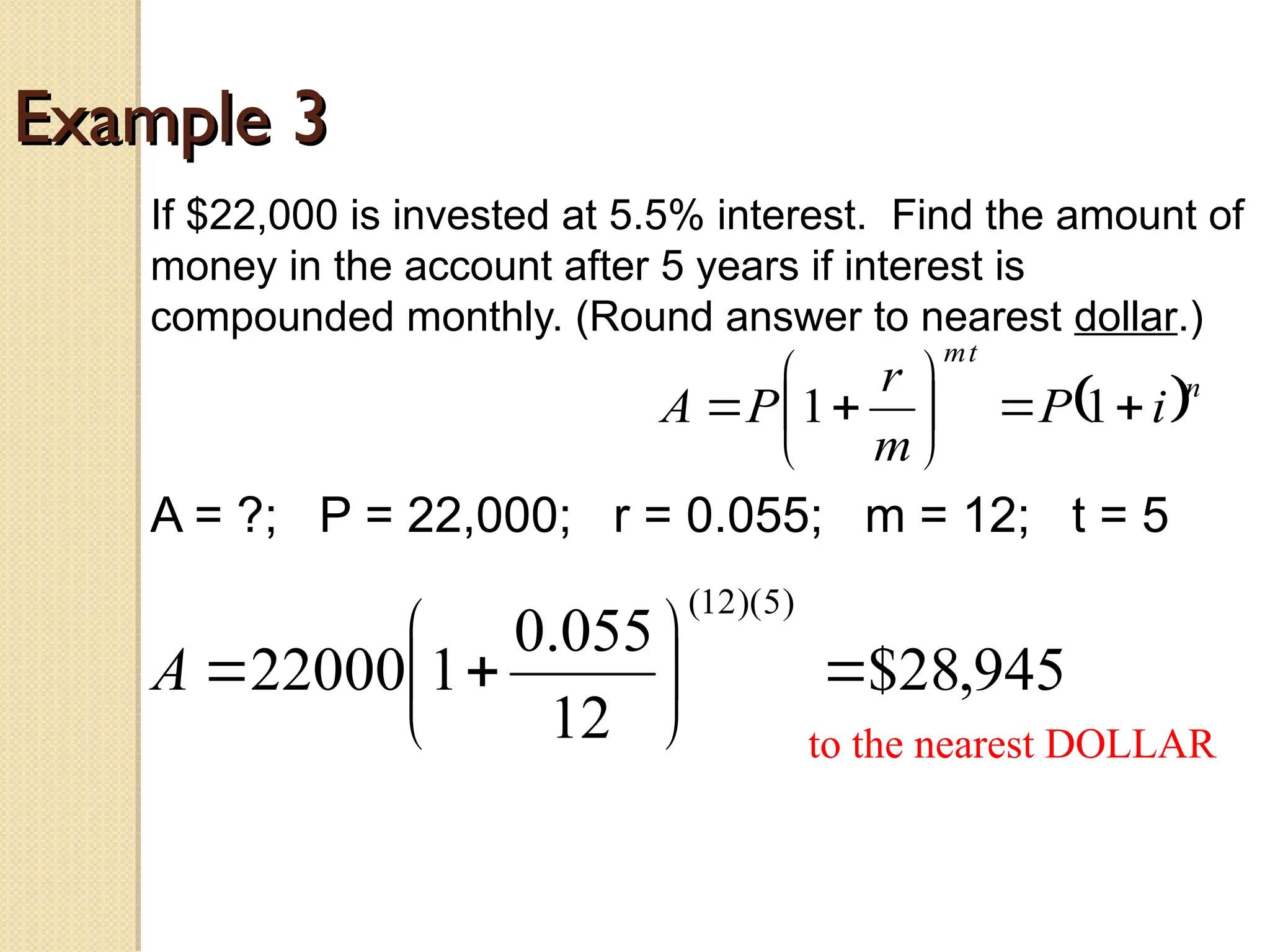
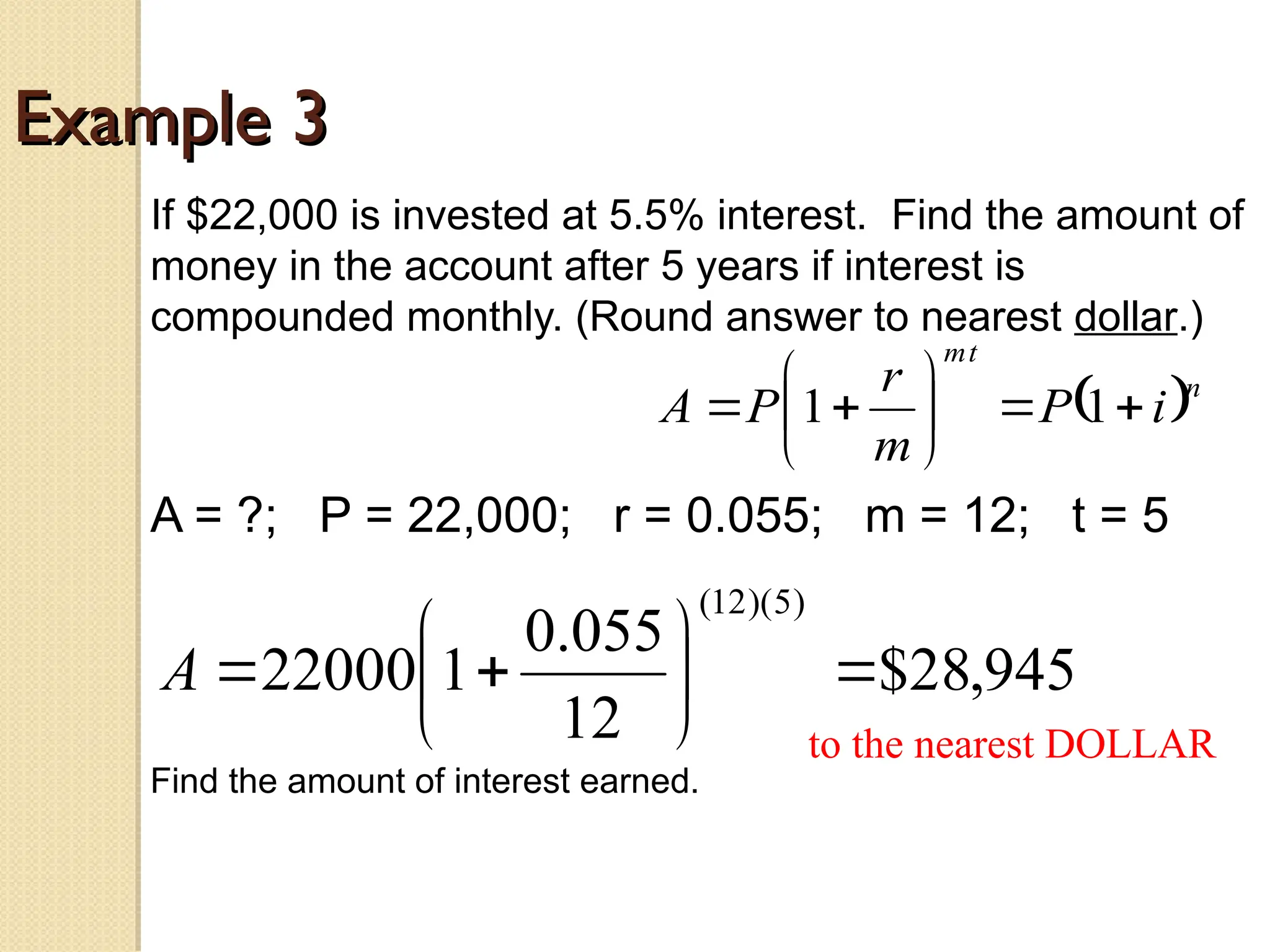
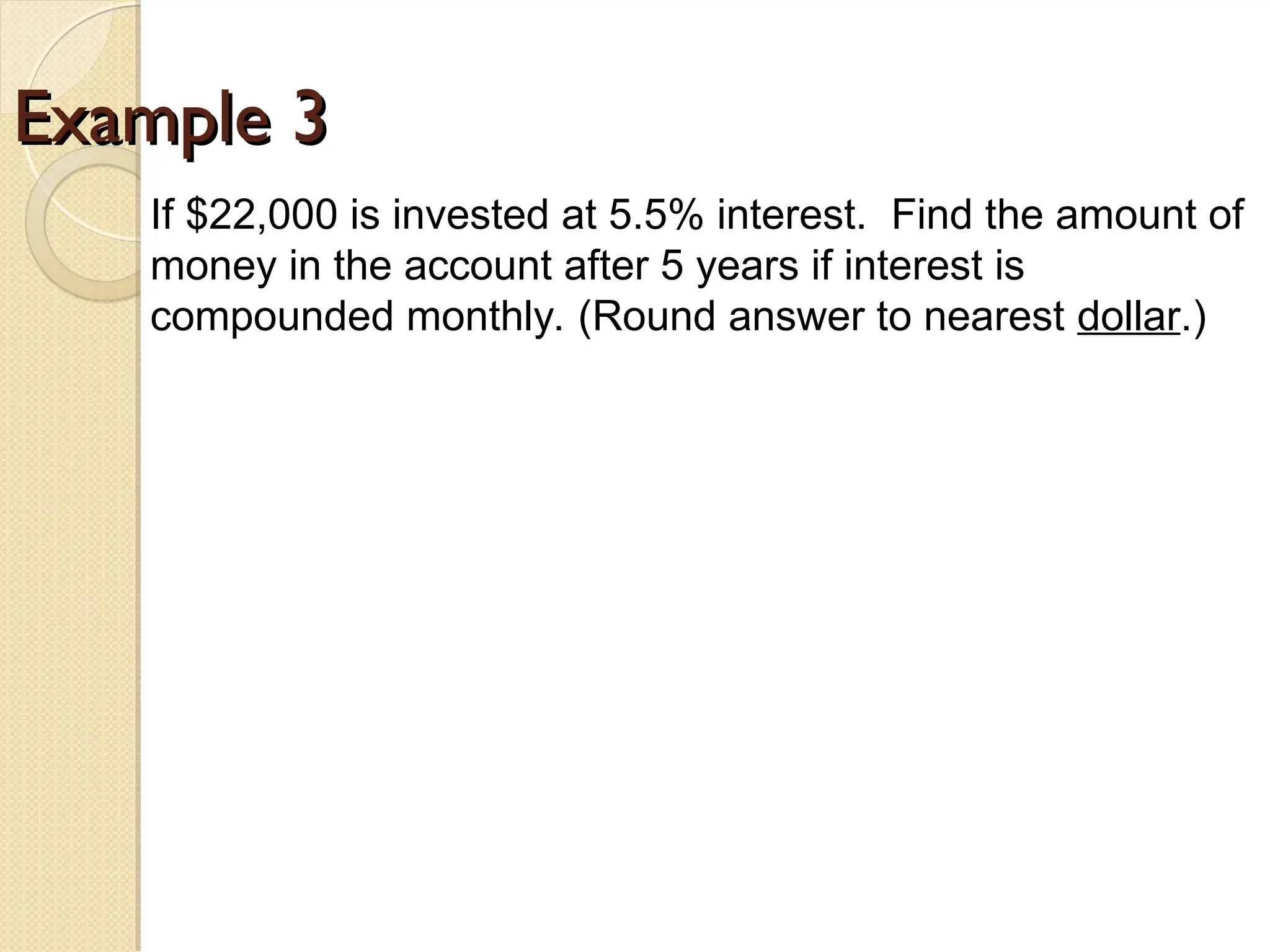
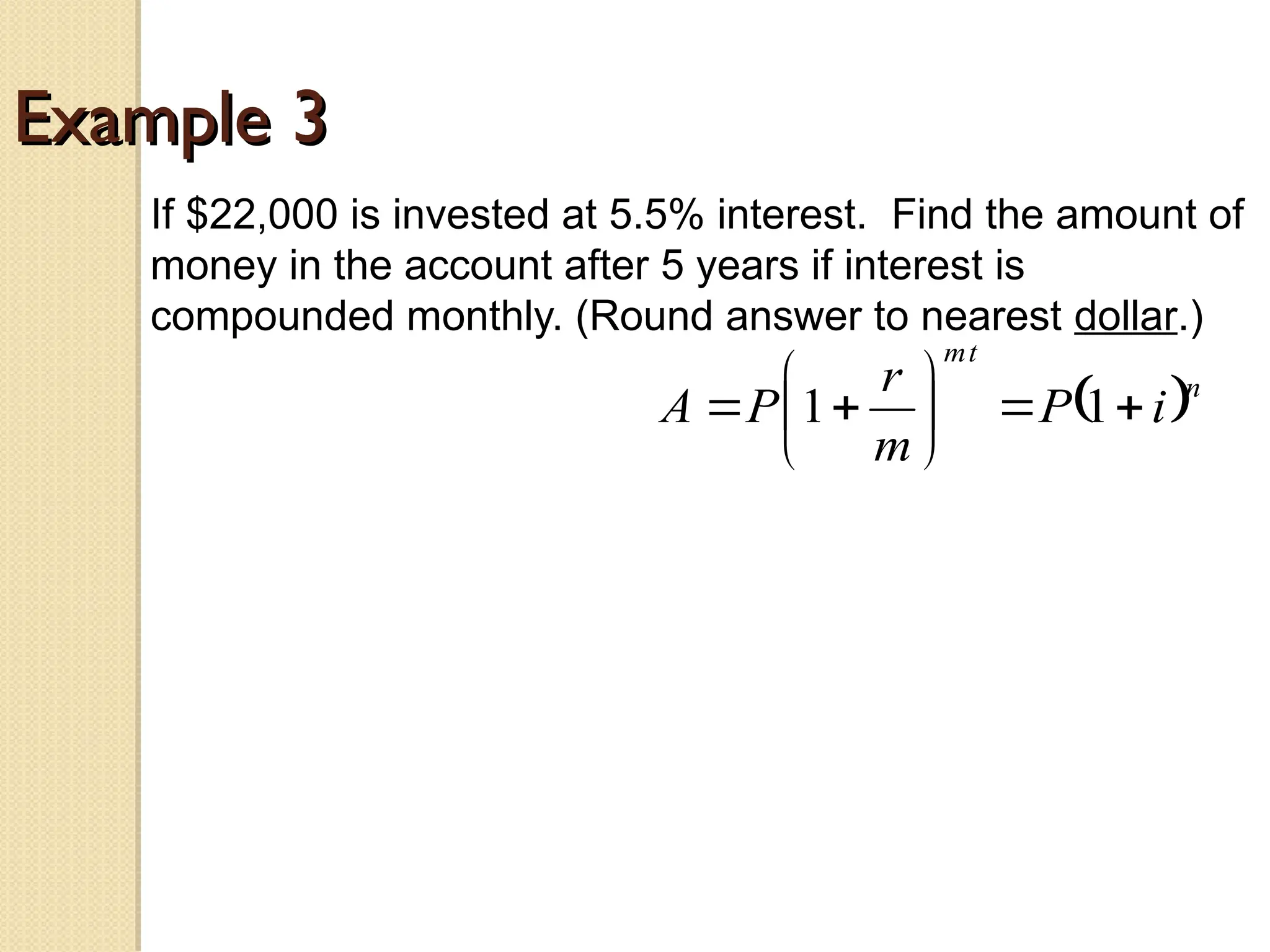
If $22,000 is invested at 5.5% interest. Find the amount of
money in the account after 5 years if interest is
compounded monthly. (Round answer to nearest dollar.)
Example 3
Example 3
If $22,000 is invested at 5.5% interest. Find the amount of
money in the account after 5 years if interest is
compounded monthly. (Round answer to nearest dollar.)
 n
t
m
i
P
m
r
P
A 








 1
1
Example 3
Example 3
If $22,000 is invested at 5.5% interest. Find the amount of
money in the account after 5 years if interest is
compounded monthly. (Round answer to nearest dollar.)
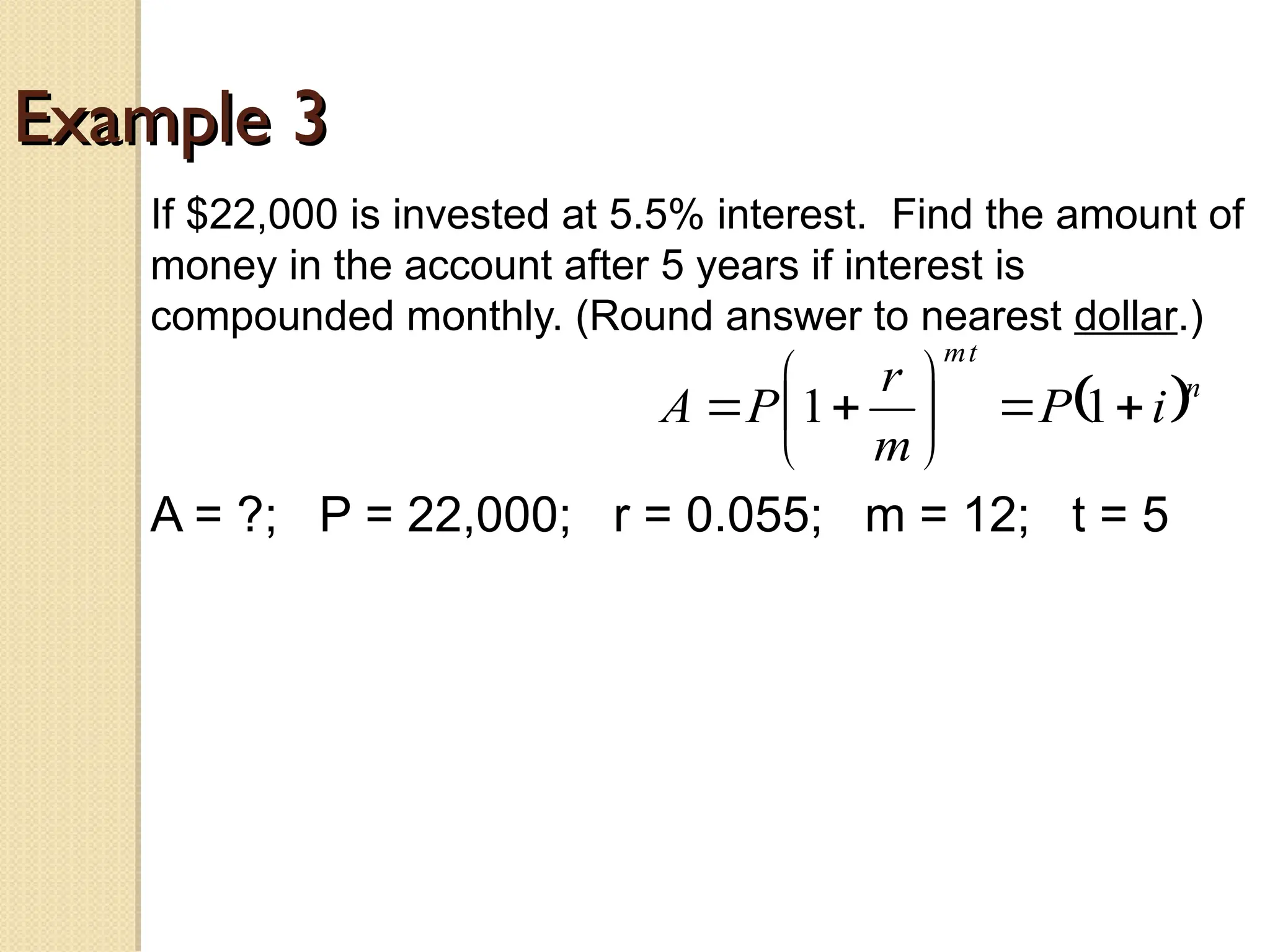
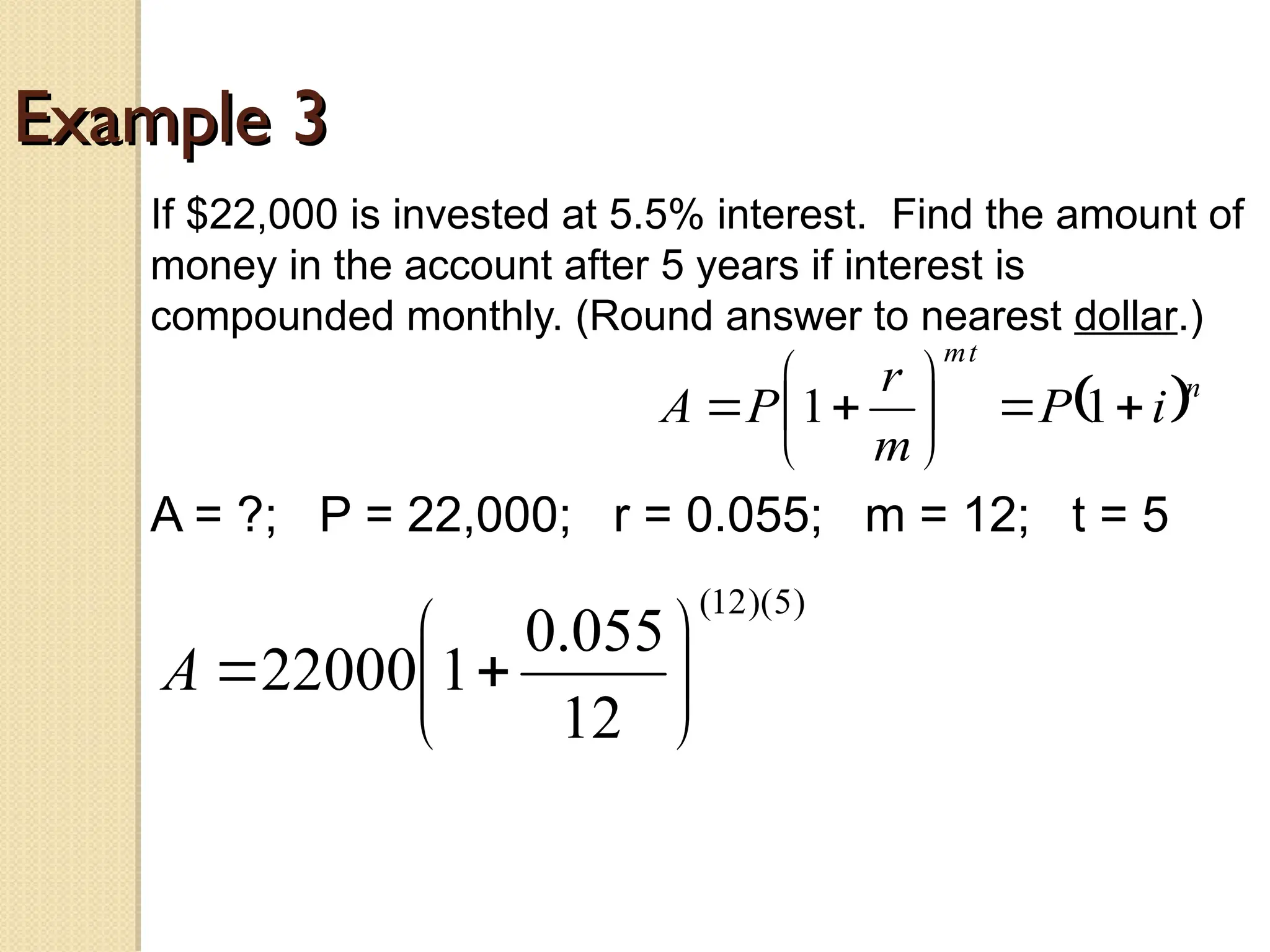
A = ?; P = 22,000; r = 0.055; m = 12; t = 5
 n
t
m
i
P
m
r
P
A 








 1
1
Example 3
Example 3
If $22,000 is invested at 5.5% interest. Find the amount of
money in the account after 5 years if interest is
compounded monthly. (Round answer to nearest dollar.)
A = ?; P = 22,000; r = 0.055; m = 12; t = 5
 n
t
m
i
P
m
r
P
A 








 1
1
)
5
)(
12
(
12
055
.
0
1
22000 







A
Example 3
Example 3
If $22,000 is invested at 5.5% interest. Find the amount of
money in the account after 5 years if interest is
compounded monthly. (Round answer to nearest dollar.)
A = ?; P = 22,000; r = 0.055; m = 12; t = 5
 n
t
m
i
P
m
r
P
A 








 1
1
945
,
28
$
12
055
.
0
1
22000
)
5
)(
12
(









A
to the nearest DOLLAR
Example 3
Example 3
If $22,000 is invested at 5.5% interest. Find the amount of
money in the account after 5 years if interest is
compounded monthly. (Round answer to nearest dollar.)
A = ?; P = 22,000; r = 0.055; m = 12; t = 5
 n
t
m
i
P
m
r
P
A 








 1
1
945
,
28
$
12
055
.
0
1
22000
)
5
)(
12
(









A
to the nearest DOLLAR
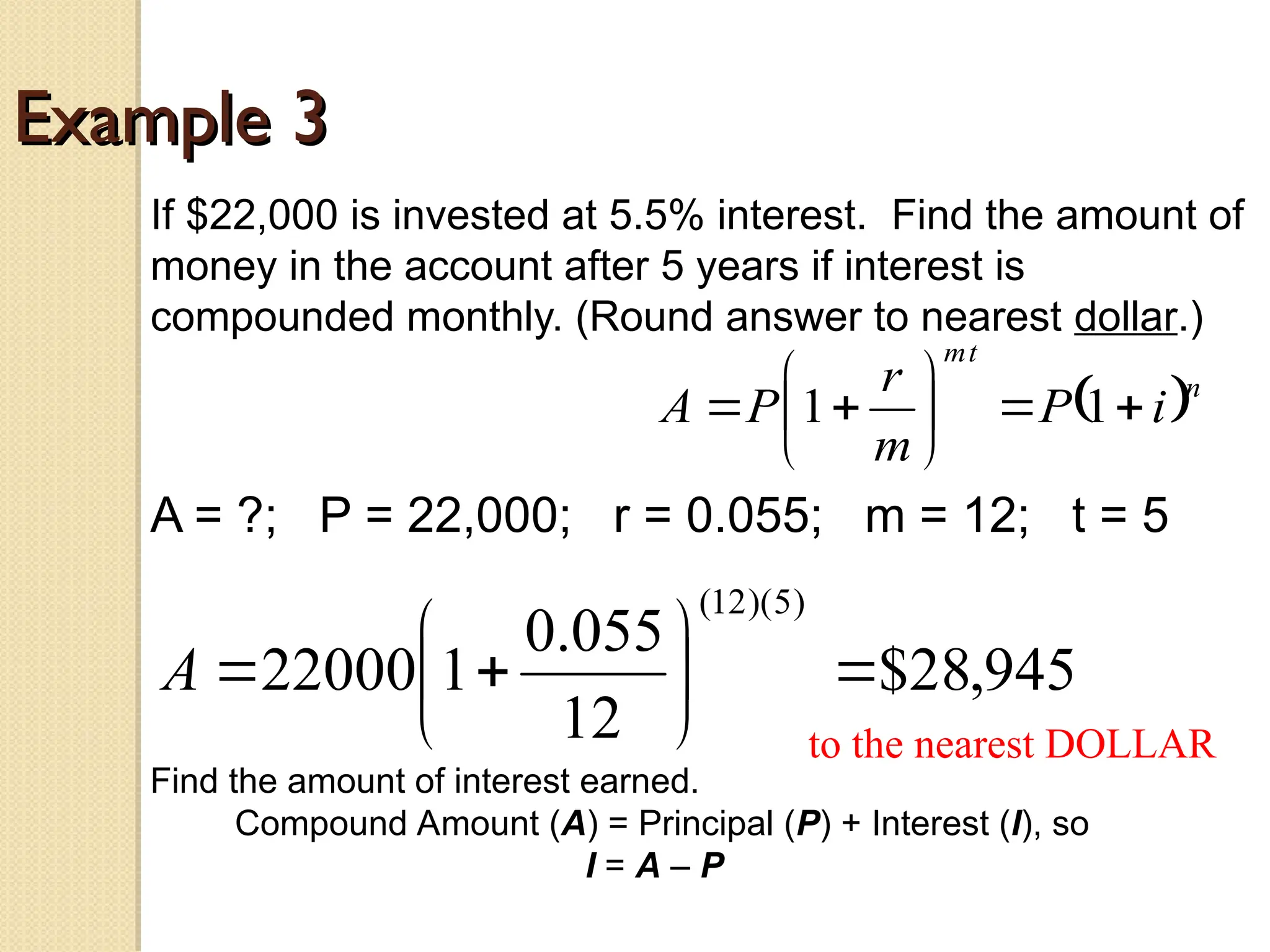
Find the amount of interest earned.
Example 3
Example 3
If $22,000 is invested at 5.5% interest. Find the amount of
money in the account after 5 years if interest is
compounded monthly. (Round answer to nearest dollar.)
A = ?; P = 22,000; r = 0.055; m = 12; t = 5
 n
t
m
i
P
m
r
P
A 








 1
1
945
,
28
$
12
055
.
0
1
22000
)
5
)(
12
(









A
to the nearest DOLLAR
Find the amount of interest earned.
Compound Amount (A) = Principal (P) + Interest (I), so
I = A – P
Example 3
Example 3
If $22,000 is invested at 5.5% interest. Find the amount of
money in the account after 5 years if interest is
compounded monthly. (Round answer to nearest dollar.)
A = ?; P = 22,000; r = 0.055; m = 12; t = 5
 n
t
m
i
P
m
r
P
A 








 1
1
945
,
28
$
12
055
.
0
1
22000
)
5
)(
12
(









A
to the nearest DOLLAR
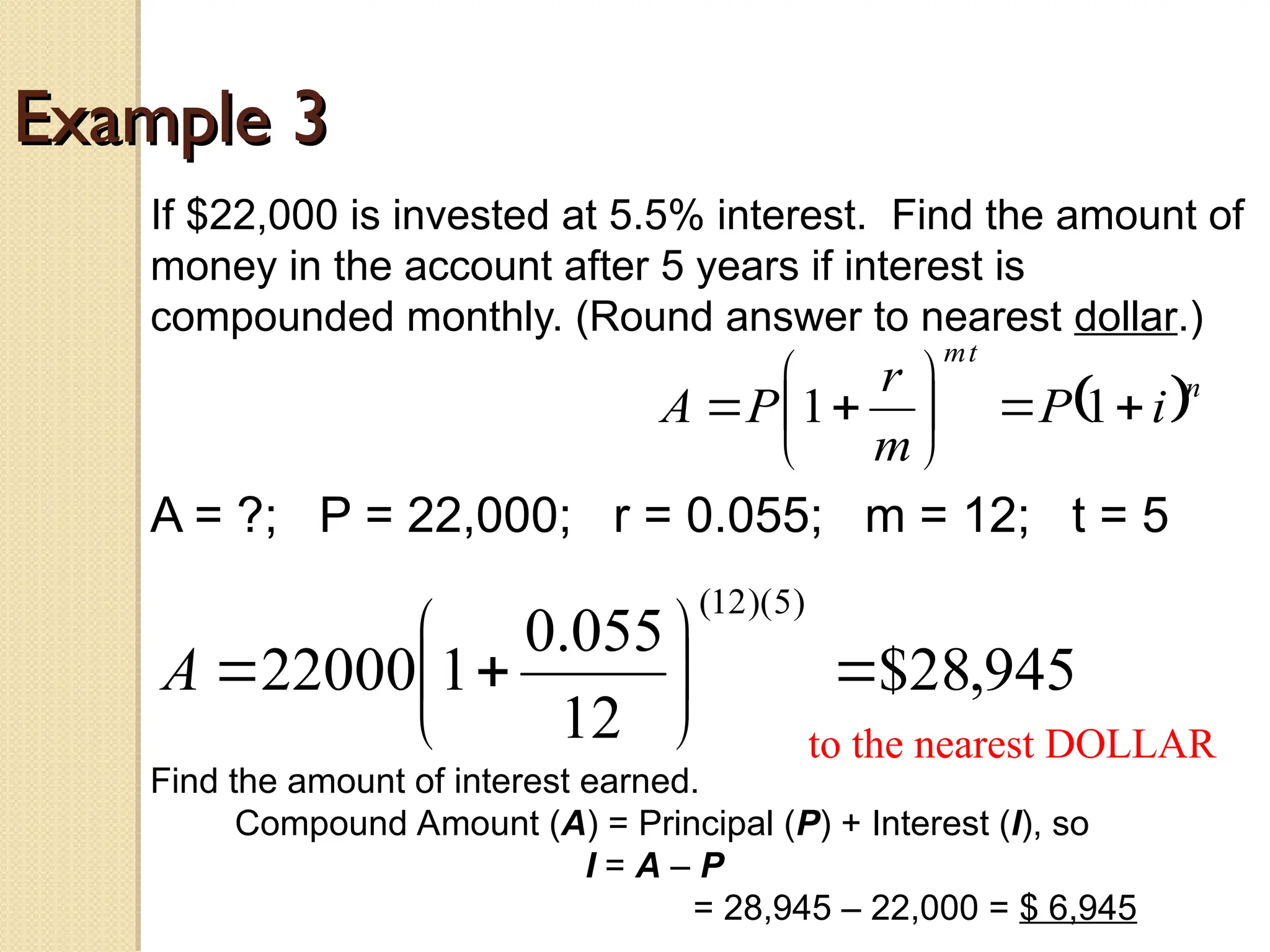
Find the amount of interest earned.
Compound Amount (A) = Principal (P) + Interest (I), so
I = A – P
= 28,945 – 22,000 = $ 6,945
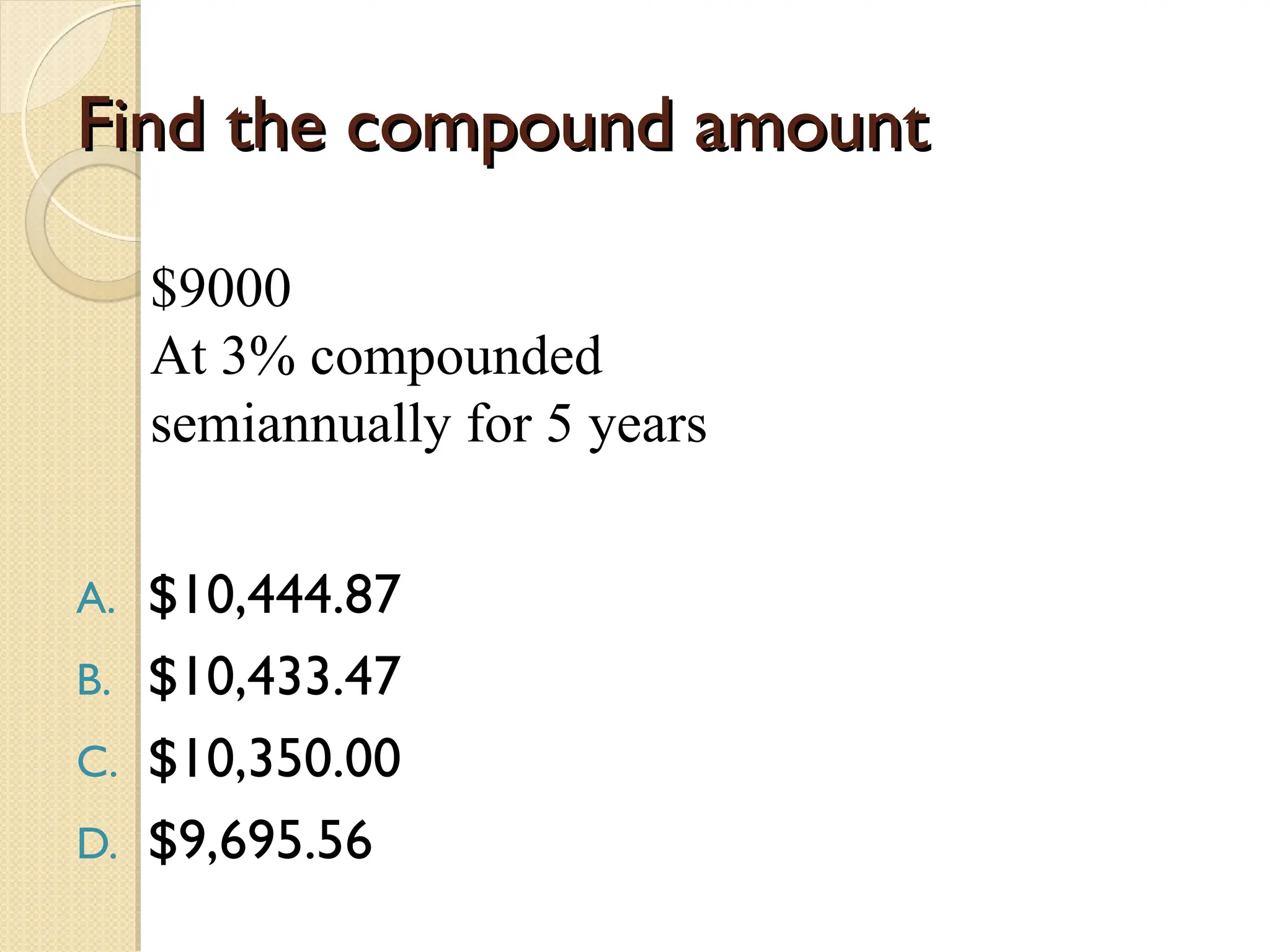
Find the compound amount
A. $10,444.87
B. $10,433.47
C. $10,350.00
D. $9,695.56
$9000
At 3% compounded
semiannually for 5 years
Example 5
Example 5
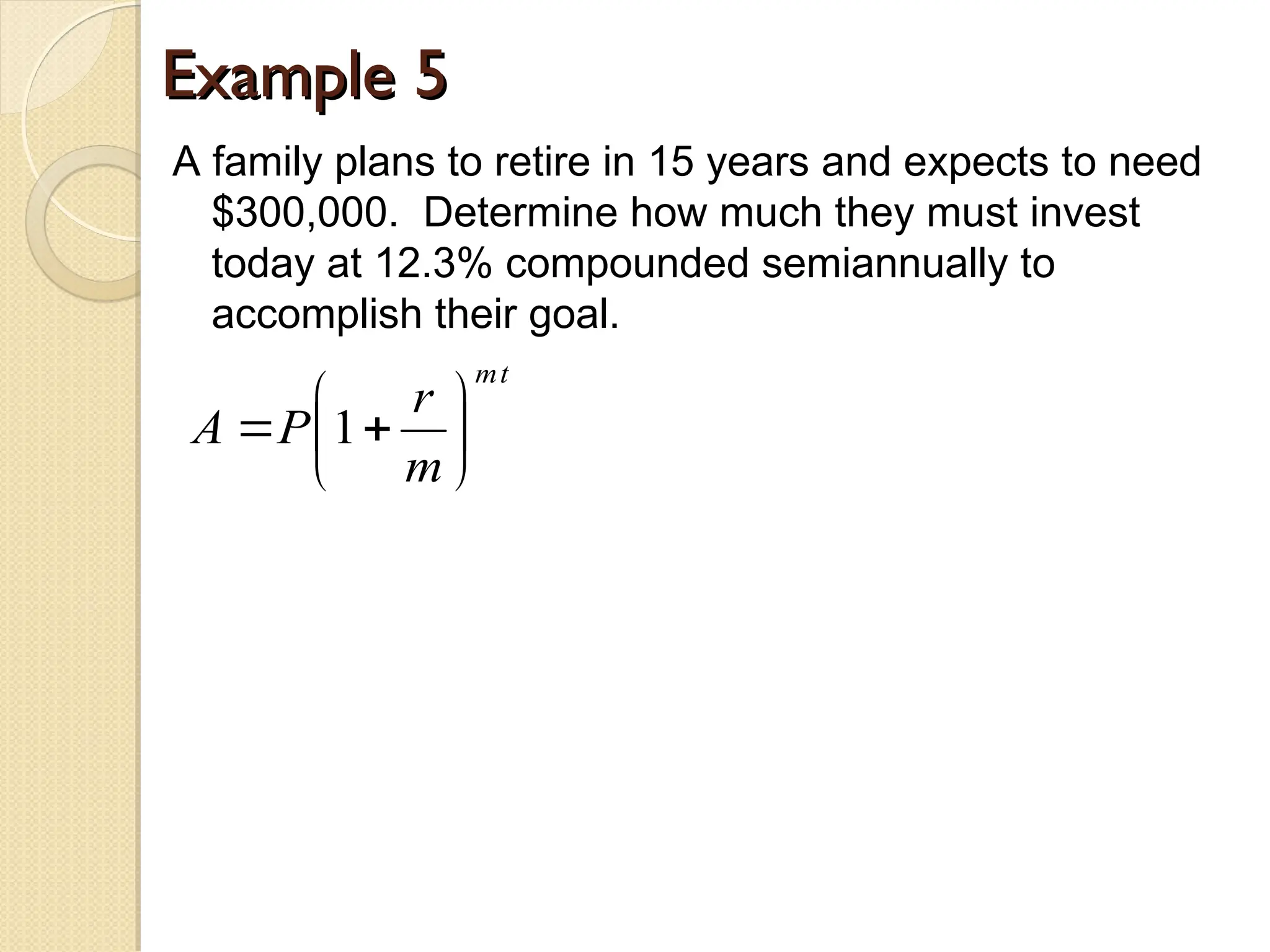
A family plans to retire in 15 years and expects to need
$300,000. Determine how much they must invest
today at 12.3% compounded semiannually to
accomplish their goal.
Example 5
Example 5
A family plans to retire in 15 years and expects to need
$300,000. Determine how much they must invest
today at 12.3% compounded semiannually to
accomplish their goal.
t
m
m
r
P
A 






 1
Example 5
Example 5
A family plans to retire in 15 years and expects to need
$300,000. Determine how much they must invest
today at 12.3% compounded semiannually to
accomplish their goal.
t
m
m
r
P
A 






 1
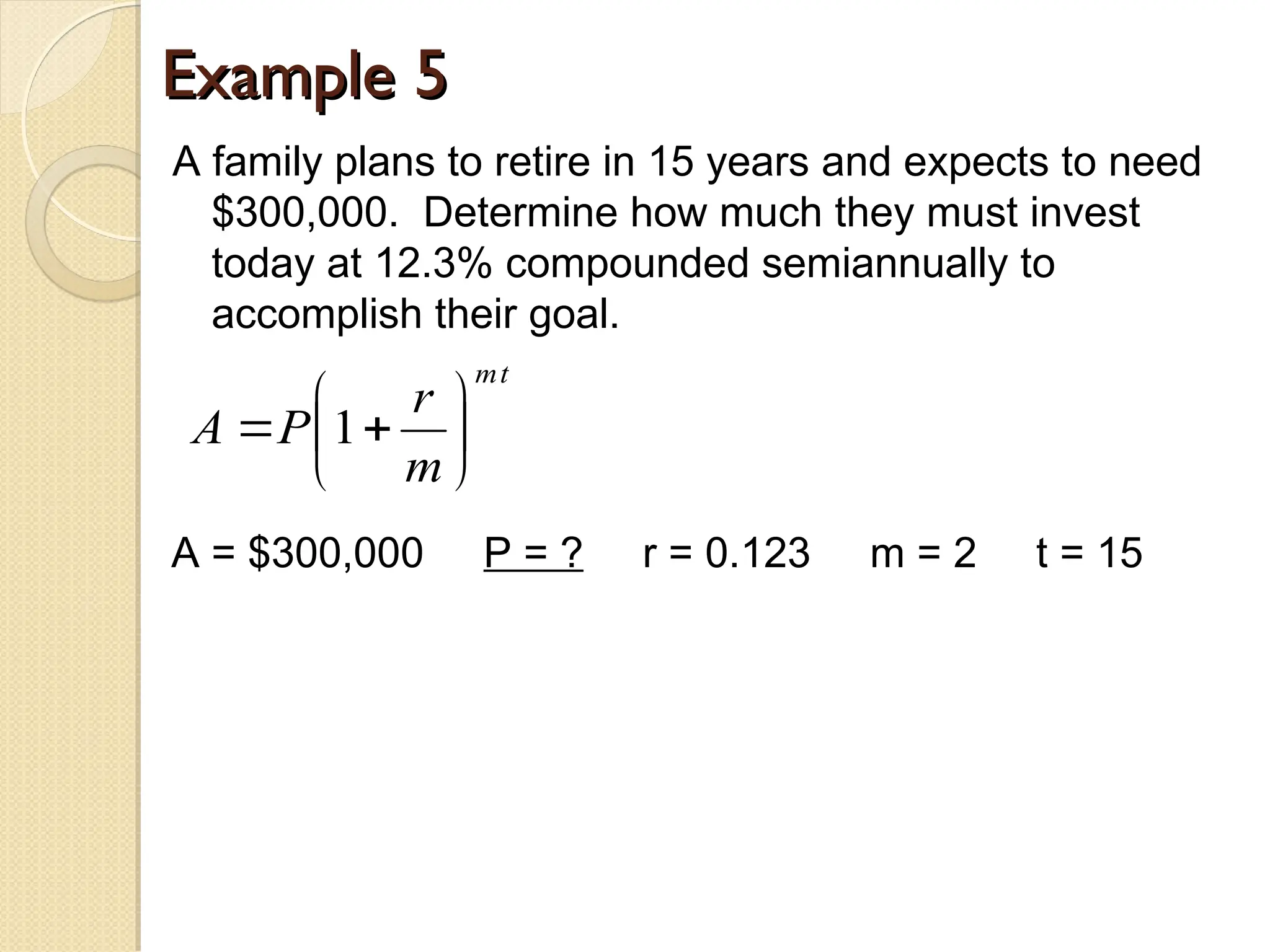
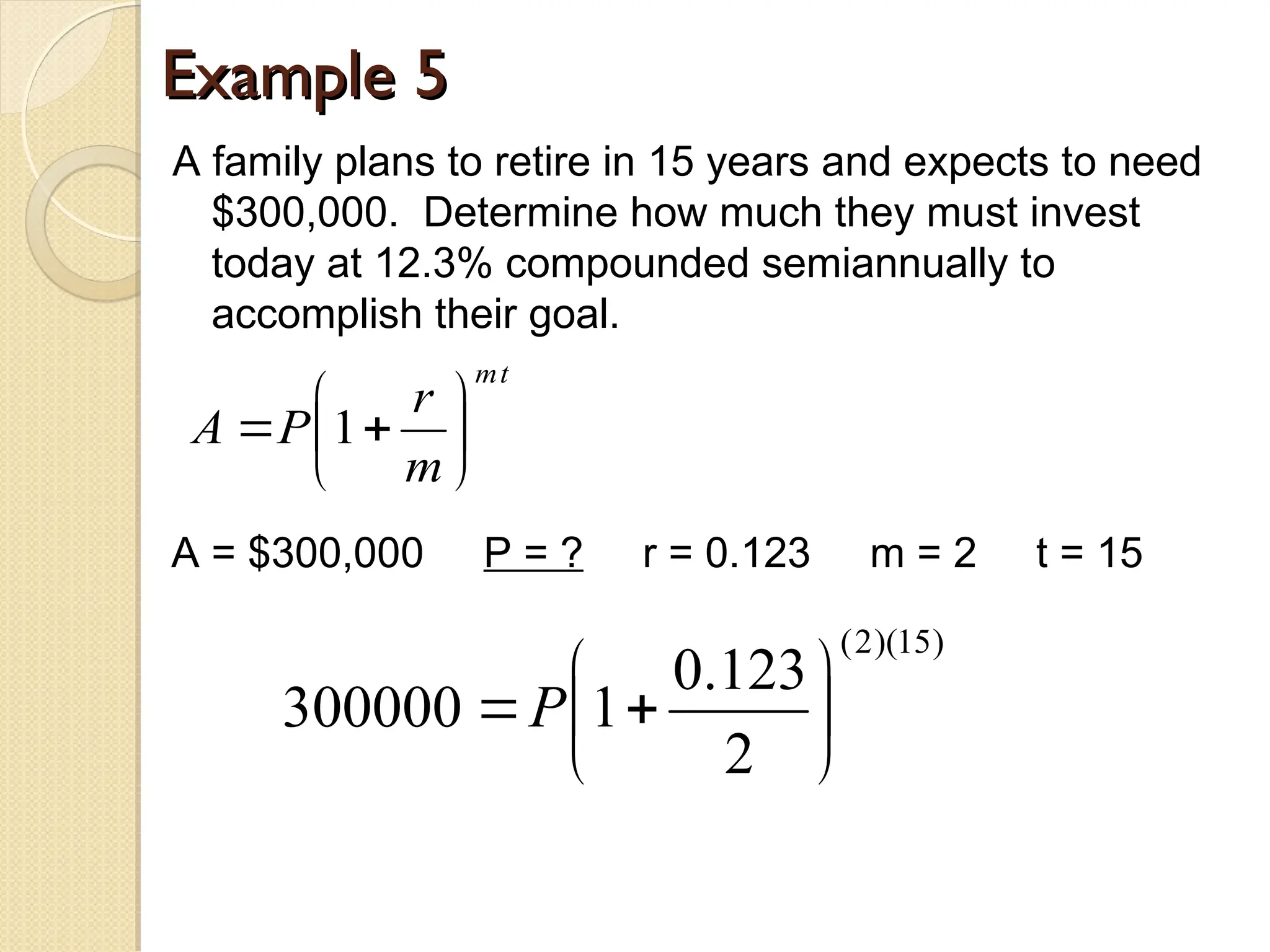
A = $300,000 P = ? r = 0.123 m = 2 t = 15
Example 5
Example 5
A family plans to retire in 15 years and expects to need
$300,000. Determine how much they must invest
today at 12.3% compounded semiannually to
accomplish their goal.
t
m
m
r
P
A 






 1
A = $300,000 P = ? r = 0.123 m = 2 t = 15
)
15
)(
2
(
2
123
.
0
1
300000 






P
Example 5
Example 5
A family plans to retire in 15 years and expects to need
$300,000. Determine how much they must invest
today at 12.3% compounded semiannually to
accomplish their goal.
t
m
m
r
P
A 






 1
A = $300,000 P = ? r = 0.123 m = 2 t = 15
P = $50,063.51
)
15
)(
2
(
2
123
.
0
1
300000 






P

Lesson 2Simple and Compound Interest.ppt

  • 1.
    Section 5.1: Section 5.1: Simpleand Compound Interest Simple and Compound Interest
  • 2.
    Simple Interest Simple Interest SimpleInterest: Used to calculate interest on loans…often of one year or less. Formula: I = Prt  I : interest earned (or owed)  P : principal invested (or borrowed)  r : annual interest rate  t : time in years
  • 3.
    Example 1 Example 1 Tobuy furniture for a new apartment, Jennifer Wall borrowed $5,000 at 6.5% simple interest for 11 months. a. How much interest will she pay? Simple interest: I = Prt I = ?
  • 4.
    Example 1 Example 1 Tobuy furniture for a new apartment, Jennifer Wall borrowed $5,000 at 6.5% simple interest for 11 months. a. How much interest will she pay? Simple interest: I = Prt I = ? P = $5,000 r = .065 t =11/12
  • 5.
    Example 1 Example 1 Tobuy furniture for a new apartment, Jennifer Wall borrowed $5,000 at 6.5% simple interest for 11 months. a. How much interest will she pay? Simple interest: I = Prt I = ? P = $5,000 r = .065 t =11/12 I = Prt = (5000)(0.065)(11/12) =
  • 6.
    a. How muchinterest will she pay? a. How much interest will she pay? Simple interest: Simple interest: I I = = Prt Prt I I = ? = ? P P = $5,000 = $5,000 r r = .065 = .065 t t =11/12 =11/12 I I = = Prt Prt = (5000)(0.065)(11/12) = $______ = (5000)(0.065)(11/12) = $______
  • 7.
    Example 1 Example 1 Tobuy furniture for a new apartment, Jennifer Wall borrowed $5,000 at 6.5% simple interest for 11 months. a. How much interest will she pay? Simple interest: I = Prt I = ? P = $5,000 r = .065 t =11/12 I = Prt = (5000)(0.065)(11/12) = $297.92
  • 8.
    Example 1 Example 1 Tobuy furniture for a new apartment, Jennifer Wall borrowed $5,000 at 6.5% simple interest for 11 months. b. What is the total amount to be repaid?
  • 9.
    Example 1 Example 1 Tobuy furniture for a new apartment, Jennifer Wall borrowed $5,000 at 6.5% simple interest for 11 months. b. What is the total amount to be repaid? Amount to Repay = Principal + Interest
  • 10.
    Example 1 Example 1 Tobuy furniture for a new apartment, Jennifer Wall borrowed $5,000 at 6.5% simple interest for 11 months. b. What is the total amount to be repaid? Amount to Repay = Principal + Interest = 5000 + 297.92
  • 11.
    Example 1 Example 1 Tobuy furniture for a new apartment, Jennifer Wall borrowed $5,000 at 6.5% simple interest for 11 months. b. What is the total amount to be repaid? Amount to Repay = Principal + Interest = 5000 + 297.92 = $ 5,297.92
  • 12.
    Example 1 Example 1 Tobuy furniture for a new apartment, Jennifer Wall borrowed $5,000 at 6.5% simple interest for 11 months. b. What is the total amount to be repaid? Amount to Repay = Principal + Interest = 5000 + 297.92 = $ 5,297.92 Notice here that we really have: A = P + I … or A = P + Prt = P(1 + rt)
  • 13.
    Example 1 Example 1 Tobuy furniture for a new apartment, Jennifer Wall borrowed $5,000 at 6.5% simple interest for 11 months. b. What is the total amount to be repaid? Amount to Repay = Principal + Interest = 5000 + 297.92 = $ 5,297.92 Notice here that we really have: A = P + I … or A = P + Prt = P(1 + rt) So, if you want a direct formula for A with simple interest, use A = P(1 + rt)
  • 14.
    Example 1 Example 1 Tobuy furniture for a new apartment, Jennifer Wall borrowed $5,000 at 6.5% simple interest for 11 months. b. What is the total amount to be repaid? Amount to Repay = Principal + Interest = 5000 + 297.92 = $ 5,297.92 Notice here that we really have: A = P + I … or A = P + Prt = P(1 + rt) So, if you want a direct formula for A with simple interest, use A = P(1 + rt) and, of course if you only want I, then use I = Prt
  • 15.
    Find simple interest Findsimple interest $10,502 at 4.2% for 10 months A. $370.66 B. $367.57 C. $404.33 D. $330.81
  • 16.
    Activity Activity Miguel is planningto invest in a local bank. He wants to earn an extra if 5000 pesos in interest after 3 years at an annual interest rate of 4%. How much should he invest to reach his goal?
  • 17.
    Activity Activity Lara wants tobuy a new laptop and decides to save up through an investment. She invests 10,000 pesos at 3.5% annual interest rate. How long will it take for her investment to generate 4,200 pesos in interest?
  • 18.
    Activity Activity Carlos borrowed moneyfrom his friend to start a small business. He agreed to pay back 15,000 pesos after 4 years with 2,700 pesos as interest. What was the annual interest rate agreed upon?
  • 19.
    Activity Activity Anna invested ina short-term project that promised 6% annual return. She invested 8,000 pesos for a period of 120 days. How much will be the exact interest will Anna earn by the end of the project?
  • 20.
    Compound Interest Compound Interest CompoundInterest: more commonly used than simple interest. With compound interest, the interest itself earns interest. Formula: t m m r P A         1
  • 21.
    Compound Interest Compound Interest CompoundInterest: more commonly used than simple interest. With compound interest, the interest itself earns interest. Formula: Where  A is the compound amount (includes principal and interest) t m m r P A         1
  • 22.
    Compound Interest Compound Interest CompoundInterest: more commonly used than simple interest. With compound interest, the interest itself earns interest. Formula: Where  A is the compound amount (includes principal and interest)  P is the initial investment t m m r P A         1
  • 23.
    Compound Interest Compound Interest CompoundInterest: more commonly used than simple interest. With compound interest, the interest itself earns interest. Formula: Where  A is the compound amount (includes principal and interest)  P is the initial investment  r is the annual percentage rate t m m r P A         1
  • 24.
    Compound Interest Compound Interest CompoundInterest: more commonly used than simple interest. With compound interest, the interest itself earns interest. Formula: Where  A is the compound amount (includes principal and interest)  P is the initial investment  r is the annual percentage rate  m is the number of compounding periods per year: t m m r P A         1
  • 25.
    Compound Interest Compound Interest CompoundInterest: more commonly used than simple interest. With compound interest, the interest itself earns interest. Formula: Where  A is the compound amount (includes principal and interest)  P is the initial investment  r is the annual percentage rate  m is the number of compounding periods per year:  Compounded annually, m = 1  Compounded semiannually, m = 2  Compounded quarterly, m = 4, etc. t m m r P A         1
  • 26.
    Compound Interest Compound Interest CompoundInterest: more commonly used than simple interest. With compound interest, the interest itself earns interest. Formula: Where  A is the compound amount (includes principal and interest)  P is the initial investment  r is the annual percentage rate  m is the number of compounding periods per year:  Compounded annually, m = 1  Compounded semiannually, m = 2  Compounded quarterly, m = 4, etc.  t is the number of years t m m r P A         1
  • 27.
    Compound Interest Compound Interest CompoundInterest: more commonly used than simple interest. With compound interest, the interest itself earns interest. Formula: Where  A is the compound amount (includes principal and interest)  P is the initial investment  r is the annual percentage rate  m is the number of compounding periods per year:  Compounded annually, m = 1  Compounded semiannually, m = 2  Compounded quarterly, m = 4, etc.  t is the number of years  n = mt is the total # of compounding periods over all t years  i = r/m is the interest rate per compounding period  n t m i P m r P A           1 1
  • 28.
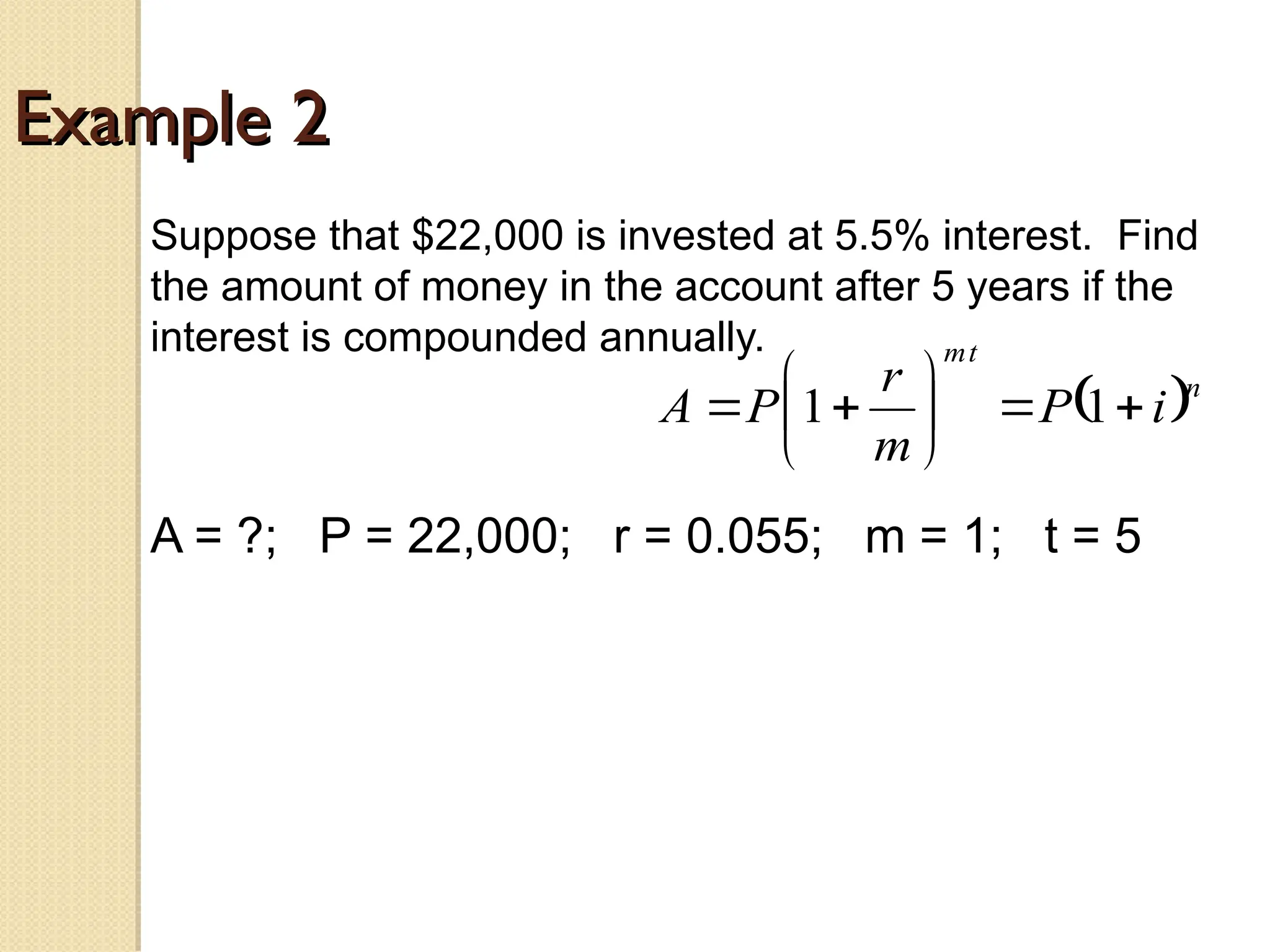
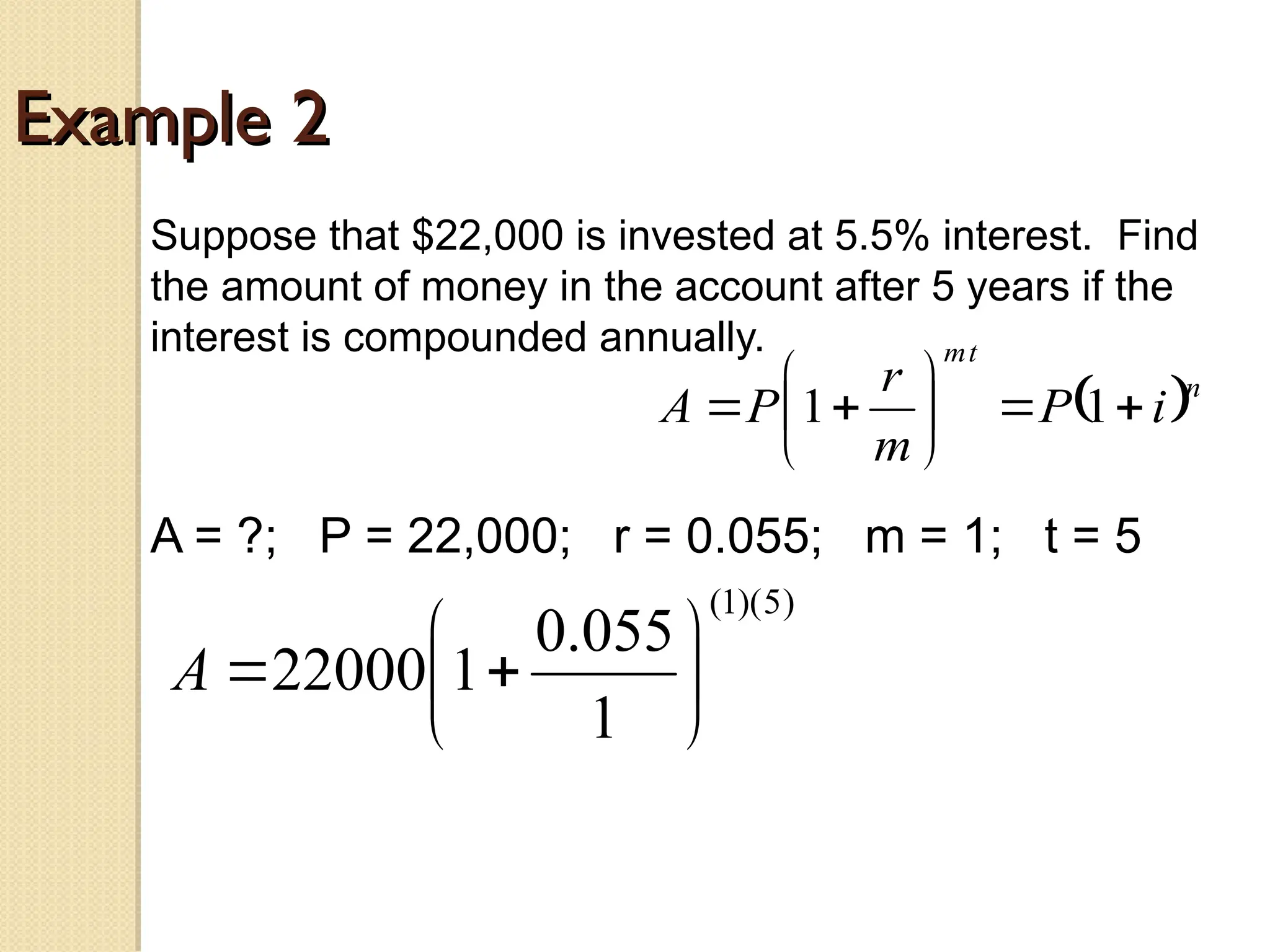
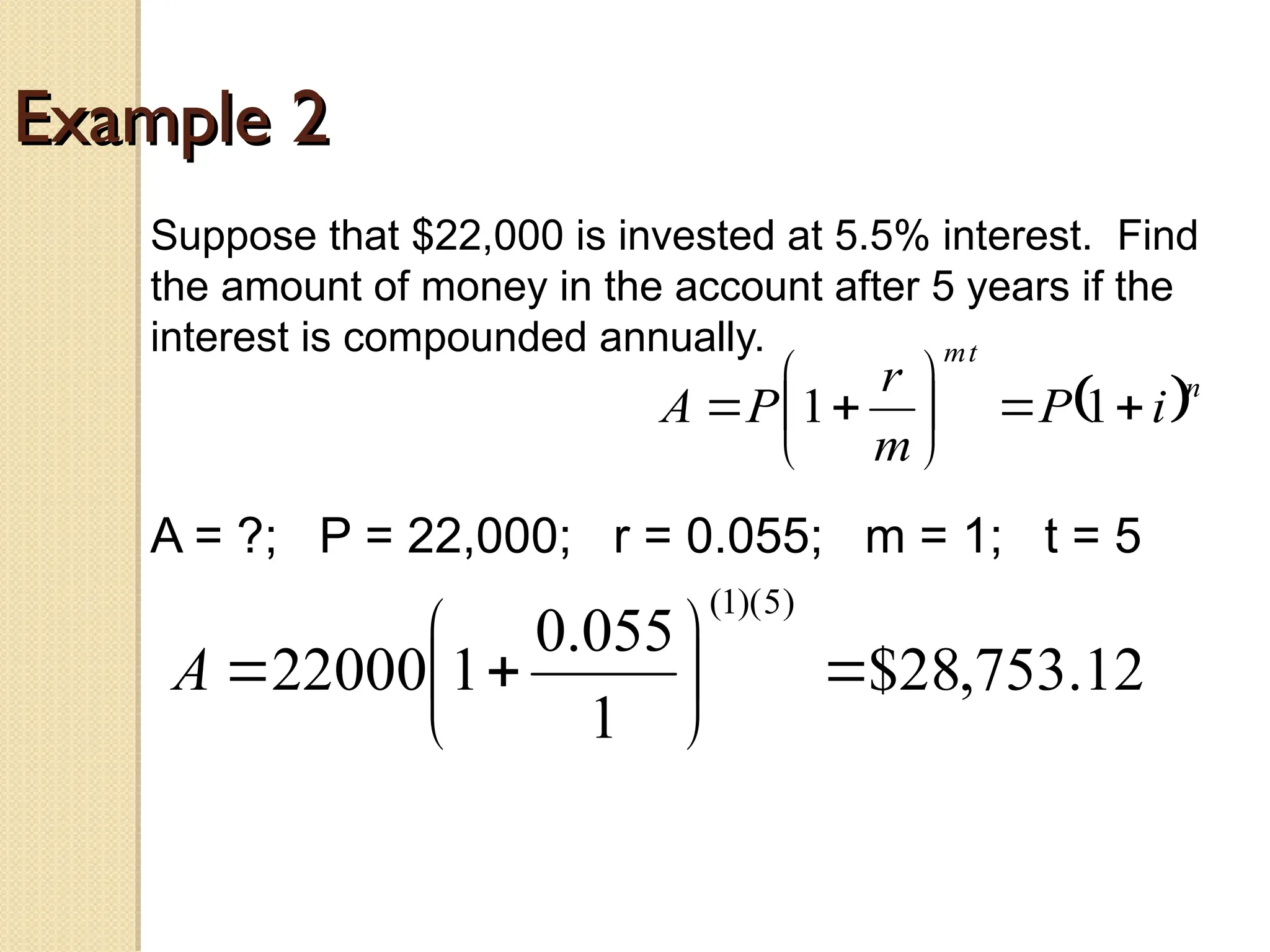
    Example 2 Example 2 Supposethat $22,000 is invested at 5.5% interest. Find the amount of money in the account after 5 years if the interest is compounded annually.
  • 29.
    Example 2 Example 2 Supposethat $22,000 is invested at 5.5% interest. Find the amount of money in the account after 5 years if the interest is compounded annually.  n t m i P m r P A           1 1
  • 30.
    Example 2 Example 2 Supposethat $22,000 is invested at 5.5% interest. Find the amount of money in the account after 5 years if the interest is compounded annually. A = ?; P = 22,000; r = 0.055; m = 1; t = 5  n t m i P m r P A           1 1
  • 31.
    Example 2 Example 2 Supposethat $22,000 is invested at 5.5% interest. Find the amount of money in the account after 5 years if the interest is compounded annually. A = ?; P = 22,000; r = 0.055; m = 1; t = 5  n t m i P m r P A           1 1 ) 5 )( 1 ( 1 055 . 0 1 22000         A
  • 32.
    Example 2 Example 2 Supposethat $22,000 is invested at 5.5% interest. Find the amount of money in the account after 5 years if the interest is compounded annually. A = ?; P = 22,000; r = 0.055; m = 1; t = 5  n t m i P m r P A           1 1 12 . 753 , 28 $ 1 055 . 0 1 22000 ) 5 )( 1 (          A
  • 33.
    Example 2 Example 2 Supposethat $22,000 is invested at 5.5% interest. Find the amount of money in the account after 5 years if the interest is compounded annually. A = ?; P = 22,000; r = 0.055; m = 1; t = 5  n t m i P m r P A           1 1 12 . 753 , 28 $ 1 055 . 0 1 22000 ) 5 )( 1 (          A Find the amount of interest earned.
  • 34.
    Example 2 Example 2 Supposethat $22,000 is invested at 5.5% interest. Find the amount of money in the account after 5 years if the interest is compounded annually. A = ?; P = 22,000; r = 0.055; m = 1; t = 5  n t m i P m r P A           1 1 12 . 753 , 28 $ 1 055 . 0 1 22000 ) 5 )( 1 (          A Find the amount of interest earned. Compound Amount (A) = Principal (P) + Interest (I), so I = A – P
  • 35.
    Example 2 Example 2 Supposethat $22,000 is invested at 5.5% interest. Find the amount of money in the account after 5 years if the interest is compounded annually. A = ?; P = 22,000; r = 0.055; m = 1; t = 5  n t m i P m r P A           1 1 12 . 753 , 28 $ 1 055 . 0 1 22000 ) 5 )( 1 (          A Find the amount of interest earned. Compound Amount (A) = Principal (P) + Interest (I), so I = A – P = 28,753.12 – 22,000 = $
  • 36.
    Example 3 Example 3 If$22,000 is invested at 5.5% interest. Find the amount of money in the account after 5 years if interest is compounded monthly. (Round answer to nearest dollar.)
  • 37.
    Example 3 Example 3 If$22,000 is invested at 5.5% interest. Find the amount of money in the account after 5 years if interest is compounded monthly. (Round answer to nearest dollar.)  n t m i P m r P A           1 1
  • 38.
    Example 3 Example 3 If$22,000 is invested at 5.5% interest. Find the amount of money in the account after 5 years if interest is compounded monthly. (Round answer to nearest dollar.) A = ?; P = 22,000; r = 0.055; m = 12; t = 5  n t m i P m r P A           1 1
  • 39.
    Example 3 Example 3 If$22,000 is invested at 5.5% interest. Find the amount of money in the account after 5 years if interest is compounded monthly. (Round answer to nearest dollar.) A = ?; P = 22,000; r = 0.055; m = 12; t = 5  n t m i P m r P A           1 1 ) 5 )( 12 ( 12 055 . 0 1 22000         A
  • 40.
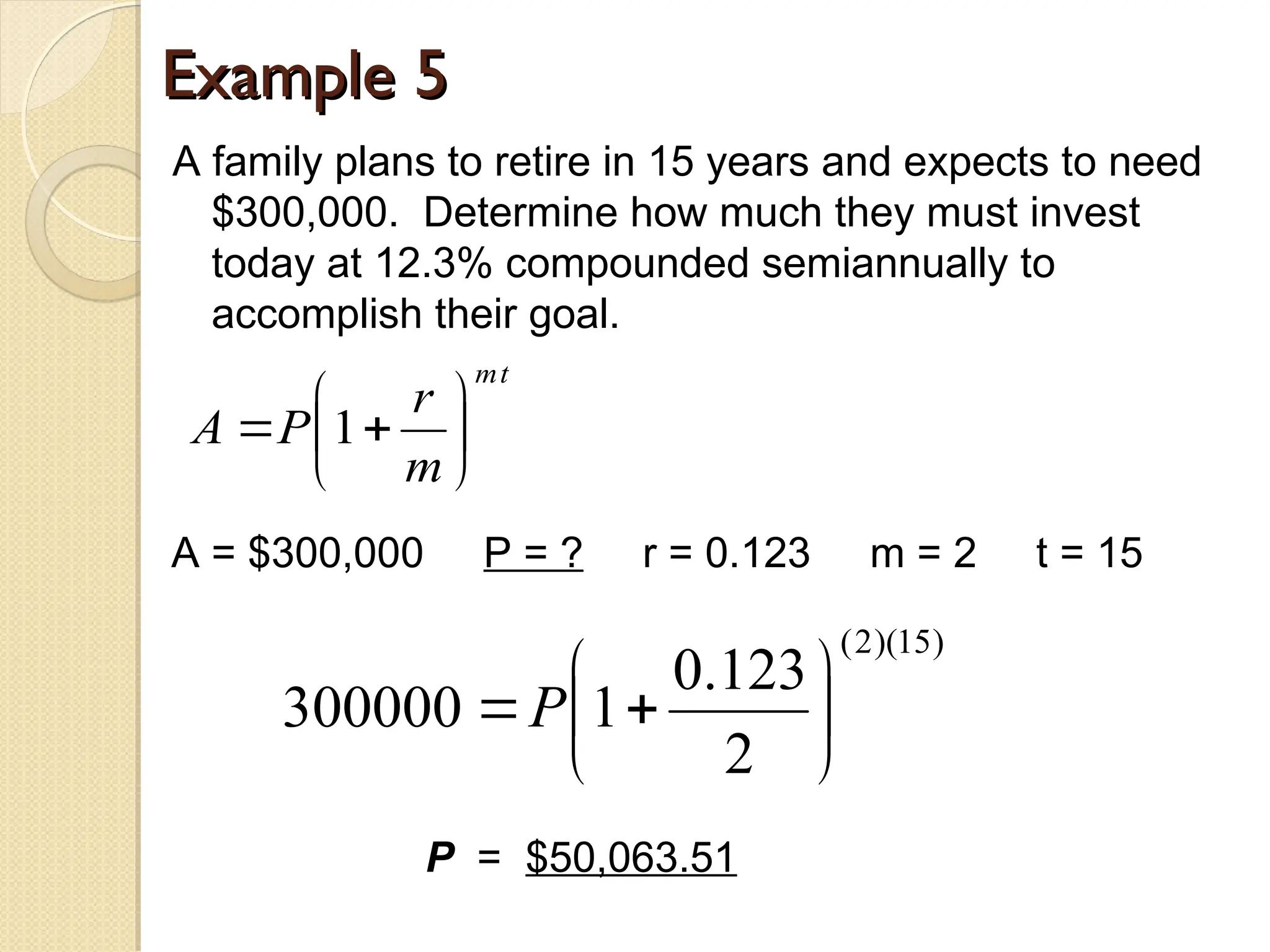
    Example 3 Example 3 If$22,000 is invested at 5.5% interest. Find the amount of money in the account after 5 years if interest is compounded monthly. (Round answer to nearest dollar.) A = ?; P = 22,000; r = 0.055; m = 12; t = 5  n t m i P m r P A           1 1 945 , 28 $ 12 055 . 0 1 22000 ) 5 )( 12 (          A to the nearest DOLLAR
  • 41.
    Example 3 Example 3 If$22,000 is invested at 5.5% interest. Find the amount of money in the account after 5 years if interest is compounded monthly. (Round answer to nearest dollar.) A = ?; P = 22,000; r = 0.055; m = 12; t = 5  n t m i P m r P A           1 1 945 , 28 $ 12 055 . 0 1 22000 ) 5 )( 12 (          A to the nearest DOLLAR Find the amount of interest earned.
  • 42.
    Example 3 Example 3 If$22,000 is invested at 5.5% interest. Find the amount of money in the account after 5 years if interest is compounded monthly. (Round answer to nearest dollar.) A = ?; P = 22,000; r = 0.055; m = 12; t = 5  n t m i P m r P A           1 1 945 , 28 $ 12 055 . 0 1 22000 ) 5 )( 12 (          A to the nearest DOLLAR Find the amount of interest earned. Compound Amount (A) = Principal (P) + Interest (I), so I = A – P
  • 43.
    Example 3 Example 3 If$22,000 is invested at 5.5% interest. Find the amount of money in the account after 5 years if interest is compounded monthly. (Round answer to nearest dollar.) A = ?; P = 22,000; r = 0.055; m = 12; t = 5  n t m i P m r P A           1 1 945 , 28 $ 12 055 . 0 1 22000 ) 5 )( 12 (          A to the nearest DOLLAR Find the amount of interest earned. Compound Amount (A) = Principal (P) + Interest (I), so I = A – P = 28,945 – 22,000 = $ 6,945
  • 44.
    Find the compoundamount Find the compound amount A. $10,444.87 B. $10,433.47 C. $10,350.00 D. $9,695.56 $9000 At 3% compounded semiannually for 5 years
  • 45.
    Example 5 Example 5 Afamily plans to retire in 15 years and expects to need $300,000. Determine how much they must invest today at 12.3% compounded semiannually to accomplish their goal.
  • 46.
    Example 5 Example 5 Afamily plans to retire in 15 years and expects to need $300,000. Determine how much they must invest today at 12.3% compounded semiannually to accomplish their goal. t m m r P A         1
  • 47.
    Example 5 Example 5 Afamily plans to retire in 15 years and expects to need $300,000. Determine how much they must invest today at 12.3% compounded semiannually to accomplish their goal. t m m r P A         1 A = $300,000 P = ? r = 0.123 m = 2 t = 15
  • 48.
    Example 5 Example 5 Afamily plans to retire in 15 years and expects to need $300,000. Determine how much they must invest today at 12.3% compounded semiannually to accomplish their goal. t m m r P A         1 A = $300,000 P = ? r = 0.123 m = 2 t = 15 ) 15 )( 2 ( 2 123 . 0 1 300000        P
  • 49.
    Example 5 Example 5 Afamily plans to retire in 15 years and expects to need $300,000. Determine how much they must invest today at 12.3% compounded semiannually to accomplish their goal. t m m r P A         1 A = $300,000 P = ? r = 0.123 m = 2 t = 15 P = $50,063.51 ) 15 )( 2 ( 2 123 . 0 1 300000        P