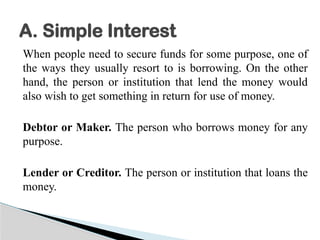
When people needto secure funds for some purpose, one of
the ways they usually resort to is borrowing. On the other
hand, the person or institution that lend the money would
also wish to get something in return for use of money.
Debtor or Maker. The person who borrows money for any
purpose.
Lender or Creditor. The person or institution that loans the
money.
A. Simple Interest
3.
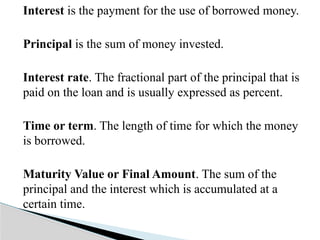
Interest is thepayment for the use of borrowed money.
Principal is the sum of money invested.
Interest rate. The fractional part of the principal that is
paid on the loan and is usually expressed as percent.
Time or term. The length of time for which the money
is borrowed.
Maturity Value or Final Amount. The sum of the
principal and the interest which is accumulated at a
certain time.
4.
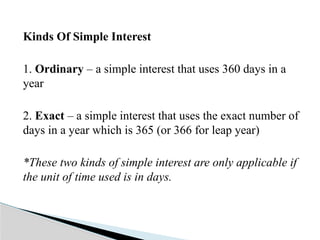
Kinds Of SimpleInterest
1. Ordinary – a simple interest that uses 360 days in a
year
2. Exact – a simple interest that uses the exact number of
days in a year which is 365 (or 366 for leap year)
*These two kinds of simple interest are only applicable if
the unit of time used is in days.
5.
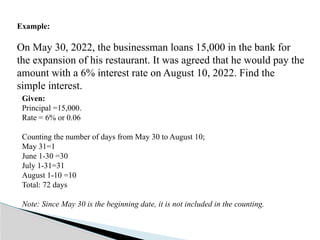
Example:
On May 30,2022, the businessman loans 15,000 in the bank for
the expansion of his restaurant. It was agreed that he would pay the
amount with a 6% interest rate on August 10, 2022. Find the
simple interest.
Given:
Principal =15,000.
Rate = 6% or 0.06
Counting the number of days from May 30 to August 10;
May 31=1
June 1-30 =30
July 1-31=31
August 1-10 =10
Total: 72 days
Note: Since May 30 is the beginning date, it is not included in the counting.
6.
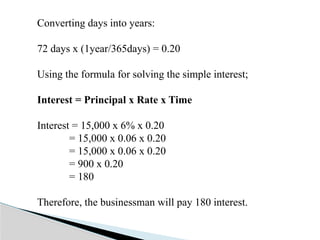
Converting days intoyears:
72 days x (1year/365days) = 0.20
Using the formula for solving the simple interest;
Interest = Principal x Rate x Time
Interest = 15,000 x 6% x 0.20
= 15,000 x 0.06 x 0.20
= 15,000 x 0.06 x 0.20
= 900 x 0.20
= 180
Therefore, the businessman will pay 180 interest.
7.
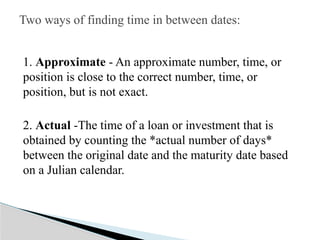
1. Approximate -An approximate number, time, or
position is close to the correct number, time, or
position, but is not exact.
2. Actual -The time of a loan or investment that is
obtained by counting the *actual number of days*
between the original date and the maturity date based
on a Julian calendar.
Two ways of finding time in between dates:
8.
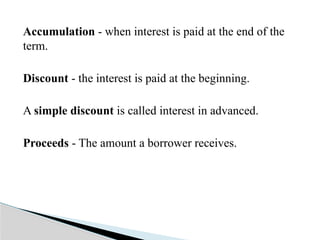
Accumulation - wheninterest is paid at the end of the
term.
Discount - the interest is paid at the beginning.
A simple discount is called interest in advanced.
Proceeds - The amount a borrower receives.
9.
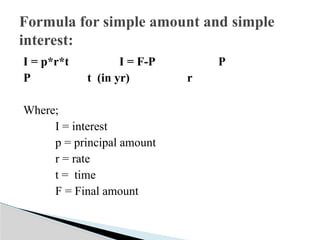
I = p*r*tI = F-P P
P t (in yr) r
Where;
I = interest
p = principal amount
r = rate
t = time
F = Final amount
Formula for simple amount and simple
interest:
10.
Example:
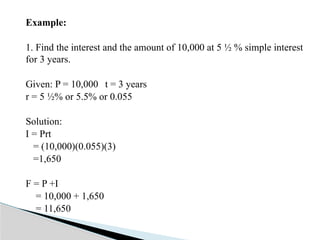
1. Find theinterest and the amount of 10,000 at 5 ½ % simple interest
for 3 years.
Given: P = 10,000 t = 3 years
r = 5 ½% or 5.5% or 0.055
Solution:
I = Prt
= (10,000)(0.055)(3)
=1,650
F = P +I
= 10,000 + 1,650
= 11,650
11.
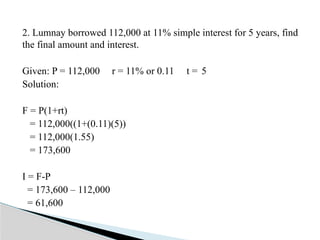
2. Lumnay borrowed112,000 at 11% simple interest for 5 years, find
the final amount and interest.
Given: P = 112,000 r = 11% or 0.11 t = 5
Solution:
F = P(1+rt)
= 112,000((1+(0.11)(5))
= 112,000(1.55)
= 173,600
I = F-P
= 173,600 – 112,000
= 61,600
12.
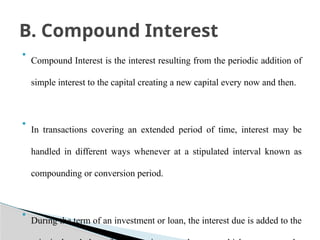
• Compound Interestis the interest resulting from the periodic addition of
simple interest to the capital creating a new capital every now and then.
• In transactions covering an extended period of time, interest may be
handled in different ways whenever at a stipulated interval known as
compounding or conversion period.
• During the term of an investment or loan, the interest due is added to the
B. Compound Interest
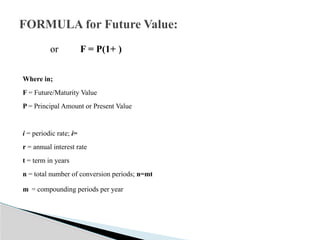
13.
or F =P(1+ )
Where in;
F = Future/Maturity Value
P = Principal Amount or Present Value
i = periodic rate; i=
r = annual interest rate
t = term in years
n = total number of conversion periods; n=mt
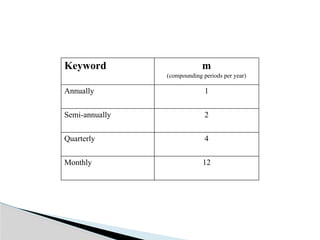
m = compounding periods per year
FORMULA for Future Value:
Example:
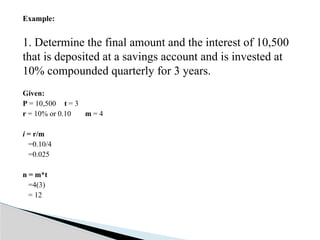
1. Determine thefinal amount and the interest of 10,500
that is deposited at a savings account and is invested at
10% compounded quarterly for 3 years.
Given:
P = 10,500 t = 3
r = 10% or 0.10 m = 4
i = r/m
=0.10/4
=0.025
n = m*t
=4(3)
= 12
16.
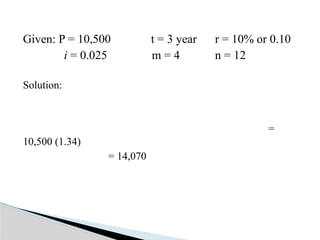
Given: P =10,500 t = 3 year r = 10% or 0.10
i = 0.025 m = 4 n = 12
Solution:
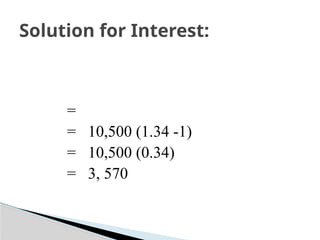
=
10,500 (1.34)
= 14,070
Example:
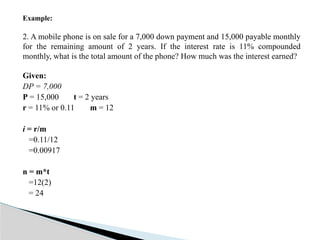
2. A mobilephone is on sale for a 7,000 down payment and 15,000 payable monthly
for the remaining amount of 2 years. If the interest rate is 11% compounded
monthly, what is the total amount of the phone? How much was the interest earned?
Given:
DP = 7,000
P = 15,000 t = 2 years
r = 11% or 0.11 m = 12
i = r/m
=0.11/12
=0.00917
n = m*t
=12(2)
= 24
19.
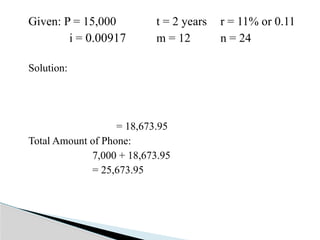
Given: P =15,000 t = 2 years r = 11% or 0.11
i = 0.00917 m = 12 n = 24
Solution:
= 18,673.95
Total Amount of Phone:
7,000 + 18,673.95
= 25,673.95
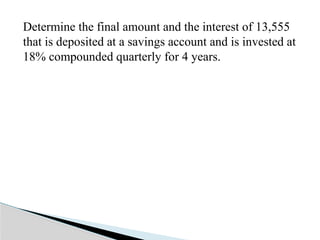
Determine the finalamount and the interest of 13,555
that is deposited at a savings account and is invested at
18% compounded quarterly for 4 years.
22.
1. Effective Rateis the interest rate that occurs more frequently
than once per year.
2. Nominal Rate is also defined as a stated interest rate. This
interest works according to the simple interest and does not take
into account the compounding periods.
Nominal rate is the interest rate when interest is compounded
more than a year.
Two types of Interest Rate:
23.
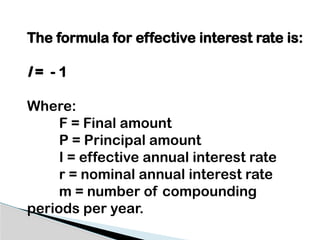
The formula foreffective interest rate is:
I = - 1
Where:
F = Final amount
P = Principal amount
I = effective annual interest rate
r = nominal annual interest rate
m = number of compounding
periods per year.
24.
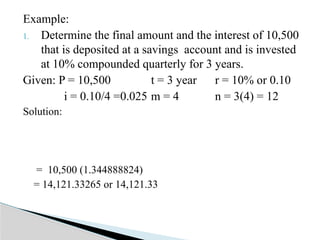
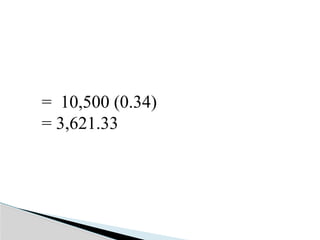
Example:
1. Determine thefinal amount and the interest of 10,500
that is deposited at a savings account and is invested
at 10% compounded quarterly for 3 years.
Given: P = 10,500 t = 3 year r = 10% or 0.10
i = 0.10/4 =0.025 m = 4 n = 3(4) = 12
Solution:
= 10,500 (1.344888824)
= 14,121.33265 or 14,121.33
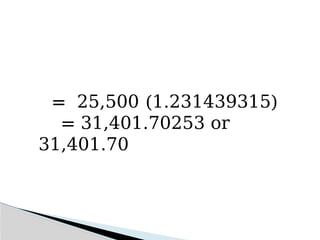
Example:
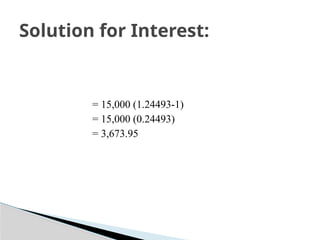
A credit cardcompany lend 25,500 with charges of 21%
compounded monthly in a year . Determined the interest
amount and final amount?
Given:
P = 25,500 t = 1 r = 21% or 0.21 m = 12 months
Solution
I = 25,500 [ (1 + (0.21 / 12)^12 – 1]
= 25,500 [(1 + 0.0175)^12 – 1]
= 25,500 (1.0175)^12 – 1
= 25,500 [1.231439315 – 1]
= 25,500 (0.231439315)
= 5,901.702533
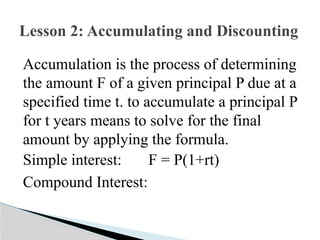
Accumulation is theprocess of determining
the amount F of a given principal P due at a
specified time t. to accumulate a principal P
for t years means to solve for the final
amount by applying the formula.
Simple interest: F = P(1+rt)
Compound Interest:
Lesson 2: Accumulating and Discounting
29.
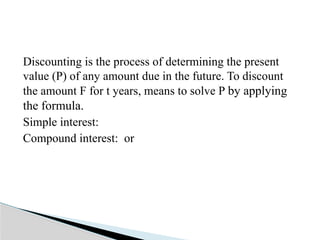
Discounting is theprocess of determining the present
value (P) of any amount due in the future. To discount
the amount F for t years, means to solve P by applying
the formula.
Simple interest:
Compound interest: or
30.
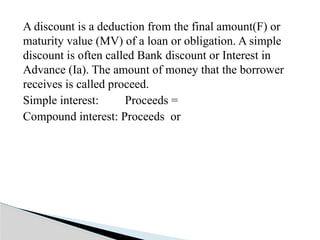
A discount isa deduction from the final amount(F) or
maturity value (MV) of a loan or obligation. A simple
discount is often called Bank discount or Interest in
Advance (Ia). The amount of money that the borrower
receives is called proceed.
Simple interest: Proceeds =
Compound interest: Proceeds or
31.
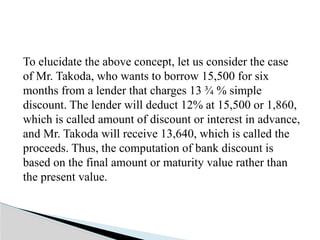
To elucidate theabove concept, let us consider the case
of Mr. Takoda, who wants to borrow 15,500 for six
months from a lender that charges 13 ¾ % simple
discount. The lender will deduct 12% at 15,500 or 1,860,
which is called amount of discount or interest in advance,
and Mr. Takoda will receive 13,640, which is called the
proceeds. Thus, the computation of bank discount is
based on the final amount or maturity value rather than
the present value.
32.
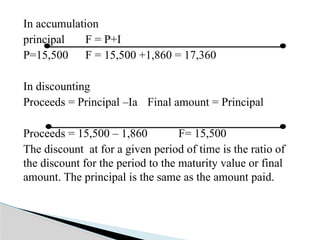
In accumulation
principal F= P+I
P=15,500 F = 15,500 +1,860 = 17,360
In discounting
Proceeds = Principal –Ia Final amount = Principal
Proceeds = 15,500 – 1,860 F= 15,500
The discount at for a given period of time is the ratio of
the discount for the period to the maturity value or final
amount. The principal is the same as the amount paid.
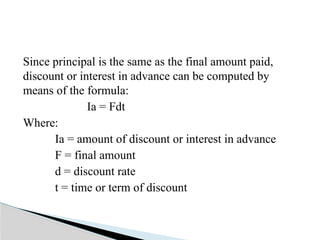
33.
Since principal isthe same as the final amount paid,
discount or interest in advance can be computed by
means of the formula:
Ia = Fdt
Where:
Ia = amount of discount or interest in advance
F = final amount
d = discount rate
t = time or term of discount
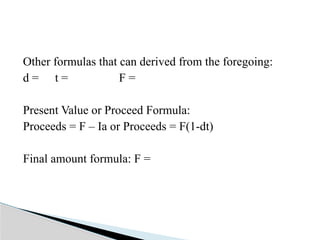
34.
Other formulas thatcan derived from the foregoing:
d = t = F =
Present Value or Proceed Formula:
Proceeds = F – Ia or Proceeds = F(1-dt)
Final amount formula: F =
35.
Example:
1. A fruitvendor at the market borrows 9,000 for 6
months at 10 ¼ % simple interest. What amount must
he repay?
Given: P = 9,000 r = 10 ¼ % or 0.1025
t = 6 months or ½ year
Solution:
F = P (1+rt)
= 9,000 [1+(0.1025x0.5)]
= 9,000 (1.05125)
= 9,461.25
36.
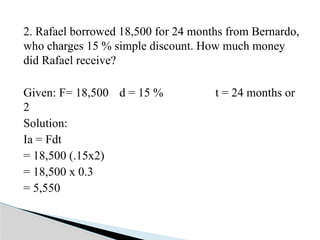
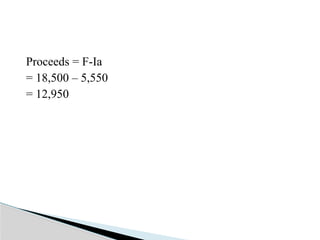
2. Rafael borrowed18,500 for 24 months from Bernardo,
who charges 15 % simple discount. How much money
did Rafael receive?
Given: F= 18,500 d = 15 % t = 24 months or
2
Solution:
Ia = Fdt
= 18,500 (.15x2)
= 18,500 x 0.3
= 5,550

![Example:
A credit card company lend 25,500 with charges of 21%
compounded monthly in a year . Determined the interest
amount and final amount?
Given:
P = 25,500 t = 1 r = 21% or 0.21 m = 12 months
Solution
I = 25,500 [ (1 + (0.21 / 12)^12 – 1]
= 25,500 [(1 + 0.0175)^12 – 1]
= 25,500 (1.0175)^12 – 1
= 25,500 [1.231439315 – 1]
= 25,500 (0.231439315)
= 5,901.702533](https://image.slidesharecdn.com/chapter-4-consumer-mathematics-250224033927-c1aa2677/85/Chapter-4-Consumer-Mathematics-pptxbbbbj-26-320.jpg)
![Example:
1. A fruit vendor at the market borrows 9,000 for 6
months at 10 ¼ % simple interest. What amount must
he repay?
Given: P = 9,000 r = 10 ¼ % or 0.1025
t = 6 months or ½ year
Solution:
F = P (1+rt)
= 9,000 [1+(0.1025x0.5)]
= 9,000 (1.05125)
= 9,461.25](https://image.slidesharecdn.com/chapter-4-consumer-mathematics-250224033927-c1aa2677/85/Chapter-4-Consumer-Mathematics-pptxbbbbj-35-320.jpg)