3.5 Interest Problems
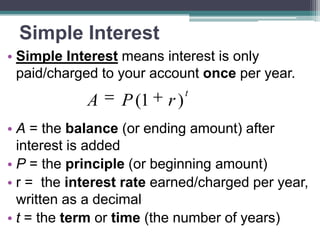
Simple Interest
• Simple Interest means interest is only
paid/charged to your account once per year.

A

P (1

r)

t

• A = the balance (or ending amount) after
interest is added
• P = the principle (or beginning amount)
• r = the interest rate earned/charged per year,
written as a decimal
• t = the term or time (the number of years)
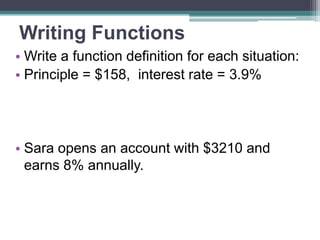
Writing Functions
• Write a function definition for each situation:
• Principle = $158, interest rate = 3.9%

• Sara opens an account with $3210 and
earns 8% annually.
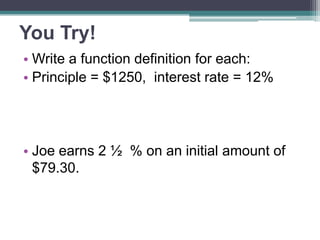
You Try!
• Write a function definition for each:
• Principle = $1250, interest rate = 12%

• Joe earns 2 ½ % on an initial amount of
$79.30.
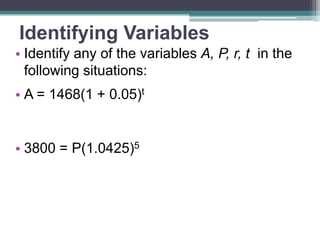
Identifying Variables
• Identify any of the variables A, P, r, t in the
following situations:

• A = 1468(1 + 0.05)t

• 3800 = P(1.0425)5
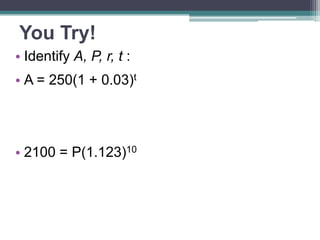
You Try!
• Identify A, P, r, t :
• A = 250(1 + 0.03)t

• 2100 = P(1.123)10
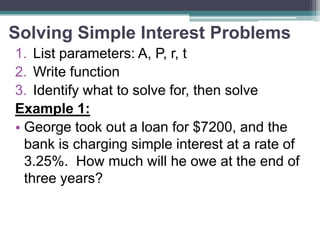
Solving Simple Interest Problems
1. List parameters: A, P, r, t
2. Write function
3. Identify what to solve for, then solve
Example 1:
• George took out a loan for $7200, and the
bank is charging simple interest at a rate of
3.25%. How much will he owe at the end of
three years?
Example 2
• After 8 years, Fred owes $10000 on a loan
for which he is charged 12.5% interest.
What was his original debt?
You Try!
• Tom has $1500 in his account after
earning 3% interest for 7 years. How
much did he originally invest?
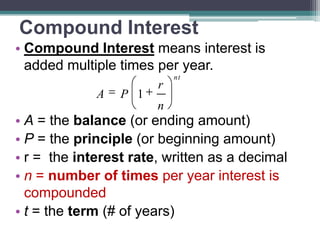
Compound Interest
• Compound Interest means interest is
added multiple times per year.
A

P 1

r
n

nt

• A = the balance (or ending amount)
• P = the principle (or beginning amount)
• r = the interest rate, written as a decimal
• n = number of times per year interest is
compounded
• t = the term (# of years)
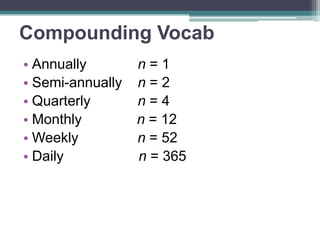
Compounding Vocab
• Annually
• Semi-annually
• Quarterly
• Monthly
• Weekly
• Daily

n=1
n=2
n=4
n = 12
n = 52
n = 365
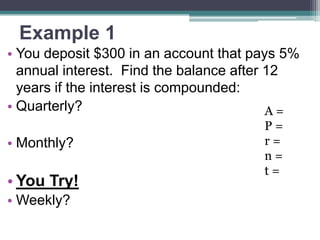
Example 1
• You deposit $300 in an account that pays 5%
annual interest. Find the balance after 12
years if the interest is compounded:
• Quarterly?
A=

• Monthly?

• You Try!
• Weekly?

P=
r=
n=
t=
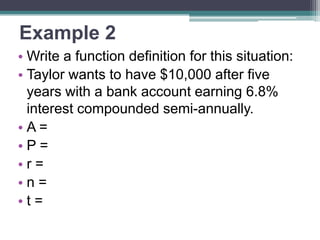
Example 2
• Write a function definition for this situation:
• Taylor wants to have $10,000 after five
years with a bank account earning 6.8%
interest compounded semi-annually.
•A=
•P=
•r=
•n=
•t=
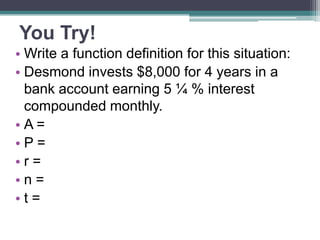
You Try!
• Write a function definition for this situation:
• Desmond invests $8,000 for 4 years in a
bank account earning 5 ¼ % interest
compounded monthly.
•A=
•P=
•r=
•n=
•t=
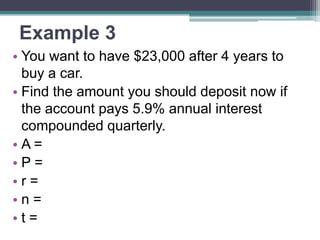
Example 3
• You want to have $23,000 after 4 years to
buy a car.
• Find the amount you should deposit now if
the account pays 5.9% annual interest
compounded quarterly.
•A=
•P=
•r=
•n=
•t=
You Try!
• New parents want to have $50,000 after 18
years for their child’s college.
• Find the amount they should deposit now if
the account pays 6.8% annual interest
compounded monthly.
•A=
•P=
•r=
•n=
•t=

3.5 interest problems

  • 1.
  • 2.
    Simple Interest • SimpleInterest means interest is only paid/charged to your account once per year. A P (1 r) t • A = the balance (or ending amount) after interest is added • P = the principle (or beginning amount) • r = the interest rate earned/charged per year, written as a decimal • t = the term or time (the number of years)
  • 3.
    Writing Functions • Writea function definition for each situation: • Principle = $158, interest rate = 3.9% • Sara opens an account with $3210 and earns 8% annually.
  • 4.
    You Try! • Writea function definition for each: • Principle = $1250, interest rate = 12% • Joe earns 2 ½ % on an initial amount of $79.30.
  • 5.
    Identifying Variables • Identifyany of the variables A, P, r, t in the following situations: • A = 1468(1 + 0.05)t • 3800 = P(1.0425)5
  • 6.
    You Try! • IdentifyA, P, r, t : • A = 250(1 + 0.03)t • 2100 = P(1.123)10
  • 7.
    Solving Simple InterestProblems 1. List parameters: A, P, r, t 2. Write function 3. Identify what to solve for, then solve Example 1: • George took out a loan for $7200, and the bank is charging simple interest at a rate of 3.25%. How much will he owe at the end of three years?
  • 8.
    Example 2 • After8 years, Fred owes $10000 on a loan for which he is charged 12.5% interest. What was his original debt?
  • 9.
    You Try! • Tomhas $1500 in his account after earning 3% interest for 7 years. How much did he originally invest?
  • 10.
    Compound Interest • CompoundInterest means interest is added multiple times per year. A P 1 r n nt • A = the balance (or ending amount) • P = the principle (or beginning amount) • r = the interest rate, written as a decimal • n = number of times per year interest is compounded • t = the term (# of years)
  • 11.
    Compounding Vocab • Annually •Semi-annually • Quarterly • Monthly • Weekly • Daily n=1 n=2 n=4 n = 12 n = 52 n = 365
  • 12.
    Example 1 • Youdeposit $300 in an account that pays 5% annual interest. Find the balance after 12 years if the interest is compounded: • Quarterly? A= • Monthly? • You Try! • Weekly? P= r= n= t=
  • 13.
    Example 2 • Writea function definition for this situation: • Taylor wants to have $10,000 after five years with a bank account earning 6.8% interest compounded semi-annually. •A= •P= •r= •n= •t=
  • 14.
    You Try! • Writea function definition for this situation: • Desmond invests $8,000 for 4 years in a bank account earning 5 ¼ % interest compounded monthly. •A= •P= •r= •n= •t=
  • 15.
    Example 3 • Youwant to have $23,000 after 4 years to buy a car. • Find the amount you should deposit now if the account pays 5.9% annual interest compounded quarterly. •A= •P= •r= •n= •t=
  • 16.
    You Try! • Newparents want to have $50,000 after 18 years for their child’s college. • Find the amount they should deposit now if the account pays 6.8% annual interest compounded monthly. •A= •P= •r= •n= •t=