COMPOUND
INTEREST
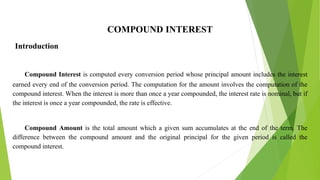
COMPOUND INTEREST
Introduction
Compound Interest is computed every conversion period whose principal amount includes the interest
earned every end of the conversion period. The computation for the amount involves the computation of the
compound interest. When the interest is more than once a year compounded, the interest rate is nominal, but if
the interest is once a year compounded, the rate is effective.
Compound Amount is the total amount which a given sum accumulates at the end of the term. The
difference between the compound amount and the original principal for the given period is called the
compound interest.
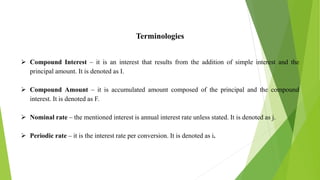
Terminologies
 Compound Interest – it is an interest that results from the addition of simple interest and the
principal amount. It is denoted as I.
 Compound Amount – it is accumulated amount composed of the principal and the compound
interest. It is denoted as F.
 Nominal rate – the mentioned interest is annual interest rate unless stated. It is denoted as j.
 Periodic rate – it is the interest rate per conversion. It is denoted as i.
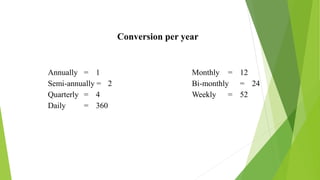
Conversion per year
Annually = 1 Monthly = 12
Semi-annually = 2 Bi-monthly = 24
Quarterly = 4 Weekly = 52
Daily = 360
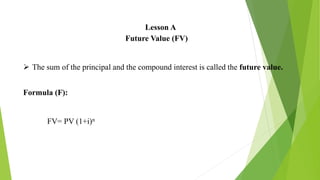
Lesson A
Future Value (FV)
 The sum of the principal and the compound interest is called the future value.
Formula (F):
FV= PV (1+i)n
Illustrative Problems:
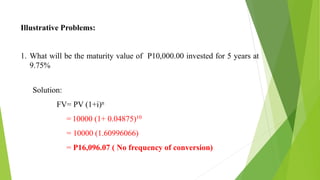
1. What will be the maturity value of P10,000.00 invested for 5 years at
9.75%
Solution:
FV= PV (1+i)n
= 10000 (1+ 0.04875)10
= 10000 (1.60996066)
= P16,096.07 ( No frequency of conversion)
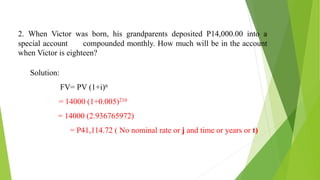
2. When Victor was born, his grandparents deposited P14,000.00 into a
special account compounded monthly. How much will be in the account
when Victor is eighteen?
Solution:
FV= PV (1+i)n
= 14000 (1+0.005)216
= 14000 (2.936765972)
= P41,114.72 ( No nominal rate or j and time or years or t)
3. Mr. Dela Cruz loaned his wife Mariela P123,000.00 to help her start
a business. Her wife promised to pay him at the end of 3 years at 10%
compounded annually. How much will Mr. Dela Cruz receive at the
end of 3years if his wife will keep her promise?
Solution:
FV= PV (1+i)n
= 12300 (1+0.1)5
= 12300 (1.61051)
= P198,092.73 (INCORRECT n)
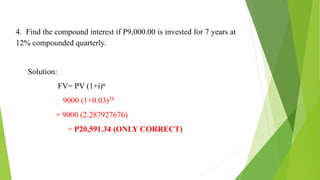
4. Find the compound interest if P9,000.00 is invested for 7 years at
12% compounded quarterly.
Solution:
FV= PV (1+i)n
= 9000 (1+0.03)28
= 9000 (2.287927676)
= P20,591.34 (ONLY CORRECT)
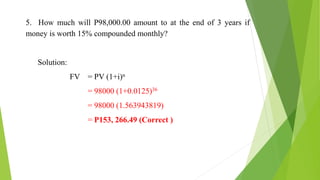
5. How much will P98,000.00 amount to at the end of 3 years if
money is worth 15% compounded monthly?
Solution:
FV = PV (1+i)n
= 98000 (1+0.0125)36
= 98000 (1.563943819)
= P153, 266.49 (Correct )
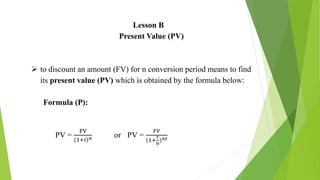
Lesson B
Present Value (PV)
 to discount an amount (FV) for n conversion period means to find
its present value (PV) which is obtained by the formula below:
Formula (P):
PV =
FV
(1+𝑖)𝑛 or PV =
𝐹𝑉
(1+
𝑟
𝑛
)𝑛𝑡
Illustrative Problems:
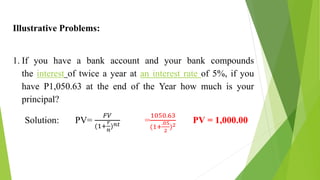
1. If you have a bank account and your bank compounds
the interest of twice a year at an interest rate of 5%, if you
have P1,050.63 at the end of the Year how much is your
principal?
Solution: PV=
𝐹𝑉
(1+
𝑟
𝑛
)𝑛𝑡
PV=
1050.63
(1+
.05
2
)2
PV = 1,000.00
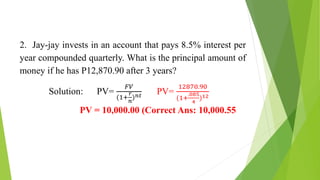
2. Jay-jay invests in an account that pays 8.5% interest per
year compounded quarterly. What is the principal amount of
money if he has P12,870.90 after 3 years?
Solution: PV=
𝐹𝑉
(1+
𝑟
𝑛
)𝑛𝑡
PV=
12870.90
(1+
.085
4
)12
PV = 10,000.00 (Correct Ans: 10,000.55
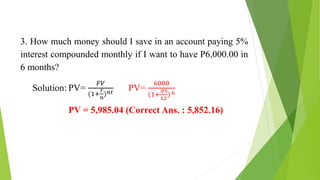
3. How much money should I save in an account paying 5%
interest compounded monthly if I want to have P6,000.00 in
6 months?
Solution: PV=
𝐹𝑉
(1+
𝑟
𝑛
)𝑛𝑡
PV=
6000
(1+
.05
12
).6
PV = 5,985.04 (Correct Ans. : 5,852.16)
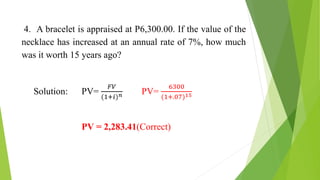
4. A bracelet is appraised at P6,300.00. If the value of the
necklace has increased at an annual rate of 7%, how much
was it worth 15 years ago?
Solution: PV=
𝐹𝑉
(1+𝑖)𝑛 PV=
6300
(1+.07)15
PV = 2,283.41(Correct)
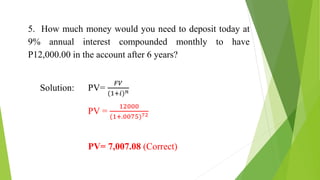
5. How much money would you need to deposit today at
9% annual interest compounded monthly to have
P12,000.00 in the account after 6 years?
Solution: PV=
𝐹𝑉
(1+𝑖)𝑛
PV =
12000
(1+.0075)72
PV= 7,007.08 (Correct)
Lesson C
Rate (j)
An interest rate is the price borrowers pay for the use
of money. It is normally expressed as percentage (%)
rate .
Formula:
j = m [(
𝐹
𝑃
)1/n -1]
Illustrative Problems:
1. What rate compounded quarterly will P1,250.00 amount
to P2,900.00 in 5 years.
Solution:
j = m [(
𝐹
𝑃
)1/n -1]
j = 4 [(
2900.00
1250.00
)1/20 -1]
j = 17.19%
2. At what nominal rate compounded semi-annually will
P50,000.00 accumulate P65,000.00 in 12 years?
Solution: j = m [(
𝐹
𝑃
)1/n -1]
j = 2 [(
65,000.00
50,000.00
)1/24 -1]
j = 2.20%
3. What is the nominal rate if P24,000.00 accumulates
to P36,000.00 in 8 years with interest compounded
semi-annually?
Solution:j = m [(
𝐹
𝑃
)1/n -1]
j= 2 [(
36,000.00
24,000.00
) 1/16 -1]
j = 5.13%
4. At what rate compounded monthly is Mr. Reyes paying the
interest if he borrows P16,500.00 and agrees to pay
P20,000.00 for his debt 2 years and 3 months from now?
Solution:
j = m [ 𝐹
𝑃
1/n -1]
j= 4 [(
20,000.00
16,000.00
)1/27 -1]
j = 8.58%
5. At what nominal rate compounded semi-annually will
P18,000.00 amount to P25,000.00 in 5 years?
Solution:
j = m [ 𝐹
𝑃
1/n -1]
j = 2 [(
25000.00
18000.00
)1/10 -1]
j = 6.68%
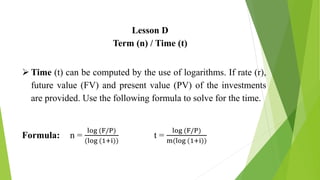
Lesson D
Term (n) / Time (t)
 Time (t) can be computed by the use of logarithms. If rate (r),
future value (FV) and present value (PV) of the investments
are provided. Use the following formula to solve for the time.
Formula: n =
log (F/P)
(log (1+i))
t =
log (F/P)
m(log (1+i))
Illustrative Problems:
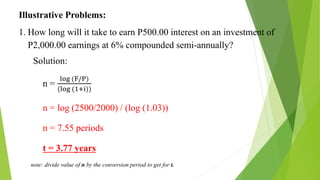
1. How long will it take to earn P500.00 interest on an investment of
P2,000.00 earnings at 6% compounded semi-annually?
Solution:
n =
log (F/P)
(log (1+i))
n = log (2500/2000) / (log (1.03))
n = 7.55 periods
t = 3.77 years
note: divide value of n by the conversion period to get for t.
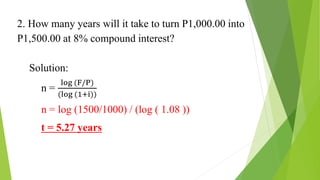
2. How many years will it take to turn P1,000.00 into
P1,500.00 at 8% compound interest?
Solution:
n =
log (F/P)
(log (1+i))
n = log (1500/1000) / (log ( 1.08 ))
t = 5.27 years
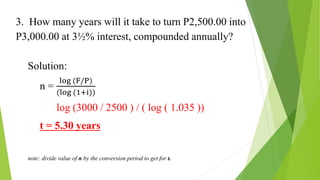
3. How many years will it take to turn P2,500.00 into
P3,000.00 at 3½% interest, compounded annually?
Solution:
n =
log (F/P)
(log (1+i))
n = log (3000 / 2500 ) / ( log ( 1.035 ))
t = 5.30 years
note: divide value of n by the conversion period to get for t.
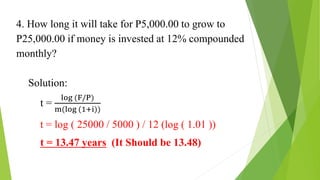
4. How long it will take for P5,000.00 to grow to
P25,000.00 if money is invested at 12% compounded
monthly?
Solution:
t =
log (F/P)
m(log (1+i))
t = log ( 25000 / 5000 ) / 12 (log ( 1.01 ))
t = 13.47 years (It Should be 13.48)
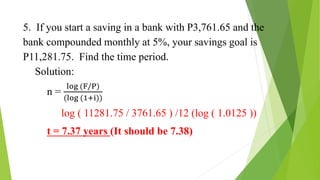
5. If you start a saving in a bank with P3,761.65 and the
bank compounded monthly at 5%, your savings goal is
P11,281.75. Find the time period.
Solution:
n =
log (F/P)
(log (1+i))
t = log ( 11281.75 / 3761.65 ) /12 (log ( 1.0125 ))
t = 7.37 years (It should be 7.38)
THANK YOU VERY MUCH!!!

Compund Interest

  • 1.
  • 2.
    COMPOUND INTEREST Introduction Compound Interestis computed every conversion period whose principal amount includes the interest earned every end of the conversion period. The computation for the amount involves the computation of the compound interest. When the interest is more than once a year compounded, the interest rate is nominal, but if the interest is once a year compounded, the rate is effective. Compound Amount is the total amount which a given sum accumulates at the end of the term. The difference between the compound amount and the original principal for the given period is called the compound interest.
  • 3.
    Terminologies  Compound Interest– it is an interest that results from the addition of simple interest and the principal amount. It is denoted as I.  Compound Amount – it is accumulated amount composed of the principal and the compound interest. It is denoted as F.  Nominal rate – the mentioned interest is annual interest rate unless stated. It is denoted as j.  Periodic rate – it is the interest rate per conversion. It is denoted as i.
  • 4.
    Conversion per year Annually= 1 Monthly = 12 Semi-annually = 2 Bi-monthly = 24 Quarterly = 4 Weekly = 52 Daily = 360
  • 5.
    Lesson A Future Value(FV)  The sum of the principal and the compound interest is called the future value. Formula (F): FV= PV (1+i)n
  • 6.
    Illustrative Problems: 1. Whatwill be the maturity value of P10,000.00 invested for 5 years at 9.75% Solution: FV= PV (1+i)n = 10000 (1+ 0.04875)10 = 10000 (1.60996066) = P16,096.07 ( No frequency of conversion)
  • 7.
    2. When Victorwas born, his grandparents deposited P14,000.00 into a special account compounded monthly. How much will be in the account when Victor is eighteen? Solution: FV= PV (1+i)n = 14000 (1+0.005)216 = 14000 (2.936765972) = P41,114.72 ( No nominal rate or j and time or years or t)
  • 8.
    3. Mr. DelaCruz loaned his wife Mariela P123,000.00 to help her start a business. Her wife promised to pay him at the end of 3 years at 10% compounded annually. How much will Mr. Dela Cruz receive at the end of 3years if his wife will keep her promise? Solution: FV= PV (1+i)n = 12300 (1+0.1)5 = 12300 (1.61051) = P198,092.73 (INCORRECT n)
  • 9.
    4. Find thecompound interest if P9,000.00 is invested for 7 years at 12% compounded quarterly. Solution: FV= PV (1+i)n = 9000 (1+0.03)28 = 9000 (2.287927676) = P20,591.34 (ONLY CORRECT)
  • 10.
    5. How muchwill P98,000.00 amount to at the end of 3 years if money is worth 15% compounded monthly? Solution: FV = PV (1+i)n = 98000 (1+0.0125)36 = 98000 (1.563943819) = P153, 266.49 (Correct )
  • 11.
    Lesson B Present Value(PV)  to discount an amount (FV) for n conversion period means to find its present value (PV) which is obtained by the formula below: Formula (P): PV = FV (1+𝑖)𝑛 or PV = 𝐹𝑉 (1+ 𝑟 𝑛 )𝑛𝑡
  • 12.
    Illustrative Problems: 1. Ifyou have a bank account and your bank compounds the interest of twice a year at an interest rate of 5%, if you have P1,050.63 at the end of the Year how much is your principal? Solution: PV= 𝐹𝑉 (1+ 𝑟 𝑛 )𝑛𝑡 PV= 1050.63 (1+ .05 2 )2 PV = 1,000.00
  • 13.
    2. Jay-jay investsin an account that pays 8.5% interest per year compounded quarterly. What is the principal amount of money if he has P12,870.90 after 3 years? Solution: PV= 𝐹𝑉 (1+ 𝑟 𝑛 )𝑛𝑡 PV= 12870.90 (1+ .085 4 )12 PV = 10,000.00 (Correct Ans: 10,000.55
  • 14.
    3. How muchmoney should I save in an account paying 5% interest compounded monthly if I want to have P6,000.00 in 6 months? Solution: PV= 𝐹𝑉 (1+ 𝑟 𝑛 )𝑛𝑡 PV= 6000 (1+ .05 12 ).6 PV = 5,985.04 (Correct Ans. : 5,852.16)
  • 15.
    4. A braceletis appraised at P6,300.00. If the value of the necklace has increased at an annual rate of 7%, how much was it worth 15 years ago? Solution: PV= 𝐹𝑉 (1+𝑖)𝑛 PV= 6300 (1+.07)15 PV = 2,283.41(Correct)
  • 16.
    5. How muchmoney would you need to deposit today at 9% annual interest compounded monthly to have P12,000.00 in the account after 6 years? Solution: PV= 𝐹𝑉 (1+𝑖)𝑛 PV = 12000 (1+.0075)72 PV= 7,007.08 (Correct)
  • 17.
    Lesson C Rate (j) Aninterest rate is the price borrowers pay for the use of money. It is normally expressed as percentage (%) rate . Formula: j = m [( 𝐹 𝑃 )1/n -1]
  • 18.
    Illustrative Problems: 1. Whatrate compounded quarterly will P1,250.00 amount to P2,900.00 in 5 years. Solution: j = m [( 𝐹 𝑃 )1/n -1] j = 4 [( 2900.00 1250.00 )1/20 -1] j = 17.19%
  • 19.
    2. At whatnominal rate compounded semi-annually will P50,000.00 accumulate P65,000.00 in 12 years? Solution: j = m [( 𝐹 𝑃 )1/n -1] j = 2 [( 65,000.00 50,000.00 )1/24 -1] j = 2.20%
  • 20.
    3. What isthe nominal rate if P24,000.00 accumulates to P36,000.00 in 8 years with interest compounded semi-annually? Solution:j = m [( 𝐹 𝑃 )1/n -1] j= 2 [( 36,000.00 24,000.00 ) 1/16 -1] j = 5.13%
  • 21.
    4. At whatrate compounded monthly is Mr. Reyes paying the interest if he borrows P16,500.00 and agrees to pay P20,000.00 for his debt 2 years and 3 months from now? Solution: j = m [ 𝐹 𝑃 1/n -1] j= 4 [( 20,000.00 16,000.00 )1/27 -1] j = 8.58%
  • 22.
    5. At whatnominal rate compounded semi-annually will P18,000.00 amount to P25,000.00 in 5 years? Solution: j = m [ 𝐹 𝑃 1/n -1] j = 2 [( 25000.00 18000.00 )1/10 -1] j = 6.68%
  • 23.
    Lesson D Term (n)/ Time (t)  Time (t) can be computed by the use of logarithms. If rate (r), future value (FV) and present value (PV) of the investments are provided. Use the following formula to solve for the time. Formula: n = log (F/P) (log (1+i)) t = log (F/P) m(log (1+i))
  • 24.
    Illustrative Problems: 1. Howlong will it take to earn P500.00 interest on an investment of P2,000.00 earnings at 6% compounded semi-annually? Solution: n = log (F/P) (log (1+i)) n = log (2500/2000) / (log (1.03)) n = 7.55 periods t = 3.77 years note: divide value of n by the conversion period to get for t.
  • 25.
    2. How manyyears will it take to turn P1,000.00 into P1,500.00 at 8% compound interest? Solution: n = log (F/P) (log (1+i)) n = log (1500/1000) / (log ( 1.08 )) t = 5.27 years
  • 26.
    3. How manyyears will it take to turn P2,500.00 into P3,000.00 at 3½% interest, compounded annually? Solution: n = log (F/P) (log (1+i)) n = log (3000 / 2500 ) / ( log ( 1.035 )) t = 5.30 years note: divide value of n by the conversion period to get for t.
  • 27.
    4. How longit will take for P5,000.00 to grow to P25,000.00 if money is invested at 12% compounded monthly? Solution: t = log (F/P) m(log (1+i)) t = log ( 25000 / 5000 ) / 12 (log ( 1.01 )) t = 13.47 years (It Should be 13.48)
  • 28.
    5. If youstart a saving in a bank with P3,761.65 and the bank compounded monthly at 5%, your savings goal is P11,281.75. Find the time period. Solution: n = log (F/P) (log (1+i)) t = log ( 11281.75 / 3761.65 ) /12 (log ( 1.0125 )) t = 7.37 years (It should be 7.38)
  • 29.